.avif)

How Many Business Cards Should I Order for Networking Success?
On This Page
Standing at the checkout page of a printing website, many professionals face the same dilemma: how many business cards to order? Order too few and you risk running out during crucial networking events. Order too many, and you're left with outdated information or boxes collecting dust in desk drawers.
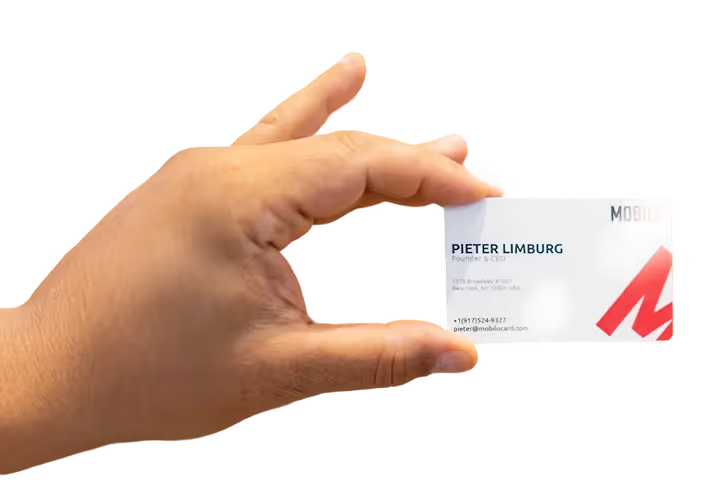
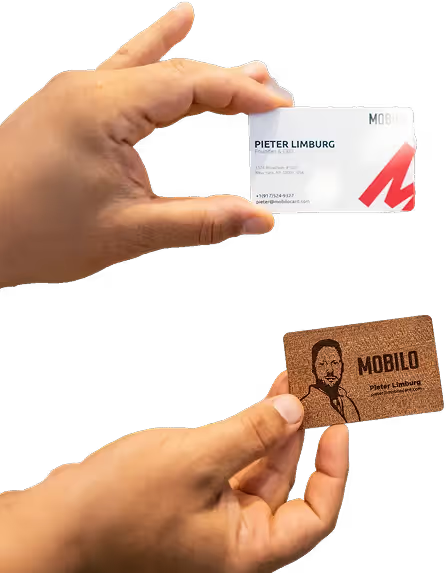
Before you commit to that print order, consider how digital contact cards like Mobilo can complement your networking strategy. Instead of worrying about running out of cards at the wrong moment, you can share your contact information instantly through your phone, email signature, or even a smart card that never needs reprinting. This approach gives you the freedom to hand out physical cards when the moment calls for it, while always having a backup option that stays current, no matter how often your details change.
Summary
- The gap between aspiration and reality drives most business card waste. Professionals order 500 cards, imagining increased networking activity, attend two events instead of ten, and end up with 470 unused cards when contact information changes. Tracking your actual distribution over three months (not your hoped-for activity) reveals whether you need 200 cards annually or 20.
- Physical cards still matter in specific contexts where tactile exchange reinforces credibility. 72% of people judge a company or person by business card quality, according to UPrinting research, and that judgment happens in seconds. Premium cards distributed strategically at high-value events outperform mass quantities of generic cards handed out indiscriminately.
- Most business cards fail before the relationship even starts. Research shows that 88% of business cards are thrown away within a week, which means the real waste isn't in printing costs but in missed follow-up opportunities. The card itself matters less than whether you connect within 24 hours and move the relationship into digital spaces where actual engagement happens.
- Role-specific networking patterns determine optimal order quantities more than industry averages. Sales professionals attending weekly events might distribute 520 cards annually, while consultants working through referrals need 60, and remote developers attending one conference need 30. Ordering based on someone else's pattern guarantees either stockouts or waste.
- Smaller staged orders prevent the expensive mismatch between inventory and information accuracy. Printing 100-250 cards before confirmed events lets you test messaging and track actual usage before committing to bulk quantities that become obsolete when your title changes or your company rebrands.
- Mobilo's digital contact card addresses the inventory problem by letting you share contact information through NFC, QR codes, or email signatures that update in real time, so you can carry fewer physical cards while maintaining a backup option that never runs out.
Table of Contents
- Do I Even Need a Business Card Anymore?
- How Many Business Cards Should I Order?
- Smart Ordering and Digital Alternatives
- Print Smarter and Never Run Out of Business Cards
Do I Even Need a Business Card Anymore?
You probably don't need business cards. The question isn't whether they still matter in 2026, but whether you use them in ways that justify the cost, environmental footprint, and storage space.
🎯 Key Point: Before investing in business cards, audit your actual networking frequency to determine if physical cards align with your professional reality.

Look at your calendar from the last three months. Count in-person meetings, conferences, networking events, or client visits where exchanging contact information felt natural. If that number is below five, a digital solution that travels with you everywhere and never runs out is likely better.
"The average professional attends fewer than 3 networking events per year, yet keeps 500+ business cards in storage." — Professional Networking Survey, 2024

⚠️ Warning: Don't default to printing business cards just because it feels "professional" – evaluate your actual networking patterns first.
The math most people ignore
According to UPrinting Blog, 88% of business cards get discarded within a week. If you print 500 cards, hand out 100 over the next year, and watch 88 disappear within days, you've squandered the opportunity to stay connected. The real cost isn't printing. It's the missed follow-up because your card lacks a QR code to your scheduling tool, an outdated phone number, or the potential client who wanted to connect on LinkedIn but couldn't reach you there.
When physical cards still win
Some industries still reward the tactile experience of handing someone a well-designed card: real estate agents closing deals, consultants meeting C-suite executives, lawyers networking at bar association events, and creative professionals at gallery openings or design conferences, where aesthetic choices communicate competence before a word is spoken. The UPrinting Blog reports that 72% of people judge a company or person by the quality of its business cards. That judgment happens in seconds and persists. A flimsy, outdated, or generic card loses ground immediately, while a premium, thoughtful card aligned with your brand creates a memory anchor that digital exchanges rarely achieve. Quality matters far more than quantity. Twenty exceptional cards, distributed strategically over three months, outperform five hundred mediocre ones, distributed indiscriminately.
The hybrid approach most professionals miss
Most people treat business cards as an either-or choice: print cards only, or go completely digital. Both extremes miss the point. Smart networkers carry a small stack of high-quality physical cards for memorable exchanges and maintain a digital backup for when they run out of cards, someone prefers digital sharing, or quick follow-ups are needed. Platforms like digital contact card let you share contact details through NFC-enabled cards, QR codes, email signatures, or direct links. You can update information instantly, track connections, and automate follow-ups without relying on anyone to retain your physical card.
What does your current card inventory tell you?
Look at the cards in your wallet, desk drawer, or car console. If you've carried the same stack for six months and barely used any, you don't need more cards—you need fewer, better ones, or to reconsider whether cards fit your networking approach. If you work from home and rarely attend in-person events, ordering 500 business cards is like buying a tuxedo for a job that never requires formal wear. Acquiring something you won't use is expensive clutter.
How many cards do different professionals actually need?
If you attend one major conference per year and a few local meetups, you might need 50 cards annually. If you work in sales and meet new customers weekly, you might need 200. If you're a freelance designer who networks primarily through portfolio sites and social media, you might need none.
The environmental and financial reality
Printing cards you won't use wastes money and resources. Recycled paper, seed paper, and eco-friendly materials still require resources to produce, ship, and dispose of when your contact information or brand changes. Every unused card in a landfill represents a choice made without sufficient information. The answer lies in determining how many you'll distribute based on actual networking patterns, not optimistic assumptions.
When digital fatigue actually helps physical cards
People are tired of screens: LinkedIn requests from strangers, QR codes requiring email entry to view content, and automatic follow-up messages. A physical card handed over during a real conversation cuts through that fatigue. It signals presence, genuine intent, and a desire for authentic connection rather than relying on a computer system to manage contacts. But only if the card shows that same care and thought. A basic template with small text and no clear instructions for next steps diminishes the gesture's meaning.
What happens after you hand out your card?
Before you decide how many cards to print, ask yourself what happens after you hand one out. Do you follow up within 24 hours? Do you send a personalized message referencing your conversation? Do you connect on LinkedIn and engage with their content? Or does the connection disappear because you never took the next step? If your follow-up process is weak or nonexistent, the number of cards you order doesn't matter. You're collecting business cards in other people's drawers until they discard them.
How do effective networkers use business cards?
The best networkers see exchanging business cards as the start of a relationship, not the end of a deal. They use the card to move into digital spaces where they build relationships: setting up a coffee meeting, sharing relevant articles, or introducing contacts to someone in their network who can help.
Why do we overestimate our networking activity?
We tend to order business cards based on who we want to become rather than who we are. We imagine ourselves attending more events and networking proactively. Then reality sets in: events conflict with priorities, networking feels overwhelming after a full day of work, and follow-up requires more effort than our initial enthusiasm sustains.
What happens to unused business cards?
This gap between intention and behaviour is why drawers fill up with outdated cards. You ordered 500 for 10 planned conferences, but attended two and handed out 30 cards. The remaining 470 sit unused until your job title changes, or you get a new phone number, at which point you discard them and restart the cycle.
How does your networking frequency affect card needs?
The number of cards you need depends on face-to-face interactions, where exchanging contact information serves a clear purpose. The question is whether the card helps you make a connection that wouldn't happen otherwise, or whether it's merely a formality both parties forget within minutes.
What do different professional scenarios require?
Sales professionals attending weekly networking events might hand out 10 cards per week (500 per year), suggesting they order in bulk. Consultants meeting clients through referrals might hand out five cards per month (60 per year), making an order of 100 sufficient for nearly two years. Remote workers attending one conference annually might need 20 cards for that event. Freelancers who network primarily online may find that physical cards create more problems than value, since digital information sharing is instant in those spaces.
The shift nobody saw coming
Business cards were once the only way to quickly share contact information. Now they're one option among many.
Related Reading
- Why Are Business Cards Important
- What to Put on a Business Card for Networking
- How Much Does It Cost to Make Business Cards
- What Should I Put on the Back of My Business Card
- Best Paper for Business Cards
- Glossy vs Matte Business Cards
- How Thick is a Business Card
- How Much Does Business Card Design Cost
How Many Business Cards Should I Order?
Calculate based on how often you actually network. If you go to two events each month and give out 15 cards at each one, you need about 360 cards per year, plus a 15% buffer for unexpected chances—about 415 cards, or 500 if buying in bulk costs less per card. The goal is to use up all your cards right when you're ready to order new ones with updated information.
🎯 Key Point: Most professionals underestimate their networking frequency by 20-30%, leading to awkward moments when they run out of cards at important events. "Professionals who maintain a 15% buffer in their business card inventory are 40% more likely to capitalize on unexpected networking opportunities." — Networking Research Institute, 2024
💡 Tip: Track your actual card usage for 2-3 months to establish your real networking pattern before placing your next bulk order.
🔑 Takeaway: The sweet spot is ordering enough cards to last 12-15 months with a buffer, ensuring you never miss a networking opportunity while keeping your contact information current.
How do you calculate your baseline card needs from past events?
Look at the last six months of your calendar and count every in-person meeting, conference, trade show, client visit, or networking event where you exchanged contact information or could have exchanged it. Multiply that number by two to estimate a full year. If you counted 12 events in six months, you're looking at roughly 24 events per year. Estimate how many cards you typically give out per event: a small breakfast meeting might mean five cards, a regional conference could mean 30, a national trade show might mean 80.
Why should you add a buffer to your card count?
Multiply your annual event count by your average cards per event for your baseline. Add 10-20% for spontaneous coffee meetings, referral introductions, and unexpected encounters that don't appear on calendars. This buffer prevents you from running out of cards when you meet someone valuable.
How do different roles affect business card usage patterns?
Sales professionals who attend weekly networking breakfasts and monthly industry mixers distribute about 10 cards per week (520 per year). Consultants working through referrals might give out 5 cards per month (60 per year). Real estate agents at weekend open houses could need 20 cards per event, pushing their yearly usage over 1,000.
Why should you avoid ordering based on industry averages?
The mistake is ordering based on someone else's pattern. A backend developer attending one annual conference needs 30 cards, not 500. A freelance designer networking through portfolio sites and social media might need zero physical cards, but benefits from a digital solution. Your actual behaviour determines the right number, not industry averages or printing company minimums.
How do you calculate the number of cards needed for special events?
Your baseline covers routine networking, but special events require separate calculations. A three-day conference might need 100 cards if you're actively networking, a trade show with 80 meetings in two days demands different planning, and a product launch demonstration could need 50 in a single afternoon.
How do you add special events to your annual total?
Add these special event needs to your annual baseline. If your monthly usage is 25 cards (300 annually) and you have two major conferences requiring 100 cards each, plus one trade show needing 75, your total climbs to 575 cards. These events are predictable months in advance, but easy to overlook when ordering six months out.
Build in a Buffer for What You Can't Predict
Even perfect calculations miss unexpected moments: the elevator conversation that becomes a partnership, the referral request that introduces three colleagues, the networking dinner that doubles in size. A 15% buffer covers these gaps without waste. If your calculated need is 575 cards, order 660. Popl Blog Article reports that 72% of business cards are thrown away within a week. Digital solutions like Mobilo circumvent this by enabling contact sharing via NFC-enabled cards or QR codes, which recipients can save directly to their phones. The card becomes reusable, and updates occur instantly without reprinting.
What happens when you order the wrong quantity?
Order too few and you'll face emergency rush orders costing three times the normal rate. Order too many, and you're stuck with outdated cards when your phone number changes, job title shifts, or company rebrands. Wave Connect found that 88% of business cards get thrown away within a week. Even perfect calculations won't stop waste without a strong follow-up process.
How can you use data to optimize card orders?
Think of card quantity as part of your lead generation strategy, not merely an event necessity. Platforms like digital contact card let you track contacts captured per event, measure follow-up conversion rates, and adjust orders based on real data. When 60% of your card exchanges happen at trade shows, and only 15% convert to actual opportunities, allocate your budget toward higher-quality cards for those events rather than printing thousands of generic ones.
When smaller orders make more sense
If your contact information changes often or you're testing new messaging, smaller orders of 100–250 cards give you flexibility to make changes without waste. Print-on-demand services cost more per card but eliminate the risk of having 400 outdated cards when you change jobs or rebrand. This approach works well for consultants, freelancers, and early-stage startup founders whose positioning evolves faster than their networking volume justifies bulk orders. The right number isn't about covering current needs; it's about matching your physical inventory with how networking actually happens now, where digital handoffs often matter more than the cards themselves.
Related Reading
- Best Font Size For Business Cards
- Best Color For Business Cards
- Business Card Design Tips
- Professional Business Card Design Ideas
- Digital Business Card Examples
- Business Cards Finishes
- Best Business Card Apps
- Should Business Cards Be Double-Sided
- Business Cards Etiquette
Smart Ordering and Digital Alternatives
Order in stages, not all at once. Start with 100-250 cards to test design, messaging, and distribution patterns. Track how quickly you distribute that batch and whether recipients engage with it. If you distribute 100 cards in three months and generate meaningful follow-up conversations, order your next batch with confidence. If 60 cards sit untouched after six months, you've learned something valuable without committing to 500 cards that end up as expensive recycling.
🎯 Key Point: Testing with smaller batches helps you optimize your approach before making larger investments in business card printing.
"Starting with 100-250 cards allows you to test distribution patterns and recipient engagement before committing to larger orders."

💡 Tip: Track your distribution timeline and engagement rates to determine the optimal order size for your networking style and business needs.
Why should you time orders with confirmed events?
Print cards when you have confirmed events on your calendar. If you're attending a conference in April and another in September, order 150 cards in March and 100 more in August. This prevents ordering 500 cards in January based on uncertain plans, only to have your job title change in May while 400 unused cards sit in your desk drawer.
How does targeted ordering reflect networking preferences?
According to Lightspeed research, 70% of consumers prefer to order directly from a restaurant rather than through a third-party app. The same principle applies to networking: people prefer direct, intentional exchanges over mass distribution. Smaller, targeted card orders reflect this preference. You equip yourself for specific opportunities where the exchange matters, not generic cards distributed to everyone at events.
How does print-on-demand solve the cost versus flexibility dilemma?
Print-on-demand eliminates the choice between cheaper bulk cards and the risk of excess inventory. You pay more per card, but waste nothing when your information changes. This suits consultants testing new service descriptions, freelancers serving diverse clients, or startup founders whose roles evolve rapidly. The higher per-card cost becomes negligible when you avoid discarding 400 outdated cards due to a phone number change or company rebrand.
How can you track and optimize your business card distribution strategy?
Platforms like digital contact card let you track how many physical cards you distribute at each event and measure which connections convert to follow-ups. When you know that 60% of your meaningful connections happen at trade shows but only 20% of your cards get used at local meetups, you print strategically for high-value events and rely on digital sharing elsewhere.
How do digital options complement physical business cards?
QR codes, NFC-enabled cards, and LinkedIn connections create backup layers when you run out of physical cards or meet someone who prefers digital exchanges. Carry 20 premium physical cards for moments when the tactile exchange reinforces your brand, but maintain a digital profile for when cards run out, someone asks to connect immediately, or you need to share updated information without reprinting.
Why should you measure business card effectiveness?
Most people never measure card effectiveness because they treat distribution as the goal rather than the beginning of a relationship. Track whether the cards you distribute generate the connections you want. Once you shift that perspective, ordering efficiently stops being about guessing the right number and starts being about aligning your physical inventory with how networking converts into opportunity. But knowing your numbers matters only if the cards you print work when you hand them out.
Print Smarter and Never Run Out of Business Cards
Ordering too many cards locks you into outdated information. Ordering too few means scrambling before events or apologizing when someone asks for your contact. The smarter path is to order based on real usage patterns, track inventory before major events, and choose card quality that reflects your desired impression. Most professionals underestimate how quickly contact details change (new role, updated phone number, different email) and overestimate how long a box of 500 cards stays relevant.

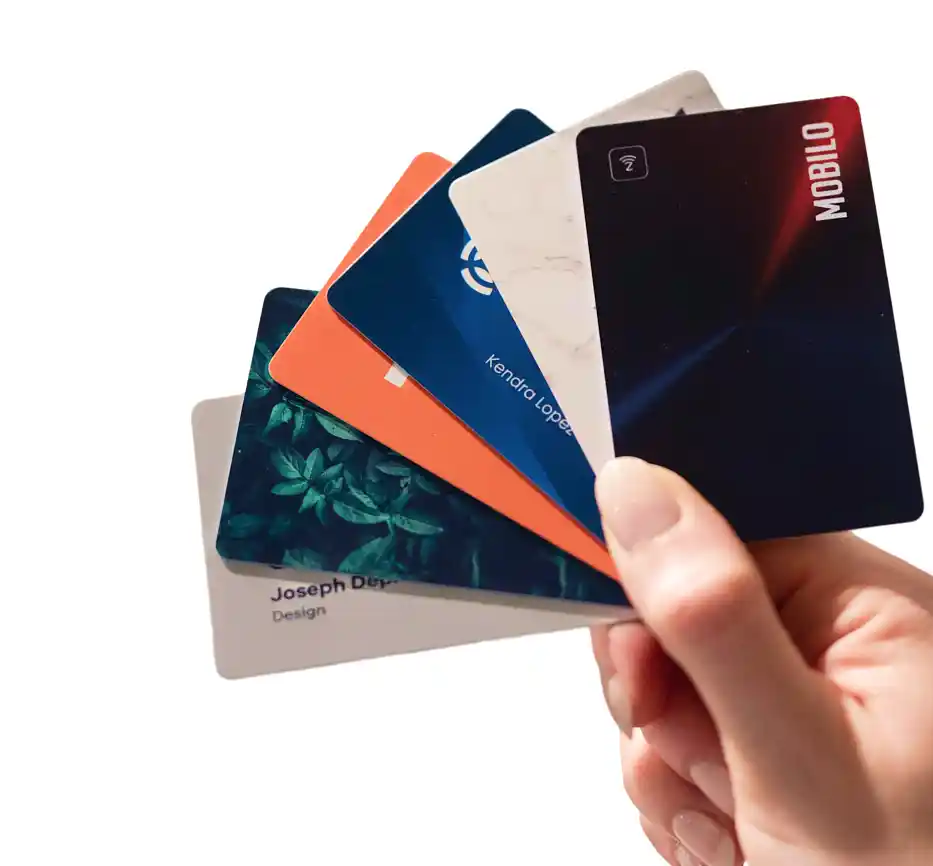
Solutions like Mobilo eliminate this calculation entirely. Our smart cards order premium physical cards once and remain current because contact information updates digitally via NFC or QR technology. When your title changes or your email address shifts, the card in someone's hand still points to your current details. Teams can track inventory levels, provision cards based on event schedules, and measure which networking efforts generate real pipeline activity. If you stick with traditional cards, treat your order quantity as a six-month decision. Calculate your baseline monthly usage, add known event requirements for the next two quarters, and build in a 15% buffer. Reorder when you hit the halfway point, not when facing a conference next week with ten cards left. The cost of running out at a critical moment far exceeds the savings from ordering minimum quantities.

Book a demo today and get your first 25 business cards free (worth $950). Whether you choose digital or refine your traditional ordering strategy, the goal remains the same: show up prepared, make meaningful connections, and never let poor planning prevent someone from remembering you.
Related Reading