.avif)

14 Business Cards Etiquette Hacks for Memorable Networking
On This Page
Walking out of a networking event with pockets full of business cards often means little without proper exchange etiquette. Mastering business card etiquette transforms brief encounters into lasting professional relationships by creating memorable moments and building trust in seconds. The way someone presents, receives, and follows up on business cards can determine whether a promising connection leads to future opportunities or gets forgotten in a desk drawer.
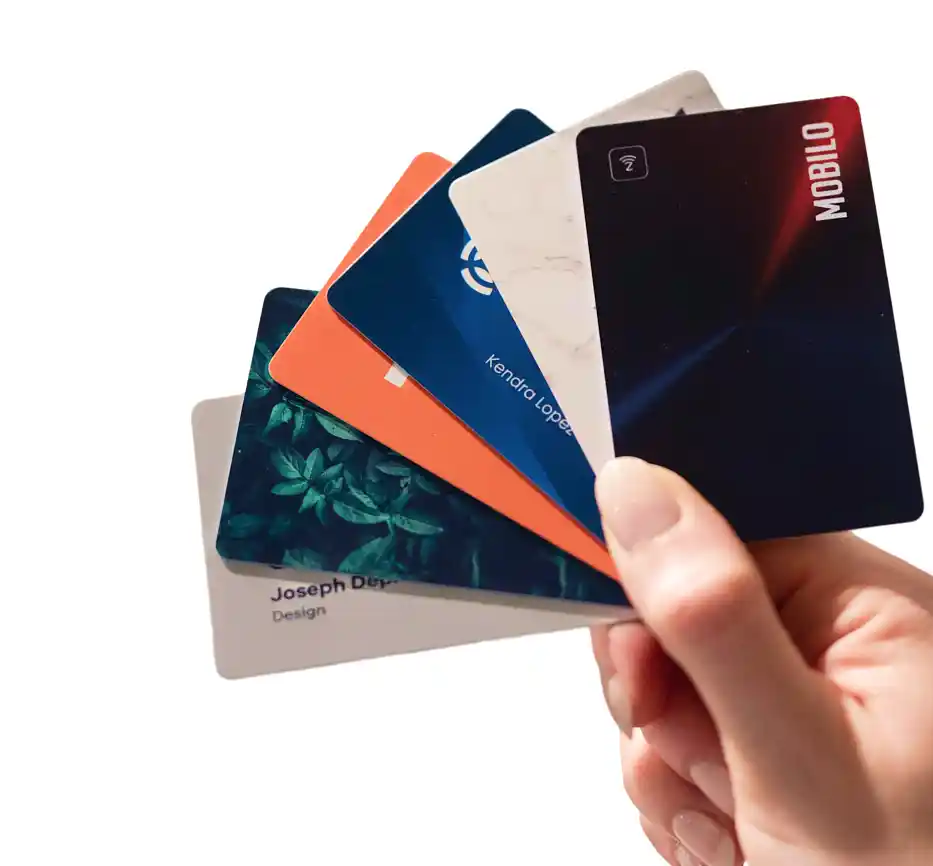
Modern networking requires adapting traditional card exchange principles to contemporary tools and expectations. Professional contact sharing should feel seamless and respectful, allowing both parties to focus on meaningful conversation rather than fumbling through wallets or worrying about running out of cards. For those ready to elevate their networking approach, Mobilo's digital contact card offers a solution that combines traditional etiquette principles with modern convenience.
Summary
- 72% of people judge a company or person by the quality of their business card, which means the moment you exchange contact information carries more weight than surface-level politeness. The format of that exchange changed, but the stakes didn't. How you present yourself in those seven seconds still determines whether someone remembers you or forgets you before they leave the building.
- Conference attendees meet an average of 30 to 50 new contacts in a single day, creating cognitive overload that makes individual recall nearly impossible without specific memory anchors. Without a unique insight you shared, a problem you can solve, or a follow-up action they agreed to, you become part of the undifferentiated mass of people they met that afternoon. Politeness alone doesn't disrupt that pattern; it just makes you blend in with everyone else who was also polite.
- Business cards increase brand recall by 39% because they create a physical or digital artifact tied to a specific moment. The card isn't just the information; it's the memory trigger that helps someone reconstruct your conversation days later when they're deciding who deserves a follow-up. Without that artifact anchored in a meaningful context, the interaction reduces to a generic summary that gets discarded during cleanup.
- The best moment to offer your card is when someone signals intent with phrases like "We should talk more about that" or "Send me your info." Offering it earlier feels pushy, and waiting too long risks the conversation ending before you exchange details. Timing determines whether the card gets kept or tossed, because exchanges that happen after context feel purposeful rather than transactional.
- Follow-up delays kill momentum because memory fades and urgency disappears within 48 hours of an event. Most professionals collect dozens of cards and then postpone personalized outreach until context has already eroded, turning promising connections into forgotten names in a stack. The card was just the first step, but without immediate action, it becomes an artifact without meaning.
- Mobilo's digital contact card addresses this by syncing contact details instantly to your CRM with tags, notes, and next steps already attached, eliminating the gap between meeting someone and capturing actionable context.
Table of Contents
- Why Business Card Etiquette Still Matters (Even in a Digital World)
- The Hidden Cost of "Polite but Forgettable" Networking
- 14 Modern Business Card Etiquette Rules That Actually Get You Remembered
- Stop Letting Good Connections Slip Through the Cracks. Turn Every Business Card Into a Real Connection
Why Business Card Etiquette Still Matters (Even in a Digital World)
You might think business card etiquette belongs to a bygone era. Yet 72% of people judge a company or person by the quality of their business card, making the moment you exchange contact information more important than ever. How you present yourself in those seven seconds determines whether someone remembers you or forgets you by the time they reach their car.
"72% of people judge a company or person by the quality of their business card." — Vistaprint Research

🔑 Key Takeaway: In our digital-first world, physical business cards create a tangible impression that digital exchanges simply cannot replicate.
💡 Pro Tip: Those seven seconds of first contact can make or break networking opportunities - proper card etiquette ensures you're remembered for all the right reasons.

Why do digital exchanges fail to create lasting connections?
Most professionals now skip context entirely, exchanging LinkedIn requests or QR codes and assuming a connection is made. But people attend events where they meet dozens of contacts in a single afternoon: memory compresses, faces blur. Without a meaningful anchor, that interaction becomes another name in a list. Business cards increase brand recall by 39% because they create a physical or digital artifact tied to a specific moment. The card isn't the information; it's the memory trigger.
What drives people to remember you after networking events?
People decide emotionally, not through a deliberate process. Without a memorable impression in that first exchange, you won't get a second chance.
Why do business cards without context feel meaningless?
Business cards feel like gimmicks when indistinguishable from others. Plain rectangles with a name and email become clutter. The problem isn't the card itself: it's the lack of intentionality. You need a reason for someone to keep it—a specific problem you solve or something memorable you discussed. Without that context, it gets discarded.
How does proper etiquette turn cards into strategic tools?
This is where etiquette becomes strategic. How you present a card, when you exchange it, and the context you attach to it determine whether someone sees you as professional or forgettable. Tools like Mobilo's digital contact card eliminate fumbling and outdated information. Contacts sync instantly to their phone with your LinkedIn profile, portfolio, or calendar link, removing friction from follow-up and turning a polite gesture into a functional next step.
Why does face-to-face networking still outperform digital outreach?
Face-to-face networking works better than cold outreach because trust builds faster when people can read body language, hear tone, and feel presence. Over 10 billion business cards are printed globally each year, reflecting the enduring value of these moments. A smudged card or outdated contact information signals carelessness. A digital card without context feels automated.
What does proper etiquette signal in professional exchanges?
Good manners in a digital world mean respecting people's attention, not following rules. When you share information, you reveal how you work, your regard for the relationship, and whether they'll think of you when they return to their desk. But perfect manners won't help if the exchange feels polite but empty.
Related Reading
- Best Business Card Printing
- How Many Business Cards Should I Order
- Why Are Business Cards Important
- What to Put on a Business Card for Networking
- How Much Does It Cost to Make Business Cards
- What Should I Put on the Back of My Business Card
- Best Paper for Business Cards
- Glossy vs Matte Business Cards
- How Thick is a Business Card
- How Much Does Business Card Design Cost
The Hidden Cost of "Polite but Forgettable" Networking
You meet 20 people at a conference, exchange pleasantries, and hand out cards. Two weeks later, there is no follow-up. The problem isn't your professionalism—it's that politeness doesn't create memory anchors. You focused on avoiding offense rather than being worth remembering.

🎯 Key Point: Polite networking creates zero lasting impression—you need to be memorable, not just pleasant.
"Being polite doesn't create memory anchors—you focused on not offending anyone instead of being worth remembering."

⚠️ Warning: The biggest networking mistake is prioritizing comfort over connection—safe conversations lead to forgotten encounters.
Why does high-volume networking overwhelm memory?
Conference attendees meet an average of 30 to 50 new contacts per day. The human brain cannot retain that many interactions without context. Names blur together, conversations compress into simple summaries: "talked about marketing," "works in finance," "seemed nice." Without a specific reason to remember you, you become part of the crowd they met that afternoon. The card you handed them sits in a stack with 40 others and gets discarded during the flight home unless you attached something memorable to that exchange.
How does cognitive load affect networking recall?
This is about cognitive load. When someone processes dozens of introductions in rapid succession, their brain defaults to pattern recognition rather than individual recall. Disrupt that pattern with something specific: a unique insight you shared, a problem you can solve for them, or a follow-up action they agreed to. Politeness alone doesn't create disruption—it makes you blend in with everyone else who was also polite.
Why do business cards without context get discarded immediately?
Most professionals hand out business cards at the end of conversations with no context attached. According to Anton Kornienko's 2025 pricing analysis, AI-generated follow-ups cost as little as $3 per million input tokens, yet most people rely on manual sorting days after an event when fatigue has set in. The card becomes an artifact without meaning, something to file away or discard rather than act on.
How do digital contact cards solve this timing problem?
Tools like Mobilo's digital contact card eliminate this gap by syncing the exchange instantly to their phone with notes, tags, or next steps already attached. Decisions about who matters happen in the moment, not days later when memory has faded, and the stack of cards feels overwhelming.
Why do networking efforts fail despite following proper etiquette?
I've watched professionals leave events convinced they made strong impressions, only to discover weeks later that their new contacts didn't remember them clearly. They followed all the etiquette rules: firm handshake, eye contact, thoughtful questions. But when the other person tried to recall the interaction, they couldn't separate it from the five similar conversations they had that same hour. The failure wasn't rudeness—it was invisibility created by doing exactly what everyone else did.
What are the real costs of prioritizing politeness over memorability?
The real cost shows up in pipeline metrics. Low follow-up rates after networking events stem from optimizing for politeness over memorability. When you prioritize avoiding mistakes over creating distinct value, you become forgettable by design. The question becomes: what specific behaviours create recall when everyone else follows the same polite script?
Related Reading
- Best Font Size For Business Cards
- Best Color For Business Cards
- Business Card Design Tips
- Professional Business Card Design Ideas
- Digital Business Card Examples
- Business Cards Finishes
- Best Business Card Apps
- Should Business Cards Be Double-Sided
14 Modern Business Card Etiquette Rules That Actually Get You Remembered
Etiquette rules matter when they produce real results. The difference between a contact who follows up and one who forgets you is whether you created a reason to be remembered. These 14 rules aren't about traditional manners—they're about making every exchange count by adding context, removing friction, and respecting the other person's attention.

🎯 Key Point: Modern business card etiquette isn't about following outdated social norms—it's about creating memorable interactions that lead to meaningful follow-ups.
💡 Pro Tip: The most successful networkers don't just hand out cards—they create micro-conversations that give recipients a clear reason to reconnect with them later.

1. Keep Your Cards Ready (But Know What "Ready" Actually Means)
Carrying cards means having them accessible when someone asks for one. Fumbling through a bag or wallet signals disorganization. Keep them in a dedicated holder or, if digital, have your sharing method ready before entering the room. According to SilkCards' 2020 research, you have 30 seconds to make an excellent first impression. Half that window disappears if you're searching for your contact information.
2. Hand Them Out After Context, Not Before It
Don't give your card at the beginning of a conversation. Wait until you've discussed something specific: a problem they mentioned, a connection you can make, or a resource you promised. Hand it over as a bridge to that next action, not a premature request for attention. Reference the conversation: "Here's my info. I'll send you that case study we talked about." Now the card has a purpose.
3. Make Eye Contact During the Exchange (It's a Trust Signal, Not a Formality)
Looking someone in the eye when exchanging business cards shows that you value the interaction. When you look away while handing someone your card, you communicate that the gesture is just a quick transaction. Hold their gaze for two seconds to show you're paying attention and not already looking around the room for the next person.
4. Accept Cards Gracefully (And Actually Look at Them)
When someone hands you their card, look at it for three seconds. Say their name aloud if you don't know it. Comment on something specific: their title, the design, or a detail that connects to your conversation. This creates a mental anchor, making it easier to remember them later. Putting it into your pocket without looking signals you don't value what they've given you.
5. Keep Your Cards Clean and Current (Outdated Information Is Worse Than No Card)
A business card with crossed-out details or outdated contact information discourages potential contacts. They'll assume the email bounces or the number disconnects and won't attempt alternative ways to reach you. If your contact information changes, order new cards or update your digital profile immediately. Handing someone incorrect information signals that you don't care whether they can reach you.
6. Add a Personal Note (Turn the Card Into a Memory Artifact)
Writing a short note on the back of a card transforms it from basic contact information into something memorable. Record where you met, what you discussed, or what you agreed to do next—for example: "Met at Austin conference. Interested in Q2 partnership." This prevents confusion weeks later when you're reviewing a pile of cards and can't recall who these people are.
7. Keep Your Cards Up to Date (Consistency Across Channels Builds Trust)
Your business card, email signature, LinkedIn profile, and website should all display the same contact information. Inconsistencies create confusion about which version is correct, preventing people from following through. Update everything simultaneously when your phone number or role changes. Research from PrintUK in 2016 found that 72% of people judge a company or person by the quality of their business card, and "quality" includes accuracy, not just design.
8. Know When to Hand It Over (Timing Determines Whether It Gets Kept or Tossed)
Offer your card when someone shows they want to talk more. Listen for signs like "We should talk more about that," "Send me your info," or "I'd love to connect." When you hear these words, make the handoff easy: "Here, this makes it easy. Scan the QR code." Offering it earlier feels pushy; waiting too long risks the conversation ending before you exchange details. Always wait until the end of a strong conversation, not the beginning. Leading with a card before establishing context feels transactional. Let the conversation earn the exchange.
How do referral moments create natural card exchange opportunities?
Referral moments create natural openings. When someone introduces you to a key contact, the introduction grants you social credibility. Match that credibility with a polished handoff: your card becomes an extension of the trust your introducer lent you.
What makes a business card worth keeping after the exchange?
If your card links to something people can use immediately—a booking page, portfolio, product catalogue, or menu—the exchange adds instant value. The card becomes a shortcut to the next step, not just contact information. That usefulness makes it worth keeping.
9. Know When Not to Hand Out a Card (Restraint Signals Confidence)
Not every conversation needs a card exchange. Pushing a card into someone's hand right away signals that you're collecting contacts, not building relationships. The exchange becomes transactional rather than meaningful. When someone is distracted, rushed, or uninterested, forcing the exchange makes you look inattentive to their needs. If they wanted your information, they would ask for it. Some environments aren't right for networking: weddings, memorials, and intimate social gatherings. Read the room. Pushing business interactions into personal spaces signals that you prioritise transactions over relationships.
10. Don't Neglect Others in Group Settings (Exclusion Kills Goodwill)
If you're in a group conversation and you hand your card to one person while ignoring the others, you've signalled that everyone else doesn't matter. Acknowledge the group by offering cards to everyone or no one. Selective exchanges create awkwardness and resentment that undermine the connection you were trying to build.
11. Don't Write on Received Cards (Unless You Have Explicit Permission)
Writing on someone else's business card without asking is disrespectful; it treats their card as a brand representation rather than a notepad. If you need to add context, write on your own note or phone instead. The only exception is when you have explicit permission, which is standard practice in some cultures.
12. Avoid Overloading Information (Clarity Beats Comprehensiveness)
A cluttered card forces people to hunt for information. Include your name, title, company, phone number, and email. For digital cards, add your LinkedIn profile or portfolio link. Omit unnecessary details like multiple phone numbers, unused physical addresses, or vague taglines. The goal is instant clarity, not a complete biography.
13. Don't Toss Cards into a Drawer (Follow Up Within 48 Hours or the Connection Dies)
Collecting cards at networking events and then putting them away guarantees those connections go nowhere. Within 48 hours, send a short email that mentions your conversation and suggests a next step: "Great meeting you at the Denver summit. I'll send over that resource we discussed by Thursday." The card is the first step. Following through is what turns it into a relationship.
How can digital tools streamline follow-up after high-volume events?
Most teams struggle with this because manual follow-ups feel overwhelming after high-volume events. You meet 30 people, collect 30 cards, and personalising 30 emails becomes easy to postpone. Tools like Mobilo's digital contact card solve this by syncing contact details instantly to your CRM with tags and notes already attached, capturing context in real time, and making follow-ups faster and more specific.
14. Never Discriminate (Every Card Deserves Equal Respect)
Treating someone's card differently based on their title or perceived status is damaging. Whether you're speaking with an intern or a CEO, the exchange should be met with equal respect. People notice when you pocket one card carefully and toss another into your bag without looking. That behaviour signals you're transactional, interested only in connections offering immediate value. The intern you dismissed today might be the decision-maker you need to reach in three years. But following these rules won't matter if the card disappears into the void before anyone acts on it.
Related Reading
- How To Use Digital Business Cards
- Are Digital Business Cards Worth It
- How to Share a Digital Business Card
- Hihello Vs Blinq
- Blinq Vs Popl
- Popl Vs Hihello
- Blinq Vs Dot
- Popl Vs Linq
- Popl Vs Dot
- Popl Vs Ovou
Stop Letting Good Connections Slip Through the Cracks. Turn Every Business Card Into a Real Connection
Traditional business cards look professional, but most get lost or forgotten before anyone acts on them. The gap isn't politeness—it's the absence of a tool that captures context, removes friction, and turns every exchange into a measurable next step.
🎯 Key Point: The window for meaningful follow-up closes fast—don't let manual processes kill your connections.
Most teams manually sort through contacts days later when memory has faded, and urgency has disappeared. By then, the other person has moved on and can't recall your conversation. The card becomes another name in a pile, disconnected from the specific problem you discussed or the value you offered.
"Over 59,000 companies use intelligent digital business cards to generate 10x more leads per event because they've replaced hope with systems." — Digital Business Card Statistics, 2024
Tools like Mobilo's digital contact card eliminate that gap by syncing contact details instantly to your CRM with tags, notes, and lead scores already attached. Our system captures everything in real time: what you discussed, what they need, and when to reach out next. This automation acknowledges that decisions about who matters happen in the moment, not when you're back at your desk reconstructing conversations from memory.
- Manual Process — Days later sorting; Lost context; Hope-based follow-up; Generic outreach
- Mobilo System — Instant CRM sync; Real-time notes & tags; Automated lead scoring; Personalized context
The result is measurable pipeline growth. Every interaction gets captured, scored, and routed to the right person without manual work. Follow-ups happen instantly because context is already there. Over 59,000 companies use intelligent digital business cards to generate 10x more leads per event by replacing hope with systems.
💡 Tip: Don't wait until you're back at the office—capture connection context while the conversation is still fresh in everyone's mind.
You can keep collecting cards and hoping people remember you, or build a system that makes forgetting impossible. Book a demo today and receive your first 25 Mobilo cards free, worth $950.