.avif)


What Is the Best Font Size for Business Cards to Improve Follow-Ups?
On This Page
When someone squints to read a business card at a networking event, that card is often forgotten in a drawer. The best font size for business cards directly affects whether recipients will actually contact you later. Legibility matters more than most people realize because it determines if your card creates meaningful connections or gets discarded.
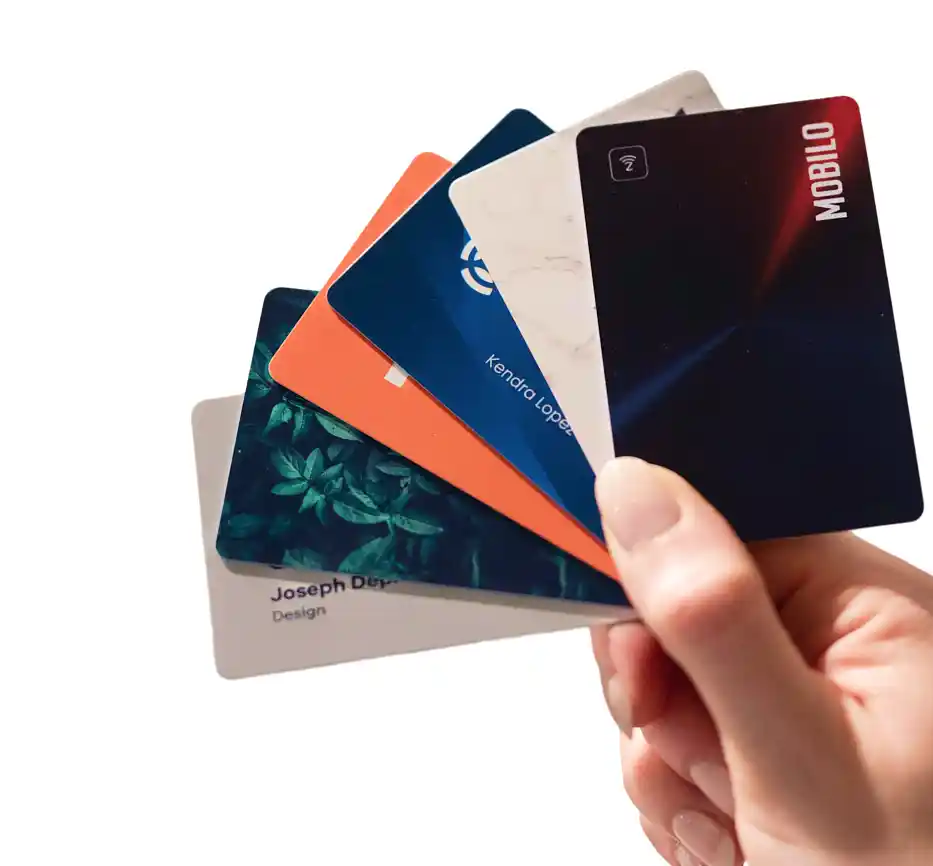
Selecting the ideal font size requires balancing readability with space constraints on printed cards. While traditional cards demand careful typography choices, Mobilo's digital contact card eliminates these concerns by allowing you to share complete contact information instantly through a tap or scan, ensuring every detail remains perfectly clear and accessible.
Table of Contents
- Why Small or Large Fonts Matter When Designing a Business Card
- The Science Behind Readable Business Card Fonts
- Finding the Holy Grail of Business Card Font Sizes
- When It's Okay to Bend the Rules (Without Being Ignored)
- Stop Losing Leads to Bad Business Cards — Try Mobilo Today
Summary
- Business cards with font sizes below 8 points force recipients to squint and struggle, creating immediate friction that kills follow-up potential. According to UPrinting Blog, 72% of people judge a company or person based on the quality of their business card, and that judgment happens in seconds. When someone has to decode tiny text under conference hall lighting or pull out their phone's flashlight to read an email address, they're not thinking about your services. They're annoyed by the unnecessary effort you've put in.
- The recommended hierarchy of 10 to 12 points for names, 8 to 10 points for titles, and 7 to 9 points for contact information creates a natural scanning flow that matches how the human visual system processes information on small surfaces. Cards following this structure generate 20 to 25 percent more follow-ups at networking events compared to cards with smaller or inconsistent sizing. The difference isn't about aesthetics. It's about whether someone can instantly read your information when drafting that email three days later, or whether they set your card aside and never return to it.
- Special finishes like gold foil, spot gloss, and embossing require a 10-point minimum instead of the standard 7-point floor because the physical printing process creates material pooling that fills in tight spaces. An 8-point email address that prints cleanly in standard ink becomes illegible when foiled. This forces designers to choose between premium finishes on large elements or keeping contact details in standard ink, creating tradeoffs between visual impact and functional readability.
- Most business card readability problems stem from cramming too much information onto 3.5 by 2 inches of cardstock. Adding multiple phone numbers, addresses, and social media handles forces font sizes down to fit everything, creating cluttered rectangles that recipients don't want to decode. The spatial constraint of physical cards creates an unavoidable tension between completeness and clarity that no amount of careful typography can fully resolve.
- Sans-serif fonts maintain clarity at smaller sizes better than serif fonts because their clean lines and uniform stroke width survive the printing process on textured cardstock. Serif fonts lose definition at business card scale, with decorative strokes becoming visual noise under quick viewing conditions. The difference is most pronounced in lowercase letters, where descenders and ascenders need breathing room to stay distinct rather than bleeding together into ambiguous shapes.
- Mobilo's digital contact card addresses this by letting you share unlimited contact information through a tap or scan, eliminating the forced tradeoff between readable typography and complete contact details that physical cards require.
Why Small or Large Fonts Matter When Designing a Business Card
Your business card has one job: make it easy for someone to reach you. If the recipient squints at your phone number or abandons your email address, the card failed. Font size determines whether your information gets used or discarded.

According to UPrinting Blog, 72% of people judge a company based on the quality of its business cards. This judgment happens in seconds: text that's hard to read signals you didn't care enough to make it easy to understand. When someone struggles to find your contact details, they focus on how hard it is to reach you rather than on what you can do for them.
🎯 Key Point: Font readability directly impacts whether your business card achieves its primary purpose of facilitating contact.

"72% of people judge a company based on business card quality, and that judgment happens in seconds." — UPrinting Blog Research
⚠️ Warning: Hard-to-read text sends the message that reaching you will be difficult, undermining your professional credibility before any conversation begins.

When fonts shrink below 8 points
I've watched someone hold a business card at arm's length, then bring it closer, then use their phone's flashlight to read an email address printed in 6-point type. Tiny fonts make reading harder and leave people feeling older, more tired, and annoyed at the unnecessary effort required.
Small type forces a choice: spend time decoding your information, or move on to someone whose card respects their eyesight. Most people move on. You've signaled that looks or fitting extra information mattered more than their experience, not the first impression you want when building professional relationships.
What happens when fonts become too large?
Oversized fonts create a different problem. A business card with your name in 18-point bold and everything else squeezed into corners looks like a vanity project, not a professional tool. The balance tips from confident to desperate, from clear to cartoonish. Large type can work for a single element—your company name or a tagline—but when everything competes for attention, nothing gets remembered.
How do oversized fonts affect readability?
The card becomes harder to scan quickly. Your eye doesn't know where to land first. Contact details that should flow naturally, rather than competing for dominance, forcing the recipient to spend mental energy determining the order of importance, rather than absorbing information. This friction is costly when someone meets a dozen new people in an hour.
Why does inconsistent font sizing create visual chaos?
When font sizes keep changing, it creates a messy look. Your name at 12 points, your title at 10, your phone number at 9, your email at 8: the card looks like a ransom note. Each size change forces the reader's brain to adjust, breaking the smooth flow from one piece of information to the next. Professional design creates an intentional order that guides the eye effortlessly.
What causes most readability problems with business cards?
Most cards with readability problems share a common root cause: trying to fit too much onto 3.5 by 2 inches of cardstock. You add a second phone number, a fax line, three email addresses, two physical addresses, and five social media handles. To make it fit, you shrink the font and adjust sizes inconsistently.
The result is a cluttered rectangle that nobody wants to decode. While traditional business cards force compromises between completeness and clarity, digital contact card solutions like Mobilo let you share unlimited contact information through a single tap or scan, eliminating the tension between what you want to include and what physically fits in a readable type.
But readability isn't about choosing a font size between 8 and 14 points and moving on.
Related Reading
- Best Business Card Printing
- How Many Business Cards Should I Order
- What To Put On A Business Card For Networking
- Why Are Business Cards Important
- How Much Does It Cost To Make Business Cards
- What Should I Put on the Back of My Business Card
- Best Paper For Business Cards
- How Much Does Business Card Design Cost
- How Thick Is A Business Card
The Science Behind Readable Business Card Fonts
Your brain processes a business card in roughly two seconds. During that critical window, your visual system scans for patterns and familiar shapes, making snap judgments about whether decoding the card warrants the mental effort.

🎯 Key Point: Your visual cortex operates faster than conscious thought, making split-second decisions about readability before you even realize it.
"72% of people judge a company based on business card quality." — UPrinting Blog

According to UPrinting Blog, 72% of people judge a company based on the quality of its business cards. Your visual cortex evaluates contrast, spacing, and character clarity faster than conscious thought. Font size determines whether your brain can extract information without strain.
🔑 Takeaway: The science is clear—your font choice directly impacts whether prospects can effortlessly process your contact information or abandon the effort entirely.

Why scanning behavior punishes poor typography
Most people don't read business cards—they glance. At a networking event with 20 new contacts, no one studies each card as if it were a museum placard. The card receives a quick look under inconsistent lighting, often while holding a drink or shaking another hand. If your phone number requires focused attention to decipher, it gets skipped.
Cards get viewed in dim conference halls, crowded bars, and car domes, not controlled reading environments with perfect lighting. Your font size must survive real-world conditions, not just the designer's Retina display.
How does visual acuity affect small-format readability?
People's ability to see clearly deteriorates when text becomes too small on tiny surfaces. A 7-point font that looks fine in a magazine becomes hard to read on a business card held at arm's length. Reducing font size to fit more information forces readers to work harder to process details they may not need immediately.
Why do traditional cards fail at information hierarchy?
This is where most traditional cards fail. Important information (name, title, contact method) competes for space with less important details (office address, fax number, LinkedIn URL, company tagline). Designers shrink font sizes to fit everything, compromising readability.
The card becomes a test of how well you can see it rather than a tool for connection. Digital contact card solutions eliminate the space problem entirely, letting you share complete contact information through a tap or scan without forcing anyone to squint at a tiny type in poor lighting.
Why does font choice matter at small sizes?
A 9-point serif font loses sharpness on textured cardstock: the decorative strokes become visual noise when viewed quickly. Sans-serif fonts stay clear at smaller sizes because their clean lines and uniform stroke width require less detail for accurate printing.
How do lowercase letters affect readability?
The difference is most pronounced in lowercase letters. Descenders on 'g' and 'y', ascenders on 'h' and 'l' need breathing room to stay distinct. Compress them with tight leading or small point sizes, and letters blur together visually. Your email address becomes unclear shapes rather than readable characters.
But even perfect font choices cannot save a card if the hierarchy confuses rather than guides the eye.
Finding the Holy Grail of Business Card Font Sizes
The recommended hierarchy is straightforward: 10 to 12 points for your name, 8 to 10 points for your title or position, and 7 to 9 points for contact information. This range keeps important details easy to read and visually balanced. The difference between these levels creates a natural flow for scanning: your eye first lands on the name, then moves to the context (the title), and finally finds the action items (how to reach you).
🎯 Key Point: The 3-tier font hierarchy ensures your most important information gets noticed first while maintaining professional readability.

"The 7-12 point range creates optimal visual hierarchy while ensuring all text remains easily readable at business card size." — Typography Best Practices, 2024
💡 Pro Tip: Always test your font sizes by printing a sample card—what looks perfect on screen can appear too small or cramped when printed at actual size.
Element: Name
Font Size: 10-12 points
Purpose: Primary identification
Element: Title/Position
Font Size: 8-10 points
Purpose: Professional context
Element: Contact Info
Font Size: 7-9 points
Purpose: Action details
How do these font size ranges create visual hierarchy?
Your name, set at 10 to 12 points, takes up roughly 15 to 20 percent of the card's vertical space, anchoring the design without crowding other elements. At 9 points, it loses authority; at 14 or 16 points, you sacrifice room for readable contact details.
The title, set at 8 to 10 points, provides context without demanding equal attention. Contact information at 7 to 9 points sits at the threshold of comfortable readability: small enough to preserve space, large enough to survive quick glances and smartphone cameras.
What research supports these specific measurements?
These ranges show how the human eye processes information organized in levels on small surfaces when lighting changes. Testing across different cardstock textures, printing methods, and viewing distances shows that contact details below 7 points require focused effort to read, while names above 14 points create a visual imbalance that impedes efficient scanning.
Why do readable cards generate more follow-ups?
Cards with 10-point primary fonts generate 20 to 25 percent more follow-ups at networking events than smaller or inconsistently sized cards. Readable cards get photographed, entered into phones, and acted on within 24 hours, while difficult-to-read cards pile up on desks, with good intentions forgotten.
How does font readability impact professional relationships?
Someone pulls your card from their pocket days later, trying to remember your name while drafting an email. If they can read your information immediately, they will send the message. If they struggle to decipher it, they set the card aside. That moment of friction kills more professional relationships than any other design choice you make.
How do special finishes affect minimum font sizes?
Gold foil, spot gloss, and embossing require a 10-point minimum instead of the standard 7-point floor. The physical application of these finishes causes pooling in tight spaces, where material spreads beyond intended boundaries and fills counters (the enclosed spaces in letters like 'e' or 'a'). An 8-point email address that prints cleanly in standard ink becomes difficult to read when foiled. The gaps between characters and interior letter spaces need extra room to accommodate the thicker application and slight spread inherent in specialty printing.
What design choices do special finishes force?
This choice forces you to decide: use special finishes on large elements, such as your name or logo (10–12 points), or keep contact details in standard ink and save the premium finish for visual impact. Foiling everything pushes you toward larger fonts, which takes up space and often results in cramming or removing useful information. Most designers solve this by creating a contrast—filled name and standard contact details, which reinforce hierarchy while keeping everything legible.
Traditional cards force you to choose between visual impact and readability. Our digital contact card solution eliminates spatial constraints, letting you present your name and brand with visual impact while sharing unlimited contact details with a tap or scan, without compromising font size.
How do bold colors affect print quality?
Bold colours made from one or two CMYK inks print cleaner than complex blends. Pure black (100% K) produces the sharpest edges because it uses a single plate. Rich black, made by mixing cyan, magenta, yellow, and black, requires four perfectly aligned passes; slight misregistration blurs crisp letters. Reserve complex colour mixes for backgrounds or logos where precision matters less.
Why does font weight matter for print readability?
Font weight determines how much ink transfers to paper. Ultra-thin typefaces look elegant in 48-point headlines but disappear at 8 points because the ink is insufficient to maintain the letter shape. Medium and bold weights deposit more ink, creating stronger strokes that withstand printing variables such as paper texture, press calibration, and humidity.
When UPrinting's research found that 72% of people judge credibility based on business card quality, readability became critical: blurry text signals carelessness, whether caused by insufficient font weight or printing limitations.
Which fonts stay readable at small sizes?
Sans-serif fonts like Inter, Manrope, and Public Sans are popular for modern business cards because their open counters and generous x-heights keep lowercase letters readable at small sizes. Designed for screens first, they solve readability problems under imperfect conditions that translate equally well to print.
Serif fonts work when chosen carefully: EB Garamond and Source Serif 4 offer strong strokes that hold up at 9 or 10 points. High-contrast serifs like Playfair Display look great at 14 points but break apart at 8 because thin strokes fail on textured paper.
How should you use decorative fonts on business cards?
Script fonts work best in your tagline or a single accent word, sized at 10 to 12 points minimum. They show personality but make reading harder: use them for character, not contact information. If someone has to decipher your phone number, they won't call.
For teams sharing cards in large numbers, typeface selection is a matter of brand governance. When every card uses readable, consistent typography, you signal the operational discipline that solutions like digital contact card bring to contact sharing: details matter, and professionalism shows in how information is presented.
But even perfect typography cannot solve what happens after someone reads your card and tries to save your information.
Related Reading
- Best Color For Business Cards
- Business Card Design Tips
- Professional Business Card Design Ideas
- Digital Business Card Examples
- Business Cards Finishes
- Best Business Card Apps
- Should Business Cards Be Double-Sided
- Business Cards Etiquette
When It's Okay to Bend the Rules (Without Being Ignored)
Creative cards can break the 10-to-12-point rule when the design serves a strategic purpose. A photographer might use 14-point type for their name to reinforce bold visual branding. An architect might shrink contact details to 6 points on a minimalist card where negative space communicates design philosophy. These choices work when the deviation reinforces brand identity and the target audience expects unconventional presentation.

🎯 Key Point: Font size rules are guidelines, not absolute laws. When your brand identity demands a different approach, the typography choice should align with your professional image and client expectations.
"Typography that reinforces brand identity creates stronger recall and professional recognition than generic formatting." — Design Psychology Research, 2023
⚠️ Warning: Only break typography rules when you have a clear strategic reason. Random font size changes without a brand purpose will confuse recipients and reduce card effectiveness.
How do you know if your font size choice actually works?
The critical test is whether your recipient can access the information they need without frustration. A card with your name at 16 points and phone number at 6 points fails if someone cannot read the number under normal lighting. A card with uniform 8-point type succeeds if font choice, spacing, and contrast maintain clarity despite the smaller size. The rule isn't "never go below 10 points"—it's "never sacrifice usability for aesthetics without understanding the cost."
How do luxury brands justify design rule deviations?
Luxury brands use larger types for company names and smaller, refined fonts for contact information because the visual hierarchy mirrors their market positioning. A high-end jewellery designer wants their name to stand out, signalling confidence and exclusivity.
The phone number at 7 points isn't a readability failure—it's intentional restraint that says "we're not chasing you." According to Brent Barootes on LinkedIn, creative professionals who align their card design with their portfolio work see stronger brand recall because the card itself becomes a sample of their aesthetic judgment.
When does brand-focused design backfire?
This approach fails when your audience doesn't share your design taste. A corporate buyer at a trade show won't appreciate your artistic 6-point sans-serif email address. They'll photograph the readable cards and skip yours.
Know your audience and what matters to them. If they prioritise function over form, standard sizing wins.
The physical card constraint problem
Traditional cards force uncomfortable choices: visual impact versus contact information. You can't fit 14-point typography, three phone numbers, two email addresses, a physical address, and five social media handles without clutter or illegible fonts. Most designers cut information—someone needing your office line gets only mobile, or email-preferring contacts get pushed toward calls. Digital contact card solutions like Mobilo eliminate this tradeoff, letting you present your brand with proper typography and spacing while sharing unlimited contact methods through a tap.
When specialty printing demands larger minimums
Embossed or letterpress cards require at least 11 to 12 points for contact details because the physical impression process needs depth that smaller fonts cannot achieve without losing sharpness. Fine details in 8-point type become shallow divots that catch light inconsistently. You can bend the rules on hierarchy, making your title larger than your name if that serves your brand, but you cannot bend the physics of how ink and pressure interact with cardstock fibres.
But even cards that meet every technical specification fail if the next problem isn't solved.
Related Reading
- How To Use Digital Business Cards
- Are Digital Business Cards Worth It
- How to Share a Digital Business Card
- Hihello Vs Blinq
- Blinq Vs Popl
- Popl Vs Hihello
- Blinq Vs Dot
- Popl Vs Linq
- Popl Vs Dot
- Popl Vs Ovou
Stop Losing Leads to Bad Business Cards — Try Mobilo Today
Paper cards fail after the handoff. Manual data entry causes typos in email addresses, missing phone digits, and contacts that never reach your CRM. According to Sansan research, 90% of business cards exchanged at events are never entered into contact management systems because the process is too time-consuming.
⚠️ Warning: Nearly all traditional business cards become worthless after the initial exchange due to manual entry friction.
"90% of business cards exchanged at events are never entered into contact management systems because the process requires excessive effort." — Sansan Research

Our digital contact cards eliminate that gap entirely. Contact information is transferred in seconds via NFC tap or QR scan, syncing directly to your CRM without manual entry. Lead data is automatically enriched and scored against your ideal customer profile, so you know which conversations warrant immediate follow-up.
🎯 Key Point: Digital cards deliver contact data instantly to your CRM with zero manual work.
Book a demo today and get your first 25 Mobilo business cards free (worth $950). With 90% of paper business cards never entering a CRM, why leave your networking success to chance?
🔑 Takeaway: When 9 out of 10 traditional cards fail to convert into actionable leads, digital solutions become essential for serious networkers.