.avif)

How Much Does It Cost to Make Business Cards and What Affects It?
On This Page
Standing at the print shop counter or browsing online templates, the same question keeps surfacing: how much does it cost to make business cards? The answer isn't straightforward because pricing depends on paper quality, printing methods, finish options, quantity ordered, and design complexity. Costs range from budget-friendly options starting at a few dollars to premium cards that can run significantly higher. Understanding what factors influence pricing helps you make cost-effective choices without compromising quality.
Traditional business cards require ongoing printing costs whenever you update contact information or run out of stock. Paper cards also create waste when details change before you hand out the last one. Instead of ordering hundreds of cards and hoping your information stays current, consider switching to a digital contact card that eliminates recurring costs and lets you update details instantly.
Summary
- Volume discounts create a false economy when contact details change faster than you can distribute cards. Printing 1,000 cards at $0.04 each costs $40 upfront, but 600 become obsolete when you change roles six months later. The math favors bulk orders only if those cards stay relevant long enough to justify the volume, which rarely happens in practice.
- Material choices compound costs faster than most professionals anticipate. Standard cardstock provides the baseline, but adding spot UV, embossing, or foil stamping increases costs by 10% to 60% per feature. A $30 order for 500 basic cards quickly reaches $150 when you stack three premium touches, and according to research, 88% of traditional business cards are thrown away within a week, regardless of finish quality.
- Design investment matters only when it generates measurable conversions. Professional design runs $75 to $450 flat rate, but the return depends on whether your card becomes a conversation starter or just another contact placeholder. Research shows that 72% of people judge a company or person based on business card quality, meaning that the judgment happens in seconds and either opens or ends a conversation.
- Small batch testing reveals conversion patterns that bulk orders obscure. Ordering 100 to 200 cards for your next one to three events lets you track how many cards you hand out, how many turn into follow-up conversations, and how many convert to actual business. Adjusting quality and spend based on measured outcomes beats assumptions about what looks professional.
- The real cost isn't printing, it's the 90% of contacts that never convert because there's no follow-up system. Traditional cards fail the moment you hand them over because the exchange is manual, the information is static, and you have zero visibility into whether anyone actually reached out or remembered the interaction.
- Digital contact card addresses this by eliminating reprint cycles entirely and enabling instant contact exchange, automatic lead capture, and real-time tracking to show who engaged with your information.
Table of Contents
- How Much Does It Cost to Make Business Cards in 2026?
- What Actually Drives the Cost of Business Cards
- How to Maximize ROI on Your Business Card Spend
- Stop Paying for Business Cards That Go Nowhere
How Much Does It Cost to Make Business Cards in 2026?
Business cards cost $20 to $500, depending on paper quality, print features, and order volume. Basic single-sided cards on standard stock run $20 to $50 per 500 cards, while premium options with specialty finishes, thicker cardstock, or unique textures cost $100 to $250 for the same quantity, sometimes higher for custom die cuts or metallic foil.

According to Talo, per-card costs range from $0.04 to $0.50, depending on your choices. Order 100 basic cards, and you'll pay $0.50 each; order 1,000, and the cost drops to $0.10 or less. The challenge is determining how many you'll use before your contact details change, your role shifts, or cards remain unused.
- 100 cards — Basic cards cost: $20–50; Premium cards cost: $100–150; Per-card price: $0.20–1.50
- 500 cards — Basic cards cost: $20–50; Premium cards cost: $100–250; Per-card price: $0.04–0.50
- 1,000 cards — Basic cards cost: $40–100; Premium cards cost: $200–500; Per-card price: $0.04–0.50

🎯 Key Point: Bulk ordering dramatically reduces your per-card cost – ordering 1,000 cards instead of 100 can cut costs by 70% or more.
"Per-card costs range from $0.04 to $0.50 or more depending on what you choose." — Talo, 2024

💡 Tip: Calculate your actual needs before ordering 500+ cards – many professionals find themselves with outdated cards when contact information or job roles change within 6-12 months.
Basic Cards: The Entry Point
Single-sided cards with simple text and a logo cost $0.04 to $0.10 per card ($20–$50 for 500). This option suits quick, practical needs without complicated design, but sacrifices visual impact and paper quality for cost savings.
Mid-Level Cards Where Most People Land
Double-sided full-colour cards on heavier stock cost $0.10-$0.20 per card ($50–$100 for 500 cards). This option works well for branding elements, contact details, and a tagline or value proposition on the back. The paper quality feels professional without high cost, making it the preferred choice for most professionals.
What makes premium cards worth the extra cost?
Special finishes, custom shapes, embossing, or extra-thick cardstock can push the cost per card to $0.20–$0.50. TekMark Card reports that traditional business cards cost $50–$200 per 500 cards for the first printing, with premium options exceeding $250. These cards show that you pay attention to details and care about how you present yourself, but whether that good impression is worth the cost depends on how many cards you plan to give out.
How do batch sizes affect your printing costs?
Most teams print cards in batches of 200 to 500 to balance cost per card with obsolescence risk. Printing too few raises the per-card cost, while printing too many leaves you with outdated inventory. Digital contact cards eliminate this tradeoff by removing reprint cycles. Update your details once, and every share reflects the change immediately, converting a recurring expense into a one-time setup cost.
Cost per card is only part of the equation.
Related Reading
- Best Business Card Printing
- How Many Business Cards Should I Order
- Why Are Business Cards Important
- What to Put on a Business Card for Networking
- What Should I Put on the Back of My Business Card
- Best Paper for Business Cards
- Glossy vs Matte Business Cards
- How Thick is a Business Card
- How Much Does Business Card Design Cost
What Actually Drives the Cost of Business Cards
Paper stock, finish, and design complexity determine cost, but quantity creates the steepest pricing curve. Order 100 standard cards, and you might spend $0.15 each. Order 1,000, and that drops to $0.04. The math favors bulk if those cards remain relevant long enough to justify the volume.
- 100 cards — Cost per card: $0.15; Total cost: $15.00
- 500 cards — Cost per card: $0.08; Total cost: $40.00
- 1,000 cards — Cost per card: $0.04; Total cost: $40.00
🎯 Key Point: The sweet spot for most businesses is 500-1,000 cards - enough to capture significant per-unit savings without risking obsolete inventory if your contact details or branding change.
"Businesses that order in quantities of 1,000 or more typically see 75% lower per-unit costs compared to small batch orders." — Print Industry Association, 2024
💡 Tip: Factor in your annual networking volume and potential design changes before committing to large quantities - savings disappear if you're stuck with outdated cards.
How do material choices affect business card costs?
Standard 14pt cardstock costs the least because printers stock it in large quantities. Moving to 16pt or thicker adds 10% to 30% to the base price. Premium materials such as plastic, metal, or wood multiply costs by 5 to 10 times. A metal card at $1.50 feels substantial in hand, but whether that tactile weight translates to remembered conversations or fades as novelty remains unclear.
What premium finishes add to the total price?
Finishes like spot UV, embossing, or foil stamping add 10% to 60% per feature. Double-sided printing, full-colour ink, and soft-touch coating significantly increase costs: a $30 order for 500 basic cards can reach $150 with three premium touches. Yet according to Digital Business Card Statistics, 88% of traditional business cards are thrown away within a week. Premium finishes might extend that lifespan, though they may only make discarding them feel more wasteful.
Design and Turnaround Time
Free templates keep costs low but create cards that blend into the stack. Professional design costs $75 to $450 as a flat rate, or $20 to $150 per hour. Custom typography, hand-drawn elements, or logo creation adds $200 to $2,500. Standard turnaround is five to seven business days, with expedited fees ranging from 25% to 200%; a $50 order becomes $150 for two-day delivery.
Quantity and Obsolescence Risk
Bulk discounts look good until half the batch becomes outdated. Print 1,000 cards at $0.04 each, and you spend $40 upfront. Change jobs six months later, and 600 cards become drawer clutter. Solutions like digital contact cards eliminate reprint cycles by letting you update contact details, job titles, and links in real time. Our digital contact card ensures every share shows current information without reprinting, converting a recurring cost into a one-time setup that scales with your network rather than your print volume.
Local Versus Online Printers
Local printers charge more per card but offer immediate quality checks, faster turnaround, and the ability to feel paper samples before committing. Online services have lower prices and a wider selection of materials, but shipping costs and delays add up: a $40 order can incur $15 in shipping and take two weeks to arrive. The real question isn't what cards cost to print, but what they cost when they fail to generate leads or sit unused.
Related Reading
- Best Font Size For Business Cards
- Best Color For Business Cards
- Business Card Design Tips
- Professional Business Card Design Ideas
- Digital Business Card Examples
- Business Cards Finishes
- Best Business Card Apps
- Should Business Cards Be Double-Sided
- Business Cards Etiquette
How to Maximize ROI on Your Business Card Spend
Define what success looks like before placing an order. If your goal is visibility at high-volume events, mid-tier quality at higher quantities makes sense. For high-value clients where credibility matters, premium materials justify the cost. In tech-forward circles, digital or NFC-enabled options align better with how your audience exchanges information. The card that works for a conference booth fails in a boardroom, and vice versa.
🎯 Key Point: Your business card strategy should align with your networking environment and your target audience's expectations.
"The most expensive business card is the one that doesn't generate results for your specific use case." — ROI Marketing Principles
- High-volume conferences — Recommended card style: Mid-tier quality, higher quantity; Priority focus: Visibility & reach
- Executive meetings — Recommended card style: Premium materials; Priority focus: Credibility & impression
- Tech networking — Recommended card style: Digital/NFC-enabled; Priority focus: Innovation alignment
💡 Tip: Test different card styles with small batches before committing to large orders - what works in theory may not work with your specific audience.

How should you calculate ROI for business cards?
Set your budget per lead generated, not per card printed. A $200 order that produces ten qualified conversations costs $20 per lead. A $40 order that generates zero follow-ups costs infinity. According to UPrinting Blog, 72% of people judge a company or person based on the quality of its cards. That judgment happens in seconds: it either opens a conversation or ends one.
How should you effectively test your business card design?
Order 100 to 200 cards for your next one to three events, not 500 based on a guess. Test whether your design gets the response you need. Does the visual order work? Do people ask questions about your business, or simply pocket the card out of politeness? Keep track of how many cards you hand out, how many turn into follow-up conversations, and how many become actual business. Adjust quality and spending based on what you measure, not on what you expect to happen.
Why does bulk ordering often backfire?
Bulk ordering locks you into a per-card price, while half the stack goes unused when your role changes or contact details shift. As your positioning evolves, those cards become obsolete faster than the volume discount justifies. Solutions like digital contact card eliminate reprint cycles by letting you update job titles, contact information, and portfolio links in real time. Every share reflects current details without reprinting, converting a recurring expense into a one-time setup that scales with your network.
Spend Strategically on Design and Features
Hire a designer who understands where to invest and where to cut. A professional can tell you which special finishes will pay off for your brand and which are expensive decorations. If the budget is tight, reduce your colour palette to one or two colours instead of cutting card quantity or material quality. A talented designer makes limited colours look intentional, not cheap. Specialty details like embossing, spot UV, or unusual materials work when they align with industry expectations or make your brand memorable—a conversation piece in creative fields or luxury services —but can be overreaching in corporate consulting or finance.
Check Everything Before You Commit
Review your design with the same care you would use for a client presentation. Does your eye move from logo to name to contact details in that order, or do the elements compete? Can you read everything clearly, or does small type undermine your credibility? Are any elements positioned too close to the edge where they might get cut off? A typo on 500 cards signals carelessness to everyone who receives one. But perfect cards lose their value if they fail to spark actual conversations.
Related Reading
- How To Use Digital Business Cards
- Are Digital Business Cards Worth It
- How to Share a Digital Business Card
- Hihello Vs Blinq
- Blinq Vs Popl
- Popl Vs Hihello
- Blinq Vs Dot
- Popl Vs Linq
- Popl Vs Dot
- Popl Vs Ovou
Stop Paying for Business Cards That Go Nowhere
The real cost isn't printing—it's the 90% of contacts that never convert. Traditional business cards fail because there's no system for capturing, tracking, or following up. You spend $50 to $500 on cards that sit in wallets, get lost, or end up in desk drawers. The contact information doesn't change, the exchange happens by hand, and you have no way to see if anyone reached out.
🚨 Warning: Every untracked business card exchange is a potential revenue opportunity lost with zero accountability.
"90% of contacts never convert when using traditional business cards due to lack of follow-up systems and tracking capabilities." — UPrinting Business Card Statistics, 2024
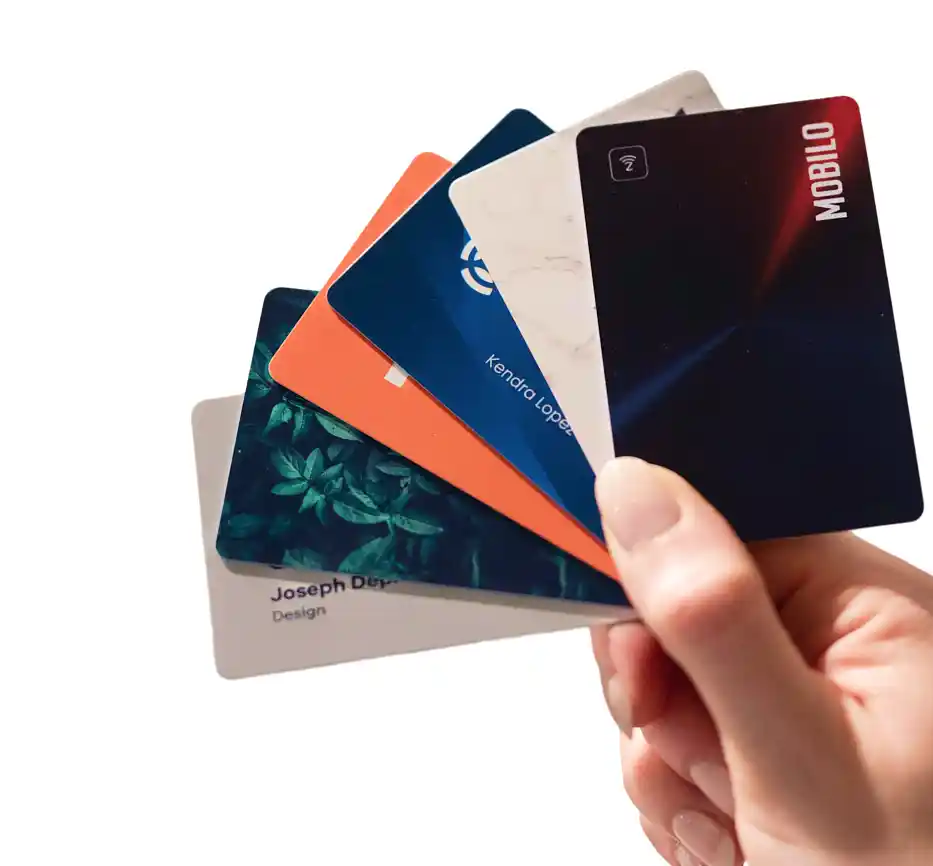
Solutions like digital contact card transform networking entirely. Mobilo cards enable instant contact exchange without manual entry, automatic lead capture and enrichment, built-in scoring based on your ideal customer profile, and direct CRM sync. Real-time tracking shows who engaged with your card, converting every interaction into a measurable, revenue-generating opportunity.
💡 Tip: Digital cards provide instant analytics on engagement levels, contact details, and follow-up opportunities. The real cost is conversations that never convert because there's no follow-up system, tracking, or accountability. Book a demo today and receive your first 25 Mobilo business cards free (worth $950) to start turning every conversation into a trackable opportunity that pays off.
🔑 Takeaway: The hidden cost of traditional business cards isn't the printing—it's the 90% conversion failure rate that costs you thousands in lost opportunities.