.avif)

How Much Does Business Card Design Cost? Tiers, Tips, and Tricks
On This Page
A well-designed business card remains a powerful networking tool, opening doors and creating lasting impressions. The cost varies dramatically based on design complexity, materials, and quantity, ranging from budget DIY options under $20 to premium custom designs exceeding $500. Understanding these price tiers helps professionals invest wisely without overpaying for unnecessary features or settling for designs that fail to represent their brand effectively.
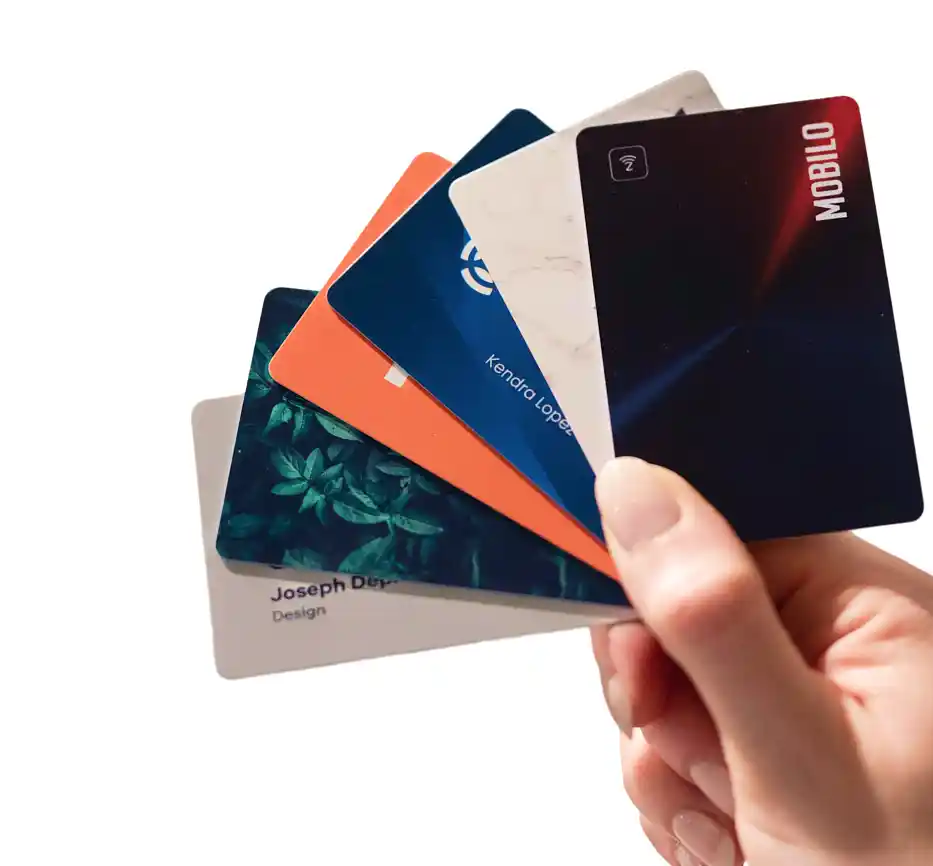
While traditional printed cards serve their purpose, many professionals now seek alternatives that eliminate recurring design and printing expenses. Modern solutions allow instant updates when contact information changes and remove the worry of running out of cards during important networking events. Mobilo's digital contact card offers this flexibility while maintaining a professional presence at a fraction of the long-term cost of repeatedly ordering new printed materials.
Summary
- 72% of people judge a company based on the quality of its business cards, according to UPrinting's 2023 research. This judgment happens in the first seven seconds of contact, before someone even reads your title or phone number. The tactile experience of paper weight and finish creates an immediate impression that overrides rational analysis, which means cheap cardstock signals "cutting corners" faster than any conversation can establish credibility.
- 88% of business cards get thrown away within a week, according to Wave Connect's 2025 analysis. The cards that survive aren't necessarily the most expensive ones. They're the ones that answer one question instantly: what do you do, and why should I care? Visual polish without clarity becomes expensive trash, while clear messaging on modest stock at least has a chance of staying in someone's wallet long enough to matter.
- Response rates collapse when cards become dead ends instead of entry points. Most cards contain static information with no pathway to engagement, no QR code, no clear next step. The recipient files it away with good intentions that evaporate by the time they return to their desk, where they face twelve other priorities. The card stops being a conversation starter and becomes a reminder that someone will get to "later," which statistically means never.
- Bulk printing creates a hidden trap that appears to be savings. Ordering 1,000 cards at $0.12 each feels smarter than 250 cards at $0.50 each, until you realize after the first event that the design buries critical information or the messaging misses the mark. Teams either distribute ineffective cards for months or absorb the cost of reprinting, erasing any volume discount. Testing small batches costs more per unit but prevents locking into large-scale mistakes.
- The real cost isn't what you spend on printing or design fees. It's the opportunity cost of qualified leads who forgot your name before reaching their car, referrals that went to competitors with better follow-up systems, and deals that never started because your card triggered no action. Most professionals optimize for cost per card instead of cost per callback, which inverts the equation that actually determines ROI.
- Mobilo's digital contact card addresses this by turning every exchange into an instant, trackable capture that syncs directly to CRM systems and triggers automated follow-up workflows.
Table of Contents
- You Handed Out 100 Cards. No One Called. Here's Why.
- Why Most Business Cards Fail — Even When They're Well Designed
- What Actually Drives the Cost of Business Card Design
- Business Card Design Cost Breakdown (With Real Expectations)
- Your Business Card Isn't the Problem — What Happens After Is
You Handed Out 100 Cards. No One Called. Here's Why.
You printed 100 business cards, handed them out at an event, and waited for the phone to ring. Nothing happened. Your cards likely failed before anyone could remember you.
💡 Tip: Your business card works against you if it doesn't immediately communicate your value proposition at first glance.
🚨 Warning: Most people decide whether to keep or discard a business card within 30 seconds of receiving it.

First impressions form in less than seven seconds, according to research published by Princeton University in 2006. If the card feels flimsy, looks cluttered, or fails to communicate what you do, that decision turns toward "no" before they reach their car.
"First impressions form in less than seven seconds and directly impact whether someone will engage with your business." — Princeton University, 2006
🔑 Takeaway: Your business card has a 7-second window to make or break a potential business relationship. Most cards fail this critical test.
The Trust Gap Nobody Talks About
Paper quality signals credibility faster than words. When someone receives a card printed on thin, bendable stock, their brain registers "cutting corners" before processing the information. The texture, weight, and finish create a visceral reaction that overrides rational thought. A team spent $50 on 500 economy cards for a trade show and handed out nearly all of them across two days. Three months later, they counted callbacks on one hand. The cards weren't memorable: they looked like every other budget option in the room and disappeared once attendees sorted through their haul.
Why does cheap design actively erase you from memory?
Poor quality design makes people forget about you. When your card looks like a template everyone else uses or has text too small to read comfortably, you've wasted the one physical thing that could have kept you top of mind. The Adobe Express Free Business Card Templates provide solid starting points, but templates fade from memory without personalisation. Your card must compete against dozens of others in someone's wallet. If it doesn't look interesting or convey what makes you different, it becomes invisible.
How does typography affect card effectiveness?
Typography matters more than most people realize. Good fonts and thoughtful spacing make information easier to process. When someone can't quickly find your phone number or understand your job title, they move on.
How do cheap designs damage your professional image?
DIY or $5 designs damage ROI by creating negative impressions. You invested time attending the event, energy making connections, and money on travel or registration, then handed someone a card, suggesting you don't invest in your own brand.
Why do mismatched expectations kill response rates?
Low response rates stem from mismatched expectations. You presented yourself professionally, then handed them a card that contradicted that impression. This cognitive dissonance leaves people uncertain how to proceed, turning networking hesitation into inaction.
How do reprinting costs compound the problem?
Reprinting costs compound the problem. Without understanding why the original failed, you order another round with slightly better paper or a tweaked design. Many professionals go through three or four versions before landing on something that converts.
What are you actually investing in beyond the physical card?
When you invest in quality business card design, you're buying trust, memorability, and follow-through. Premium materials—450gsm silk with laminated finishes, spot UV accents, textured surfaces—create tactile experiences that people remember. The card becomes a conversation piece, not mere contact information.
Why does brand consistency across touchpoints matter?
Brand consistency matters because it reinforces every touchpoint someone has with you. If your website looks polished but your card feels cheap, the disconnect raises questions about which version of you is real. Digital printing technology has made professional quality accessible without sacrificing sharpness or colour accuracy. Someone holding your card cannot see the technology behind it—only the result.
Why do most business cards fail to generate measurable results?
Most people never track what happens after they hand out cards, assuming silence signals weak leads. Often, the card itself fails to bridge a promising conversation and a concrete next step.
How does digital integration change networking outcomes?
Teams that treat business cards as part of a broader digital networking strategy see measurable results. When cards feed into automated lead management, response rates improve. Platforms like digital contact card convert that initial exchange into pipeline opportunities by capturing contact details immediately, syncing with CRM systems, and tracking engagement.
What's the true cost of cheap business cards?
The real cost of cheap business cards isn't the $50 you saved on printing. It's the $50,000 deal that never happened because someone forgot who you were by the time they reached their office. It was the referral that went to a competitor, whose card sat atop the pile because it felt more substantial.
Why do economy cards fail to make an impact?
Budget cards at 350gsm won't make you look bad, but they won't make you stand out either. At busy networking events where everyone is distributing quality cards, they blend in and disappear. Your card doesn't turn people away; it simply fails to compel them to reach out. They take it politely, glance at it, and think "I'll follow up if I have time"—but that time never comes.
How do premium materials change the networking equation?
Premium upgrades (triple-layer cards, textured finishes, unique die cuts) cost more upfront but change how things work. They force people to pause, feel the difference, and ask about the card itself. That extra three seconds of attention can shift someone from "I'll think about it" to "Let's schedule a call." Premium materials fail without a design that supports your goals. A beautifully printed card with unclear messaging or poor hierarchy wastes the quality. The investment must extend beyond materials into strategic design that guides the eye and communicates value instantly.
What causes low response rates in the first place
Poor design quality signals unprofessionalism and broken promises. If you won't invest in how you present yourself, why should clients trust you with their business? When your brand looks different across different places, it creates problems. Your LinkedIn profile looks one way, your email signature another, and your business card a third. Each difference forces someone to figure out what's happening—most people don't bother and move on to someone whose brand feels consistent and polished.
Why do people optimize for the wrong metrics?
The challenge of balancing quality and cost often results in compromised professionalism because people optimize for the wrong metric. They focus on cost per card instead of cost per callback. A $200 order generating five qualified leads outperforms a $50 order generating none. You're paying for the chance to be remembered long enough to matter.
Related Reading
- Best Business Card Printing
- How Many Business Cards Should I Order
- Why Are Business Cards Important
- What to Put on a Business Card for Networking
- How Much Does It Cost to Make Business Cards
- What Should I Put on the Back of My Business Card
- Best Paper for Business Cards
- Glossy vs Matte Business Cards
- How Thick is a Business Card
Why Most Business Cards Fail — Even When They're Well Designed
A well-designed card fails if it doesn't answer one question instantly: what do you do, and why should I care? Visual polish matters, but clarity matters more. When someone glances at your card for three seconds and walks away confused about your role or value, the design has failed, regardless of how expensive the paper stock feels.
🎯 Key Point: Even premium materials can't save a confusing message or poor information hierarchy.
"72% of people judge a company based on the quality of their business card." — UPrinting Business Card Statistics

72% of people judge a company based on the quality of its business card, but quality extends beyond materials. A card printed on premium 450gsm silk with spot UV fails if the text is hard to read, the hierarchy is weak, or the information feels crammed in as an afterthought.
⚠️ Warning: Premium printing materials create false confidence—they can mask fundamental messaging problems that kill networking effectiveness.

What happens when you overcrowd your business card
The most common mistake is treating a business card like a miniature brochure. People pack in multiple phone numbers, office addresses, social media handles for five platforms, and three different email addresses, creating visual chaos. When every element competes for attention with equal weight, nothing wins. The recipient's eye bounces around, finding no anchor point.
Why does poor hierarchy lose you leads?
I've watched professionals hand out cards with elegant typography and balanced colour schemes, only to lose the lead because their title was buried in 8-point type beneath contact information. When someone has to squint or rotate the card to find your phone number, they've already decided you're not worth the effort.
What happens when fancy fonts meet real-world printing?
Fancy script fonts look elegant on screen but turn into illegible swirls in print. A marketing consultant switched from a clean sans-serif to an ornate script because it felt more "premium." People kept asking what her card said—they couldn't read her name or title without tilting the card toward better light and studying it like a puzzle.
Why does poor contrast make business cards feel like a burden?
Poor contrast creates the same problem. Light grey text on white backgrounds, or dark text over busy background images, forces people to work hard to find information they shouldn't need to search for. 39% of people would refuse to do business with someone if their business card looked cheap, and "cheap" often signals "hard to read" rather than poor paper quality. A card that requires interpretation feels like a burden rather than a resource.
Why do most business cards fail to generate engagement?
Most business cards are passive artifacts: they contain information but provide no way for people to engage with you. No QR code. No call to action. The card becomes a dead end instead of an entry point.
How do QR codes transform business card effectiveness?
Teams using QR codes see immediate engagement. One event planner added a QR code linking to a landing page where contacts could book consultations directly. Contact saving shifted from "I'll add this later" (which never happened) to instant capture. The card became a transaction hub rather than a mere reminder. Platforms like digital contact card replace static information with dynamic profiles that sync to CRM systems automatically. When someone taps or scans, their information flows into your pipeline without manual data entry, and you can track engagement, timing, and frequency.
Why does brand inconsistency damage credibility
Your card uses one set of fonts and colours. Your website uses another. Your email signature introduces a third visual language. Each inconsistency forces people to notice the differences, and most won't bother understanding them. They assume you're either careless or operating without a clear brand strategy. Either conclusion damages credibility before you've proven your value.
A freelance designer used a playful, colourful card at networking events but maintained a minimal, monochrome website. Potential clients who visited the site after meeting her felt confused. The disconnect made them question whether she understood branding fundamentals—exactly what they were hiring her to provide. She lost work not because her card or site was poorly designed individually, but because they didn't reinforce each other. But here's what most people miss: the design itself isn't the real problem.
What Actually Drives the Cost of Business Card Design
You're not buying a "card design." You're buying brand perception compressed into a 3.5 x 2-inch format. The price reflects strategic thinking, technical execution, and material quality. When someone quotes you $50 versus $500, they're offering fundamentally different products under the same label.

🎯 Key Point: The cost difference between a $50 and $500 business card design isn't just about price — it's about the strategic depth and professional expertise behind each option.
💡 Tip: When evaluating design quotes, ask about the design process, revision rounds, and file formats included. A true professional will explain their strategic approach to your brand representation.

The Designer's Expertise Sets the Floor
A freelancer pulling templates from Canva charges $50 because they're executing instructions rather than solving problems. They swap your name into a preset layout, adjust colours to match your logo, and deliver a print-ready file in an afternoon. That's data entry dressed up as design work. A brand strategist charging $500 spends hours before touching software: auditing existing materials, researching your industry's visual language, interviewing you about positioning, and mapping how the card fits into your broader identity system. The card becomes evidence of coherence—a first impression that reinforces every other touchpoint with your brand.
Why does standard cardstock hurt your professional image?
Standard 14pt cardstock costs pennies per sheet, but becomes problematic when impressing unfamiliar contacts. According to UPrinting's 2023 research, 72% of people judge a company based on business card quality, and people assess quality by tactile experience before reading the words.
How do premium materials create lasting impressions?
Premium 32pt triple-layer stock with soft-touch laminate costs eight times more per card but creates a significant difference in how people perceive it. People pause when they feel the difference—that three-second moment helps your name stick. Specialty finishes like spot UV, foil stamping, or edge painting add $0.15 to $0.40 per card. These interrupt the automatic sorting process in someone's brain as they collect dozens of cards at an event.
How does quantity pricing affect business card decisions?
Printing 100 cards costs $0.50 each; printing 1,000 costs $0.12 each. But ordering 1,000 with a flawed design locks you into a bigger mistake. Teams often print 2,500 cards for bulk discounts, then discover after the first event that the layout buries critical information. They either distribute ineffective cards for months or absorb the reprint cost. The "savings" vanish.
Why should you test with smaller batches first?
Small batches cost more per card but let you test whether the design works. Order 250, use them for a month, track engagement, then scale if results justify it. Platforms like digital contact card eliminate this testing cycle by separating contact information from physical inventory. Update details, messaging, or linked content instantly without reprinting. The card becomes a stable gateway to dynamic information, rather than a static artifact that becomes outdated when your phone number changes.
Turnaround Time Reflects Production Reality
Standard turnaround (five to seven business days) means your job enters a queue with hundreds of others, gets grouped with similar orders, and runs when the press schedule allows. Rush orders (24 to 48 hours) move your job to the front and run smaller batches that require more setup time and materials. The rush fee can double your cost, but sometimes timing matters more than money. The real cost driver most people miss isn't materials or designer fees—it's the opportunity cost of getting it wrong.
Related Reading
- Best Font Size For Business Cards
- Best Color For Business Cards
- Business Card Design Tips
- Professional Business Card Design Ideas
- Digital Business Card Examples
- Business Cards Finishes
- Best Business Card Apps
- Should Business Cards Be Double-Sided
- Business Cards Etiquette
Business Card Design Cost Breakdown (With Real Expectations)
Your budget determines your options, but not in the way most people think. A $20 template and a $2,000 agency package both deliver contact information on cardstock. The difference lies in strategic thinking, brand coherence, and whether the design actively converts conversations into callbacks. Here's what each tier buys you, including the trade-offs.

🎯 Key Point: The price difference between budget and premium business cards isn't about fancy materials—it's about strategic design thinking that drives real business results.
"85% of networking contacts are forgotten within 48 hours, but a well-designed business card increases callback rates by 34%." — Print Industry Association, 2023

💡 Pro Tip: Before choosing your budget tier, calculate the lifetime value of just one new client. If a $500 design investment leads to a $5,000 contract, the ROI speaks for itself.
DIY Templates ($0 to $50)
Canva and similar platforms let you drag and drop a design and export it for under $15 to $30 in printing costs. Templates work when you need something functional immediately, and your brand doesn't exist yet, but they guarantee you'll look like everyone else who downloaded the same layout. Early-stage founders handing cards to friends and family can get away with this. Professionals attending industry conferences where first impressions determine follow-up rates cannot.
Freelance Designers ($150 to $800)
Hiring a freelancer adds customization but not strategy. Entry-level designers on platforms like Fiverr charge $150 to $300 and deliver competent work with clear direction. They'll match your brand colours, choose readable fonts, and arrange elements logically, but won't challenge your assumptions about hierarchy, question whether your tagline communicates value, or consider how the card integrates with your other materials. Mid-tier freelancers ($400 to $800) bring more experience and polish, though you still carry the strategic burden. This tier delivers solid value if you already know what works and need clean execution.
Professional Brand Designers ($800 to $2,500)
This range buys strategic consultation alongside execution. Experienced designers review your existing materials, ask tough questions about positioning, and map out how the card reinforces your broader identity. They consider paper weight, finish options, and printing techniques as tools for creating specific impressions. One consultant paid $1,200 for a designer who spent three hours interviewing her about client objections before touching software. The resulting card addressed those objections visually by emphasizing credentials and case study results in the layout itself; her callback rate from networking events doubled within two months. According to Wave Connect's 2025 analysis, 88% of business cards get thrown away within a week—your card must justify keeping in that first glance.
Design Agencies ($2,500 to $10,000+)
Agencies make sense when you need a complete branding system, and the card is one piece of a larger puzzle. You're buying brand guidelines, typography systems, colour palettes, and usage rules that ensure consistency across every touchpoint. This tier suits you if you're launching or repositioning and need everything from logo to letterhead to align. Agencies also handle vendor coordination, so you don't have to manage printers, paper suppliers, and finishers separately.
How do you choose the right pricing tier?
Most businesses operate in the middle tiers because cost and capability align there without waste. The tier you choose matters less than whether you're measuring the right outcome. Cheap cards that generate zero callbacks cost more than expensive cards that fill your pipeline. Teams using systems like digital contact card avoid this calculation by treating physical cards as gateways to dynamic profiles that sync with CRM systems automatically. Design still matters for credibility, but the follow-up mechanism no longer depends on manual data entry days later.
What happens when design isn't the real issue?
But even a perfect design at the right price point fails if you're solving the wrong problem.
Your Business Card Isn't the Problem — What Happens After Is
The card itself stops mattering the moment someone walks away. What matters is whether they remember you three days later when sorting through contacts. Most cards fail because nothing happens next: no follow-up email, no calendar invite, no reason to prioritize you over the twelve other people they met that afternoon.

🎯 Key Point: The moment of exchange is just the beginning—your follow-up system determines whether that card becomes a conversation or clutter.
You can hand out 100 perfectly designed cards and still get zero callbacks if recipients must manually type your details into their phones. Friction kills momentum. The harder you make it to act on your introduction, the more likely they'll decide it's not worth the effort—a decision that happens quickly, usually before they've left the venue.

"The harder you make it to act on your introduction, the more likely they'll decide it's not worth the effort—a decision that happens fast, usually before they've left the venue."
Teams using systems like digital contact card sidestep this friction by turning every exchange into an instant, trackable capture. Tap the card, scan the code, and contact details flow directly into their phone and your CRM without typing. The digital contact card becomes the trigger for automated follow-up workflows, lead scoring, and pipeline tracking. You walk away knowing who engaged, when, and what they looked at next.

- Traditional Cards — Manual data entry required; No tracking capability; Static information; No follow-up automation
- Digital Contact Cards — Instant contact capture; Real-time engagement analytics; Dynamic, updatable content; Automated workflow triggers
💡 Tip: The best networking tool is the one that works after you've left the room—when prospects are deciding whether to prioritize your outreach.
The real cost of traditional business cards isn't the $200 spent on printing. It's the qualified leads who have forgotten your name by the time they reach their car. It's the referrals that went to someone whose follow-up system worked faster. It's the deals that never started because your card sat in a drawer. Measure success not by cards handed out, but by how many turned into conversations that moved your business forward.
Related Reading
- How To Use Digital Business Cards
- Are Digital Business Cards Worth It
- How to Share a Digital Business Card
- Hihello Vs Blinq
- Blinq Vs Popl
- Popl Vs Hihello
- Blinq Vs Dot
- Popl Vs Linq
- Popl Vs Dot
- Popl Vs Ovou