

33 Business Networking Tips to Grow Your Career in 2026
On This Page
Most networking advice skips the real problem: contacts vanish before follow-up can start. These 33 tips fix the handoff gap, so every conversation becomes a CRM record.
Forty contacts photographed. Twenty entered into a spreadsheet three days later. Six actually made it into the CRM. That math plays out after almost every trade show, and it has nothing to do with how good the conversations were.
"Networking advice to 'stay in touch' is vague and actionable steps are rarely explained, leaving people confused about what to actually do after exchanging contacts, a gap that causes follow-up to fail before it even begins."
— what we hear from job seekers and professionals networking
Most networking professionals believe the gap between meeting someone and entering them into the CRM is an inevitable cost of doing business, a friction point that discipline and faster follow-up emails can eventually overcome. But the failure most sales professionals never diagnose sits between the handshake and the CRM record. Not the follow-up. Not the pitch. The gap where a real prospect quietly disappears before any follow-up workflow can reach them. See our digital business card for how this works in practice.
For a team measured on pipeline, professional networking is a contact-capture operation. Every conversation is only as valuable as the record it produces.
Without that record, the conversation never happened as far as the CRM is concerned. The definition has shifted because accountability has shifted. BDRs are judged on meetings booked and pipeline sourced, not on how many people they met at a conference.
That means automatic lead capture is the operational foundation that makes every other networking behavior count, and the return is greatest for teams that attend events regularly and need structured, repeatable lead follow-up.
HubSpot community practitioners note that without a systematic, automated handoff process, offline event contacts frequently stall between the initial meeting and CRM entry, causing pipeline leakage that faster follow-up emails alone cannot reliably prevent. Follow-up velocity is irrelevant when there is no record to trigger it.
Follow-up velocity is irrelevant when there is no record to trigger it. Most networking advice assumes the contact is already in the system, skipping straight to subject line optimization and follow-up cadence.
It is the bottleneck that makes every other tip conditional. The 33 tips here are built differently. Each one is designed to produce a CRM-ready contact, not just a good conversation. Closing the handoff gap starts before you walk into the room.
Key takeaways
- 90% of new contacts never make it into a CRM, not because reps lack effort, but because the handoff between meeting someone and logging them is broken by default.
- 88% of paper business cards are thrown away within a week, which means most networking ROI evaporates before follow-up even begins.
- The real bottleneck isn't the follow-up email, it's the missing CRM record that makes every follow-up tip irrelevant.
- Arriving at an event with three to five named targets, not a stack of cards and good intentions, is what separates pipeline builders from badge collectors.
- Reply rates drop sharply after 48 hours, so any friction between contact exchange and CRM entry directly kills conversion, not just efficiency.
- An open-ended question in the first 30 seconds decides whether a conversation surfaces a real business problem or stays at the weather-report level.
- Your LinkedIn profile is checked within 24 hours of a meeting, what a new contact finds there either confirms the impression you made or quietly erases it.
- Mobilo's Contact Exchange and Lead Capture closes the gap by capturing contact information the moment someone taps or scans a Mobilo card, feeding it directly into your CRM so follow-up is automatic, not heroic.
The Networking Prep Steps That Separate Pipeline Builders from Badge Collectors
Eighty-eight percent of business cards are thrown away within a week of a networking event, according to industry research. That number should stop every Sales Manager cold, because it means the prep work most reps focus on, polishing the pitch, printing enough cards, rehearsing the handshake, is protecting almost nothing.
The real preparation gap is infrastructure.
1. Set a Goal-First Networking Intention Before Every Event
Pipeline builders don't show up hoping something good happens, they define a specific, measurable outcome before they walk in the door. Whether that's securing two discovery calls, meeting one potential referral partner, or validating a new market segment, a pre-set goal filters every conversation through a ROI lens. The tradeoff: rigid goal-fixation can make you dismissive of serendipitous connections that don't fit your predetermined criteria.
2. Craft a Jargon-Free 30-Second Elevator Pitch Built Around Who You Help
A pitch that leads with your title and company name loses the room in seconds. Effective business networking tips demand a structure that answers three questions instantly: who you are, what problem you solve, and who specifically you solve it for. Stripping corporate jargon forces clarity that resonates with strangers. The real limitation is that a rehearsed pitch can sound robotic, delivery practice is non-negotiable to keep it conversational.
3. Pre-Research Attendees and Lock In 3-5 High-Priority Targets Before Arrival
Pull the attendee list the night before and filter by title, company size, and vertical against your ideal customer profile. LinkedIn's event tools make it possible to identify specific individuals worth approaching before you set foot in the room, which shifts every opening conversation from cold to contextual. Reps who arrive with three to five named targets convert more event conversations into scheduled meetings, because context replaces cold openers and every minute on the floor works toward a defined pipeline goal rather than a contact count.
Pre-Event Networking Readiness Checklist
1 — Pull attendee list; filter by title, company size, vertical
2 — Flag 3-5 high-priority ICP targets by name
3 — Write one personalised conversation opener per target
4 — Draft a jargon-free 30-second elevator pitch
5 — Define a concrete goal (e.g., 3 VP-level conversations with a next step)
6 — Configure CRM integration on digital business card tool
7 — Test tap-to-share flow on at least one device
8 — Prepare 3 context-specific open-ended questions
4. Prepare a Digital Contact-Capture System So No Conversation Goes Unrecorded
Paper business cards get lost; memory fades within hours. Serious networkers arrive with a frictionless digital contact-sharing method, a QR code, a tap-to-share app, or a mobile CRM intake form, ensuring every meaningful exchange ends with a captured record ready for follow-up sequencing. This habit is what turns a good conversation into a pipeline entry. The limitation: over-relying on tech can feel transactional if introduced too abruptly mid-conversation.
Related Reading
- Business Relationship Building
- How To Build A Network For A Small Business
- How To Build A Strong Sales Pipeline
- How To Reach B2b Decision Makers
- How To Ask For Referrals In Sales
- Expand Your Network
- Business Networking Goals
- Business Cards For Networking
- How To Start A Business Networking Group
How to Run Networking Conversations That Actually Build Relationships
Arriving with three to five named targets solves the first problem, getting in front of the right people, but it does not solve what happens once you are standing in front of them. Observed professional behavior data puts the number of conversations at a typical networking event that reach the depth needed to surface a real business problem at only two or three. That number is a signal. The professionals who consistently convert networking into pipeline are the ones who stayed long enough in a single conversation to hear something true.
1. Prioritize 2-3 Deep Conversations Over Collecting Business Cards
CliffsNotes' 2024 networking guidance is direct: effective networking means building a few meaningful connections rather than collecting as many contacts as possible. A BDR who spends 25 minutes with one VP of Sales, uncovers a real hiring pain, and books a discovery call before leaving the room has outperformed every rep who cycled through 15 two-minute handshakes. Volume without context is just noise in your CRM. A contact captured from a 90-second surface exchange carries almost no pipeline signal. It is an email address with no story attached.
This is especially true for salespeople transitioning into relationship-driven industries, construction, professional services, enterprise accounts, where the instinct to stack as many introductions as possible actively works against you. New reps in those environments often struggle to know where to start building meaningful professional connections, and the answer is almost never "meet more people faster." It is "go deeper with fewer people, sooner." That discipline is what this section is about.
2. Apply the 70/30 Listening Rule - Let Them Talk First
Active listening is the mechanism that separates a memorable conversation from a forgettable pitch. CliffsNotes' 2024 analysis identifies letting the other person lead by talking about their own challenges as the core skill that builds genuine rapport. In practice, that means asking one open question, then staying quiet long enough to hear the actual answer. Mirror the language they use to describe their problem and repeat it back. That single habit signals more authentic interest than any prepared pitch.
One of the real fears that stops salespeople, especially those newer to client-facing roles, from doing this well is the worry that listening without pitching makes them look passive or uncommitted. It does the opposite. The prospect who feels genuinely heard remembers you because most reps they met that evening were waiting for their turn to speak. The problem is a listening problem. Fix the listening and the tone follows.
3. Give Value First - Share Resources, Make Introductions, Offer Expertise
The fastest way to be remembered the next morning is to offer something useful before the conversation ends. Share a relevant article. Introduce two people in the room who should know each other. Offer a specific perspective on a challenge they just described. CliffsNotes' same-figure guidance frames thoughtful follow-up questions as the signal of authentic engagement. Giving value first works on the same principle: it reframes you as a connector rather than a collector, and makes the ask for a follow-up call feel like a natural next step rather than a transaction.
This approach is most beneficial for professionals who attend frequent in-person networking events or hold client-facing roles where the relationship precedes the sale. For those teams, every event is a compounding asset; each conversation either deepens a relationship or starts a new one that will be picked up again next quarter.
Every conversation should end with one concrete, mutually agreed action. A specific date, a specific topic, a specific reason to meet again. That closing commitment is what separates a contact worth entering into your pipeline from a name you will not remember by Friday.
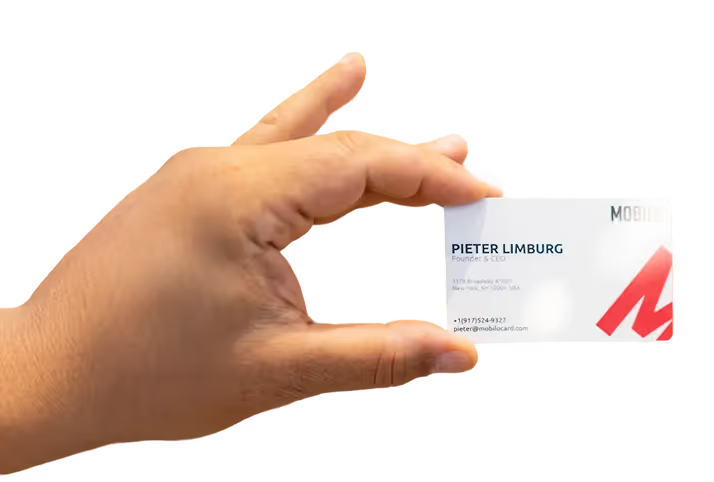
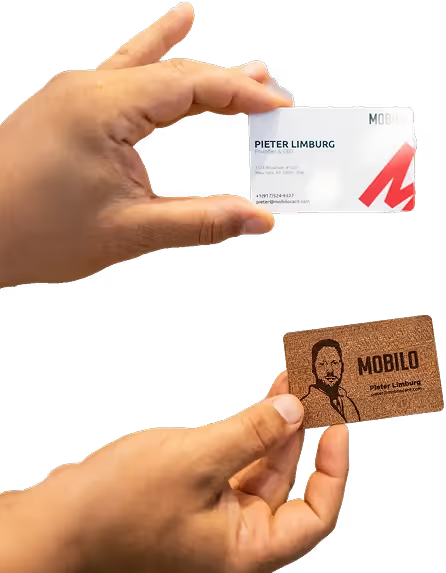
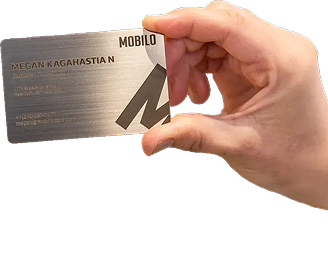
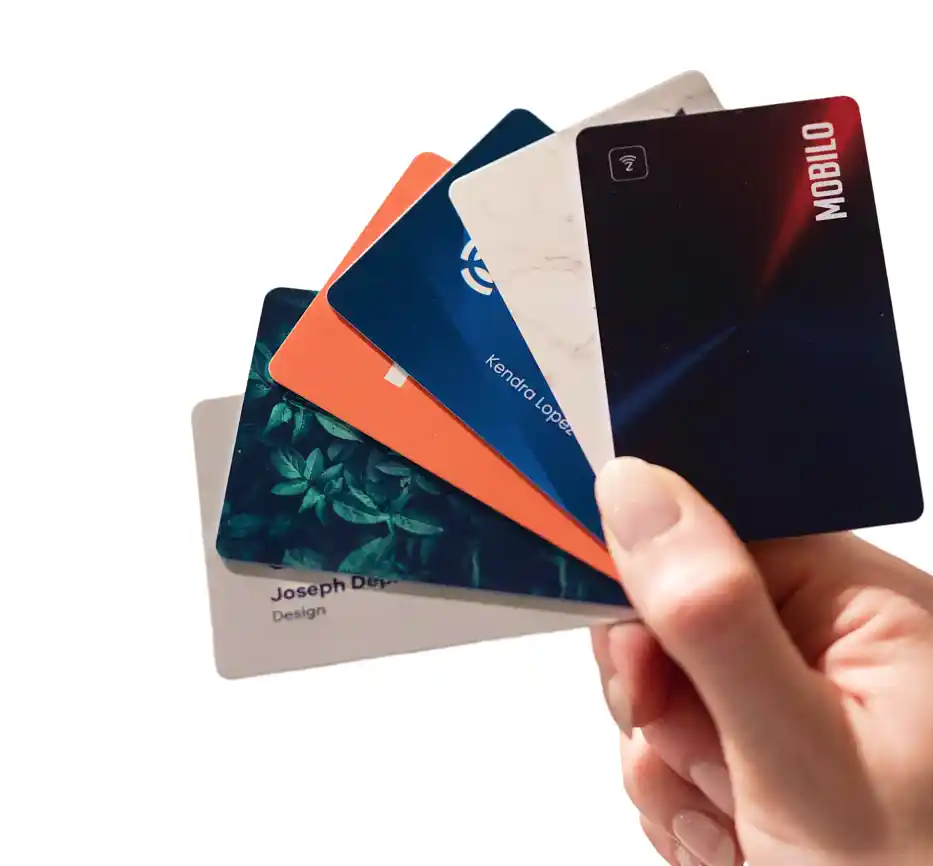
This is where most well-intentioned reps lose the ground they just earned. The richer the conversation, the harder it is to reconstruct in a spreadsheet two days later. Nuanced context, implied urgency, the exact phrase a prospect used to describe their pain, all of it evaporates before the post-event data entry session begins. A tap or scan from a Mobilo NFC card, available in Custom Design, Metal, Wood, or Paper Plus formats under the Teams tier, starting at $4/month billed annually, creates a timestamped record instantly through the built-in lead capture and management workflow. The depth of the conversation is preserved in the CRM before you have walked ten steps away.
For teams on the Teams plan, that workflow also includes full team data analytics, CRM integrations, and the ability for managers to control, lock, and override data fields across every card in the organization, so the context a rep captures in the field flows directly into the pipeline structure the team has already agreed on. The Teams tier also connects to 6,000 integrations through Zapier, which means the lead a rep captures with a single tap can trigger whatever follow-up sequence, CRM entry, or notification workflow the team has set up, without a single manual step standing between the handshake and the pipeline.
Most beneficial when your team attends events regularly and needs structured follow-up, this approach turns a genuine connection into an actionable lead without a single manual step standing between the handshake and the pipeline. The trade-off is worth naming: if your team rarely meets prospects in person, the operational lift of setting up CRM integrations outweighs the return. For field-facing sales teams, it is the thing that makes every other conversation habit actually stick.
Knowing how to hold a high-quality conversation is only half the equation. You also need the right words to open one, especially when the room is loud, the clock is short, and small talk feels like a dead end. The next section gives you a concrete set of conversation starters and open-ended question frameworks designed to surface real pain fast, whether you are a natural extrovert or someone who dreads the first thirty seconds of every introduction.
Conversation Starters and Open-Ended Questions That Open Real Doors
Researchers who study first impressions find that people form a judgment about a new contact within seconds, which means the opening question in any networking conversation is not a warm-up. It is the moment that decides whether the next ten minutes produce a pipeline-worthy contact or a polite exchange about the weather.
The common assumption is that icebreakers are social lubricant, something to ease awkwardness before the real conversation starts. The reality is sharper: a well-designed open-ended question functions as a discovery question. It surfaces ICP-relevant pain in the first sixty seconds, so the best networkers are already qualifying the contact before anyone reaches for a drink.
1. "What Brought You to This Event Tonight?" - The Universal Door-Opener
This question works at every event type because it is anchored to a shared, visible context rather than a generic opener like "So, what do you do?" The answer almost always reveals a business priority, handing you a discovery thread in the first thirty seconds. Low-pressure to ask, high-signal in return, it is the closest thing to a universal conversation starter that actually earns its keep.
2. "What's the Biggest Challenge You're Working Through Right Now?" - The Problem-First Starter
Asking about challenges rather than accomplishments builds trust faster because it positions you as a resource, not a pitch machine. The contact's answer either confirms an ICP match or rules them out cleanly, and both outcomes save time. The one trade-off: some contacts find this opener too direct in purely social settings, so read the room before deploying it cold. Pair it with a brief self-introduction first if the environment feels more casual than professional.
3. "How Did You Get Into This Industry?" - The Origin Story Question
Origin story questions unlock genuine conversation because they invite the other person to talk about something they know better than anyone else: themselves. The answer often surfaces the professional pain that shaped their career, which is discovery data dressed as small talk. This opener is particularly effective for introverts who, as Sogolytics research notes, excel at deep, focused exchanges and naturally follow an origin story with the kind of attentive follow-up question that makes a contact feel genuinely heard.
4. Arrive Early to Claim the Room Before the Crowd Does
Large networking events drain energy fast, and the crowd dynamic makes cold approaches harder as the room fills. Arriving early resets those odds. One-on-one conversations form naturally when attendance is still thin, and the contacts available early tend to be more senior, less distracted, and more willing to go deep before the noise builds. Sogolytics identifies this specifically as a strategy that helps introverts engage more comfortably before the environment becomes overwhelming. It is a structural advantage.
5. Pre-Prepare Three Questions Before You Walk In the Door
Blank-mind paralysis at the moment of introduction is a real and common experience. The fix is simple: prepare three context-specific questions before you arrive, tied to the event theme, the speaker agenda, or a known industry challenge your ICP is facing. Sogolytics research confirms that introverts are naturally deliberate communicators who prepare carefully before speaking, making pre-built question frameworks a structural fit rather than a workaround. Three questions is enough; more becomes a script.
Those three questions should be:
- One tied to the event theme or speaker agenda
- One tied to a known industry challenge your ICP is facing
- One that invites the contact to talk about their current priorities or role
6. Let Your Clear Purpose Make Cold Openers Feel Natural
Walking into a room without a defined goal makes every approach feel transactional, because it is. Knowing exactly which role types you want to meet, and what pain point you are listening for, transforms a cold opener into a purposeful question. That clarity shows. Contacts sense the difference between someone working the room and someone who is genuinely curious about their situation. Purpose does not eliminate awkwardness entirely, but it gives the first question a reason to exist beyond filling silence.
7. The Right Opening Question Sets Up a 70/30 Listening Ratio
After the opener lands, the goal is to speak roughly thirty percent of the time and listen for the rest. That ratio is a qualification mechanism. The more the contact talks, the more signal you collect about whether their pain maps to your ideal customer profile.
Introverts tend to be strong listeners who gravitate toward focused, meaningful exchanges over surface-level small talk, which makes this ratio feel natural rather than forced. The discipline is resisting the urge to pivot to your value proposition the moment a pain point surfaces. Ask one follow-up question first.
How to Optimize Your Digital Presence So Networking Pays Off Between Events
That search happens before the conversation has fully settled in their memory. Within 24 hours of meeting you at an event, a new contact will look up your name on LinkedIn, and what they find in those first ten seconds either confirms the impression you made in person or quietly erases it.
Recruiters and sales professionals rely on LinkedIn as the primary platform to search for and reconnect with people they met at conferences, so an incomplete or outdated profile creates a credibility gap that undermines even the strongest in-person conversation. That gap is a revenue-protection problem.
Your LinkedIn presence works best as a live asset between every event you attend. Here are five elements worth getting right.
1. Keep Your LinkedIn Profile Current, Polished, and Aligned With Your Professional Brand
Your LinkedIn profile is the first place a new contact lands within 24 hours of meeting you, and an outdated profile quietly kills the momentum of an otherwise strong in-person conversation. Professionals who list current accomplishments and industry affiliations are significantly more discoverable to peers searching for them after an event. Treat every conference you attend as a deadline for a profile review, not a reason to hand out more cards.
2. Lead With a Professional Photo, Keyword-Rich Headline, and Quantified Accomplishments
Three profile elements do the heaviest lifting when a new contact searches your name:
- A current headshot
- A headline that names the outcome you deliver
- Accomplishments expressed in numbers rather than duties
"Closed $2.4M in field-event pipeline in 12 months" lands differently than "responsible for revenue growth." Complete, accomplishment-rich profiles reduce the friction between an initial meeting and a follow-up connection request. This combination is worth the 30 minutes it takes to update.
3. Build a Consistent Digital Presence That Eliminates Friction When Contacts Search for You
Spreading effort across every platform produces mediocre presence everywhere and meaningful presence nowhere. For Sales Managers and BDRs, LinkedIn is the single platform worth owning completely: consistent photo, headline, and recent activity that match the professional identity you project in person. A contact who searches your name and finds a polished, coherent profile feels the conversation continuing. One who finds a half-finished page with a five-year-old role listed feels the rapport dissolve. Consistency is conversion.
4. Use a Digital Business Card Profile as an Always-Current Micro Landing Page
A polished LinkedIn profile only works if contacts reach it. The failure point is the handoff: a contact motivated to reconnect searches for you within hours of the event, but if your details went into a jacket pocket and never surfaced, that window closes permanently. A Mobilo digital business card acts as the live bridge between the in-person handshake and your digital credibility layer, routing contacts directly to your LinkedIn and capturing their details in the same motion, feeding leads from events and field meetings directly into the CRM without relying on reps to manually log contacts.
Most beneficial when you attend events regularly and need structured follow-up, it ensures your profile gets seen before motivation fades.
5. Align Your LinkedIn 'About' Section Narrative With the Story You Tell In Person
If your elevator pitch at the event focused on helping mid-market SaaS teams build field-event pipeline, but your About section reads like a general sales biography, the contact who searches for you afterward feels a disconnect. That mismatch creates doubt where you need confirmation. A pattern we consistently see among professionals building their networking presence between events is lacking a clear value proposition, which turns them into passive spectators in their own digital network rather than active contributors worth following up with.
Write your About section opening sentence to mirror the positioning you use in conversation: same ICP, same problem, same outcome. The rest of the section can carry the career context. The first sentence is the only one most visitors read, so make it earn the connection request.
How to Choose and Work In-Person Networking Events That Generate Real Pipeline
That confirmation, or the doubt that replaces it, follows you to the next event you choose to attend. Most reps select events the same way they write a generic About section: on instinct, with no mechanism to test whether the instinct is right. A BDR who attends three chamber mixer events per quarter but tracks zero CRM entries per event cannot tell the difference between a high-yield venue and an expensive social hour. That gap is a measurement problem, and it starts before you walk through the door.
One of the most common frustrations professionals we work with describe is spending a full day tabling at a Chamber of Commerce expo only to find the room was dominated by other service providers, not actual buyers. That is an event-selection failure, and it compounds every time teams cannot attribute pipeline to specific venues, causing budget to spread thin rather than concentrate on what converts. When every event looks equally worthwhile, every event gets an equal share of a budget that should be unevenly distributed toward the formats that actually generate pipeline.
The six criteria below treat in-person networking events as a data problem, not an instinct problem.
Contact-to-CRM Conversion Rate as the Post-Event Score
After each event, measure one number: how many contacts collected became CRM entries within 48 hours. That rate, tracked across events, is the only objective filter for next quarter's calendar. As noted, without a systematic process for logging event contacts into a CRM in near-real time, sales managers cannot determine which events generated pipeline-ready leads. Most teams accept the lag between meeting a prospect and logging them as unavoidable. Without real-time capture, the attribution chain breaks before it begins, and companies routinely defund the exact offline channel that was quietly generating pipeline.
Mobilo connects to integrations through Zapier, available on Pro, Teams, and Business plans, so a tap or scan at the event floor can trigger a CRM entry automatically, keeping the 48-hour window well within reach even for reps managing a full event day.
1. Match Your Event Type to Your Pipeline Goal Before You Register
Not every event format serves the same pipeline stage. Hosted-buyer summits and vertical trade shows generate net-new ICP contacts; peer roundtables and association dinners are better for advancing existing relationships toward a decision. Register for an event before mapping it to a specific pipeline goal, and you will almost certainly misread its ROI. The trade-off is real: niche formats with higher ICP concentration often carry higher per-seat costs, so they require a tighter contact-yield estimate to justify the spend.
2. Attend Events Outside Your Vertical to Surface Unexpected ICP Matches
One cross-vertical event per quarter consistently surfaces referral pathways that same-industry conferences cannot. A supply-chain contact who refers you into a manufacturing account often arrives warmer than any cold sequence into that same company. The limitation matters here: cross-vertical relationships carry longer nurture cycles, so this tactic only pays off when your existing pipeline is healthy enough to absorb the wait. Treat it as a referral channel, not a primary lead source.
3. Solve the ROI-Measurement Problem Before the Event, Not After
Define your measurement criteria before you register: contacts captured, CRM-entry rate within 48 hours, and pipeline value attributed per venue. Without those baselines set in advance, every event looks equally productive, and budget gets spread thin rather than concentrated on the formats that actually convert. Marketing's contribution to pipeline only becomes visible when every offline touchpoint carries a source tag, and that tag can only exist if capture happens at the moment of exchange, not in a hotel room three days later.
4. Treat Running Out of Business Cards as a Systems Failure, Not a Rep Failure
Running short of cards mid-event signals that the contact-capture process depends on physical inventory rather than a repeatable system. Generating new leads at in-person events is already significantly harder than re-engaging past attendees. Cold outreach to net-new prospects rarely converts as efficiently. Adding an inventory constraint on top of that friction means every conversation that ends without a captured record never enters the follow-up sequence at all.
Mobilo's NFC digital business card is most beneficial for professionals who attend frequent in-person networking events or hold client-facing roles, precisely because it removes the inventory variable entirely. A Team Custom Design Card (originally $39.00, available at $29.50 + $4/month on the Teams plan) or a Team Metal Custom Design Card (originally $139.00, available at $69.50 + $4/month) gives a rep unlimited taps and scans with no reorder cycle. The Pro tier offers the same unlimited taps and scans starting at a Mobilo Branded Card (originally $19.99) with the first 90 days of the Pro plan free, a low-friction entry point for individual reps testing the format before rolling it out to a team.
5. Use Pre-Event Attendee Lists to Prioritize Conversations That Move Pipeline
When an event publishes an attendee list or app, identify three to five high-priority targets before you arrive. Time-box conversations to ten minutes and move deliberately between those anchors. This is about protecting the finite rep time that makes in-person networking worth the travel budget. Without pre-prioritization, the floor plan controls you rather than the other way around.
6. Build a 48-Hour Post-Event Follow-Up Protocol That Converts Contacts to CRM Entries
The structural reason most follow-up fails is that manual data entry delays CRM entry long enough for context and urgency to evaporate. A 48-hour protocol only works if the contacts are already logged with event-source tags at the moment of exchange. Mobilo's lead capture and management, available across all plan tiers, including the Teams plan at $4/month billed annually, automates that capture step so follow-up sequencing starts with a clean, attributed record rather than a stack of paper that may never get entered at all. Teams on the Business plan ($5/month billed annually) also get lead enrichment, custom lead capture forms, and a paper business card scanner, closing the attribution loop even for contacts who hand over a traditional card rather than tapping back.
Choosing the right events and working them with discipline gets you to the room. But none of these tactics produce measurable pipeline unless the contact-to-CRM handoff is airtight. The next section examines exactly why that handoff is where most networking investment quietly disappears, and what closing it actually looks like in practice.
Related Reading
- How To Scale Business Networking Online
- Business Networking Automation
- Business Networking Skills
- Virtual Speed Networking
- How To Build A Referral Network
- Business Networking Tips
- Business Networking Plan
- Strategic Networking For Business Growth
- Where To Network For Business
How Closing the Contact-to-CRM Gap Makes Every Other Networking Tip Actually Stick
The real failure point in most networking workflows is the contact that never made it into the CRM at all. Every tip in a networking playbook, from personalized outreach to pipeline tracking, assumes a clean record already exists. When that record is missing, no amount of follow-up hustle recovers it.
Lead Leakage Starts at the Moment of Exchange
The 80% trade-show follow-up failure rate is a structural problem. When contact details live on a physical card or in a rep's memory, they require a separate, delayed data-entry step to reach the CRM. That friction compounds at every handoff: the card goes into a jacket pocket, the jacket goes into a closet, Monday's batch upload never happens. Industry analysis identifies this manual transcription bottleneck as the primary source of lead leakage after networking events, noting that delay, errors, and incomplete records are structural consequences of the handoff gap, not individual rep failures.
The timing matters more than most sales managers assume. Conversion rates drop sharply after 24 to 48 hours of delay. Once a contact misses that window because their information sat in a stack of cards waiting to be entered, no follow-up velocity can recover the opportunity. The failure was locked in at the moment of exchange, not the morning after.
How Real-Time CRM Sync Turns a Single Tap Into an Automatically Logged Lead
NFC and QR-based digital business card tools capture contact data at the exact moment of exchange and route it directly into the CRM in real time, collapsing the entire manual handoff chain. According to industry analysis, platforms using NFC tap or QR scan technology eliminate the manual entry step entirely, so a contact flows into the pipeline before the rep leaves the room.
What disappears from the workflow is significant: no card photography, no spreadsheet rows, no Monday batch upload, no chasing reps to log their contacts. The follow-up sequence that every other networking tip depends on starts automatically at the moment of the handshake. This benefit is most pronounced for teams that attend events regularly and need structured, repeatable lead follow-up rather than heroic individual effort. One honest caveat: if your team rarely meets prospects in person, the real-time capture advantage is minimal and the setup investment may not justify itself.
How Landsea Homes Saved $21,000 by Eliminating Post-Event Data Entry
Manual data entry is slow and expensive. Sales reps across industries spend several hours per week on CRM data entry that generates no revenue and introduces errors that automated capture avoids entirely. At scale, that unbillable time adds up fast.
Landsea Homes quantified it precisely: deploying automated contact capture across 400 employees saved the company $21,000 annually by removing post-event data entry from their workflow entirely. Contacts entered the CRM the moment a card was tapped, not days later when context had faded and motivation had dropped. That is the financial shape of a fixable operational gap, not an unavoidable cost of doing business.
Once every contact flows into your CRM the moment you meet them, the follow-up problem changes shape. The work becomes what you say to those contacts and when you say it. That is where the next section picks up: turning a clean, automatically captured CRM entry into a personalized follow-up sequence that actually converts.
Best Practices for Post-Event Follow-Up That Actually Converts New Contacts
Reply rates drop sharply after the 24-hour window closes. According to industry research, waiting longer than 48 hours causes the interaction to fade in both parties' minds, dramatically reducing the chance of a response. The three moves that convert a new contact into active pipeline are timing, personalization, and a clear next step. None of them are complicated. All three fall apart when the contact's details are still sitting in a camera roll the morning after the event.
A common pattern: reps spend the first hour of the next workday transcribing cards into a spreadsheet, then doing a bulk CRM upload, then drafting a generic "great to meet you" email that goes out to people who may not even remember the conversation, or, worse, to people who never actually attended the event at all. That last error is more common than most teams admit, and it makes the sender and their organization look sloppy and untrustworthy at the exact moment a first impression is being formed. By that point, the follow-up window has already closed. The problem is the gap between meeting someone and having their information somewhere actionable before the follow-up sequence needs to start.
Badge scans compound the problem differently: they yield low-quality contact data. Prospects often use junk email addresses and blank or generic phone numbers, which makes post-event outreach nearly impossible regardless of how well-timed or personalized the message is. The record in the CRM looks complete, but the underlying data is dead on arrival. A contact exchanged through a Mobilo card works differently.
When a prospect taps or scans a rep's card, they enter their own details, the information they actually want to share, which means the record that lands in the CRM reflects a real, willing exchange rather than a badge-scan guess. Mobilo's contact exchange and lead capture is most beneficial when a team attends events regularly and needs structured lead follow-up, and that is precisely where the data-quality gap between badge scans and active exchanges does the most damage over time.
Most teams handle the lag by accepting it as normal. The hidden cost is real: contacts entered late are entered incompletely, and incomplete records produce generic outreach. Mobilo closes that gap by routing contact details directly into the CRM at the moment of the tap or scan, across unlimited team members on the Teams plan ($4/month, billed annually) or the Business plan ($5/month, billed annually), so the follow-up sequence can begin the same evening rather than after an hour of data entry that quietly kills the timing advantage the 24-hour window was supposed to provide.
Both plans include lead enrichment, lead capture and management, unlimited leads and contacts, and thousands of integrations through Zapier, which means the captured record can move automatically into whatever CRM or outreach tool the team already uses. That said, automated capture is most valuable when a team attends events regularly; for a rep who networks once a quarter, the manual lag is painful but survivable.
Once the contact is in the system, execution comes down to three practices.
Make the Next Step Easy to Accept
By day seven, ask for a specific, low-commitment meeting. TeeHC Open recommends framing it as a virtual coffee or a brief call rather than a vague "let's connect." A specific ask with a suggested time slot removes the friction of scheduling ambiguity and gives the contact a clear, easy way to say yes. Vague next steps produce vague responses. For reps who meet dozens of contacts at a single event, this cadence only scales when the CRM already holds clean records; without that foundation, crafting a specific ask for each contact becomes the bottleneck, not the message itself.
1. Follow Up Within 24-48 Hours While the Conversation Is Still Fresh
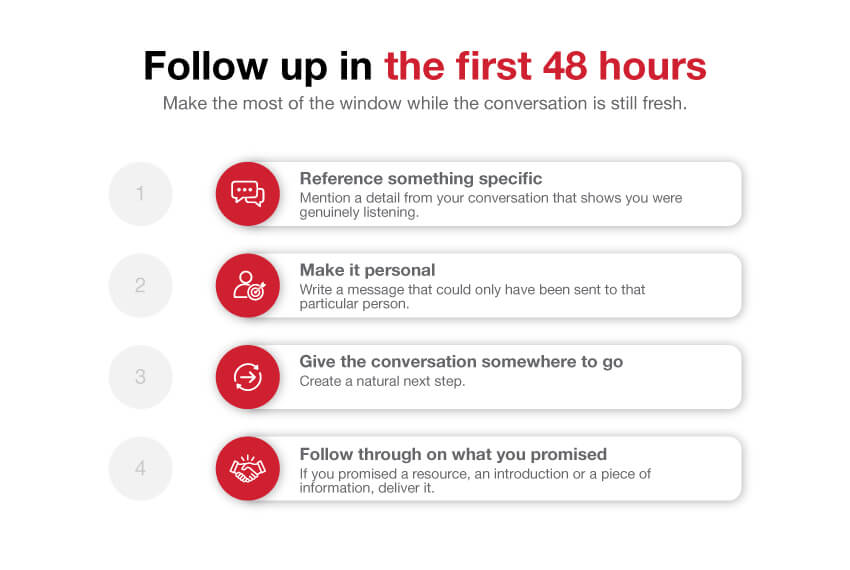
Follow up within 24-48 hours of meeting someone new; after that window closes, response rates drop sharply because the shared memory of the conversation fades for both parties. TeeHC Open frames this plainly: the countdown starts the moment you leave the venue, and prompt outreach while the interaction is still fresh is what separates a contact from a cold lead. Timing is the structural condition that makes every other follow-up move worth attempting.
2. Reference a Specific Conversation Detail to Make Every Follow-Up Feel One-to-One
Personalized follow-up converts at a measurably higher rate than templated outreach, and the mechanism is simple: one concrete reference signals that you were listening, not just collecting. TeeHC Open is direct on this point: mention a topic the contact raised or a specific detail from your exchange to demonstrate genuine attention. A single line like "You mentioned rebuilding your outbound motion before Q4" does more than a polished paragraph of generic warmth.
The limitation worth naming: this only works when the contact record includes a note from the conversation, which is why capturing context at the moment of exchange matters as much as capturing the contact itself. Mobilo's custom lead capture forms, included on both the Teams and Business plans, let reps log conversation notes and qualifying details at the tap, so the personalization data is already in the record before the rep leaves the venue floor.
3. Propose a Low-Pressure Next Step Like a Virtual Coffee to Remove Relationship Friction
A specific, easy-to-accept ask converts far better than a vague "let's stay in touch." TeeHC Open recommends framing the next step as a virtual coffee or a brief call rather than an open-ended meeting request, because low-commitment framing removes the friction of scheduling ambiguity and gives the contact a clear path to yes. Pair the ask with a suggested time slot and the barrier drops further. For teams that work events regularly, Mobilo's insights and analytics, available on both Teams and Business plans, surface which contacts have engaged with the card since the exchange, giving reps a signal-based reason to prioritize one follow-up over another rather than working the list in arbitrary order.
Converting a new contact into a reply is the first win. A single well-timed message, however personalized, does not build a relationship on its own. The next section covers how to keep those connections alive and compounding long after the initial exchange, turning a growing CRM into a network that actively works for you between events.
How to Maintain and Nurture Your Network So Relationships Survive Past the First Meeting
Fewer than 1 in 10 new contacts ever makes it into an active nurture workflow, which means the network most Sales Managers believe they're building is mostly a graveyard of good intentions. The real problem is infrastructure, and for many salespeople, it's compounded by a fear of reaching out only when they need something, which makes sustaining relationships feel hollow before the system even breaks down.
1. Send Value-First Check-Ins Every 30-60 Days to Keep Relationships Warm Without Spamming
A forwarded case study, a congratulations note on a new role, or a one-line observation about a shared industry shift lands far better than a generic "touching base" message. Engagify's post-event nurture guidance frames periodic, value-adding outreach as the mechanism that sustains relationship equity between direct conversations. The honest constraint: this only feels genuine when the CRM record includes enough original conversation context to make the reference specific. Generic check-ins at any cadence read as automated noise, and recipients know it on the first one.
2. Join Local Business Groups and Active Online Communities to Stay Visible With ICP Contacts

Visibility between direct touchpoints matters as much as the touchpoints themselves. Showing up consistently in the forums, LinkedIn groups, or chamber events where your ICP contacts are active keeps you top-of-mind without requiring a one-on-one outreach every cycle. Engagify frames regular community participation as an ongoing nurture layer, not a one-time tactic. The trade-off is time: this approach rewards consistency over months, not weeks, and produces no immediate pipeline signal.
3. Use CRM-Automated Touchpoint Scheduling to Replace Memory-Dependent Follow-Up

A BDR managing a high contact volume cannot maintain a network on calendar reminders and goodwill alone. The cognitive ceiling for memory-dependent relationship management sits well below the contact volumes most active sales teams carry. Automated touchpoint scheduling, triggered the moment a contact enters the CRM with a timestamp and source tag, converts nurture from a good intention into a repeatable workflow.
The Business plan ($5/month, billed annually) adds enterprise SSO, HR directory sync, and a custom domain for teams that need tighter identity management alongside the automation layer. Both plans include 24/7 customer support. Because contact records are created immediately after setup, recipients see the profile on the first tap, and the CRM timestamp is accurate from day one, not backfilled from a stack of paper cards scanned days later.
4. Treat the 90-Day Network Decay Threshold as a Hard System Rule, Not a Guideline

B2B contact records decay at 70.3% per year, which means a contact left untouched for a quarter is already likely stale in both data quality and relational warmth. Build a CRM workflow that flags any contact with zero activity inside 90 days and queues a re-engagement task automatically. A hard rule here is what separates a compounding network from a list that quietly rots. Not worth configuring if your team meets fewer than a handful of new contacts per month.
5. Segment Your Network Into Tiers and Assign Different Nurture Frequencies to Each
One-size-fits-all follow-up schedules waste effort on cold contacts and under-serve warm ones. Splitting connections into active pipeline, warm relationship, and long-term keep tiers, then assigning a 30-, 60-, and 90-day cadence respectively, concentrates outreach where it compounds fastest. Engagify's framework confirms that defined-interval scheduling consistently outperforms impulse-driven contact. The limitation worth naming: tiering only holds up when CRM records are clean enough to classify accurately, which circles back to capturing context at the moment of exchange, the one problem a Mobilo card solves at the source, before the conversation ends.
Related Reading
- Business Networking Trends
- Business Networking Opportunities
- Networking Ideas For Small Business
- Business Networking Event Ideas
- Business Networking Conversation Starters
- Business Networking Questions
- Networking Ideas For Virtual Events
- Virtual Networking Ideas For Large Groups
Next steps
If your best conversations keep disappearing before they reach your CRM, the path forward starts with eliminating the capture gap at the moment of exchange, not after it. Start with our digital business card.
The 80% trade-show follow-up failure rate is a structural consequence of the capture moment itself: because paper cards require a separate, delayed data-entry step, friction compounds at every handoff until most contacts never reach the pipeline at all. Every hour between meeting a contact and logging them also corrupts the relational context that makes follow-up worth sending, so a delayed CRM entry does not just arrive late, it arrives shallow and stripped of the qualifying signals that would have made the outreach feel human. Together, these two realities point to one action: automate contact capture at the handshake, so a clean, context-rich record exists in your CRM before the conversation ends.
Start with a digital business card from Mobilo. When a prospect taps or scans, their details sync directly into your CRM through 6,000 Zapier integrations, and the follow-up sequence starts before you leave the room.
Frequently Asked Questions
What does business networking actually mean for a sales team?
For a team measured on pipeline, business networking is a contact-capture operation, every conversation is only as valuable as the CRM record it produces. Without that record, the conversation never happened as far as the pipeline is concerned.
How do I introduce myself confidently at a networking event?
Lead with a jargon-free 30-second elevator pitch that names who you are, what problem you solve, and who you solve it for in plain language, for example, "I help mid-market sales teams stop losing leads after trade shows." Contacts who remember you are the ones who understood you immediately, and having a concrete goal for the event anchors your confidence so the introduction feels natural rather than rehearsed.
Is it better to meet as many people as possible or focus on a few conversations?
Focus on fewer, deeper conversations. A BDR who spends 25 minutes with one VP of Sales, uncovers a real business pain, and books a discovery call has outperformed every rep who cycled through 15 two-minute handshakes. The post cites guidance that effective networking means building a few meaningful connections rather than collecting as many contacts as possible.
What steps should I take before a networking event to actually build pipeline?
Pull the attendee list and flag three to five ICP-fit targets by name, write a personalised conversation opener for each, draft a jargon-free 30-second elevator pitch, set a concrete goal (such as three VP-level conversations each ending with a next step), and configure a digital contact-capture workflow so every contact goes directly into your CRM at the moment of handshake, the post includes an eight-step pre-event readiness checklist covering all of these.
Why do so many contacts from events never make it into the CRM?
Manual data entry creates too much friction after a long event day, Mobilo's own data from surveying 4,000 sales reps shows that 90% of new contacts never enter a CRM. Contacts captured on a notepad or photographed business card rarely survive the commute home, which is why the post recommends configuring an automated tap-to-share contact capture workflow before the event so records are created at the moment of handshake.