

9 Business Networking Trends Sales Leaders Can't Ignore in 2026
On This Page
Networking is moving to smaller rooms, faster follow-ups and AI-made introductions. Each shift makes one weak spot more expensive: the gap between the handshake and the CRM.
Business networking has not slowed down. The way it works has changed shape. Rooms are smaller, invitations are more selective, introductions start before anyone arrives, and the expectation for a follow-up message has shrunk from a polite week to a single business day. For a sales leader, that shift creates a new kind of exposure: the conversations your team has at events are worth more than ever, and the cost of losing one is higher too.
Most of the advice written about networking trends stops at the individual. Be more authentic. Ask better questions. Join a community. That advice is fine, but it skips the part a VP of Sales actually owns, which is what happens to a conversation after it ends. A rep can have a strong, unscripted, value-first chat with the right buyer and still produce nothing if the contact sits in a jacket pocket until Friday.
That gap is the thread running through every trend in this guide. Each one changes how professionals meet, and each one raises the price of a slow or manual handoff into your sales system. When a contact moves from a tap on a digital business card into the CRM while the conversation is still warm, the trends below work in your favor. When it depends on someone typing in a stack of cards after a three-day conference, the same trends quietly work against you.
This guide is written for sales directors, revenue leaders and business development managers who send people to events and need those events to show up in pipeline. It covers the professional networking shifts that matter this year, the objections leaders raise when they try to act on them, and a practical plan for turning the trends into a repeatable team habit. Everything here is about people meeting people and turning those conversations into pipeline.
Key takeaways
- Nine professional networking shifts define 2026, and every one of them raises the cost of a slow or manual contact handoff.
- Most contacts never reach the CRM: Mobilo's survey of 4,000 reps found 90% of new contacts are never logged.
- Events are shrinking, with 92% now under 100 participants, so each lost contact matters more.
- Networking is now the main reason people attend events, and AI matchmaking means introductions start before anyone arrives.
- Follow-up norms have tightened to one business day, and response speed strongly predicts whether a lead qualifies.
- Event ROI is a data problem: tag every contact with rep, event and date at capture, and the report builds itself.
- Mobilo's Contact Exchange and Lead Capture sends a contact into your CRM the moment someone taps or scans a card, closing the gap these trends expose.
The Handoff Gap That Turns Good Networking Into Lost Pipeline
The biggest risk in business networking this year is a quiet one: your team meets the right people and the relationship never reaches a system anyone can act on. Event budgets, travel and rep time are all spent up front. The return depends entirely on what happens in the hours after a conversation ends.
The Leak Between the Handshake and the CRM
Mobilo's own survey of 4,000 sales reps found that 90% of new contacts do not enter the CRM because logging them takes too much effort. That number describes a process problem. Reps are not careless. They come back from an event to a full inbox, a quota and a pile of follow-ups, and manual data entry loses that contest almost every time. The time pressure is real. Salesforce research found that reps spend 70% of their time on non-selling tasks. Asking them to transcribe business cards after a trade show adds one more admin job to a week that already has too many. One sales director described it this way: "My reps come back from events with a stack of business cards and half of them never make it into Salesforce. I have no idea what happened to those conversations."
Why the Leak Costs More This Year
Three conditions make the same leak more expensive now than it was a few years ago.
- Buyers do more on their own. Gartner found that 61% of B2B buyers prefer a rep-free buying experience.
- A buyer who chose to talk to your rep in person has given you a rare opening.
- Losing that contact means losing one of the few human touchpoints in the deal.
- In-person time is scarce and valuable. Event organizers call in-person conferences their most impactful marketing channel, with 78% ranking them first. Your competitors are in the same rooms, chasing the same people.
- Speed decides who gets the meeting. Harvard Business Review's study of lead response found that firms contacting a prospect within an hour were nearly seven times as likely to qualify the lead as firms that waited one more hour, and far more likely than firms that waited a day.
- An event contact behaves the same way.
- Interest fades fast.
The Visibility Problem Leaders Inherit
There is a second cost that lands on the leader directly. When contacts never reach the CRM, nobody can tell which reps are networking well, which events produced pipeline and which ones were expensive coffee. Planning next year's event budget turns into guesswork, and the QBR conversation about field activity rests on anecdotes. Stale contact details make it worse. A rep changes territory, a title changes after a promotion, the company rebrands, and hundreds of cards with the old details keep circulating. Every outdated card is a small brand problem and a broken path back to your team. The trends below are where networking is heading. Read each one with a simple question in mind: does this trend make our handoff problem bigger or smaller?
9 Business Networking Trends Shaping 2026
Nine shifts define how professionals meet, connect and follow up this year. Each item below explains the trend, the data behind it and what it means for a sales team that needs networking to produce pipeline.
1. Smaller, Curated Rooms - Fewer People, Better Conversations
The large mixer is losing ground to small, deliberate gatherings. Lyyti's analysis of more than 90,000 events found that 92% of events now have fewer than 100 participants. Executive dinners, role-based roundtables and invite-only breakfasts are taking budget that once went to booth space alone.
For a sales team, a smaller room changes the math. You meet fewer people, and each person matters more. A curated dinner with twelve target accounts can be worth more than a day on a crowded show floor, but only if every one of those twelve conversations is captured and followed up. Losing one contact out of three hundred is noise. Losing one out of twelve is a missed account.
What to do: treat curated events as account plays. Assign an owner for each guest, agree on the follow-up before the event starts and log every exchange the same evening.
2. Networking Becomes the Main Reason People Attend
Sessions and keynotes are no longer the main draw. Freeman's research found that 58% of attendees were motivated by networking in 2024, up from 39% in 2021, and that 51% say effective networking is reason enough to return to an event. Speaker content is easy to find online. A useful conversation with a peer is not.
Organizers are struggling to keep up. Only 15% of event organizers rate their networking experiences as very effective, while 60% call them somewhat effective. That gap is an opening for prepared teams. If the event does not engineer good conversations, the reps who arrive with a target list, a clear reason to talk and an easy way to swap details will get the most out of the room.
What to do: build a pre-event target list for every rep, with names, roles and a one-line reason each person should care.
3. AI Matchmaking and Pre-Event Introductions
Networking now starts before the badge pickup. Event apps suggest who to meet based on role, industry and stated goals, and attendees book short meetings in advance. Freeman found that nearly 50% of younger professionals want pre-event curated connection recommendations, and organizers are responding. Bizzabo reports that 95% of event professionals expect their use of AI in events to increase.
Matchmaking only works with good profile data. Attendees who fill in a vague profile get vague matches. For sales teams, that means two jobs before every event: complete each rep's attendee profile with a clear description of who they help, and use the event platform to request meetings with target accounts early, before calendars fill.
AI also changes what happens after the match. A pre-booked meeting arrives with context: the person's role, company and why they accepted. That context is valuable in a follow-up, so make sure it travels with the contact into your CRM instead of staying inside the event app after the show closes.
What to do: make profile completion and meeting requests a standard part of event prep, owned by the rep and checked by the manager.
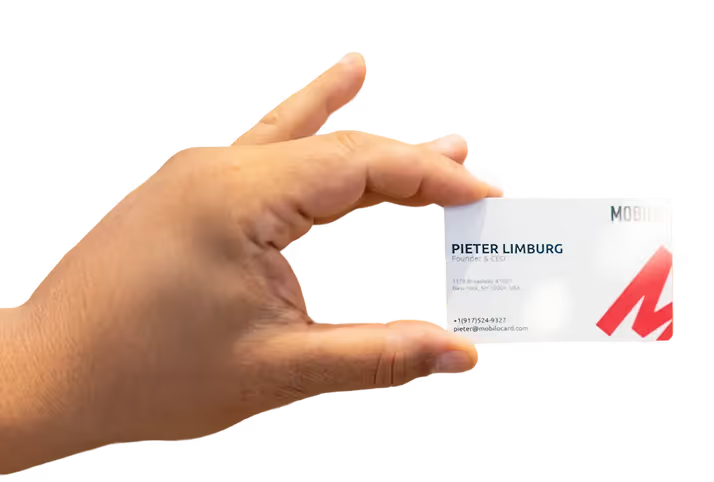
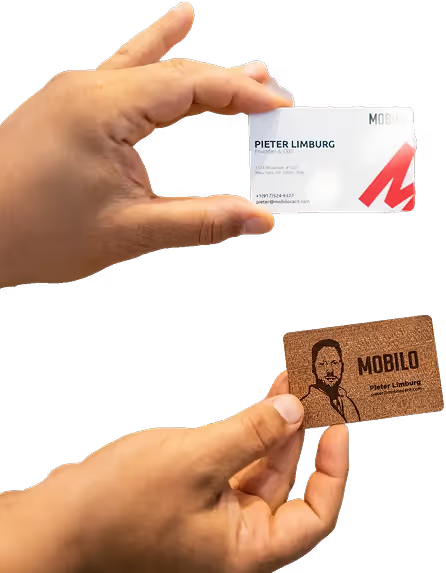
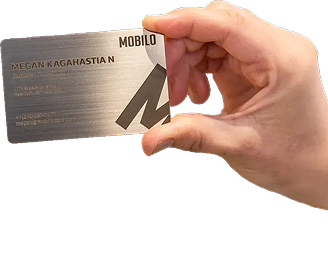
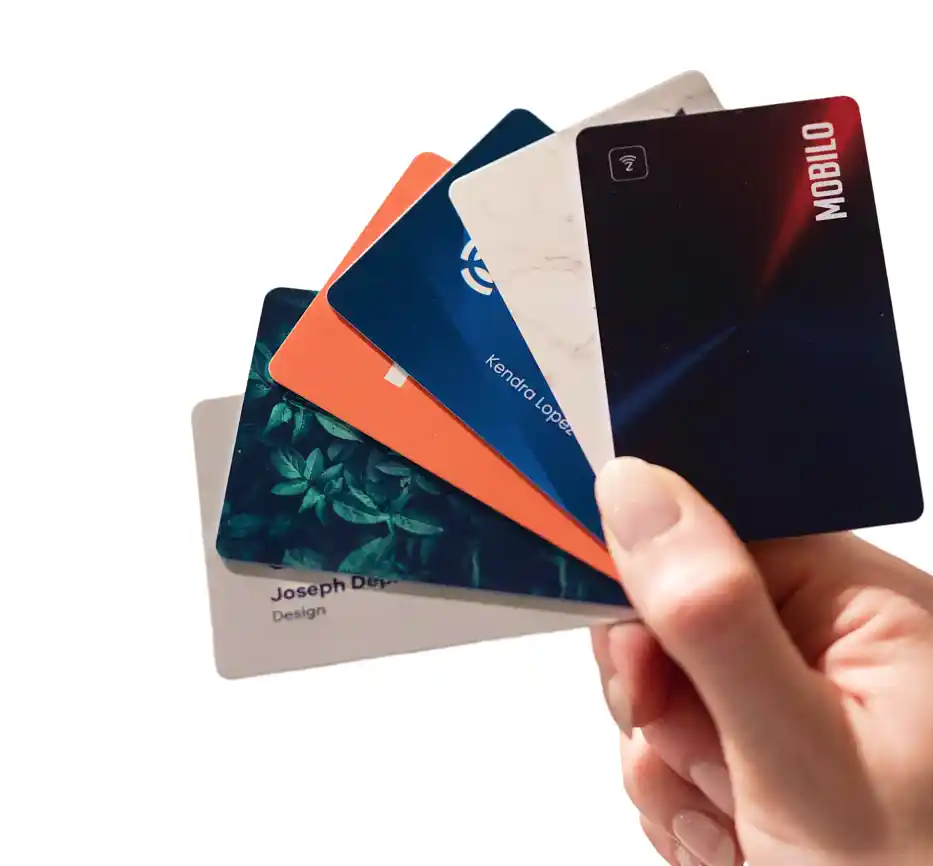
4. Digital Business Cards Replace the Card Swap
The exchange itself is going digital. QR codes and NFC taps let someone save your details in seconds, with no app required on their side, and the contact lands in their phone instead of a pocket. The category is growing steadily: IMARC Group sized the digital business card market at USD 178.5 million in 2024 with an expected 8.81% annual growth rate through 2033.
For a sales organization, the real shift is two-way. The best digital cards do more than share a profile. They capture the other person's details at the same moment and send them into your contact list or CRM. That turns the most fragile step in networking, the moment after the handshake, into a recorded event with a timestamp, a rep and a source.
There is a cost argument too. Mobilo's research puts average spend at $194 per employee per year on business cards, and every title change or rebrand means reprints. A digital profile updates once and stays current everywhere it has been shared.
What to do: standardize how your team shares and captures contacts, so every exchange creates a CRM record instead of a card in a drawer.
5. Follow-Up Is Measured in Hours, Not Days
The polite week-later email is gone. Professionals now expect a personalized follow-up within a day of meeting, and the research on response speed supports them. Harvard Business Review found that firms reaching out within an hour were more than 60 times as likely to qualify a lead as firms that waited 24 hours or longer. That study looked at inbound leads, but the logic carries over to the event floor: interest is highest right after the conversation and drops quickly.
A fast follow-up is only possible when the contact exists somewhere a rep can act on it. If the details are on a card in a hotel room, the clock runs out before the rep is back at a desk. If the contact is already in the CRM with a note about the conversation, a short, specific message can go out that evening.
What to do: set a team norm of a personal follow-up within one business day, and make it measurable by tracking the time between capture and first touch.
6. Hybrid Gets Selective as In-Person Leads
The early prediction that every event would become hybrid did not hold. Bizzabo's platform data shows 63% of events are in-person and only 4% are hybrid, and 54% of attendees plan to attend more in-person events than last year. The B2B exhibition industry is still recovering, with the CEIR Total Index forecast to grow 2.1% in 2026.
Virtual still has a role. It works well for pre-event meetups, regional follow-on sessions and community calls. The pattern for most teams is in-person for relationship building and virtual for keeping those relationships moving between events.
What to do: plan your event calendar around a few high-value in-person moments, then use short virtual touchpoints to keep momentum between them. Make sure contacts from both channels flow into the same system so nothing splits across tools.
7. Peer Communities Shape Buying Before Sales Calls
Buyers trust each other more than they trust vendors. A SurveyMonkey and Reddit study of 1,202 US decision-makers found that 73% trust their peers more than vendor websites, which only 55% trust, and 83% research on their own before speaking to sales. Peer groups, Slack communities, chapter-based referral groups like BNI and online forums are where many buying opinions now form.
Community-led networking rewards consistency over volume. The people who show up every month, answer questions and make introductions earn trust that a single booth visit cannot buy. LinkedIn is the most visible example of this shift, with at least 1.20 billion registered members, and it is where most professionals look someone up right after meeting them.
What to do: encourage reps to commit to one or two communities where their buyers spend time, and make sure their profiles, cards and LinkedIn pages tell the same story when a new contact checks them out.
8. AI-Assisted Follow-Up With a Human Voice
AI has moved into everyday sales work. HubSpot's 2025 State of Sales research found that only 8% of sales reps report using no AI at all. Reps use it to summarize conversations, draft follow-ups, enrich contact records and suggest next steps.
The risk is sameness. When every rep sends a polished AI-written email, inboxes fill with messages that sound identical. Gartner's buyer research shows buyers actively avoid suppliers who send irrelevant outreach, and the same HubSpot study found that 40% of sales pros name trust and rapport as their most effective upsell strategy. The winning follow-up uses AI for speed and structure, and the rep adds one detail only they could know: the joke about the keynote, the problem the buyer mentioned, the introduction they promised.
What to do: give reps AI tools for drafting and enrichment, but coach them to reference one specific moment from the conversation in every follow-up.
9. Event ROI Becomes a Networking Metric
Leaders are getting better at proving that events pay off. Bizzabo found that 40% of organizers report difficulty proving event ROI in 2026, down from 70% in 2025. The organizations that improved did it with data: who attended, who met whom and what happened next.
For sales teams, event ROI starts with the contact record. If every exchange is tagged with the rep, the event and the date, you can answer the questions finance will ask: how many qualified contacts did this event produce, how many became meetings and how much pipeline traces back to it. Without that tagging, ROI is an estimate built on memory.
Rep-level data also changes coaching. A manager who can see which reps captured the most contacts, and which followed up fastest, can coach to specific behaviors instead of vague advice to "network more."
What to do: define your event scorecard before the event, including contacts captured, follow-ups sent within a day, meetings booked and pipeline created, and review it within two weeks of every show.
Related Reading
- Business To Business Networking
- Business Relationship Building
- How To Build A Network For A Small Business
- How To Start A Business Networking Group
- How To Build A Strong Sales Pipeline
- How To Reach B2b Decision Makers
- How To Ask For Referrals In Sales
- Expand Your Network
- Business Networking Goals
- Business Cards For Networking
The Objections Sales Leaders Raise, and What the Evidence Says
Most sales leaders agree with the trends above. The hard part is acting on them inside a real team with real budgets. These are the objections that come up most often when leaders try to modernize how their team networks, and what the evidence says about each one.
"My reps won't change how they swap contacts"
This objection is fair. Reps who have carried business cards for a decade are not looking for a new habit, and a tool nobody uses is wasted budget. Adoption improves when the new habit saves the rep work instead of adding it. A tap or scan that also logs the contact removes the evening data-entry chore, which is the part reps dislike most. Starting with one flagship event, where the team can see contacts land in the CRM in real time, usually does more for adoption than any training deck. Peer proof helps too: once a top performer shows the team their follow-up numbers, the rest tend to follow.
"Business cards are basically free, so why pay per seat?"
Business cards feel free because their cost is spread across print orders, reprints and lost contacts that never appear on any report. The per-employee spend covered in trend 4 is only the visible part, before counting reprints after title changes or rebrands. Real deployments show the savings at scale. Landsea Homes onboarded 400 employees and saved $21K per year while improving its sales process, and The Falcon Group saved $6K per year. The larger return, though, sits in pipeline: a contact that reaches the CRM the same day has a real chance to become a meeting.
"I can't prove networking ROI to finance"
This is the objection that the trends themselves are answering. Organizers who once struggled to prove ROI are getting better at it because they collect data at every step, and sales teams can do the same. The requirement is simple: every contact needs a source, a rep and a date at the moment it is captured. With that in place, the event report writes itself. Contacts captured, follow-up speed, meetings booked and pipeline created become numbers you can bring to a QBR instead of stories.
"Our buyers are senior and won't tap a phone"
Some buyers prefer a physical card, and that is fine. Digital cards come in physical formats, and a QR code works on any modern smartphone camera with no app. The rep can still hand something over. The difference is what happens next: the exchange is recorded, and the rep's details stay current on the buyer's phone.
"IT and security will slow the rollout"
Security reviews are a normal part of buying any tool that stores customer data. Choose a vendor that integrates with the CRM you already use, supports central admin control and lets you remove access the day someone leaves. Bringing RevOps and IT in early, ideally a quarter before a flagship event, keeps the review from colliding with the event date.
A 90-Day Plan to Put These Trends to Work on Your Team
Trends are only useful if they change what your team does at the next event. This plan turns the shifts above into a 90-day rollout a sales leader can run without a large project team.
Days 1 to 30 - Set the Standard
Start by deciding how your team will share and capture contacts, and write it down. One method for everyone makes reporting possible. Define the fields every contact record must carry: name, company, role, the rep who met them, the event and a short note on the conversation. At the same time, agree on the follow-up norm. A personal message within one business day is a sensible default for most B2B teams. Write two or three example follow-ups that show the standard: short, specific and tied to something said in the conversation.
Days 31 to 60 - Pilot at One Event
Pick one event where the team will be together, ideally a show or a curated dinner series with clear target accounts. Prepare each rep with a target list, a complete attendee profile in the event app and pre-booked meetings where possible. During the event, the manager watches the contact flow in real time. If one rep's numbers are low by lunchtime on day one, the manager can coach while the event is still running.
Days 61 to 90 - Measure and Expand
Two weeks after the pilot, review the scorecard.
- Contacts Captured per Rep → What It Tells You: Who is actively networking → Where It Comes From: CRM records tagged by rep and event.
- Time from Capture to First Follow-Up → What It Tells You: Whether the one-day norm is holding → Where It Comes From: CRM activity timestamps.
- Meetings Booked from Event Contacts → What It Tells You: Conversation quality → Where It Comes From: Calendar and CRM opportunity data.
- Pipeline Created → What It Tells You: Whether the event earned its budget → Where It Comes From: Opportunities linked to event-sourced contacts.
Use the results to decide which events get more budget next year and which reps need support. Then roll the standard out to the rest of the team, starting with the people attending the next big show.
Keep It Running
The habit sticks when it shows up in regular reviews. Add event-sourced pipeline to your monthly sales meeting and celebrate the fastest follow-ups. A team that sees its networking turn into numbers starts to treat events as pipeline work instead of a break from the desk.
Where a Digital Business Card Fits in a 2026 Networking Stack
Every trend in this guide points to the same weak spot: the moment between meeting someone and getting them into the system your team sells from. Smaller rooms, AI matchmaking, faster follow-up norms and data-driven ROI all depend on that moment going right. This is where Mobilo fits.
Capture the Contact at the Moment of the Exchange
Mobilo's Contact Exchange and Lead Capture means that when someone taps or scans a Mobilo card, their details can be captured and sent straight into your contact list or CRM, including Salesforce, HubSpot and other tools through integrations. The contact exists in your system before the rep leaves the table. That makes a same-day follow-up realistic and gives every record a source, a rep and a date. This is most useful when a team attends events regularly and needs structured follow-up. If your team only meets prospects online, or exchanges contacts a few times a year with no CRM in the loop, the value is smaller.
Keep Every Rep's Card Current and On Brand
The Team Management and Admin Dashboard lets an admin manage cards and profiles across the whole team from one place. When a rep changes title, moves territory or leaves, the update happens once, centrally. Brand stays consistent across every profile, and nobody hands out outdated details at the next show. It pays off most for teams of five or more people, where ordering and updating cards one by one becomes a recurring admin task.
Give Leaders the Data the Trends Demand
Because every exchange is recorded, managers can see which reps are networking, which events produce contacts and how quickly follow-ups go out. That is the data a QBR needs and the data finance asks for when event budgets come up for renewal. Teams such as Landsea Homes have rolled it out across hundreds of employees from one admin view. A digital business card does not replace your CRM or your event platform. It closes the gap between them, so the conversations your team works hard to have actually become pipeline.
Related Reading
- How To Scale Business Networking Online
- Business Networking Automation
- Business Networking Skills
- Business Networking Plan
- Strategic Networking For Business Growth
- Where To Network For Business
- Virtual Speed Networking
- How To Build A Referral Network
- Business Networking Tips
Next steps
If your team is heading into a busy event season, start with the handoff. Pick one upcoming event, set a one-day follow-up standard and make sure every contact your reps meet lands in the CRM with a source attached. See how a digital business card with built-in lead capture can make that standard automatic for your whole team, from the first tap to the first follow-up.
Frequently Asked Questions
What are the biggest business networking trends in 2026?
The biggest shifts are smaller curated events, networking as the main reason people attend, AI matchmaking before events, digital business cards replacing the card swap, faster follow-up norms, selective hybrid formats, peer communities, AI-assisted follow-up and data-driven event ROI. Together they reward teams that capture contacts quickly and follow up while the conversation is still fresh.
Is in-person networking still worth it for B2B sales teams?
Yes. Event organizers rank in-person conferences as their most impactful marketing channel, with 78% putting them first. In-person time is valuable because buyers do so much research on their own, so the conversations a rep does get carry more weight. The return depends on capturing those contacts and following up quickly.
Are digital business cards replacing business cards?
For many teams, yes. Digital business cards share details through a QR code or NFC tap with no app needed, stay current after title changes and can capture the other person's details at the same time. Many still come in a physical format, so reps can hand something over while the exchange is recorded digitally.
How soon should you follow up after a networking event?
Within one business day is the current norm, and sooner is better. Research on lead response found that contacting a prospect within an hour made firms nearly seven times as likely to qualify the lead as waiting one more hour. A specific, personal message that references the conversation works best.
How do you measure the ROI of business networking events?
Tag every contact with the rep, the event and the date at the moment it is captured. Then track contacts captured per rep, time to first follow-up, meetings booked and pipeline created from event-sourced contacts. Reviewing that scorecard within two weeks of each event shows which events and which behaviors are worth repeating.