.avif)

Honest Beacons vs Linktree Review for Creators and Brands
On This Page
The choice between Beacons and Linktree goes beyond selecting a simple landing page for your bio. Both platforms offer distinct features for monetization, analytics, and audience engagement, but understanding their differences helps creators and brands maximize conversions and revenue. Each tool approaches link management differently, affecting how followers interact with content and how effectively those interactions translate into meaningful results.
While link-in-bio tools solve basic redirect needs, they often miss opportunities to build lasting professional relationships. Smart creators recognize that every click represents potential for deeper engagement beyond a simple page view. Converting those interactions into actionable leads requires tools designed for comprehensive contact management and real-time tracking, which is where Mobilo's digital contact card transforms casual clicks into valuable business connections.
Summary
- Most link-in-bio pages fail because they present too many choices without a clear hierarchy, creating decision fatigue at the exact moment when users arrive with the highest intent. A research study analyzing 100 million Instagram profiles found that creators treat bio links as passive indexes rather than active conversion tools. When visitors scan a wall of equal-weight options, they feel overwhelmed by the cognitive load of choosing and leave without taking action.
- Improving conversion rates on existing traffic delivers faster results than growing follower counts. If a bio page receives 4,000 monthly clicks and converts at 8%, that generates 320 conversions. Improving conversion to 14% through better design and clearer calls-to-action produces 560 conversions, adding 240 subscribers or buyers monthly from the same traffic without acquiring a single new follower.
- Most link-in-bio tools redirect users to platforms engineered to keep them there, causing attention leakage that kills conversions. When you send visitors to YouTube, Instagram, or TikTok after they click your bio link, algorithmic feeds immediately suggest other content. Those platforms spent billions optimizing retention, and once your visitor lands there, you've lost control of their attention with no pathway back to your conversion goal.
- Transaction fee structures matter more than subscription costs for creators processing significant revenue. Platforms charging 9% transaction fees on sales cost creators earning $5,000 monthly, about $450 in fees, while a $25 monthly subscription with zero transaction fees eliminates those costs entirely. The economic incentive to upgrade becomes clear once sales volume reaches levels where percentage-based fees exceed flat subscription pricing.
- In-person networking suffers from worse conversion tracking than digital channels, with up to 90% of contacts from events never properly logged into CRM systems. Business cards get photographed poorly, typed incorrectly, or lost, while email addresses scribbled on napkins disappear. This creates blind spots in attribution, follow-up timing, and pipeline forecasting that most professionals have normalized despite having rigorous tracking for their digital traffic.
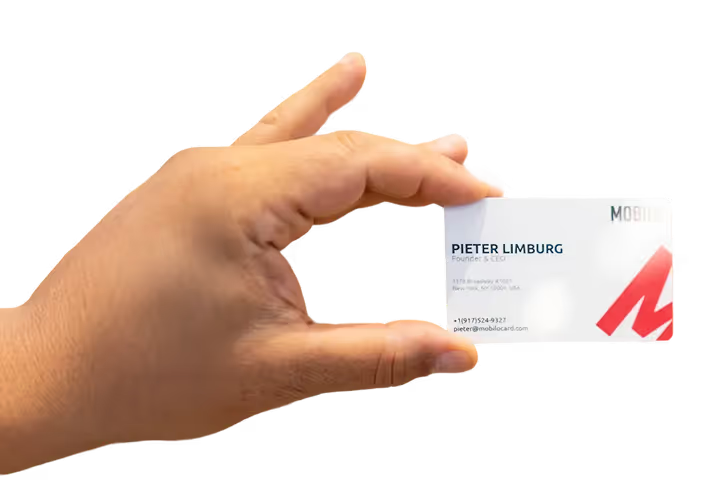
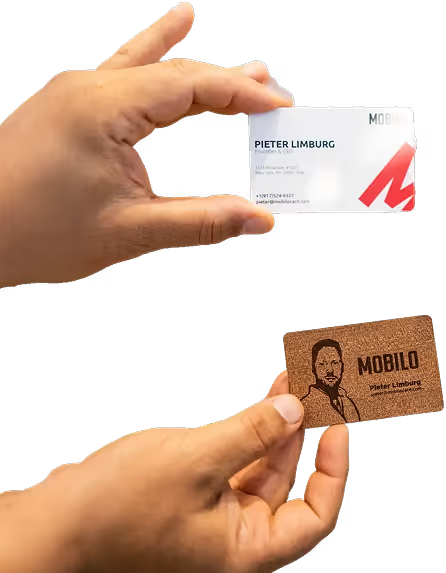
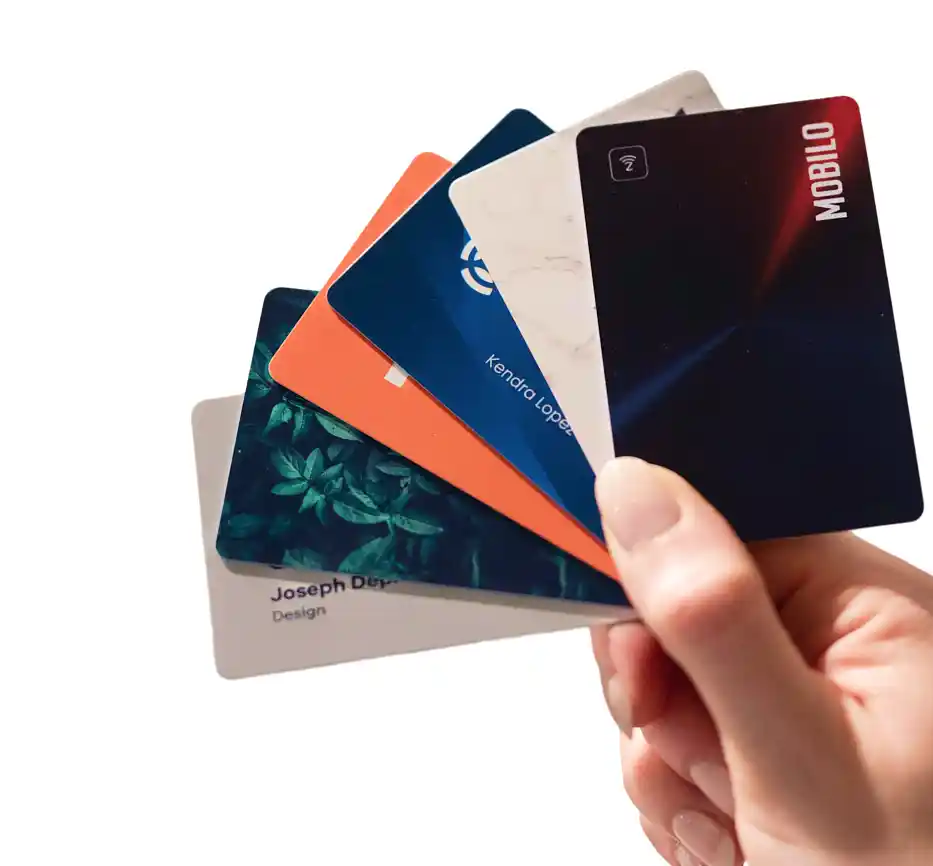
- Mobilo's digital contact card addresses this gap by treating every networking moment as a lead-capture opportunity, using NFC-enabled cards and QR codes to instantly transfer contact details into CRM systems with full source attribution and automated lead scoring.
Table of Contents
- The Real Problem With Most Link in Bio Pages
- What Actually Matters When Comparing Link in Bio Tools
- Detailed Feature-by-Feature Beacons vs Linktree Guide
- Your Bio Link Should Capture Clicks. Your Networking Should Capture Data.
The Real Problem With Most Link in Bio Pages
Most link-in-bio pages fail because they're made like directories, not systems that turn visitors into customers. When someone lands on your bio page after engaging with your content, they arrive wanting something and knowing what they saw. That moment of interest is your most valuable traffic, and most creators waste it by showing seven separate links with no clear order or reason.
🎯 Key Point: Your link-in-bio page isn't just a collection of links—it's a conversion funnel that should guide visitors toward a specific action based on their current level of interest.
"That moment of interest is your most valuable traffic, and most creators waste it by showing seven separate links with no clear order or reason."

⚠️ Warning: When visitors see multiple competing options without a clear hierarchy, they experience decision paralysis and often choose nothing at all—turning your highest-intent traffic into missed opportunities.
Why do too many choices hurt conversions?
Too many choices create decision fatigue. When you give users 7 or more links, each requiring them to read descriptive text before deciding, you've made it harder to use at the moment that should feel easy. According to research analyzing 100M Instagram profiles, the average creator treats their bio link as a passive list rather than an active tool. Users arrive, see a wall of equally important options, feel overwhelmed, and leave without taking action. The problem isn't that they didn't care—it's that you made it too hard for them to care.
What does the conversion math actually look like?
If your bio page gets 4,000 clicks per month and converts 8% of visitors into meaningful actions, you're creating 320 conversions. Improve that to 14% through better design, clearer organisation, and a single primary call-to-action, and you'll generate 560 conversions—240 additional subscribers, buyers, or leads monthly from the same traffic.
Why do creators focus on the wrong metrics?
Most creators focus on growing their follower base and learning algorithmic tricks while ignoring conversion design entirely. I've seen creators spend considerable energy doubling their audience from 10,000 to 20,000 followers while their bio page converts only 6% of visitors. If they applied that effort to improving conversion to 12%, they would double their business results without gaining a single new follower.
How do generic layouts signal low professionalism?
A bio page with no visual hierarchy looks unprofessional. When every link has identical button styling and neutral spacing, users don't know where to focus. A well-designed landing page, by contrast, features a clear headline, supporting text that removes doubt, and one visually dominant call-to-action button that directs users to the next step.
Why do scattered goals produce scattered results?
This pattern shows up everywhere. Teams building lead generation systems know that scattered goals produce scattered results. When you ask someone to follow you on YouTube, buy your course, join your newsletter, book a call, and check out your podcast simultaneously, you're not giving them choices—you're asking them to do your strategic thinking for you. They won't do it. They'll leave.
Why do most link-in-bio setups fail to convert visitors?
Most link-in-bio setups lose value by sending users to platforms designed to retain them. You built an audience, created content that resonated, and earned a click on your bio link—then send them to YouTube, Instagram, TikTok, or Twitter, where algorithmic feeds immediately suggest alternative content. Those platforms spent billions ensuring people stay on their sites. Once your visitor lands there, you've lost control of their attention and any means to direct them back to your intended action.
How do landing pages solve the attention control problem?
Landing pages solve this problem by keeping users in a controlled space. Every element answers questions, builds trust, or drives the main action. Navigation is minimal, and external links are used strategically. The user journey has a start (when someone arrives), middle (learning about what you offer), and end (they convert or leave). Bio pages with eight outbound links lack a coherent journey; they're intersections where traffic scatters in different directions.
What happens when warm intent meets strategic bio design?
When someone engages with your profile after weeks of following your content, that's warm intent. They know your voice, trust your perspective, and choose to learn more. Our digital contact card treats bio pages as lead capture systems rather than link lists. Instead of sending users to fragmented platforms, we consolidate your professional presence, capture contact information immediately, and track which interactions convert—turning every click into actionable business intelligence rather than scattered traffic you cannot measure or follow up on.
How do high-performing bio pages actually work?
The best bio pages work like compressed landing pages. They open with a clear statement of who you help and how, using visual hierarchy to direct attention to a single primary goal. Secondary options exist but are visually subordinate, placed below the fold or styled to feel optional. Text is minimal because users arrive to act, not read. This mirrors what converts elsewhere: email campaigns with a single clear ask outperform those with three competing CTAs. Product pages with focused messaging convert better than pages listing every feature. Your bio page isn't a portfolio—it's a gateway, and gateways work best when they lead somewhere specific.
Why do most bio pages fail to convert?
Most creators never define what "somewhere specific" means, which is why their bio pages lack a clear purpose. Without a primary conversion goal, every link feels equally important, so none stand out. Traffic arrives, looks at the options, and leaves. You've built a directory when you needed a funnel. What should you look for when choosing a link-in-bio tool?
Related Reading
- Best Link in Bio Tool
- What is Link in Bio
- How to Improve Linkedin Profile
- How To Build Personal Branding
- How to Add Portfolio to Linkedin
- How To Add Link To Tiktok Bio
- How to Add Instagram Link to Tiktok
- Where is Link in Bio on Instagram
- How to Add Link to Linkedin Post
- How to Add Website Link to Linkedin Profile
- Link in Bio Examples
- How To Add Link To Tiktok Bio
- How to Add Instagram Link to Tiktok
What Actually Matters When Comparing Link in Bio Tools
Most people shop for link-in-bio tools by looking at features, comparing prices, and picking what looks cleanest. But your bio link isn't a digital decoration—it's a conversion engine. The tool that drives the most money isn't the one with the most features. It's the one that aligns with your main conversion goal, streamlines every tap, and captures data you can use.

🎯 Key Point: Your link-in-bio tool should be chosen based on its conversion potential, not just its feature count or visual appeal.
"The tool that drives the most money isn't the one with the most features—it's the one that aligns with your conversion goals and captures actionable data."

⚠️ Warning: Don't fall into the trap of choosing a link in bio tool just because it has the most bells and whistles. Focus on conversion optimization and user experience instead.
What outcome should you prioritize over interface design?
Start with the outcome, not the interface. What's the one action you need visitors to take? If you're building an email list, your bio link should prioritize signup forms with minimal steps and clear value propositions. If you're selling products, you need smooth e-commerce integration with real-time inventory sync. If you're driving event registrations, your tool should highlight upcoming dates and simplify ticket purchases.
Why do visitors make split-second decisions about your page?
According to Sprout Social, 80% of social media users follow at least one business account. Your bio link competes with every brand and influencer for attention. When visitors click through, they make a quick decision about whether your page merits their time. If your layout forces them to scroll past unrelated links to find what they need, you've lost them.
How do design decisions become revenue decisions?
The economics are straightforward: if your goal is email list growth at a $ 2-per-subscriber lifetime value, a 2% conversion improvement generates predictable revenue. A bio page with 5,000 monthly clicks converting at 10% produces 500 signups worth $1,000. Improve conversion to 12% through better layout and friction reduction, and you've added $200 monthly—$2,400 annually from the same traffic. Design decisions become revenue decisions when you tie financial outcomes to conversion goals.
What matters more than impressive feature lists?
Most platforms show feature lists that sound impressive until you realise they solve problems you don't have. Unlimited link capacity matters far less than whether the tool lets you visually prioritise one link. Animation options add cognitive load without improving clarity. The real question isn't what a tool can do; it's whether what it does matches how your audience moves from interest to action.
Why should you focus on one primary conversion goal?
Too many options overload people's brains. When visitors see 10 equally important links, they either choose at random or leave without acting. Your bio link should guide people toward the action that matters most to your business. Create a visual hierarchy that makes the main path obvious without hiding other options.
How do you structure your bio link for maximum impact?
If your goal is to capture leads, your signup form should appear above the fold with a single, strong reason to subscribe. Secondary links—your latest YouTube video, your podcast, your Instagram—can sit below, where people can find them without competing for attention. If your goal is to sell products, feature your bestseller or current promotion prominently, with supporting links arranged in priority order.
What tools help you create effective visual hierarchy?
Many platforms treat all links identically, offering a grid of uniform buttons. Better tools provide featured sections, customizable button sizes, and layout options that let you emphasize what matters without hiding everything else.
Why does mobile friction hurt conversions?
Every extra tap, scroll, or decision point between arrival and conversion costs you money. Link in Bio Blog reports that over 80% of social media users access social media platforms on mobile devices. Your bio link must load instantly on slower networks, display perfectly on small screens, and feature buttons large enough to tap without zooming. Mobile users bounce quickly. Pages that take more than 3 seconds to load lose a significant portion of visitors. Buttons that are too small or too close together frustrate users and erode trust. Navigation requiring horizontal scrolling or hidden menus adds unnecessary complexity.
What makes touch-friendly design essential?
Touch-friendly design requires buttons at least 44 by 44 pixels—the smallest size for reliable tapping. Adequate spacing between interactive elements prevents accidental clicks. Images should compress automatically to reduce load times without losing quality. A one-second delay in page load can reduce conversions by seven percent.
Why does brand consistency matter for bio links?
Your bio link is often the first thing someone visits after discovering you on social media. If it looks generic—default fonts, stock colours, platform branding across the top—you've missed a chance to show who you are. Customisation isn't vanity; it's consistency.
How do white-label capabilities enhance your brand presence?
White-label capabilities remove third-party branding and keep attention on your content instead of the tool. Custom domain support replaces generic URLs with your branded domain, making your bio link feel like a natural extension of your website.
What customization options create smooth brand experiences?
Advanced customization options—colour palettes that match your brand guidelines, fonts that reflect your visual identity, and logo placement that reinforces recognition—create a cohesive experience. When someone moves from your Instagram profile to your bio link to your website, the transition should feel smooth. Consistency builds trust.
How does bio link data inform your strategy?
Every visitor who clicks your bio link generates behavioural data. This information helps you decide what content to create, what products to offer, and where to focus your marketing efforts. Simple click counts reveal which links attract the most engagement. More detailed analytics show who clicked, when, where they were from, and what they did after clicking.
Why should you integrate with existing systems?
Connecting your bio link with your other systems transforms separate data into actionable information. If your bio link integrates with your CRM, you can identify which social media campaigns generate the best leads. If it connects with your email platform, you can segment subscribers by which link they clicked before signing up. If it sends data to Google Analytics, you can measure conversion rates for bio link visitors compared to traffic from other sources. Most teams work with data spread across different locations: they know how many people clicked a link but not whether those people converted, can see how many people signed up but not which content drove those sign-ups, or track sales without connecting revenue to specific social posts. When your bio link integrates with all your other tools and systems, these gaps close.
How does Mobilo capture structured contact data?
Mobilo's digital contact card captures real contact information from everyone who engages with your profile. When someone taps your card, they choose to share their details, sign up for your list, or connect directly. That interaction generates organized data that flows automatically into your CRM, giving you immediate visibility into who engaged, when, and how to follow up.
Why should you test and iterate on your bio link?
Your first layout won't be your best. The offer that works today might not work as well next quarter. Your audience's preferences shift as your content evolves and new platforms emerge. The only way to improve is to test different versions, measure results, and refine based on what works.
What testing features should you look for?
A/B testing capabilities let you compare different headlines, button placements, or visual treatments without guessing. Scheduling features automatically rotate featured content, keeping your bio link current during campaigns or product launches. Link management tools with drag-and-drop reordering let you adjust priorities as goals change.
How do you optimize based on performance data?
Treating your bio link as static is a mistake. It should evolve with your strategy, reflecting current priorities and responding to performance data. If analytics show visitors scroll past your primary call-to-action, test different placement or a clearer value proposition. If a link underperforms, remove or replace it. Small, continuous improvements compound into significant gains in conversion. But features only matter if they serve your strategy, and that's where most comparisons fall apart.
Related Reading
- How to Add Linktree to Tiktok
- How To Add Linktree To Instagram
- How To Add A Link To Instagram Story
- How To Add Link To Instagram Profile
- Personal Landing Page Examples
- Graphic Design Portfolio Websites
- Personal Portfolio Website Design Examples
- Small Business Bio Examples
- One Page Website Examples
- Best Photography Portfolio Websites
- Instagram Landing Page Examples
Detailed Feature-by-Feature Beacons vs Linktree Guide
Strategy matters more than the tool itself, but once you've decided on your main conversion goal, the platform you choose either supports that goal or creates unnecessary friction. Both Beacons and Linktree turn a single social media link into multiple destinations, but they differ fundamentally in monetization, customization, and data capture. These differences affect how fast people convert, your control over the experience, and whether your bio link becomes a revenue driver or just a traffic redirect.
🎯 Key Point: Your bio link platform choice directly impacts conversion rates and revenue potential - it's not just about organizing links.
💡 Tip: Focus on platforms that align with your primary goal: choose Beacons for direct monetization or Linktree for brand-focused traffic distribution.
"The right bio link platform can increase conversion rates by 25-40% compared to basic link-in-bio solutions." — Social Media Marketing Research, 2024
🔑 Takeaway: Beacons excels at turning followers into customers, while Linktree focuses on professional link management and brand presentation.

What makes Beacons different from other link-in-bio tools?
Beacons positions itself as a creator business platform, not a link aggregator. Launched in 2019, it integrates payment processing, email capture, product storefronts, and booking systems into a single platform. A Beacons page functions as a micro-site with built-in shopping features. The creator-first approach makes monetisation central rather than an add-on. You can sell digital products, accept tips, offer subscriptions, and manage affiliate links without external services. Request forms collect information for collaborations or commissions. Media embedding showcases videos, music, and social posts directly on your page. The experience feels like a landing page built to convert visitors into customers.
How does AI help creators optimize their monetization strategy?
In 2025, Beacons added AI-powered content suggestions that analyse audience demographics and engagement patterns to recommend monetization strategies. The system identifies which products your specific audience is most likely to purchase based on behavioural data from similar creator profiles, shifting the platform from passive infrastructure to active business intelligence.
What makes Beacons different from other platforms?
Beacons stand out by going deep instead of wide. It builds features into the platform itself, eliminating the need to connect other tools. You can monetise through digital products, physical goods, subscriptions, and one-time services. The storefront tracks your inventory and orders, and you can collect email addresses directly without Mailchimp or ConvertKit.
How do request forms streamline commission workflows?
Request forms solve a specific problem for creators who take commissions or custom orders. Instead of managing inquiries through Instagram DMs or email, you can collect organized information through a form embedded in your Beacons page. The data flows into a dashboard where you can review requests, respond, and convert inquiries into sales without leaving the platform.
What analytics and insights does Beacons provide?
Analytics track how visitors behave, which links they click, and how many conversions occur in one dashboard. You can see which products generate the most revenue, which links drive the most traffic, and where visitors disengage. Traffic and transaction data are integrated, eliminating the need to piece together insights from multiple tools.
What are Beacons' subscription plan options?
Beacons offers a free plan with basic link-in-bio features and limited monetisation options, including Beacons branding. The Pro Plan ($10/month) removes branding, adds customisation options and advanced analytics, and includes priority support. The Premium Plan ($25/month) adds custom domains, A/B testing, priority marketplace placement, and lower transaction fees. Enterprise pricing is custom for larger creators requiring dedicated support and integrations.
How do transaction fees impact overall costs?
The pricing structure involves tradeoffs beyond subscription fees. Crevio's comparison notes that the platform charges a 9% transaction fee on sales through the free plan, with a lower fee on paid tiers. For creators with significant sales volume, these fees can exceed costs on competing platforms with lower or zero transaction fees.
What customization options does Beacons offer?
Beacons offers a drag-and-drop page builder requiring no coding skills. You can organize links into sections, add video backgrounds, adjust spacing, choose from layout options and visual themes, and customize colours and fonts. The design is mobile-responsive and adapts to different screen sizes, though pages with heavy embedded media may load slowly on older devices.
How do Beacons AI design suggestions work?
The platform's AI-powered design suggestions analyze your brand assets and social media aesthetic to automatically generate page layouts, reducing setup time. However, this assumes your Instagram aesthetic translates well to a landing page; you may need to override suggestions manually if it doesn't.
Overview of Linktree
Linktree started in 2016 to solve Instagram's one-link limitation. The platform lets users create a clean landing page with multiple links, share a single URL, and let visitors choose their destination. Today, Linktree serves more than 35 million users worldwide, offering analytics, payment integrations, email capture, and scheduling features while maintaining the simple design that made it popular. Linktree's years of operating the service have strengthened its infrastructure, accelerated page load times, and established connections with major e-commerce platforms, membership sites, and content management systems. The result is a polished, reliable tool that performs consistently.
What are the basic functions of Linktree?
Linktree's main features let you create, organize, and share multiple links in one place. Priority links visually emphasize your most important destinations. Scheduling lets you set links to appear or disappear at specific times, useful for limited-time offers or event promotion. Link analytics track views, clicks, and engagement across all your links.
How does Linktree handle payments and contact collection?
Payment and donation links are available via PayPal, Square, and Venmo. However, checkout occurs off-platform, adding extra steps compared to native payment processing. Email and SMS collection gathers contact information from visitors, while social icons provide direct links to your social profiles.
What new features did Linktree add in 2025?
In 2025, Linktree enhanced its third-party integrations with major e-commerce platforms, membership sites, and content management systems. Contextual analytics now reveal conversion patterns and audience journey mapping, showing which links drive conversions, not just clicks.
Linktree Pricing Structure
Linktree's free plan includes unlimited links, basic customisation, and limited analytics with branding. Paid tiers remove branding and add features: Starter ($5/month) offers enhanced analytics and more themes; Pro ($9/month) adds priority links, scheduling, and integrations; Premium ($24/month) includes custom domains, advanced security, and priority support. Unlike Beacons, Linktree doesn't take a percentage of transactions from third-party payment integrations like Shopify, Gumroad, or Stripe, making it more affordable for creators processing high transaction volumes.
Linktree User Experience and Design
Linktree has a clean, simple design that loads fast and takes minutes to set up. Its mobile-first design ensures it looks perfect on smartphones, while customization options remain intuitive. While Linktree offers fewer design variations than Beacons, its 2025 updates include more detailed customization options and improved theme selections that balance simplicity with brand alignment. This tradeoff is intentional: Linktree prioritizes speed and ease of use over visual flexibility. If you need deep design control, look elsewhere; if you want something that works immediately, Linktree delivers.
Ease of Use
Linktree wins for simplicity. The interface is intuitive, setup is fast, and most users feel comfortable within minutes. You add a link, choose a title, pick a theme, and you're done. Beacons require more upfront time due to additional configuration options: monetization tools, request forms, email capture, and layout organization. However, once configured, daily use is straightforward, and users who need these tools find the learning curve worthwhile.
Customization
Beacons offers design flexibility with multiple layout styles, customizable fonts, colours, spacing, and custom CSS on higher plans. The platform supports video backgrounds, custom domains, and advanced block arrangements, making it ideal for creating a branded micro-site aesthetic. Linktree provides solid customization within defined boundaries. Users can select themes, adjust button styles, and upload backgrounds, but deep design control is available only on paid plans. The template-driven approach ensures consistency while limiting creative freedom.
How does Beacons handle direct creator sales?
Beacons have a clear advantage for creators who sell directly. It includes native payment processing for digital products, memberships, one-time services, and bookings without third-party integrations. Taap.bio's comparison table shows that Beacons charges a 10% transaction fee on tips for free-plan users, though this fee decreases on paid tiers. The benefit is control: you manage the entire transaction within one platform.
What are Linktree's monetization limitations?
Linktree depends on outside integrations to generate revenue. Users can link to Shopify stores, Gumroad products, or Stripe payment pages, but customers check out away from Linktree, adding extra steps and limiting control over the customer experience. However, Linktree doesn't take a percentage of transactions. If you're already using outside commerce tools, this approach avoids duplicate fees.
Analytics
Both platforms offer analytics, though the depth varies by plan. Linktree provides traffic data, click tracking, and audience location information. Paid plans unlock conversion tracking and UTM parameter support to identify which links drive the most engagement. Beacons includes similar analytics, with added monetisation tracking: revenue, email signups, and product sales all appear in the same dashboard. This matters more for creators managing multiple income streams, since seeing revenue alongside clicks provides better business insight than traffic numbers alone.
Performance and Reliability
Linktree benefits from years of infrastructure investment, delivering consistently quick load times and rare downtime, with issues resolved quickly when they occur. Beacon performs well with reliable uptime, though its added feature complexity occasionally introduces minor bugs. Performance has improved steadily as the platform matures, and for most creators, the reliability difference between platforms is negligible.
How does Beacons approach integrations and third-party connections?
Beacons takes a "built-in first" approach, focusing on native features while offering key integrations. Email marketing connects with Mailchimp, ConvertKit, and Klaviyo. Analytics integrates with Google Analytics. Social platforms embed content from Instagram, TikTok, YouTube, and Twitter. Music services include Spotify, Apple Music, and SoundCloud. Membership platforms connect with Patreon and Discord. In 2025, Beacons expanded its API capabilities for custom integrations on higher-tier plans. However, their philosophy prioritises native tools over extensive third-party connections. This works well if you want everything in one place, but it may create friction if you rely on specialised tools for specific functions.
What integration options does Linktree provide for existing workflows?
Linktree uses an integration-focused approach with a large marketplace. E-commerce connections include Shopify, Etsy, and Amazon. Payment processing supports PayPal, Venmo, Cash App, Square, and Stripe. Content platforms connect with YouTube, Twitch, Spotify, Apple Music, and podcast directories. Marketing tools integrate with Mailchimp, HubSpot, and ConvertKit. NFT and Web3 options include OpenSea and Metamask. Booking systems connect with Calendly and Acuity. Linktree's 2025 updates expanded their integration marketplace, positioning the platform as a connector rather than a replacement for specialized tools. If you rely on multiple third-party services, Linktree's ecosystem reduces friction and preserves existing workflows.
How do Beacons and Linktree compare for mobile performance?
Beacons offers designs that work across different screen sizes. Complex pages may load more slowly, and pages with numerous images and videos consume more mobile data. A mobile editor app enables on-the-go updates, though advanced features like video backgrounds may slow performance on older devices. Linktree delivers fast loading times optimized for mobile connections, with simple layouts that work consistently across all devices. Low data usage benefits users with limited data plans, and the mobile editing experience functions reliably on older smartphones.
Why does mobile loading speed matter for bio links?
Most networking happens on mobile. If your bio link takes more than three seconds to load, you're losing visitors before they see your content. Speed affects your conversion rate.
When should creators choose Beacons over Linktree?
Beacons work well for creators with multiple revenue streams. If you sell courses, offer coaching, accept tips, and build an email list, consolidating these into one platform simplifies management and reduces subscription costs. The built-in payment processing and product catalog function like a real store, saving you money on transaction fees. For small businesses, Beacons suits service-based businesses like coaches, consultants, and freelancers that need to manage bookings, payments, and inquiries in one place.
What scenarios favor Linktree as the better choice?
Linktree works well for creators who drive traffic to existing platforms. If your income comes from YouTube ad revenue, Patreon, or Spotify streams, Linktree provides a clean hub. The extensive integration ecosystem lets you connect to specialized tools without friction. For small businesses, Linktree suits those needing a simple landing page for social media profiles: restaurants sharing menus, salons linking to booking systems, or local shops directing customers to e-commerce sites. For simple link-in-bio pages, Linktree excels. If you only need to share a handful of links—social profiles, a portfolio, a contact form—Linktree delivers without distraction. Beacons can accomplish the same outcome, but require ignoring most of their features.
Pricing Breakdown
Linktree's free plan includes unlimited links and basic customisation with Linktree branding. Paid plans remove branding, add priority support, unlock advanced analytics, and enable link scheduling and custom thumbnails. Beacons offers a free plan with most core features, including email marketing and basic monetization. Paid plans remove transaction fees, unlock premium themes, add custom domains, and enable automation. Beacons offers more functionality in its free tier for users planning to monetize. Linktree's paid plans suit users prioritizing analytics and integrations over native commerce tools. Choose Beacons for built-in monetization or Linktree for external system integrations.
Measurable Next Step
Check your monthly bio link clicks and identify your single most important conversion goal. Measure your current conversion rate, choose the platform that supports that goal, then recheck the conversion rate after 30 days. Choose based on the metric that matters, not popularity. But clicks alone don't build relationships, and most bio links ignore this entirely.
Your Bio Link Should Capture Clicks. Your Networking Should Capture Data.
Beacons and Linktree organize your online presence and track link performance. Yet most business growth happens in conference halls, sales meetings, trade show booths, and networking events where someone asks for your card and you either capture that moment or lose it forever. When you meet someone in person, you're dealing with warm intent at its highest concentration. Yet most professionals exchange contact information through methods that guarantee data loss: business cards get photographed poorly or typed incorrectly into phones, LinkedIn requests sit unaccepted for weeks, and email addresses scribbled on napkins never reach your CRM. According to research on business networking patterns, up to 90 percent of in-person contacts are never properly logged. "Up to 90 percent of in-person contacts never get logged properly, creating massive blind spots in business development." — Business Networking Research, 2024
🔑 Key Point: Your link-in-bio tool tracks clicks, device types, geographic locations, and time spent on the page. But it can't tell you what happened to the 47 people you met at last month's industry conference, because those interactions live in a completely separate system.
⚠️ Warning: The gap between your digital conversion tracking and your in-person lead capture creates blind spots in attribution, follow-up timing, and pipeline forecasting. Solutions like Mobilo's digital contact card treat every networking moment as a lead capture opportunity with the same rigor you apply to digital traffic. Our NFC-enabled cards and QR codes instantly transfer details to your CRM without manual entry, with source attribution. Lead scoring happens automatically against your ideal customer profile, and team-level analytics reveal which networking activities convert into pipeline. If you're optimizing click-through rates on your bio page but ignoring the conversion rate of your in-person interactions, you're solving half the problem. Book a demo today and receive your first 25 Mobilo business cards free, worth $950.
Related Reading