.avif)


80+ Personal Portfolio Website Design Examples That Convert
On This Page
Your portfolio website might be the only interview you get. Hiring managers spend seconds scanning your work before deciding whether to reach out, making the design of your online presence more crucial than your resume. The best personal portfolio website design examples share best link in bio tool and specific traits that land jobs, attract paying clients, and open doors that seemed locked shut.
Creating an impressive portfolio is only half the battle—you need an effective way to direct people to it. A digital contact card transforms casual networking moments into real opportunities by letting you share your website instantly through a tap or scan, ensuring your carefully designed portfolio gets seen by the people who can hire you or send projects your way.
Table of Contents
- Why Your Personal Portfolio Website Isn't Getting Results
- The Cost of Looking Like Every Other Portfolio Online
- 80+ Personal Portfolio Website Design Examples That Actually Convert
- Your Portfolio Stands Out Online—What About In Person?
Summary
- Digital business cards saw 340% growth in adoption in 2024, according to Forrester's workplace technology report. Remote work made physical cards obsolete for most professionals, but the shift accelerated because mobile-first sharing eliminated the friction of manual contact exchange that always plagued paper cards.
- Portfolio websites fail because they treat design as decoration rather than direction. When potential clients land on your site, they're deciding whether you solve their problem, not browsing for inspiration. Poor visual hierarchy buries your best work below chronological project lists, and visitors spend only 10 to 20 seconds on a webpage before deciding whether to stay or leave, according to Nielsen Norman Group research from 2020.
- Over 60% of portfolio traffic comes from mobile devices, yet most portfolios break completely on phones with unreadable text, images that don't scale, and navigation menus that don't work. A three-second delay in page load time increases bounce rates by 32% according to Google's 2023 mobile speed research, and most portfolio sites load in five to eight seconds because they're packed with uncompressed images and animation libraries.
- Generic template design creates a recognition problem that kills opportunities before comparison begins. Users form visual impressions of websites in 50 milliseconds according to Baymard Institute research from 2021, which isn't enough time to evaluate work quality but is enough to register whether something feels familiar or distinct. When your portfolio triggers the same visual pattern recognition as the previous five sites someone viewed, your work never gets the attention it deserves.
- Portfolios that include project context and process documentation convert 40% better than image-only galleries, according to Weblish's 2025 portfolio analysis. Writing creation stories and case study explanations adds SEO value while demonstratinga problem-solving approach, helping potential clients understand the thinking behind finished work rather than just seeing polished outputs.
- Digital contact card addresses this by letting you share a mobile-optimized portfolio landing page instantly during in-person networking, ensuring the impression you make face-to-face connects smoothly to your digital presence before the moment passes.
Why Your Personal Portfolio Website Isn't Getting Results
Your portfolio looks polished and modern, but nobody's reaching out. The problem isn't your work or traffic—it's that your site was built to display, not convert.
🎯 Key Point: Most portfolios fail because they treat design as decoration rather than direction. When a potential client lands on your site, they're deciding whether you solve their problem. If your site doesn't answer that question in seconds, they're gone.

⚠️ Warning: Your beautiful portfolio might actually be working against you if it prioritizes aesthetics over action. Visitors need to understand immediately what you do, who you help, and how to take the next step.
"The average website visitor decides whether to stay or leave within 3-5 seconds of landing on a page." — Nielsen Norman Group Research

Why do templates make you invisible to clients?
Thousands of designers use the same three portfolio templates: clean white backgrounds, grid layouts, and minimal navigation. When a creative director reviews ten portfolios in an hour, and eight look structurally identical, you don't get remembered. You get skipped.
How do templates erase your design context?
Templates erase context. A template cannot explain why you chose a particular typeface for a healthcare brand versus a tech startup, nor can it demonstrate your thinking and process. It displays finished work in a grid, forcing viewers to guess what distinguishes you from others using the same layout.
What happens when clients can't distinguish portfolios?
The real cost shows up in hiring decisions. When clients cannot distinguish between portfolios based on organisation or presentation, they rely on other signals: who they've met in person, who was referred, and who followed up at the right time. Your work becomes less important than factors beyond your control.
Why does poor visual hierarchy hurt conversions?
Poor hierarchy buries information that converts browsers into clients. If your best project sits 4 scrolls down, or your contact information is hidden in a footer menu, most visitors won't find it. According to research from the Nielsen Norman Group (2020), users spend an average of 10-20 seconds on a webpage before deciding whether to stay or leave.
When case study text, images, and calls to action compete for attention with equal visual weight, nothing stands out. Visitors scan without absorbing and leave without remembering what you do or why they should care.
How does strong visual hierarchy guide visitors?
A strong hierarchy creates a clear path through your content. Your best work should appear first, your unique value should be obvious within seconds, and the next step—whether viewing a case study or booking a call—should feel like the natural conclusion of each section.
Why do mobile visitors abandon portfolio sites immediately?
Over 60% of portfolio traffic comes from mobile devices, yet most portfolios break on phones. Text becomes hard to read, images don't resize, navigation menus hide behind non-functional buttons, and touch targets are too close together. The experience feels like a desktop site shrunk to fit a phone screen.
This is a conversion killer. When a potential client finds your work through social media while commuting, they're viewing it on their phone. If the experience frustrates them, they won't return on desktop; they'll visit a competitor whose site works.
What causes the biggest mobile performance problems?
The failure point is usually the images. High-resolution portfolio pieces take 15 seconds to load on mobile connections. By the time the second image appears, the visitor has left. Designers optimize for how they view their own work, forgetting that clients experience it under different conditions: smaller screens, slower connections, and less patience.
How does slow loading speed affect visitor behavior
A three-second delay in page load time increases bounce rates by 32%, according to Google's 2023 mobile speed research. Most portfolio sites load in five to eight seconds due to uncompressed images, custom fonts, animation libraries, and tracking scripts. Every second past two seconds reduces your conversion rate.
If 100 people visit your portfolio and 40 leave because it loads too slowly, you've lost nearly half your possible opportunities before anyone sees your work. These visitors disappear without giving feedback, so you never know they were there.
Why are mobile speed issues particularly damaging?
Speed problems worsen on mobile. A portfolio that loads acceptably over Wi-Fi becomes difficult to use over cellular connections. When images take 10 seconds to appear and scrolling lags, you signal indifference to user experience—a serious liability when seeking design work.
Why does professional polish make you forgettable?
Professional polish often strips away the personality that makes someone want to work with you. Portfolios designed to look credible can feel empty and cold: clean layouts, neutral language, generic descriptions that reveal nothing about how you think, what you care about, or why you approach problems differently.
What do clients really want to know about you?
Clients hire people, not portfolios. They want to know if you'll understand their industry, communicate clearly, and handle feedback without drama. A site showing only finished work and formal case studies doesn't answer those questions. It positions you as interchangeable with anyone else who can do similar projects.
How does showing personality build trust?
When there's no voice, people trust less. When someone can't recognize you, they pause and hesitate. Portfolios differ because you can see the designer's point of view in how they explain their projects—you can tell they care about fixing the problems they work on. Those websites work better because they feel like the beginning of a conversation, not a sales catalogue.
Why do visitors leave portfolio sites so quickly?
Visitors arrive with a clear goal: they want to see your work, understand your process, and figure out how to contact you. If they can't do those three things quickly, they leave. Yet most portfolios bury contact forms behind multiple clicks, hide case studies in dropdown menus, or organize projects by categories that only make sense to the designer.
Behaviour data from tools like Hotjar reveals the problem: visitors land on a homepage, scroll halfway, click nothing, and exit. They came looking for something specific, couldn't find it within 10 seconds, and gave up. Navigation that seems obvious to you confuses first-time visitors in a hurry.
How should navigation match visitor intent?
Clear navigation means matching what visitors want to find with how your site is organized. If most people want to see your work right away, your homepage should show projects first, not a long bio. If they need to understand your process before hiring you, that explanation should be one click away, not buried under "About > Approach > Philosophy." Every extra click risks losing a visitor.
Teams often report that their best leads come from in-person connections where they can walk someone through their work. Face-to-face interaction provides the clarity that websites cannot. Platforms like digital contact card bridge that gap by letting you share a mobile-optimized landing page during conversations, ensuring the person you impressed can access your portfolio before the moment passes. When your work becomes immediately viewable with a tap or scan, you eliminate opportunities lost to broken links, forgotten URLs, or the friction of traditional follow-up.
Why aren't design problems just aesthetic preferences?
These aren't superficial issues. They're structural problems with measurable impact. A portfolio that takes 8 seconds to load fails because 40% of visitors leave before it loads. A mobile-broken site underperforms because 60% of traffic can't use it properly.
This distinction matters because it changes how you fix the problem. Measurable design failures require testing and data, not taste and experimentation.
How do you measure design performance with data?
You can A/B test load times, track mobile bounce rates, analyse click patterns, and measure scroll depth. These metrics reveal where visitors drop off and why your site isn't converting.
Most designers never examine this data. They update their portfolio upon finishing projects and assume the site is fine because it looks professional. Meanwhile, conversion rates stagnate or decline because structural problems go unaddressed. Traffic grows, but results don't.
Looking professional and getting results aren't the same thing.
Related Reading
- Best Link in Bio Tool
- What is Link in Bio
- How to Improve Linkedin Profile
- How To Build Personal Branding
- How to Add Portfolio to Linkedin
- How To Add Link To Tiktok Bio
- How to Add Instagram Link to Tiktok
- Where is Link in Bio on Instagram
- How to Add Link to Linkedin Post
- How to Add Website Link to Linkedin Profile
- Link in Bio Examples
- How To Add Link To Tiktok Bio
- How to Add Instagram Link to Tiktok
The Cost of Looking Like Every Other Portfolio Online
Generic design actively erases you from consideration. When your portfolio uses the same Squarespace template, grid layout, font pairings, and muted color scheme as a dozen other candidates, you become invisible. Hiring managers cannot separate your work from the three other portfolios they viewed in the same sitting; you blur into undifferentiated competence.
🎯 Key Point: Standing out isn't about having the best work—it's about being memorable in a sea of sameness.
This isn't about ego. Human brains encode distinctiveness, not sameness. A recruiter reviewing portfolios for an hour will remember the one with unusual navigation, unexpected color choices, or unconventional layout, even if the work wasn't objectively stronger. Your cookie-cutter design signals either a lack of attention to detail or a misunderstanding of how differentiation works in competitive markets. Neither helps you.

"Human brains encode distinctiveness, not sameness—the memorable portfolio wins over the objectively stronger one." — Cognitive Psychology Research
⚠️ Warning: Using popular templates makes you instantly forgettable, no matter how strong your actual work is.

Why does the invisibility problem get worse over time?
According to an informal Twitter poll of 154 freelancers, 58% maintain online portfolios. Most look functionally identical because they're built from the same template libraries. When 48% of freelancers report finding clients via their online portfolio or website, the ones who land those opportunities aren't necessarily more talented—they're more memorable.
What signals does a generic portfolio send to clients?
A portfolio that looks like everyone else's suggests you took the easiest path. It shows you didn't invest in custom design, didn't think carefully about how to present your work, or didn't consider how your site differentiates you from competitors. Clients and employers notice this. They're looking for someone who demonstrates care, strategic thinking, and attention to detail before hiring. Your generic design undermines that impression before anyone reads a single case study.
How does first impression timing affect your competitive position?
People decide what they think about your portfolio in the first 8 seconds. If your design resembles the three portfolios they just reviewed, you've lost. The decision-maker's brain categorises you as "another qualified person" rather than "I need to talk to this person." Once placed in that category, it's nearly impossible to change their mind through additional content. They won't engage deeply enough to discover what makes you different.
Why does design distinctiveness impact search engine rankings?
Search engines rank content partly based on how unique it is. When your portfolio uses the same structural patterns, heading hierarchies, and content organization as thousands of other sites, algorithms have nothing distinctive to prioritize. You're competing in an undifferentiated pool where ranking depends on domain age and backlink volume rather than work quality. A custom design with unique content architecture gives search engines clear signals about what makes your portfolio different, improving discoverability for searches that matter to your target clients.
How does each week compound the cost of generic design
According to research on client acquisition among freelancers, 91% find work through referrals or word of mouth. Your portfolio serves as the validation step: someone hears your name, searches for your work, and decides whether to recommend you based on what they find.
Generic design means lost opportunities. Each week you operate with a cookie-cutter design is another week of forgettable first impressions that could have turned into consulting gigs, speaking opportunities, or job interviews.
What opportunities are you missing without realizing it
The real results show up in what doesn't happen: the consulting project that went to someone whose portfolio demonstrated strategic thinking, the speaking slot that went to someone whose site made them memorable enough to recommend.
The job went to a candidate whose portfolio demonstrated that presentation shapes perception. These missed opportunities occur silently when someone views your portfolio, feels nothing distinctive, and moves on.
How can you bridge the gap between impressive work and actual connection
Solutions like Mobilo close the gap between impressive work and real connection by embedding your contact information directly into your portfolio. When someone views your work and wants to reach out, a digital business card lets them save your details, access your social profiles, and contact you immediately without having to navigate elsewhere.
That smooth handoff from interest to action prevents the moment from passing before they send that email.
Why does narrative matter more than visual appeal?
Portfolios help you tell a clear story about your career. Professionals often possess diverse skills—writing, editing, social media, consulting, technical work—and need a place to organize them into one consistent narrative. A website with separate sections clarifies who you are and what you offer. But when that structure mirrors everyone else's, your story dissolves into sameness.
The challenge is distinguishing professional polish from a personality vacuum. You want credibility without becoming forgettable. Portfolios that create real opportunities aren't necessarily the most technically advanced; they're the ones where someone's thinking, approach, and perspective come through clearly enough that a potential client thinks, "I want to work with this specific person." Generic design strips away those signals by forcing your work into predetermined structures that weren't built around your unique value.
How does generic design affect client perception?
When your portfolio looks like a corporate brochure—neutral colours, stock photography, generic language—you've removed every signal of who you are as a collaborator. Clients hire people they can consider working with, people whose approach resonates with how they think about problems. A portfolio that shows no personality, perspective, or voice makes imagination impossible. The pattern often stems from overcompensating for imposter syndrome by hiding behind a formal presentation, making it indistinguishable from every other qualified candidate.
But what happens when someone meets you in person and the impression doesn't match what they saw online?
Related Reading
- How to Add Linktree to Tiktok
- How To Add Linktree To Instagram
- How To Add A Link To Instagram Story
- How To Add Link To Instagram Profile
- Personal Landing Page Examples
- Graphic Design Portfolio Websites
- Small Business Bio Examples
- One Page Website Examples
- Best Photography Portfolio Websites
- Instagram Landing Page Examples
80+ Personal Portfolio Website Design Examples That Actually Convert
Looking at successful portfolios reveals which design choices convert visitors into customers and which ones create friction. The portfolios below demonstrate different solutions to the same core problem: capturing visitor attention and prompting action. Some prioritise personality, others efficiency, but each makes deliberate choices about hierarchy, navigation, and visual flow that you can apply to your own work.
🎯 Key Point: Every successful portfolio makes deliberate choices about visual hierarchy and user flow – there's no such thing as accidental conversion optimisation.
💡 Pro Tip: Notice how top-performing portfolios balance personality with functionality – the best ones never sacrifice usability for creativity.
"The difference between a portfolio that converts and one that doesn't often comes down to intentional design choices rather than creative flair." — UX Design Research, 2024

Jey Austen
Jey Austen's site opens with their name and biography in white text on a black background, followed by a bright gallery of work. A moth peeking over the portfolio grid adds personality without clutter.
Why this converts
High contrast makes text immediately readable. The moth detail provides a memorable focal point without overwhelming the viewer. The simple design builds trust.
What works for implementation
This approach suits professionals from different fields who need one central hub for readers, fans, and clients. Blog integration lets visitors engage with your thinking without committing to hiring you. If you produce content beyond client work, this structure prevents your portfolio from feeling like a static showroom.
The minimal aesthetic includes written articles and external content links, making the site valuable for multiple visits. This versatility matters when someone discovers you through one channel but might hire you for something else entirely.
David Kushner
David Kushner's musician portfolio dedicates each homepage row to a different facet of his artistry. Dark portraits shift to vintage colour schemes and script fonts, demonstrating his range while maintaining cohesion.
Why this converts
The thick scrolling rows create natural separation between brand facets. A creative director sees experimental edge in row one, commercial polish in row two, and accessibility in row three without confusion between competing identities.
What works for implementation
If your professional identity includes seemingly contradictory elements (technical precision and creative risk-taking, corporate polish and indie authenticity), this row-based structure prevents them from canceling each other out. Each section receives full visual commitment before moving to the next, allowing viewers to absorb one facet completely before encountering another.
This demonstrates you can switch between different styles intentionally rather than appearing inconsistent or unfocused.
Sophia Amoruso
Sophia Amoruso's site by Rare Days features editorial-inspired visuals with bold fonts and a seated potential pose overlapping her name. Scrolling animations keep viewers engaged as her story unfolds.
Why this converts
The uneven layout and animation create momentum, encouraging visitors to scroll and discover what comes next. The editorial style conveys confidence without arrogance and professional drive without corporate stiffness.
What works for implementation
If your work requires establishing authority quickly (consulting, advisory roles, executive positioning), this approach demonstrates command through design before credentials appear. The homepage contact form reduces friction for visitors who are ready to hire and don't need case studies.
The animations guide attention to specific achievements and testimonials as they enter the viewport, creating a curated tour instead of a static page.
Marlon Wayans
Marlon Wayans's comedian site opens with a full-screen demo reel and lime-green ticket buttons. The navigation menu prioritizes stand-up highlights with extensive video access.
Why this converts
The design prioritises screen space for what matters most. For performance-based work, watching clips answers the hiring question faster than reading descriptions. Bright call-to-action buttons create clear next steps for different visitor intents: booking tickets, buying merch, or watching more.
What works for implementation
If your work is best evaluated through video, audio, or interactive demos, this layout treats media as primary content. Full-screen treatment conveys confidence: the work speaks for itself. This suits speakers, performers, developers with live demos, or anyone whose medium requires experience rather than explanation.
The extensive navigation helps visitors who arrive knowing exactly what they want to find. Sometimes reducing clicks matters more than reducing visual elements.
Mark Clennon
Mark Clennon's site by Blackpepper Studio is an infinitely scrolling gallery with thin black borders separating rectangular images. Photos and videos animate in multiple directions, with only his name and navigation buttons as text.
Why this converts
For visual artists, the work is the credibility. The design removes anything that competes with the images themselves for attention. The unconventional multi-directional animation creates a signature navigation experience that viewers remember.
What works for implementation
This approach trades normal usability for memorability. If your portfolio's main job is making people remember your visual style, accepting some navigation friction for a distinctive presentation can be the right trade-off.
The brief career summary appears only after visitors engage with the work, reversing the typical bio-then-portfolio structure. This approach works best when your target clients value creative risk-taking and experimentation.
Colin Moy
Colin Moy's site uses circles as a visual motif throughout. The O's in his name become eyes that follow the cursor, while circles expand text, reveal portfolio samples, and direct visitors toward contact information.
Why this converts
The geometric consistency creates cohesion without repetition. Each circle interaction serves a different function: navigation, revelation, and direction. The cursor-following eyes signal technical capability through immediate interactivity.
What works for implementation
The portfolio serves as proof of capability and is available as a Webflow template you can clone and adapt rather than building from scratch. This demonstrates how a single design element functions across multiple uses.
The clean layout proves you can create immersive experiences without visual noise, a valuable signal for clients concerned about over-designed solutions.
Nick Velten
Nick Velten's one-page site by Dennis Snellenberg centres a professional headshot with his name overlaid and "Entrepreneur, Advisor & Investor" beneath it. The colour-forward palette and mixed fonts add visual style.
Why this converts
The single-page structure removes decision paralysis by presenting expertise areas, track record, and testimonials in a predetermined sequence. Bold visual separation makes the page easy to scan for busy executives.
What works for implementation
For advisory or consulting services, the one-page format demonstrates confidence in your offering. Everything a decision-maker needs appears on one easy-to-scroll page. Specific achievements provide tangible proof that outweighs mere credential listings.
This structure works when your audience has limited time and high expectations.
Alice Lee
Alice Lee's self-designed site features a colorful sea life collage banner over a white background, followed by an extensive gallery where each piece pairs with the story of its creation.
Why this converts
Examining each piece adds SEO value while demonstrating our problem-solving approach. Potential clients see the thinking behind finished illustrations, and the straightforward gallery layout lets the distinctive art style stand out.
What works for implementation
If your work has a strong visual identity, writing creation stories improves search visibility and client confidence. According to Weblish's 2025 portfolio analysis, portfolios with project context and process documentation convert 40% better than image-only galleries.
This approach works across disciplines: developers explaining technical decisions, designers walking through iterations, strategists revealing research insights. Content depth, not design complexity, creates a standout experience.
Charles Bruyerre
Charles Bruyerre's French developer portfolio features an interactive background for a modern, playful aesthetic. The compact layout includes Instagram, Behance, and LinkedIn profiles.
Why this converts
The interactive background demonstrates front-end skill without overwhelming viewers. Links to different platforms acknowledge that visitors seek varying levels of detail: some explore the portfolio, others verify credentials on LinkedIn, and others examine detailed work on Behance.
What works for implementation
If your work spans multiple platforms (GitHub for code, Dribbble for visuals, Medium for writing), the hub-and-spoke approach lets you avoid duplicating everything in one place. Your portfolio becomes a curated introduction with clear paths to deeper work elsewhere, which suits professionals whose complete body of work cannot fit in a single portfolio without becoming unwieldy.
Keita Yamada
Keita Yamada's clean three-section site (bio, projects, contact) includes a light/dark theme toggle in the lower-left corner.
Why this converts
The theme option demonstrates technical skill while improving usability. Some users prefer dark mode to reduce eye strain, while others require high contrast for readability. Offering these choices signals commitment to user needs, which is essential for user experience roles.
What works for implementation
The three-section simplicity works when your projects speak for themselves. For roles where portfolio reviews happen quickly—such as in-house positions or agency hiring—the streamlined structure respects reviewers' time while providing everything needed for evaluation. The theme toggle serves as both a portfolio piece and a usability enhancement.
Bruno Simon
Bruno Simon's 3D animated portfolio lets visitors control a car to navigate sections, from projects to social media links. The interactive system works across different devices.
Why this converts
The navigation itself becomes the most memorable portfolio piece. For creative developers, this demonstrates technical ambition and execution capability simultaneously. The risk of non-standard navigation pays off because the target audience—clients seeking innovative web experiences—values this experimentation.
What works for implementation
This approach works when your ideal clients want cutting-edge interactive work. It filters out clients seeking conventional solutions, saving time on mismatched inquiries. The responsive implementation demonstrates production-quality work that functions across different contexts.
If your differentiation is technical creativity, demonstrate it immediately rather than describing it in text.
Ian Dunkerley
Ian Dunkerley's front-end developer portfolio showcases UX/UI design work, skills, experience, and contact information on a single page.
Why this converts
The single-page design demonstrates the exact skill being sold: creating clear, easy-to-use interfaces. The portfolio serves as proof—no unnecessary clicks, hidden information, or friction between arrival and action.
What works for implementation
If you position yourself as someone who removes complexity, your portfolio must demonstrate that principle. Every additional page, nested menu, or unclear navigation choice undermines your value proposition. The one-page structure forces tough choices about what truly matters.
This works best for specialists with focused offerings rather than generalists with diverse services.
Patrick David
Patrick David's creative portfolio combines stylish typography with graphics, demonstrating originality and confidence in web design.
Why this converts
The integration of typography and graphics demonstrates design fundamentals (hierarchy, contrast, composition) without requiring viewers to understand design theory. Bold, unapologetic choices build confidence.
What works for implementation
In visual fields where taste matters (branding, editorial design, art direction), your portfolio must demonstrate taste immediately. Playing it safe with neutral design signals you'll play it safe with client work. Distinctive approaches attract clients seeking non-generic solutions, provided bold choices serve readability and navigation, not aesthetics alone.
Brittany Chiang
Brittany Chiang's portfolio uses a dark background with light fonts and icons, featuring a sticky sidebar for easy navigation.
Why this converts
The dark theme reduces eye strain during extended screen time while making colourful accents stand out. The sticky sidebar keeps navigation accessible without requiring users to scroll back up. For technical portfolios where viewers examine multiple projects in detail, these choices respect their time and attention.
What works for implementation
The clutter-free one-page structure works when you have 5-10 strong projects rather than 50 mediocre ones. Quality curation signals confidence in your best work. The dark theme suits developer portfolios, aligning with common IDE preferences and creating familiarity for technical audiences.
Matt Farley
Matt Farley's portfolio uses white and purple colours for consistent web design. The homepage showcases who he is, what he does, impressive projects, notable clients, and testimonials.
Why this converts
The colour consistency creates visual cohesion. The homepage structure answers every initial question—identity, capability, proof, and social proof—in scannable sections, so visitors don't need to hunt for information or click through multiple pages to evaluate fit.
What works for implementation
This structure works best for clients who make quick hiring decisions based on clear qualifications. Testimonials from well-known clients provide third-party proof more persuasive than self-description. Project highlights focus on results and recognizable names rather than process.
This approach works when your target audience prioritises efficiency over storytelling and prefers proof points to personality.
Lauren Waller
Lauren Waller's portfolio uses large text and minimal backgrounds to create dynamic contrast. The work, about, and contact pages feature large headers that highlight key sections.
Why this converts
Text size and style-driven organisation guides attention without colour or imagery. Large headers serve as wayfinding: visitors always know where they are. The plain background prevents the text from competing with the background.
What works for implementation
For text-heavy work (writing, editing, content strategy), text-forward design demonstrates your medium. Large headers improve accessibility for vision-impaired users and increase scannability on mobile devices.
Eric Van Holtz
Eric's portfolio features a unique menu on the homepage with a dark blue background that accommodates numerous projects without appearing cluttered.
Why this converts
The dark background makes the menu structure stand out while reducing eye strain when viewing multiple projects. The distinctive menu creates a unique navigation experience that differs from standard hamburger menus or top bars.
What works for implementation
If you have substantial work to show (20+ projects), a well-designed menu system prevents endless scrolling. Dark blue provides a strong contrast for light text while being easier on the eyes than pure black.
This approach works for professionals with established careers and large portfolios, where the challenge is helping visitors find relevant examples quickly.
Olaolu Olawuyi
Olaolu's front-end developer and UX engineer portfolio uses a vibrant colour palette to stand out. The homepage clearly displays skills and services, with a contact form and social media links below.
Why this converts
The bright colours demonstrate personality and creative confidence in a field dominated by neutral tones. A clear service presentation helps potential clients immediately understand your offerings. Strategic placement of the contact form removes friction for visitors ready to hire.
What works for implementation
In crowded markets where technical skills are expected, a distinctive colour palette helps you stand out. Social media links give visitors alternative ways to connect with you.
This approach works when your ideal clients care about personality and cultural fit as much as technical ability.
Adenekan Wonderful
Adenekan's JavaScript engineer and UX designer portfolio features a subtle glitch effect on the homepage that directs attention to his name at the centre. Links to site pages are embedded in his bio rather than presented in an extensive menu.
Why this converts
The glitch effect demonstrates technical skill while creating immediate visual interest. The embedded navigation simplifies the interface and contextually integrates next steps within the bio, eliminating the need for visitors to hunt for traditional menus.
What works for implementation
Show off your technical skills through how things work, not what you show. The glitch effect is subtle enough to enhance rather than obstruct, demonstrating restraint and confidence. Bio-embedded navigation works well for sites with few pages that you want to maintain a single-scroll experience.
This works well for developers who want their portfolio to feel like one connected experience rather than separate pages.
Gift Egwuenu
Gift Egwuenu's content creator portfolio includes a blog section that keeps visitors updated on creative and development work.
Why this converts
The blog demonstrates your expertise while teaching readers, improving search engine visibility through regular content updates, and providing value to potential clients before they're ready to hire. Visitors can assess how you think and communicate before reaching out.
What works for implementation
If you produce content regularly (articles, tutorials, talks), integrating that content into your portfolio prevents it from living in disconnected silos. The blog gives returning visitors a reason to return, keeping you top of mind when they have a relevant need.
This works particularly well for professionals in consulting or advisory roles where thought leadership matters as much as execution capability.
Many professionals struggle with translating their digital presence into real-world conversation. When someone meets you at a conference, that impression often weakens by the time they visit your site days later.
Platforms like digital contact cards let you share your mobile-optimized portfolio during in-person interactions. Instead of hoping someone remembers your URL, you ensure they're viewing your work while your conversation is fresh, removing friction between networking and follow-through.
Adham Dannaway
Adham Dannaway's homepage features an eye-catching graphic showcasing coding and design skills with elegant simplicity. A section outlines his previous work, guiding visitors through his career.
Why this converts
The opening graphic demonstrates two capabilities before any text explanation. The career timeline contextualises projects rather than presenting them as isolated pieces, helping visitors understand the person's growth and specialisation.
What works for implementation
If your career includes a clear growth or specialization path, the timeline approach helps potential clients understand your current focus while revealing your foundational work. The elegant simplicity signals you can create sophisticated work without visual clutter—valuable for clients seeking refined solutions.
This works when your career story adds credibility to your current positioning rather than creating confusion about what you do now.
Ram Maheshwari
Ram Maheshwari's front-end development portfolio features a simple menu bar that explains his credentials and work.
Why this converts
The straightforward approach respects viewer time: no long bios or extensive case studies, only a clear presentation of what you do and examples of doing it well. For technical roles where portfolio reviews happen quickly, this efficiency signals that you understand how to prioritise information.
What works for implementation
This simple structure works best when applying for jobs where decision-makers review many portfolios quickly, such as agency hiring, contract work, or technical positions. You're not asking them to navigate your site or read lengthy explanations. It's ideal when your projects are self-explanatory or when applying for roles with clear requirements where your work demonstrates you're a strong fit.
The Craftsmen
The Craftsmen agency website demonstrates CSS expertise through smooth hover effects as you scroll.
Why this converts
For an agency selling web development services, the website itself is the most important portfolio piece. Smooth interactions signal attention to detail and technical polish.
What works for implementation
If you're selling technical services, your portfolio must demonstrate those capabilities through its construction. Describing your skills in words while presenting them in a basic template contradicts your offering. The hover effects prove you can create the interactive experiences clients seek.
This works when your target clients seek advanced technical implementation and recognise quality execution.
Adeola Adeoti
Adeola Adeoti's front-end engineer portfolio displays projects as animated playing cards.
Why this converts
The playing card metaphor creates a memorable organizational system while demonstrating front-end skill. Animation makes browsing projects more engaging than static grids.
What works for implementation
Use metaphor-based organization (cards, tiles, folders) to add personality without sacrificing professionalism. Animations should reveal information and provide feedback rather than serve as decoration.
This approach signals both technical capability and creative thinking.
Kenneth Jimmy
Kenneth Jimmy's software developer portfolio features a simple, straightforward design that makes his work, resume, and blog easy to find.
Why this converts
The simplicity removes friction between arrival and information. Three clear paths (work, credentials, writing) serve different visitor intents without forcing unnecessary navigation. The blog adds depth for visitors, evaluating thinking beyond code samples.
What works for implementation
This approach demonstrates that you value clear information over fancy design, which matters to clients and employers. The three-section structure works well when you have strong examples in each category that need minimal explanation—especially for technical roles where your work and qualifications speak for themselves.
Edewor Onyedika
Edewor Onyedika's portfolio uses simple animated elements and unique headings to attract potential clients. Project details feature interactive, colourful buttons that encourage visitors to learn more.
Why this converts
The animated elements create visual interest without overwhelming content. Colourful buttons provide clear calls to action for each project, reducing ambiguity about next steps. The unique heading establishes personality immediately.
What works for implementation
Project-specific buttons create clear paths through your portfolio, rather than letting visitors browse at random. Research compiled by Muzli across 100 portfolio websites found that portfolios with clear, contextual calls to action convert 35% better than those with generic "Contact Me" buttons. The colourful buttons also add visual variety to project listings that might otherwise feel repetitive.
This works best with 8-15 projects, each deserving individual attention, rather than 30+ projects that benefit from filtering systems.
Seán Halpin
Seán Halpin's web designer portfolio uses colour and visuals that work together cohesively, showcasing the exact skills he sells. The homepage features concise copy with a call to action that indicates his availability for freelance projects.
Why this converts
The availability call-to-action addresses the most common friction point in freelance hiring: uncertainty about whether a freelancer is actively taking on new work. Making availability explicit prevents browsers from assuming you're too busy.
What works for implementation
Potential clients often hesitate to reach out, assuming good designers are fully booked. A clear availability statement removes that hesitation, while short copy keeps focus on work rather than a lengthy self-description.
But your portfolio only matters if people see it when the moment to share arrives.
Related Reading
- Bio Site vs Linktree
- Linktree Alternatives
- Shorby Vs Linktree
- Linkinbio vs Linktree
- Linktree vs Carrd
- Beacons vs Linktree
- Beacons vs Stan Store
- Milkshake vs Linktree
- Taplink vs Linktree
Your Portfolio Stands Out Online—What About In Person?
You've invested in distinctive design to stand out online. But at conferences, client meetings, and networking events, you hand someone a paper business card and become forgettable. Paper cards get lost in pockets, and 90% never make it into anyone's CRM.
⚠️ Warning: Even beautifully designed paper cards fail when they don't reach your prospect's contact system.
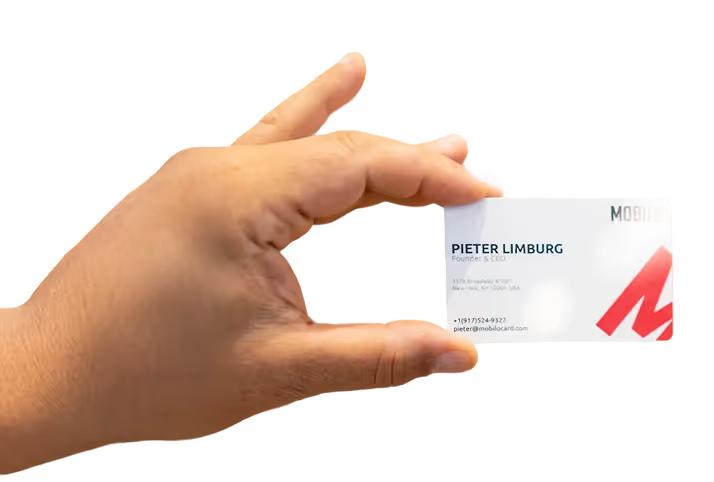
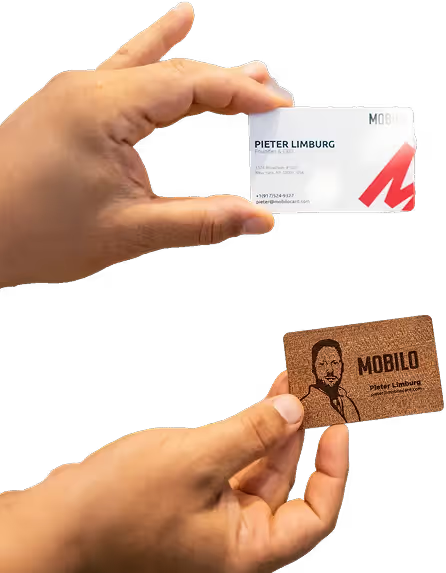
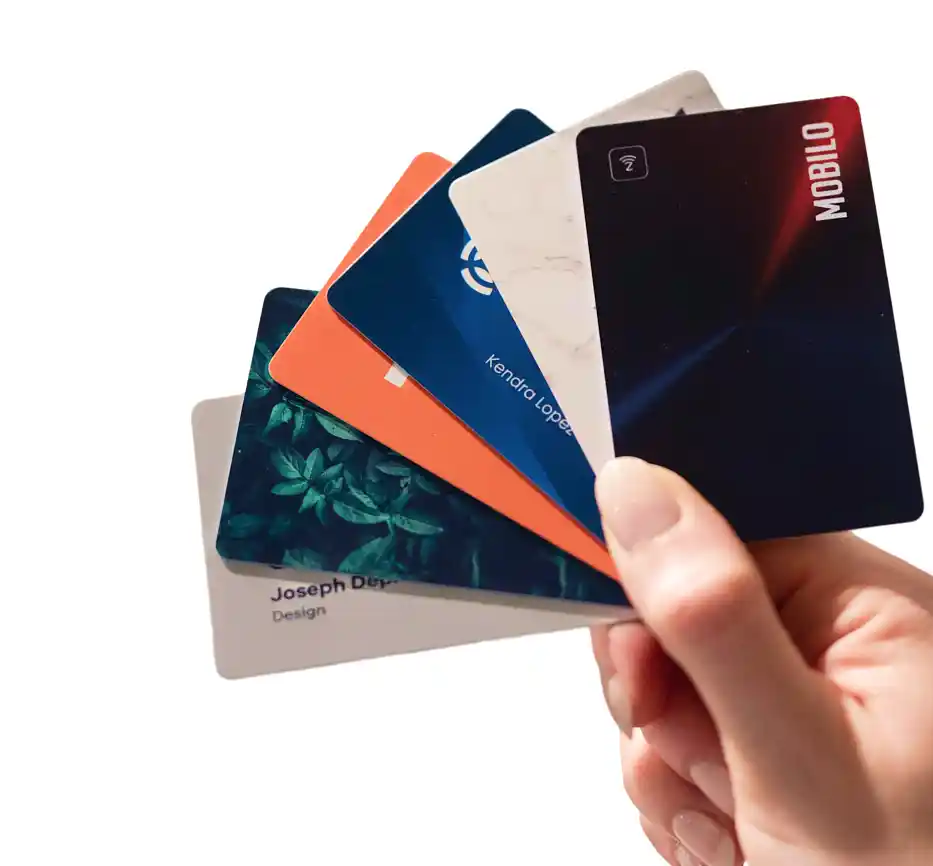
Mobilo brings conversion intelligence to face-to-face networking. Over 59,000 companies use our smart digital business cards to automatically exchange information, enrich lead data, score prospects, and sync directly to their CRM—eliminating manual follow-up and lost contacts.
"90% of paper business cards never make it into anyone's CRM, creating a massive gap in lead capture." — Kadi Connect, 2024
🎯 Key Point: Digital cards eliminate friction between meeting someone and converting them into a trackable lead.
Your in-person networking deserves the same strategic approach as your portfolio. Book a demo today and receive your first 25 Mobilo business cards free (worth $950).
🔑 Takeaway: Bridge the gap between your polished online presence and memorable face-to-face interactions with intelligent networking tools.