.avif)

.webp)
23 Unique Business Card Ideas to Inspire Your Next Design
On This Page
A business card is often the first tangible impression someone takes away from a conversation. When it looks identical to every other card in the pile, it rarely survives the week. Unique business card ideas help solve that problem by turning a small design choice into a lasting brand signal that keeps your name in someone's mind well after the meeting ends.
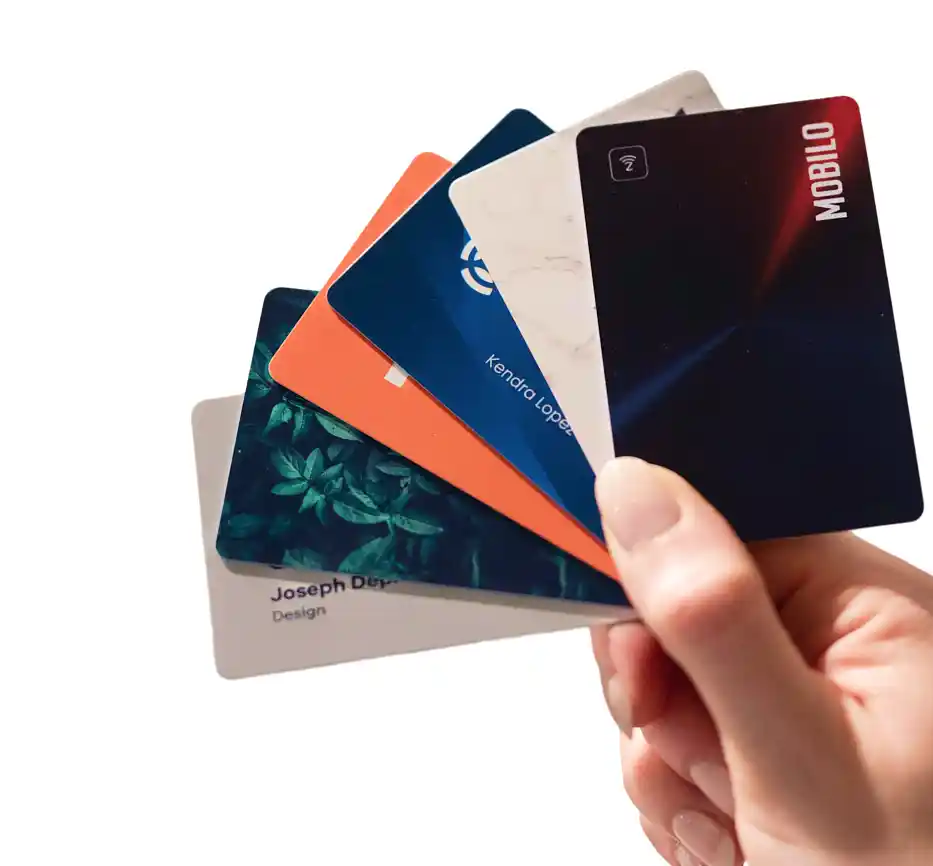
The right card goes beyond paper stock and fonts. It reflects personality, communicates professionalism, and gives people a reason to hold onto it. For those ready to move past print entirely, a digital business card from Mobilo offers a shareable, always-updated profile that contacts can save directly to their phone.
Summary
- First impressions formed through business cards carry real financial weight. Research from VistaPrint found that 72% of people judge a company by the quality of its business card, and 39% would choose not to do business with a company whose card looks cheap. The card functions as a proxy for how a business handles everything else.
- The core problem with most business cards is not design but purpose. According to UPrinting's business card statistics, 88% of cards handed out are thrown away within a week. Standard cards are built to transfer information, but in an era where contact details are instantly accessible, memorability has become the more valuable outcome.
- Cognitive science explains why certain card formats outperform others. The Von Restorff Effect shows that the brain flags items that stand out from a uniform group as worth remembering. Cards printed on brushed metal, frosted acrylic, or sustainably sourced wood occupy their own mental category, making them far easier to recall than standard stock alternatives.
- Tactile materials do something visual design alone cannot achieve. Physical sensation from soft-touch matte finishes, letterpress indents, or rough-cut edges creates a second memory trace that flat printing never produces. This is why unusual shapes, die-cut formats, and non-standard textures consistently outperform conventional cards in recall, even when the visual design is simpler.
- The digital business card market was valued at close to $180 million in 2024 and is projected to double by 2030, with over one-third of small businesses already making the shift. The sustainability case is real, but the operational case is stronger. A digital card can be updated instantly, tracked for engagement, and connected to CRM workflows so every exchange becomes a trackable lead rather than a contact that may never be followed up.
- Most teams have no visibility into what happens after a card is handed over. There is no signal for who followed up, which connections converted, or whether a promising introduction ever moved forward. Without a feedback loop, even the most distinctive printed card becomes a dead end.
- Mobilo's digital business card addresses this by pairing NFC tap and QR code sharing with direct CRM integration, so the moment of exchange connects to the sales pipeline rather than ending in someone's pocket.
Why Traditional Business Cards No Longer Stand Out
Most professionals believe a business card's job is to share information — name, title, phone number, email. But that belief dates back to a time when contact details were hard to find. Today, you can get that information instantly almost anywhere. The card's real job has changed completely.
"The traditional business card was built for a world where information was scarce — that world no longer exists." — Mobilocard
💡 Tip: If your business card is only delivering contact information, it's already obsolete — focus on making it a tool for memorable first impressions instead.
⚠️ Warning: Clinging to the old model of business card design means your card is doing the bare minimum in a world that demands instant, meaningful connection.
- Information Sharing: Move beyond just sharing names and titles to creating a memorable, value-driven impression that defines your professional identity.
- Digital Connection: Replace static phone and email text with systems that drive an instant, trackable digital connection to your pipeline.
- Engagement Style: Shift from passive information delivery to using your card as an active, interactive engagement tool.
- Relevance: Transition from the era of scarcity to modern strategy, where your card must cut through the noise to stand out in an information-rich world.

Why do most business cards get thrown away within a week?
At networking events, you collect cards and put them in your pocket. By the time you get home, you've gathered six more just like it. According to the UPrinting Blog's business card statistics, 88% of business cards handed out are thrown away within a week. That's not a design problem; it's a purpose problem. The card was built to deliver information, not to create desire.
The real currency is memorability, not information
Here's what separates the cards people keep from the ones they throw away: the ones that survive create a feeling—curiosity, surprise, a moment of "I've never seen that before." Psychology research on first impressions shows that emotional encoding happens within seconds and is driven far more by sensory distinctiveness than by content. A card printed on translucent plastic, laser-etched wood, or embedded with a QR code that opens a live portfolio doesn't share contact details—it creates a memory anchor. The information becomes secondary to the experience of receiving it.
What happens when there's no way to track whether a card led anywhere?
Most teams print a batch, hand them out, and hope for the best with no tracking, follow-up signal, or way to know if the card led anywhere. A digital business card changes that equation by pairing the physical impression with a live digital profile, keeping the card connected to your brand, latest work, and pipeline.
Why does a cheap-looking card cost you business before you say a word?
UPrinting's research found that 39% of people choose not to do business with a company if their card looks cheap. This reflects more than vanity: a poorly designed card signals how a business handles details, and people form quick judgments from small clues. A thoughtfully designed card suggests the person behind it works with the same care.
How do distinctive formats serve a strategic function beyond aesthetics?
The professionals who invest in distinctive card formats understand that attention is the first conversion. You cannot build a relationship with someone who doesn't remember meeting you. Custom shapes, premium finishes, embedded NFC chips, and interactive elements serve the same strategic function: they give the recipient a reason to pause, engage, and remember. But knowing a card needs to be memorable is only half the equation—and the easier half.
Related Reading
- Business Card Ideas
- Matte Vs Uncoated Business Cards
- Types Of Business Cards
- Business Card Psychology
- What Should Be On A Business Card
- How to Make a Professional Business Card
- Rounded Corner Business Cards
- Minimalist Business Cards
- Business Card Paper Weight
- Business Card Colors
What Makes a Business Card Memorable?
The harder part is knowing which design choices actually make people stop and pay attention, and why they work based on how people think and feel rather than just how they look. Understanding the psychology behind memorability — not just the aesthetics — is what separates a card that gets kept and acted on from one that gets immediately forgotten or tossed aside.
"A business card is not just a piece of information — it's a first impression frozen in time, and every design decision either reinforces or undermines that moment." — Design Psychology Principle
🎯 Key Point: The most memorable business cards aren't just pretty — they're engineered around cognitive triggers that influence how people process, remember, and respond to what they see.
💡 Tip: When evaluating your design choices, always ask why a choice works on a psychological level, not just whether it looks good — that's the difference between good design and truly unforgettable design.
- Color: Triggers immediate emotional associations and brand recall, providing a high impact on long-term memorability.
- Typography: Signals professional personality and builds foundational trust, creating a high impact on how the brand is perceived.
- White Space: Reduces cognitive load by focusing the viewer's attention, offering a medium-high impact on clarity and message retention.
- Texture/Finish: Engages tactile memory, creating a physical connection to the card that results in a very high impact on overall memorability.

Why does standing out make a card easier to remember?
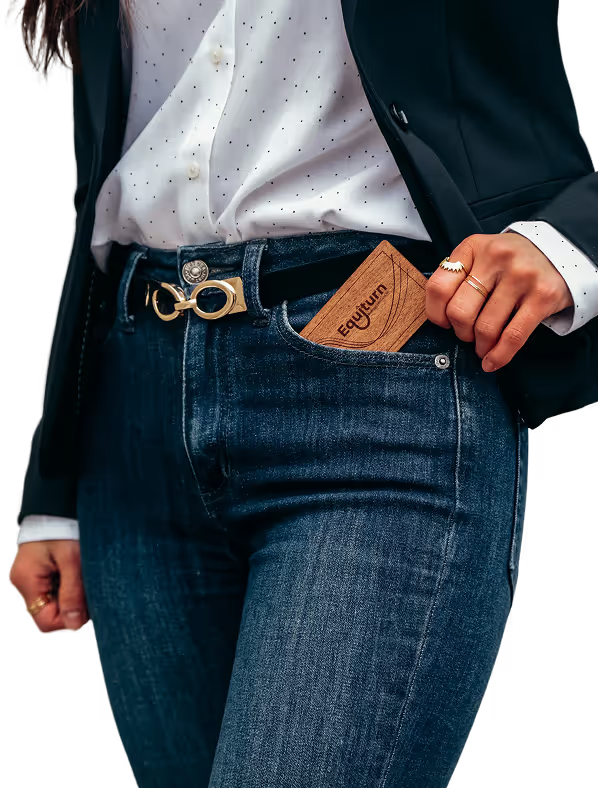
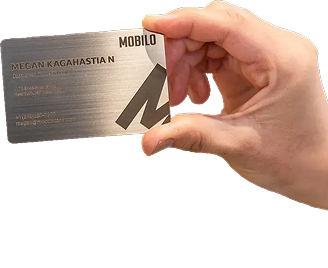
Every memorable business card triggers the Von Restorff Effect: when something stands out from similar items, your brain marks it as worth remembering. A card printed on standard 16pt gloss stock gets filed alongside every other card in the stack. A card printed on brushed metal, translucent frosted plastic, or sustainably sourced wood gets its own special place. Your brain doesn't have to work to remember it because it never grouped it with the others.
Why material and texture matter more than you think
Materials you can touch engage a second sense that visual design alone cannot. When someone runs a thumb across a soft-touch matte finish, a letterpress indent, or a rough-cut edge, that physical sensation creates a memory trace that flat printing never will. The brain encodes experiences, not images. A card that feels different gets remembered differently. This is why unusual shapes, die-cut designs, and non-standard card sizes consistently outperform conventional counterparts in recall, even with simpler visual design.
How does card quality signal competence before a conversation starts?
According to VistaPrint's Business Card Trends 2026, 39% of people would choose not to do business with a company that has a cheap-looking business card. A quality business card signals competence before any conversation begins.
Why does a passive card fail to move the needle?
Most professionals order a standard card with their logo and phone number, then wonder why it underperforms. A passive card only shares information. Teams using digital business cards combine physical formats—metal, wood, classic paper—with NFC taps, QR codes, and digital landing pages that connect directly to CRM workflows. The card becomes a system entry point, not something that sits forgotten in someone's pocket.
The elements every card must still get right
Creative formats get attention, but the basics close the loop. Your name, title, company, contact details, and a clear way to reach your digital presence—whether a QR code or social handle—are essential. VistaPrint's research shows that 72% of people judge a company based on business card quality, making brand consistency as important as creativity. Your logo, typography, and color palette should match every other touchpoint your audience encounters. Color psychology matters: navy signals trust, black signals authority, warm tones signal approachability. None of this works if the typeface is illegible at small sizes or hierarchy buries your name below your tagline.
Why does restraint make a business card more effective?
Minimalism works because a cluttered card forces the reader to work hard. White space isn't empty—it's breathing room that directs the eye to what matters most. When typography, color, and layout work together with restraint, the card communicates confidence. When they compete, it communicates noise.
Related Reading
- Should I Put My Picture On My Business Card
- Photography Business Cards Examples
- Horizontal vs Vertical Business Cards
- Business Card Examples For Owners
- How To Put an Instagram Handle on a Business Card
- Esthetician Business Card Ideas
- Photography Business Cards Examples
- Back Of Business Card Ideas
- Business Card Details
- Business Card Requirements
- Business Card Dimensions
23 Unique Business Card Ideas to Inspire Your Next Design
Every card on this list solves a specific problem. The ideas range from innovative material choices to digital formats, each answering one critical question: what does this card do for the recipient and the business?
💡 Tip: Before choosing a design, ask yourself what specific problem your business card needs to solve — memorability, functionality, or brand storytelling.
"The best business cards don't just share contact information — they solve a problem and leave a lasting impression the moment they're handed over." — Design Industry Insight
- Material Choices: Solves the problem of being forgettable by using texture and weight to stand out through a premium tactile experience; best for creative industries where first impressions are visual and sensory.
- Digital Formats: Eliminates the friction of manual entry and paper loss by providing instant, effortless information sharing; best for tech-forward and remote professionals who operate in fast-paced digital ecosystems.
- Functional Designs: Addresses the issue of business cards being tossed aside by adding real-world utility (e.g., tools, appointment calendars, or portfolio links); best for service-based businesses that need to remain top-of-mind for long-term retention.
🎯 Key Point: The 23 ideas in this list aren't just aesthetic choices — each one is a strategic decision designed to make your card work harder for your brand.

1. Non-Rectangular Shapes
Best for brands that want their identity felt before the card is even read. A custom die-cut shape—circular, bone-shaped, or a product silhouette—instantly signals differentiation. Custom shapes work because they interrupt automatic sorting behavior. When something doesn't fit the expected format, the brain pauses—and that pause is your opportunity.
Implementation tips
- Keep practicality in mind: unique shapes stand out, but cards must still fit in wallets or cardholders.
- Balance creativity with legibility. Use a clean layout to keep contact information easy to find and read.
- Choose a print partner experienced with custom die cuts that offers templates or design guidance for irregular shapes.
- Order a small batch to test how the shape looks and feels before printing a large quantity of cards.
2. Vertical Design
Best for brands with strong visual content, portraits, architectural photography, or product imagery that benefits from a tall format. Vertical orientation prioritizes the order in which information appears: the image typically leads, followed by contact details. Rens Park Designs demonstrated this with Cookie Wizard, using a vertical card where the illustration conveys the design's personality before the viewer reads the name.
3. QR Code Business Cards
Best for professionals who want their card to do more than sit in a drawer. A QR code turns a physical card into a live gateway, linking directly to a portfolio, booking page, social profile, or digital contact card. The advantage is continuity. The in-person exchange starts the relationship, and the QR code extends it into a digital environment where the prospect can act immediately.
Benefits of using QR codes
- Easy contact sharing. Instantly direct people to your website, store, or digital business card.
- Portfolio or store linking. This works well for creators, freelancers, or ecommerce owners who want to showcase products or work samples.
- Track engagement. Many QR code generators let you monitor scan frequency, timing, and location. This helps you measure your card's performance at events.
- Dynamic updates: change the link behind the code later to promote new campaigns or products without reprinting your cards.
How to set it up
- Use a trusted QR code generator such as QR Code Generator, Beaconstac, or Flowcode.
- Pick a dynamic QR code for analytics and editing flexibility.
- Link to a clean, mobile-friendly landing page or digital contact card.
- Test your code on multiple devices to ensure it scans quickly and redirects properly.
- Place the QR code in a visible, uncluttered area with sufficient white space around it for easy scanning.
4. Minimalist Black and White Cards
Best for brands where authority and precision matter more than personality. Clean black-and-white design with bold typography eliminates visual distraction, focusing entirely on your name, title, and logo. The constraint is the point. When you strip color from a card, every remaining element must justify its presence, producing cards that feel intentional rather than assembled.
5. Full-Bleed Photo Background
Best for brands built around a visual identity, food, travel, real estate, or creative services. A full-bleed photograph communicates context that words cannot compress into two lines of copy. The risk is legibility. Use contrast, overlay, or a dedicated text zone to keep contact information readable without letting the image overwhelm the typography.
6. Spot UV Gloss Finish
Best for brands seeking a premium feel without specialty materials. Spot UV applies a high-gloss coating to specific areas, typically your logo or key graphic, while the rest remains matte. The contrast creates a tactile experience that's subtle yet clear, making recipients pause before setting the card aside.
7. Metallic Foil Stamping
Best for luxury, finance, legal, or any brand where perceived value is part of the product. Gold, silver, and holographic foil finishes signal investment before the conversation begins. According to VistaPrint's Business Card Trends research, 72% of people judge a company or person by the quality of their business card. Foil stamping is one of the most direct ways to influence that judgment in your favor.
8. Transparent Acrylic Cards
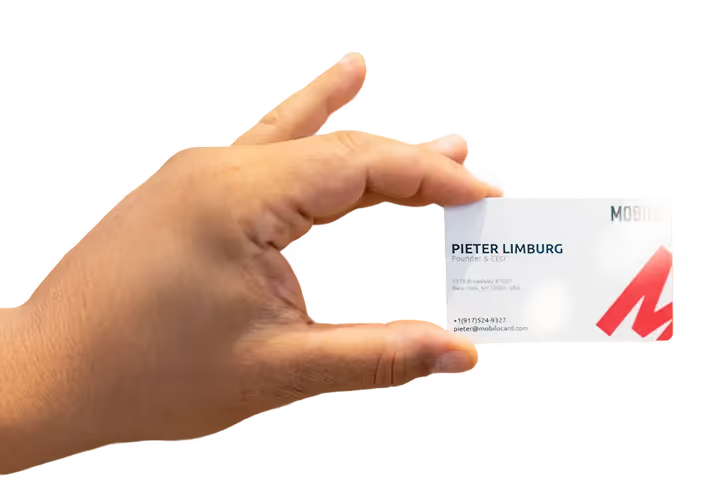
Best for tech, architecture, or design brands that want their card to feel like a product prototype. Transparent acrylic cards have a weight and clarity that standard paper cannot match, and they photograph exceptionally well—a key advantage when people share interesting cards on social media.
9. Embossed or Debossed Logos
Best for brands where craft and quality are core values. Embossing raises your logo above the card surface; debossing presses it into the card. Both create tactile details that reward careful handling. The effect is strongest with a clean surrounding design. Texture competes with clutter, so give the dimensional element room to be noticed.
10. Die-Cut Shaped Cards
Best for brands with a strong visual symbol: a camera for photographers, a leaf for sustainability brands, a coffee cup for cafes. Die-cutting makes the card's outline part of the brand story. The implementation challenge is practicality: a card that cannot survive in a wallet will impress once and disappear. Design for durability alongside creativity.
11. Magnetic Business Cards
Best for service businesses where repeat contact matters. A magnetic card attached to a refrigerator or filing cabinet stays visible for months, not days, competing for space on a surface where your number is already visible when someone needs it.
12. Soft-Touch Velvet Coating
Best for beauty, wellness, luxury retail, or any brand where sensory experience is part of the promise. Velvet coating transforms a standard card into something that feels thoughtful and intentional while reducing fingerprints and smudging to keep it looking sharp longer.
13. Gradient Color Palettes
Best for creative agencies, tech startups, and brands targeting younger professional audiences. Gradients signal modernity cost-effectively without requiring a material upgrade. The execution risk is printing consistency. Gradients that look smooth on screen can band or shift on certain paper stocks. Always request a physical proof before committing to a full print run.
14. Minimal Text With Bold Logo
Best for established brands where the logo carries recognition weight. A name, title, one contact method, and large logo are confidence moves: the brand doesn't need to explain itself. This approach ages better than cards packed with social handles, phone extensions, and secondary emails. Fewer elements ensure longer relevance.
15. Holographic Finishes
Best for tech, gaming, entertainment, or any brand showing forward momentum. Holographic finishes shift color under different lighting conditions, making the card look different each time someone picks it up and encouraging repeated handling. That variability drives engagement: a card that behaves differently across contexts is handled more than once.
16. Bold Typography Focus
Best for writers, speakers, consultants, or personal brands where the name itself is the product. When typography is the design, every font choice, weight, and spacing decision carries meaning. The failure mode is to use bold type for decoration rather than for hierarchy. Bold everything, and nothing stands out. Make the most important element, usually your name or specialty, impossible to miss.
17. Multi-Language Cards
Best for businesses serving international clients or operating across multiple markets. Printing both sides in different languages demonstrates consideration for the recipient's experience and streamlines the first exchange. Prospects are more likely to keep a card they can read in their preferred language.
18. Textured Specialty Paper
Best for brands where sustainability and craft are core to the identity. Kraft, linen, and recycled paper stocks communicate values before a word is read. Special types of stocks perform differently with different printing techniques. Letterpress on cotton paper produces a depth that offset printing on standard card stock cannot achieve.
Why does defaulting to standard card stock become a problem?
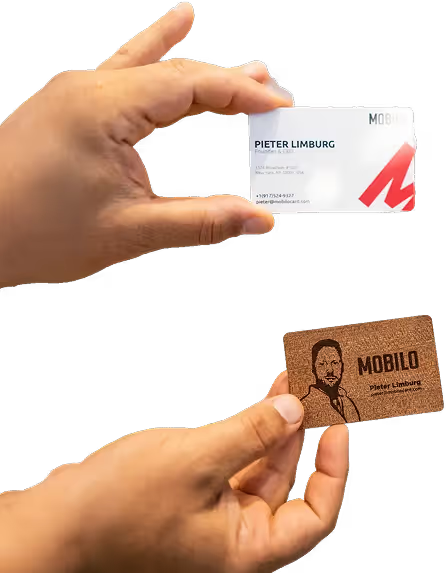
Most teams use standard card stock for convenience and bulk ordering. As brands grow and introductions become more important, that convenience becomes more expensive. Teams working with our digital business card pair smart physical cards made of wood, metal, or paper with digital profiles that update automatically, eliminating the need to reprint cards.
19. Personal Photo Cards
Best for personal service providers, creatives, and anyone whose face is part of their brand. A photo card creates recognition before the follow-up call: the prospect already knows what you look like when they reach back out. This works equally well for photographers, interior designers, copywriters, child care providers, and anyone whose business runs on personal trust.
20. Folded Cards
Best for service businesses needing more space than a standard card. A folded card provides twice the room for service menus, pricing overviews, instructions, and contact details. The extra space makes QR codes feel natural rather than crowded, a logical next step to a booking page.
21. Cards With Freebies or Promotional Codes
Best for retail, food, and consumer service brands where product trials drive purchases. A card that functions as a coupon or includes a discount code gives recipients a reason to act, not merely remember your business. The seed packet variation works naturally for landscaping, gardening, or plant-related businesses. A small envelope printed with your business information and filled with seeds becomes something recipients use, keeping it in their space much longer than a standard card.
22. Digital Business Cards
Digital business cards let professionals share contact information, portfolio links, and social profiles through NFC tap, QR code, or Apple NameDrop. They deliver measurable results: cards update in seconds, track engagement metrics, and integrate directly with CRM workflows, turning every exchange into a lead. The global digital business card market was valued at $180 million in 2024 and is projected to double by 2030. Over one-third of small businesses have already adopted digital cards.
23. 3D and Dimensional Effects
Best for brands where innovation and craft demand tactile experience. Techniques like embossing, layered cutouts, and spot UV create physical depth that encourages prolonged, deliberate handling.
What makes dimensional effects so memorable on a business card?
The Go Forth Creative cards for South Texas Brick and Stone demonstrate this perfectly. Stacked, they resemble a brick wall, transforming the card into a miniature version of the product itself.
Tips for using dimensional effects
- Keep it intentional. Highlight key elements, such as your logo or tagline, rather than overloading the design.
- Combine textures wisely. Pair matte and glossy finishes for subtle depth.
- Test before printing. Different papers and finishes interact differently, so request samples to ensure the effect matches your brand's look.
The right card idea is only half the equation, and what you do with the connection it creates is where most people leave real opportunity on the table.
Turn a Great Business Card Idea Into a Better Networking Experience
A great card design only creates an opening. What happens after the handoff determines success. When contact details live on paper, there's no way to track who followed up, which leads converted, or whether the connection moved forward.
"A card that tracks outcomes is more valuable than one that only looks good." — Mobilo
💡 Tip: Think of your business card not as a final impression, but as the starting point of a trackable relationship.
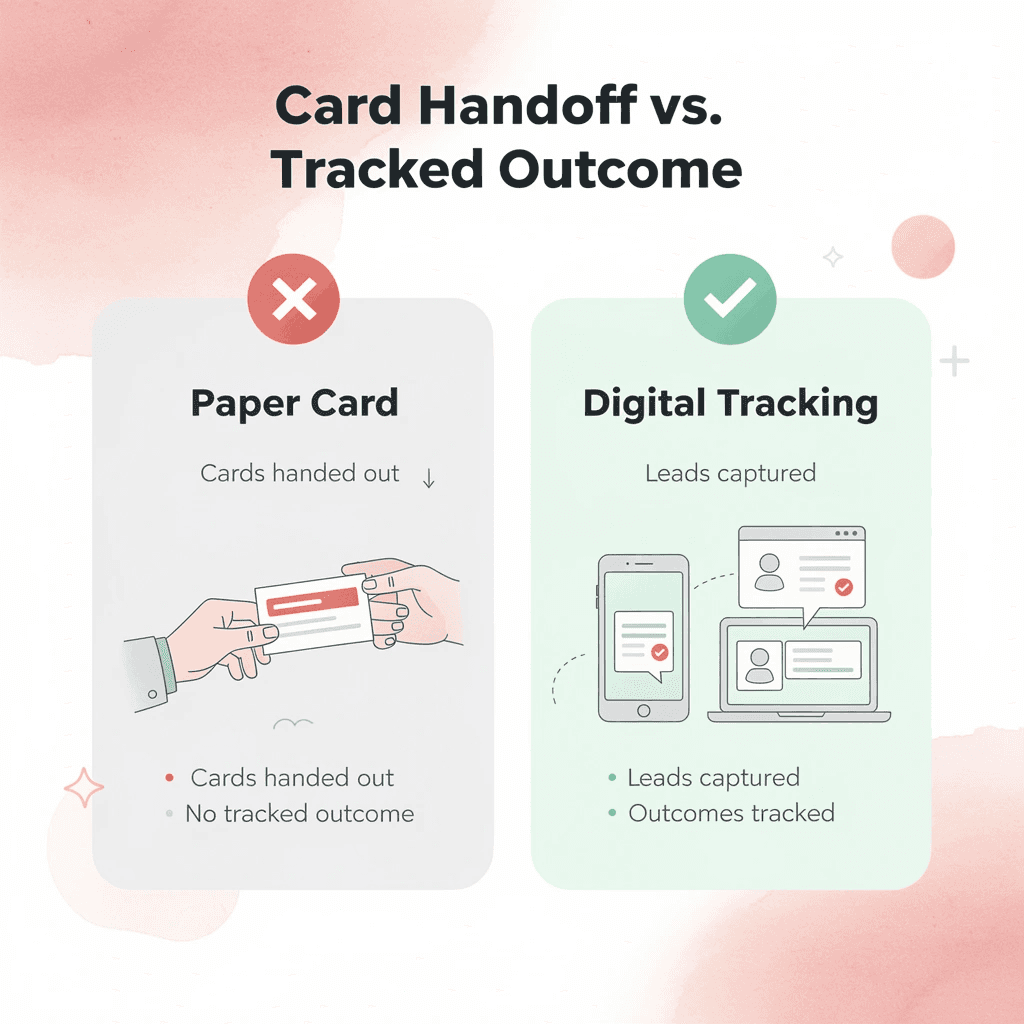
Most professionals collect cards, enter details manually, and hope timing is right. As teams grow and events multiply, this process breaks down: leads go cold, data entry lags, and visibility disappears entirely. A digital business card like Mobilo closes that gap by combining NFC tap, QR code sharing, and CRM sync into a single interaction — giving sales teams the pipeline data that printed cards cannot generate.
- Data Entry: Move from tedious manual entry to automatic CRM synchronization, ensuring every contact is captured instantly.
- Lead Tracking: Replace "lost" leads with full visibility, allowing you to see exactly who engaged and when.
- Contact Sharing: Upgrade from static cards to NFC tap and QR sharing for a professional, frictionless exchange.
- Conversion Insights: Transform a simple handshake into actionable pipeline data that measures your actual networking ROI.
- Lead Retention: Stop leads from going cold with automated, timely, and trackable follow-up sequences.
⚠️ Warning: Every day your team relies on manual card entry is a day qualified leads risk going cold.
Over 55,000 companies have switched to digital cards because a card that tracks outcomes is more valuable than one that only looks good. Book a personalized demo to see how Mobilo works. New customers receive their first 25 digital business cards free — a $950 value — so your team can experience smarter networking before committing.
🎯 Key Point: With 55,000+ companies already using digital cards, the shift from passive paper to active, data-driven networking is the new standard.

Related Reading
- Plumbing Business Cards Examples
- HVAC Business Cards Examples
- Unique Business Card Ideas
- Artist Business Cards Examples
- Therapist Business Cards Examples
- How To Put Social Media On Business Card
- Best Real Estate Business Cards