.avif)

What Are the Standard Business Card Dimensions and Bleed Size?
On This Page
Getting business card dimensions wrong is a small mistake with real consequences. A misaligned bleed area, text too close to the edge, or incorrect file setup can result in cut-off details and unprofessional borders after printing. Standard business cards measure 3.5 x 2 inches, but print-ready files require a precise bleed zone, safe zone, and resolution to produce clean results. Understanding these specifications before sending a file to print saves time, money, and frustration.
Even a perfectly printed card has limits. It can run out, get lost, or fail to capture everything a contact needs in one exchange. Pairing a physical card with a digital business card from Mobilo lets professionals share contact details, links, and portfolio work instantly, removing the risk of missed connections when print runs dry.
Summary
- The standard US business card size is 3.5 x 2 inches (88.9 x 50.8 mm), which aligns with the ISO 7810 ID-1 format used for credit cards and driver's licenses. This compatibility is deliberate: a card that fits existing wallet slots is one that survives beyond the first interaction. Commercial printers standardize around this format because it reduces material waste, speeds up press runs, and lowers setup costs.
- Correct dimensions are only one part of a print-ready file. The full bleed size must extend to 3.75 x 2.25 inches, adding 0.125 inches (3mm) on each side beyond the trim line to prevent white borders caused by natural cutting variance. The safe zone pulls inward 0.125 inches from the trim line, keeping critical elements like names, phone numbers, and logos away from the blade. Resolution must be at least 300 DPI, and color mode must be set to CMYK before design begins, not converted at export, since RGB-to-CMYK shifts can dull vibrant colors in ways that only become visible after the cards arrive.
- International sizing adds another layer of complexity for teams operating across regions. The European standard sits at 85 x 55 mm, and Japan uses 91 x 55 mm for its meishi cards, both close to the US format but not identical. A US-spec card printed on a European press can trigger format mismatches that add cost or require a redesign. For teams distributing cards across multiple markets, standardizing on a single specification is worth more than accommodating regional variations.
- Non-standard formats such as square cards (2.5 x 2.5 inches), mini cards (around 2.75 x 1 inch), and folded cards each carry specific functional trade-offs. Square cards feel distinctive but do not fit standard cardholders or most wallets. Mini cards solve portability but sacrifice layout space, making it difficult to include all necessary contact information without crowding. Folded cards double the surface area but cost more to produce and add bulk that makes carrying quantities inconvenient.
- Print failures at scale are rarely caused by ignorance of trim size. They come from teams where each person submits slightly different file dimensions, bleed setups, or resolution settings, resulting in inconsistent cards across the organization, some with white borders, some with cropped logos, none of them reinforcing a unified brand identity. The failure point is the assumption that trim size and print-readiness are the same thing, compounded by the number of people involved in the process.
- Mobilo's digital business card addresses this by centralizing contact sharing under a single brand template and removing production variables such as bleed, DPI, and color mode conversion entirely, so every team member presents a consistent identity without managing a single print file.
What Is the Standard Size for a Business Card?
The standard business card size in the US is 3.5 x 2 inches (88.9 x 50.8 mm). This matches the ISO 7810 ID-1 format used for credit cards and driver's licenses, so it slides cleanly into wallet slots and card holders. A card that fits where people already store things is a card that survives the first 24 hours.
💡 Tip: The 3.5 x 2-inch standard isn't arbitrary — it's deliberately engineered to match wallet slot dimensions worldwide, making it the single most compatible card size you can print.
The standard dimensions for a professional business card are:
- Width: 3.5 inches (88.9 mm)
- Height: 2 inches (50.8 mm)
- Standard: ISO 7810 ID-1
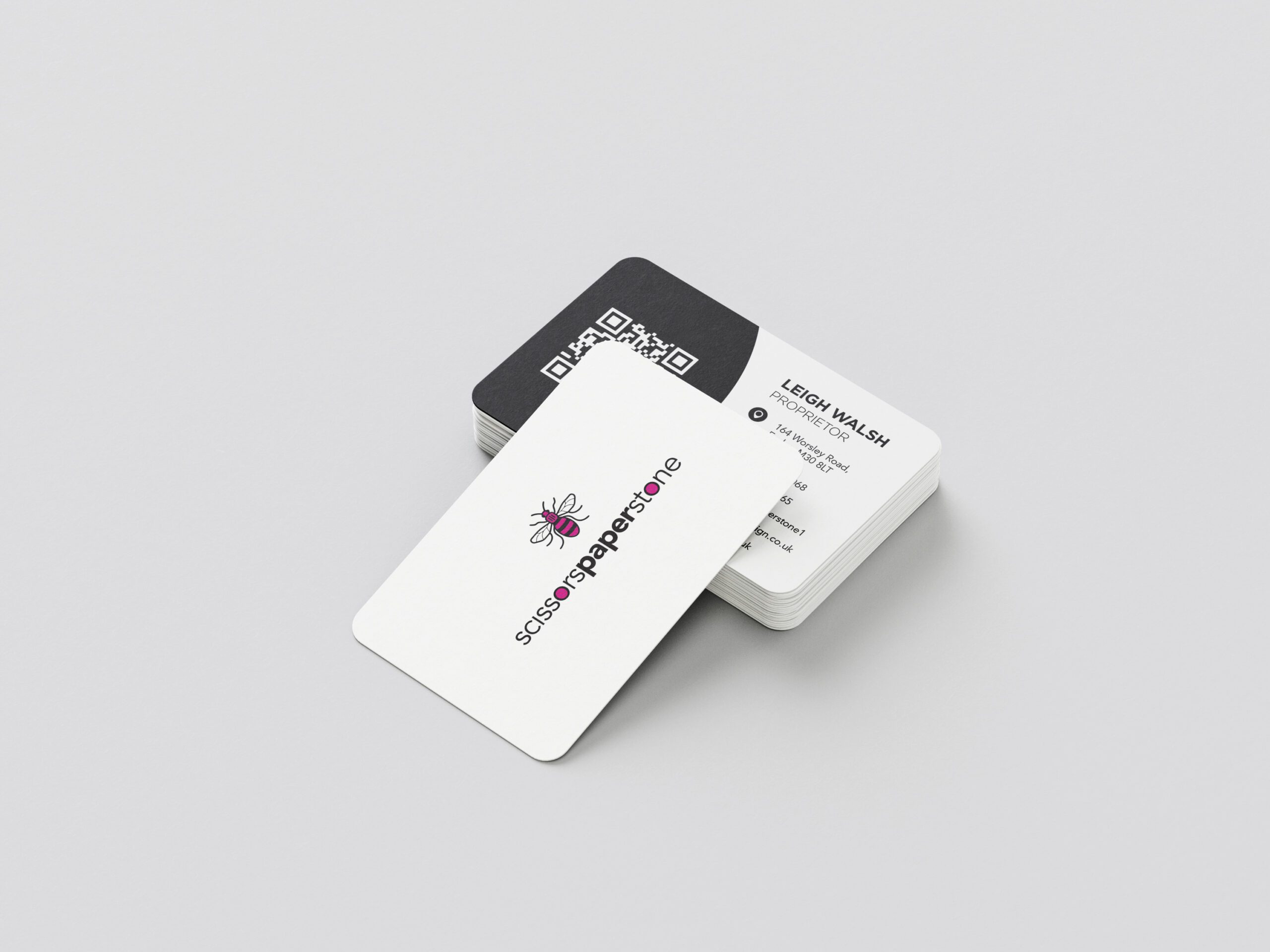
According to Wave Connect's Business Card Statistics, this size is the dominant format across virtually every industry in the US and Canada. Commercial printers standardize around it because standard sheet sizes reduce material waste, speed up press runs, and lower setup costs. Deviating from the standard increases both time and money.
"The 3.5 x 2 inch format is the dominant business card size across virtually every industry in the US and Canada, making it the safest, most cost-efficient choice for print production." — Wave Connect Business Card Statistics
⚠️ Warning: Choosing a non-standard size may seem like a creative differentiator, but it increases printing costs, production time, and the risk that your card won't fit standard wallets or card holders.
How dimensions translate across formats
At 300 DPI (the minimum for sharp print output), a standard US business card renders at 1050 x 600 pixels. With a full bleed of 0.125 inches (3 mm) on all sides, the dimensions expand to 1083 x 633 pixels. The safe zone for text and logos is 1008 x 558 pixels, preventing important details like phone numbers from being trimmed at the edge.
How do international card sizes differ from US standards?
International sizing differs notably. Jukebox Print's Business Card Size and Dimension Guide confirms the standard European card is 85 x 55 mm, slightly shorter and taller than the US format. Japan uses 91 x 55 mm for "meishi" cards. A card designed to US dimensions may not fit in a European cardholder, leading it to be set aside.
When a 50-person sales team each submits different file dimensions, bleed setups, or resolution settings to the printer, the result is inconsistent cards: some with white borders, some with cropped logos, none reinforcing unified branding. Our digital business card centralizes design and distribution, ensuring every team member shares the same accurate contact details without print variability.
Do rounded corners change the dimensions of your file?
Rounded corners confuse many designers because adding a corner radius does not change document dimensions. Set up your file at full trim size with standard bleed; rounding happens at the cutting stage, not the design stage. Treating it differently creates files at incorrect sizes and wastes the entire print run. Knowing the right dimensions is only half the equation.
Related Reading
- Business Card Ideas
- Matte Vs Uncoated Business Cards
- Types Of Business Cards
- Business Card Psychology
- What Should Be On A Business Card
- How to Make a Professional Business Card
- Rounded Corner Business Cards
- Minimalist Business Cards
- Business Card Paper Weight
- Business Card Colors
Why Correct Business Card Dimensions Alone Won't Prevent Printing Mistakes
Choosing the right business card dimensions doesn't guarantee a professional print. Dimensions only tell the printer how large to cut the card — they don't say anything about what happens at the edges, how sharp the image will be, or whether your colors will survive the change from screen to ink.
"Getting the dimensions right is just the starting point — what happens at the edges, in the resolution, and through the color conversion process is what truly determines print quality." — Print Production Fundamentals
⚠️ Warning: Relying on correct dimensions alone is one of the most common mistakes designers make — your card can still be cut incorrectly, appear blurry, or suffer color shifts without proper bleed, resolution, and color profile settings.
Understanding these factors is essential for high-quality print results:
- Card Size: Controls the physical dimensions but misses necessary print technicals like edge bleed and safe zones.
- Resolution (DPI): Ensures image sharpness for print, but is not determined by the physical dimensions alone.
- Color Profile: Manages the transition from screen (RGB) to ink (CMYK) accuracy, but requires a separate, manual setup in your design software.
💡 Tip: To truly prevent printing mistakes, pair your correct card dimensions with proper bleed settings, a minimum of 300 DPI resolution, and a CMYK color profile — dimensions are just one piece of the puzzle.

Why do so many designers overlook bleed and safe zones?
This misconception spreads because design software opens with a blank canvas, asking for one thing: page size. Templates downloaded from the internet are often sized correctly at 3.5 x 2 inches, but they rarely include visible guides for bleed or safe zones, and almost never explain why those zones exist. Online tutorials focus on aesthetics, font pairing, and color choices while treating print production as an afterthought.
What the printer actually needs
A print-ready file is built in layers that most designers never see on screen. According to the Jukebox Print Business Card Size and Dimension Guide, your full print file must be set up at 3.75 x 2.25 inches, not the standard 3.5 x 2 inches, because the extra space is reserved for bleed. This bleed area—0.125 inches (3mm) beyond the trim line on every side—ensures that background colors and edge-to-edge design elements extend past the cut point. Without it, natural variation in industrial cutting equipment leaves a thin white border.
The safe zone sits 0.125 inches inside the trim line, keeping your name, title, phone number, and logo away from the blade. Resolution must be at least 300 DPI; lower resolutions print with visible softness. Color mode must be CMYK, not RGB. RGB is built for screens, which emit light; CMYK is built for ink, which absorbs it. A vivid blue on your monitor can print noticeably duller if you don't convert to CMYK.
What goes wrong when teams skip these checks?
Most teams send whatever file the designer exports, trusting the printer will flag errors before the run begins. Many do not, especially at volume. What surfaces instead is a finished box of cards with washed-out colors, cropped logos, or a sliver of white at one edge—discovered only after payment and delivery. The failure point is not a lack of knowledge about trim size, but the assumption that trim size and print-readiness are identical.
Why does production risk grow as teams scale?
This matters more when cards represent a brand at scale. A single designer can catch errors during review, but a team of 50 people across multiple offices, each ordering their own version, cannot consistently check the work. The gap between what looks right on screen and what prints correctly widens with every person added. Digital business cards eliminate this production risk entirely: no bleed to miscalculate, no DPI threshold to miss, no color mode conversion to get wrong. For teams managing brand consistency at scale, removing these production variables is critical. Bleed, safe zone, resolution, and color mode determine whether your dimensions produce deliverable work.
Related Reading
- Should I Put My Picture On My Business Card
- Photography Business Cards Examples
- Horizontal vs Vertical Business Cards
- Business Card Examples For Owners
- How To Put an Instagram Handle on a Business Card
- Esthetician Business Card Ideas
- Photography Business Cards Examples
- Back Of Business Card Ideas
- Business Card Details
- Business Card Requirements
- Business Card Dimensions
How to Set Up Your Business Card Dimensions Before Printing
Getting the file set up right before printing is essential. The trim size is 3.5 x 2 inches according to VistaPrint's business card specifications, but your file must account for what happens around and inside that trim — not just at it.
"The standard business card trim size is 3.5 x 2 inches — but your design file must extend beyond that boundary to account for bleed, safe zones, and cutting tolerances." — VistaPrint Business Card Specifications
To ensure your business card prints perfectly, you need to manage these three zones precisely. Here is the breakdown:
- Trim Size (3.5 x 2 inches): This is the final, physical dimension of your card after it is cut.
- Bleed Area (+0.125 inches on all sides): Your background colors or images should extend fully into this area. This prevents thin white slivers from appearing on the edges if the cutting blade shifts slightly.
- Safe Zone (0.125 inches inside trim): Keep all critical content (names, phone numbers, logos) strictly inside this boundary. This ensures your text isn't accidentally cropped off or placed too close to the edge for a professional look.
💡 Pro Tip: Always set up your bleed area first before placing any design elements — repositioning content after the fact is one of the most common and costly pre-print mistakes.
⚠️ Warning: Submitting a file built only to the 3.5 x 2 inch trim size — with no bleed and no safe zone — is the #1 reason business cards come back from the printer with unwanted white borders or clipped text.
How do bleed and trim settings affect your canvas size?
Build your canvas at full bleed size, not trim size. As Jukebox Print's business card size and dimension guide explains, bleed requires an additional 0.125 inches on each side beyond the trim, bringing your working canvas to 3.75 x 2.25 inches. Background colors, textures, and full-bleed images must extend to that outer edge; stopping at the trim line risks exposing a white border even with a 1mm cutting shift.
Why does the safe zone matter for critical design elements?
Pull every critical element—name, title, phone number, logo—at least 0.125 inches inside the trim line. Batch cutting has inherent variance, and text sitting too close to the edge might survive on one card but fail across 500 cards. The safe zone accounts for the mechanical reality of production.
What happens when file errors multiply across a full team order?
Most teams design in familiar tools, then export and hope the printer's template catches errors. At scale, a single misaligned file across a full team order results in reprints, delays, and brand inconsistency. Teams managing cards for dozens or hundreds of employees find that digital business cards eliminate this layer entirely, replacing file management and print coordination with centralized profile control and instant updates.
Start With Where And How You'll Use The Card
Context shapes every choice you make. A card handed across a table at a client meeting needs to feel confident and familiar. A card left on a retail counter can afford more personality. A card slipped into a mailer needs to survive the trip without curling at the corners. Map out where your card will travel before opening design software, since that journey determines every sizing choice. Geography matters too. US and Canadian networking adheres to local standards, but international events make size compatibility a logistical concern rather than a design preference.
Consider Wallet And Card Holder Fit
According to VistaPrint's business card dimensions guide, the standard US business card size is 3.5 x 2 inches because it fits wallets, card holders, badge sleeves, and desk organizers. Most wallet slots accommodate a width of 3.4 to 3.6 inches and a height of 2 to 2.2 inches. Cards that fit get kept; those that don't get folded or discarded. Square and oversized cards don't survive a jacket pocket or standard card holder without damage. The novelty fades when the card cannot go where your contact goes.
Match The Size To Your Brand Personality
Size is rarely useful on its own—it's part of your brand message. Standard horizontal cards signal stability and professionalism, while square or vertical formats signal creativity and confidence. A law firm and a design studio both need cards that communicate something before a word is read. Most professionals hand out cards during high-value moments: introductions, pitches, events, and follow-ups. A digital business card removes the constraint of fitting every detail into a fixed 3.5 x 2-inch space. Physical cards carry your brand; digital cards carry everything else and update instantly.
Think About How Much Info You Really Need
The failure point is usually trying to fit too much onto too small a surface. Before choosing dimensions, list what needs to appear: logo, name, title, contact details, QR code, and legal text if required. Standard card sizes handle simple information cleanly. Larger formats provide breathing room when the list grows. Decide what earns its place before layout begins, not after.
How does paper weight affect the feel of a business card?
Paper weight changes how a card feels to receive. Thin cards bend and feel temporary, while the standard weight for professional cards is 18pt stock, with 20pt and 24pt common for premium uses. According to Jukebox Print's business card size and dimension guide, the bleed area should extend 0.125 inches beyond the trim line on all sides. Weak paper makes it harder to maintain clean edges when cutting.
Which finish best matches your brand personality?
Finish is where brand personality becomes tangible. Soft touch feels intentional the moment someone picks it up. Gloss makes color stand out but shows fingerprints. Matte looks clean and simple. Uncoated feels natural and is easy to write on. Each message should align with what your brand communicates elsewhere.
Color mode and resolution are not optional
Set your file to CMYK before you design, not after. Converting an RGB file to CMYK at export shifts colors unpredictably: deep blues flatten, vibrant oranges dull. You may not notice until the cards arrive. Lock resolution at 300 DPI from the start; a file built at 72 DPI and scaled up prints with blur at larger sizes.
Why does the order of setup steps affect your final print?
The most preventable print failures stem from designing first and checking specs second. When canvas dimensions, color mode, and resolution are established before placing any element, every design decision is made within the correct constraints. This sequence costs nothing extra; skipping it costs a reprint. Getting the file technically correct is only half the decision. The other half is whether the dimensions work for how and where the card will be used.
How to Choose the Right Business Card Dimensions for Different Needs
Choosing the right card format starts with one honest question: where does this card actually end up? A card tucked into a European jacket pocket, filed in a corporate binder, or pinned to a corkboard faces different physical constraints — and your format either works with those constraints or fights against them.
"Your business card format must answer one question first: where does this card actually end up? The environment it lives in determines every dimension that matters." — Core Design Principle
- European Pocket: Use slim/vertical layouts to fit narrow spaces.
- Corporate Folder: Stick to exact 3.5" x 2" dimensions for standard slots.
- Display: Use landscape formats to maximize visual impact on pinboards.
🎯 Key Point: The single most important factor in choosing your card dimensions isn't aesthetics — it's the physical environment where your card will live, be stored, and be retrieved.
⚠️ Warning: Choosing a non-standard format without considering your audience's storage habits is one of the most common and costly mistakes in card design — even a beautifully designed card gets discarded if it doesn't fit where it needs to go.

The US Standard and Why It Dominates
According to VistaPrint's Business Card Dimensions guide, the standard US business card measures 3.5 x 2 inches. This size fits inside most card holders, wallet slots, and Rolodex sleeves in North America. A card that fits easily into standard storage solutions removes a practical barrier to retention. Professionals in finance, legal, real estate, and consulting favor this format because storability is a core function of the business card itself.
When European and ISO Formats Apply
The European standard is slightly smaller at 85 x 55 millimeters, which differs from the US size. That 2mm difference matters when cards are filed in holders designed for one standard or the other. If you're printing for international distribution, particularly across Germany, France, or the UK, matching the ISO CR80 format prevents your card from sliding around or bending inside a holder built to tighter tolerances. Print to the standard of the market where the card will be used most.
Square, Mini, and Folded: When Non-Standard Formats Earn Their Place
Square cards (typically 2.5 x 2.5 inches) and mini cards work when the card itself is part of the brand statement, not just a way to share contact information. A photographer, illustrator, or boutique agency can use the format to demonstrate creative confidence. The trade-off is significant: square cards don't fit standard wallet slots, they stack awkwardly in card holders, and they cost more to print per unit. Mini cards sacrifice readability at scale. Folded cards offer more surface area for content like service summaries or QR codes, but they're too thick for standard holders. Use non-standard formats only when the format itself communicates something your brand needs to say.
What happens to non-standard cards after they're handed over?
Most professionals who choose a non-standard format don't test how the card works in the recipient's environment. It gets handed over, briefly admired, then placed somewhere because it obviously fits nowhere. That's friction wearing a creative disguise, not memorability.
Printing Specifications That Affect Every Format
No matter which format you choose, the artwork setup follows the same logic. VistaPrint's specifications recommend a 0.125-inch bleed area on all sides: your background color or edge-to-edge imagery must extend beyond the trim line. Without bleed, cutting shifts leave white borders that undermine even expensive print jobs. Keep critical text and logos at least 0.125 inches inside the trim line as a safety margin. Resolution should be at least 300 DPI. These aren't suggestions—they're the difference between a card that looks intentional and one that looks like a draft.
Digital Cards Remove the Format Constraint Entirely
Physical cards have physical limits. A digital business card takes up no space, fits in every pocket, and updates without reprinting. For teams attending multiple events across different markets, this flexibility proves advantageous. While a printed card locks contact details, job titles, and URLs to outdated information, a digital card displays current information and connects directly to CRM workflows. The card transforms from a static object into the first step in a documented lead pipeline. The card is ready. What happens in the next 48 hours determines whether most of the value gets saved or quietly disappears.
Now That Your Business Card Is Ready, Put It to Work Immediately
Getting the dimensions right and making the file ready to print matter. But a correctly formatted card sitting in a box won't help your business grow.
"The most important dimension of any business card is what it makes possible after the handshake." — Mobilo
💡 Tip: A business card is only as powerful as the follow-up system behind it. Design gets you noticed; strategy gets you results.

Book a personalized digital business card demo with Mobilo in about 5 minutes and get 25 free digital business cards, worth $950, for your team. Mobilo turns ordinary contact information into a lead capture system that enriches prospect data, scores contacts against your ideal customer profile, and syncs every new connection directly to your CRM.
🎯 Key Point: The real value of a business card isn't the paper — it's the pipeline it feeds. With Mobilo, every handshake becomes a tracked, enriched, CRM-ready lead
- Traditional: Static info, manual data entry, no tracking or scoring.
- Mobilo: Dynamic info, CRM sync, lead scoring, and ROI tracking.
✅ Best Practice: Don't just hand out cards — activate them. A 5-minute demo with Mobilo is all it takes to turn your team's next 25 connections into a fully automated, CRM-integrated lead flow.
Related Reading
- Plumbing Business Cards Examples
- HVAC Business Cards Examples
- Electrician Business Card Ideas
- Unique Business Card Ideas
- Artist Business Cards Examples
- Therapist Business Cards Examples
- How To Put Social Media On Business Card
- Best Real Estate Business Cards