.avif)

.png)
12 HVAC Business Card Examples That Get Remembered
On This Page
When an HVAC job wraps up and a satisfied homeowner asks for a card, that small moment can either earn a referral or lose one. Studying real HVAC business card examples reveals what separates a card that stays on the fridge from one that ends up in the trash. The right contact details, a clean layout, and a design that signals professionalism all work together to build trust before the first follow-up call.
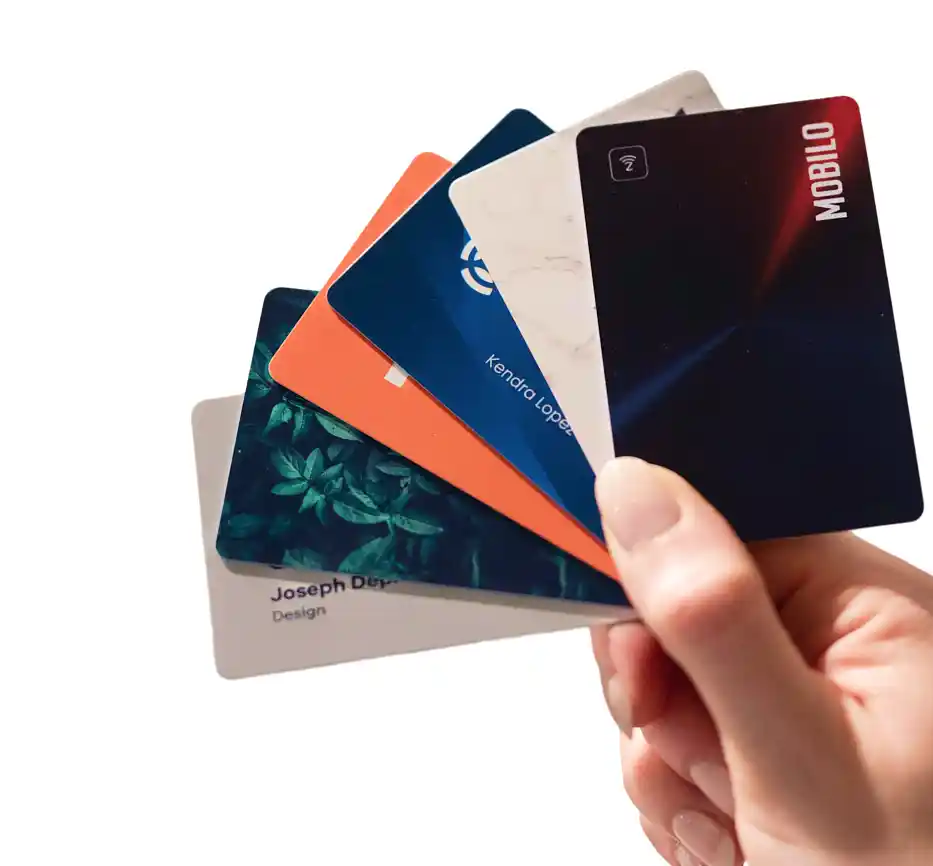
For technicians who want to make an even stronger impression, Mobilo offers a digital business card that lets customers save contact information instantly from their phone, no paper needed, making it easier for them to call back or refer a neighbor.
Summary
- Word-of-mouth referrals remain one of the most powerful conversion channels in the HVAC industry, with 88 percent of consumers trusting recommendations from people they know above all other forms of advertising, according to Nielsen's 2023 Trust in Advertising report. Most contractors hand out cards without engineering them to be passed along, which leaves that channel largely untapped.
- The physical quality of a business card directly affects whether a prospect calls or walks away. Research cited by FieldEdge found that 72 percent of people judge a company's credibility based on the quality of its business card, and Sera Tech's research found that 39 percent would choose not to do business with a company if its card looked cheap. Card stock and finish are conversion variables, not aesthetic preferences.
- Missed HVAC calls carry a measurable cost. According to AgentZap's HVAC industry phone statistics, a single missed call costs contractors $350 or more in lost revenue. A card that fails to build enough trust to get dialed produces the same financial outcome as a missed call, making card design a direct factor in revenue, not just branding.
- Profit margins in the HVAC industry vary dramatically depending on how contractors handle every customer touchpoint. HVAC Know It All reports that industry-average net profit margins range from 2.5 to 5 percent, while top-performing companies reach 15 to 25 percent. The contractors operating at the top of that range tend to treat materials like business cards as deliberate parts of a brand experience rather than afterthoughts.
- Card design should match the specific customer being targeted, because a card designed for everyone persuades no one. Residential homeowners prioritize reassurance and speed, commercial property managers look for credentials and reliability, and premium clients respond to tactile quality and restraint. Mismatched design signals create friction before a conversation even starts.
- Most HVAC businesses distribute cards to field technicians without a system to track what happens after the handoff, creating a lead visibility gap that compounds at every job site. Mobilo's digital business card addresses this by logging each contact exchange, automatically syncing lead data to a CRM, and providing owners with measurable data on which field interactions convert into booked jobs.
Why Most HVAC Business Cards Don't Generate More Calls
Customers keep HVAC business cards for one reason: when the air conditioning breaks at 11 pm in July, or the furnace stops working on a January morning, they call someone they already trust. That card becomes a split-second decision point, and most contractors are losing that moment without even knowing it.
"That card becomes a split-second decision point — and most contractors are losing that moment without knowing it." — Key Industry Insight
⚠️ Warning: If your business card doesn't instantly communicate trust, clarity, and a reason to call, it gets ignored — no matter how good your HVAC service actually is.
💡 Tip: Think of your business card as a 24/7 silent salesperson. The real question isn't whether customers kept it — it's whether your card gives them a compelling reason to dial your number when it matters most.
What Customers Need at the Moment of Crisis
- Instant trust signal
What Most HVAC Cards Deliver: Generic logo and name - Clear, bold phone number
What Most HVAC Cards Deliver: Cluttered contact details - Specific service reminder
What Most HVAC Cards Deliver: Vague tagline - Reason to call you over a competitor
What Most HVAC Cards Deliver: No differentiator - Easy-to-read design under stress
What Most HVAC Cards Deliver: Small, hard-to-read fonts
.webp)
Why is a business card the same as a missed call?
Most contractors assume that if the phone number is easy to read, the card is doing its job. But that thinking costs real money. According to AgentZap's HVAC Industry Phone Statistics, missed HVAC calls cost contractors $350 or more per call. A card that doesn't build enough trust to prompt a call is equivalent to a missed call. The card isn't contact information—it's the final marketing touchpoint between you and a booked job.
How do weak design choices quietly destroy customer trust?
A flimsy card stock, cluttered layout, or stock logo doesn't whisper "unprofessional"—it shouts it. Marketing psychology research shows that people make trust judgments within milliseconds of seeing a brand element, and those judgments are rarely reversed. A weak HVAC business card signals that the contractor cuts corners, the last message you want a homeowner processing when deciding who to let into their house.
What happens after you hand a card out?
Most HVAC contractors hand out cards without knowing what happens next. There's no tracking, no follow-up trigger, and no way to know if that introduction converted to a customer. Mobilo's digital business card solves this problem: when a customer taps or scans to save your contact, that interaction gets logged and tracked, turning a simple handoff into a measurable lead event. For HVAC companies managing field technicians across multiple job sites, that visibility transforms how you evaluate what's working.
How do top HVAC contractors use every touchpoint to build trust?
The best HVAC business cards signal competence and trustworthiness before a customer reads a word. Print quality, material weight, layout clarity, and logo consistency establish credibility. HVAC Know It All reports that the industry average net profit margin sits at 2.5 to 5 percent, while top performers reach 15 to 25 percent. Top contractors treat every customer touchpoint, including the business card, as part of a deliberate brand experience.
Trust isn't built when you hand over the card. It's built weeks later when the customer picks it up under pressure and decides whether to call.
Related Reading
- Business Card Ideas
- Matte Vs Uncoated Business Cards
- Types Of Business Cards
- Business Card Psychology
- What Should Be On A Business Card
- How to Make a Professional Business Card
- Rounded Corner Business Cards
- Minimalist Business Cards
- Business Card Paper Weight
- Business Card Colors
12 HVAC Business Card Examples That Get Remembered
Your HVAC business card either ends up in a junk drawer or on a prospect's counter: the difference comes down to design choices made before printing. Each element on that card—from typography and color to layout and finish—signals whether your business is worth remembering or worth forgetting.
"The difference between a card that gets kept and one that gets tossed comes down to intentional design choices made long before the card ever reaches a prospect's hand."
.webp)
🎯 Key Point: A well-designed HVAC business card isn't just contact information—it's a silent salesperson working for you 24/7 in wallets, drawers, and on countertops across your service area.
Here are twelve examples that show exactly what those winning design choices look like in practice—so you can steal what works and avoid the mistakes that send cards straight to the trash.
💡 Tip: Before diving into the examples, ask yourself: does your current business card pass the counter test? If a prospect set it down next to a competitor's card, would yours stand out immediately—or blend into the background?
.webp)
1. QR Code HVAC Business Card
The idea
A standard card format with a scannable QR code printed prominently on the front or back, linking directly to your website, booking page, or service menu.
What's good
It closes the distance between interest and action. A QR code eliminates the "I'll look them up later" delay that prevents follow-through, giving prospects a one-tap path to your business instead of requiring them to remember your website address.
Who should use it
HVAC companies running seasonal promotions, offering online booking, or directing leads to a Google review page. It works especially well for technicians who leave cards at job sites where the homeowner was absent during the visit.
Who shouldn't
If your website isn't mobile-optimized or your booking page is broken, a QR code will only amplify the problem. Fix the destination before advertising the path.
One improvement
Add a one-line call to action above the code. "Book your tune-up in 60 seconds" outperforms a naked QR code every time.
2. Multiple Services HVAC Business Card
The idea
A card that uses both the front and back to list your service categories (installation, maintenance, emergency repair, and indoor air quality) in a clean bulleted format.
What's good
It answers the question most prospects have before they ask it: "Do they do what I need?"
Why does it work psychologically?
Seeing something is easier than remembering it. A homeowner who sees "duct cleaning" listed on your card is more likely to call you for that service than one who must recall whether you offer it.
Who should use it
Full-service HVAC companies compete in markets where customers consult multiple contractors. A list of services provides an immediate competitive advantage.
Who shouldn't
Specialists focused on one category. If you're an emergency repair company, a long list of services weakens that core message.
One improvement
Place your highest-margin services at the top of the list.
3. Eco-Friendly HVAC Business Card
The idea
A card printed on recycled or seed paper stock, using earth tones and green accents, with a sustainability statement or certification badge. Digital alternatives like Apple's AirDrop eliminate paper entirely.
What's good
It demonstrates that your values align before the conversation begins. For homeowners who chose a high-efficiency heat pump or solar-integrated HVAC system, a card reflecting those values confirms they made the right choice.
Why does it work psychologically?
People hire contractors they understand. A card that demonstrates shared values builds trust faster than conventional cards.
Who should use it
HVAC companies focusing on energy-efficient installations, green building projects, or LEED-certified properties, particularly in markets where environmental concerns drive customer purchasing decisions.
Who shouldn't
Companies whose practices contradict their message. A recycled card paired with wasteful operations creates cognitive dissonance that customers will notice.
One improvement
Include a specific credential, such as an Energy Star partner badge or NATE certification, to make the eco-positioning concrete rather than superficial.
4. Simple HVAC Business Card
The idea
A clean, minimal card displaying your logo, business name, your name, phone number, and website.
What's good
It shows confidence. A card that doesn't try to say everything suggests a company that knows exactly what it does and who it helps.
Why does it work psychologically?
Visual noise creates doubt, while simplicity signals competence.
Who should use it
Solo technicians and small owner-operated shops where the relationship is the product. When customers hire you specifically rather than a brand, simplicity keeps the focus on the person handing the card.
Who shouldn't
Multi-service companies competing on breadth. If a prospect doesn't already know your range, a minimal card leaves too much unsaid.
One improvement
Make your phone number the largest text element. That's the action you want taken.
Most HVAC teams hand out cards at job sites without tracking follow-up. For solo technicians, this is manageable, but for companies with multiple field reps, it creates a lead-tracking gap that widens each week. Mobilo digital business cards capture contact data automatically at the moment of exchange and sync it to your CRM, converting every introduction into a tracked sales opportunity.
5. Luxury HVAC Business Card
The idea
A thick, matte or soft-touch card with foil stamping, embossed lettering, or spot UV finish communicates premium positioning through physical weight and texture before a single word is read.
What's good
The card stock sells itself. In a high-end residential market, the card a prospect holds signals whether you belong in their home.
Why does it work psychologically?
How something feels in your hands shapes what you think about it. Research in consumer psychology shows heavier, higher-quality physical objects are rated as more valuable and trustworthy than lighter ones. Your card becomes a tangible representation of the quality of your work.
Who should use it
HVAC companies servicing luxury residential properties, custom home builders, or high-end commercial clients. If your average job ticket exceeds $5,000, your card should reflect that caliber.
Who shouldn't
Budget-focused contractors whose customers are mainly price-sensitive. A luxury card creates a mismatch that can push leads away.
One improvement
Keep the design simple. Material quality should carry the card, not a busy layout competing with it.
6. Emergency Repair HVAC Business Card
The idea
A card designed around urgency, featuring a bold 24/7 emergency number as the dominant visual element, high-contrast red and white colors, and a single message: "We answer when others don't."
What's good
It solves the card's main job in emergency situations. When a furnace breaks down at 11 PM in January, homeowners aren't deliberating—they're grabbing the card that delivers exactly what they need.
Why does it work psychologically?
In high-stress moments, people choose clarity. A card requiring reading or interpretation is set aside; one that answers the question immediately is called.
Who should use it
Any HVAC company offering after-hours or emergency service as a competitive advantage. This card works best when placed on a refrigerator or bulletin board rather than carried in a wallet.
Who shouldn't
Companies that don't offer 24/7 service. If you promise emergency availability but customers reach voicemail, you will lose their trust.
One improvement
Add a secondary line below the phone number: "Average response time: 45 minutes." Specificity converts hesitant prospects.
7. Residential HVAC Business Card
The idea
A warm, approachable design using home imagery, soft color palettes, and language that speaks directly to homeowners rather than facility managers or contractors.
What's good
It shows you specialize in one thing. Homeowners feel more comfortable hiring someone who clearly works in homes, not warehouses.
Why does it work psychologically?
When something is relevant to you, it builds trust. When someone sees their own situation reflected in your materials, the mental gap between "stranger" and "right person for the job" closes quickly.
Who should use it
HVAC companies serving only residential clients, or those wanting to separate marketing efforts and present distinct offerings to homeowners and business clients.
Who shouldn't
Contractors focused on commercial work. Giving a residential card to a property manager or facilities director misrepresents your company's capabilities.
One improvement
Add a tagline that speaks to homeowner priorities, such as "Comfortable homes, honest pricing," rather than a generic slogan.
8. Commercial HVAC Business Card
The idea
A clean, corporate-looking card with a professional color palette (navy, charcoal, white), your commercial certifications displayed prominently, and language targeting building managers, general contractors, and facilities teams.
What's good
It demonstrates you work at a larger scale. Business clients make substantial financial decisions and need confidence that you can handle complex situations.
Why does it work psychologically?
Signs of authority matter more in B2B purchasing. Certifications, license numbers, and professional design choices reduce buyer anxiety about selecting you as a vendor, particularly when they must justify their choices to others.
Who should use it
HVAC companies seeking commercial contracts, property management relationships, or general contractor partnerships.
Who shouldn't
Residential-only companies. A commercial-style card feels cold and transactional to homeowners, whereas warmth builds trust.
One improvement
Add your bonding and insurance status in small print. Commercial clients often require this information before considering hiring you.
9. Family-Owned HVAC Business Card
The idea
A card that leads with the family story, using a prominent family name, a "serving [city] since [year]" line, and possibly a photo of the founders or team.
What's good
How long a business has been around can show that people trust it. A family that has run a business in the same community for 30 years has much to lose if they do poor work.
Why does it work psychologically?
When something feels familiar, it seems less risky. Local, family-owned businesses consistently outperform national chains in customer trust surveys because they feel accountable in ways corporate brands do not.
Who should use it
Multi-generational HVAC businesses or any owner-operated company where the personal story is part of the brand.
Who shouldn't
Companies are trying to appear larger or more corporate than they are. A family card signals closeness and local focus, which contradicts enterprise positioning.
One improvement
If you have a founding year, use it. "Family-owned since 1987" is a credibility statement no marketing copy can replicate.
10. Blue-Collar HVAC Business Card
The idea
A straightforward, no-frills card that leans into the trade identity. Bold fonts, a strong logo, direct language, and colors like black, orange, or industrial blue. No stock photography of smiling families.
What's good
It's honest. Customers who value skilled tradespeople over polished salespeople respond to a card that doesn't pretend to be something it isn't.
Why does it work psychologically?
Authenticity is a differentiator in a market full of over-designed, generic contractor cards. A card that looks as if it were made by someone who actually works with their hands signals competence with confidence.
Who should use it
Technician-led businesses where the owner is also the primary service provider. This card works best when the person handing it over has grease under their fingernails and a reputation that precedes them.
Who shouldn't
Companies trying to move upmarket or attract premium residential clients. The blue-collar aesthetic can inadvertently signal price competition rather than value.
One improvement
Keep the font legible at small sizes. Bold doesn't mean illegible, and a card that's hard to read defeats the whole purpose.
11. Premium HVAC Business Card
The idea
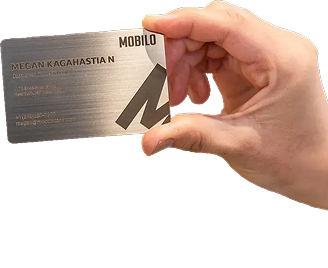
A card combining high-end materials (like Mobilo's metal card variants) with minimal design signals top-market positioning without stating it directly.
What's good
The card itself becomes a conversation piece. A metal card handed to a facilities director or luxury homeowner doesn't get thrown away. It gets shown to other people.
Why does it work psychologically?
Scarcity and novelty drive retention. A card that feels different from every other card in someone's collection gets remembered and kept, which is the entire point of handing one over in the first place.
Who should use it
HVAC companies in premium commercial markets, high-end residential contractors, or business development professionals who attend industry events and need their card to do more work after the handoff.
Who shouldn't
Companies where the card cost would feel incongruent with their pricing. A $3 metal card handed out at a $79 tune-up special creates a confusing brand signal.
One improvement
Pair the premium card with a digital profile link so the physical impression is backed by an equally polished digital presence.
12. Referral-Focused HVAC Business Card
The idea
A card designed to be passed along, with words like "Give this to a neighbor" or "Refer a friend, get $50 off your next service." It's built for its second and third life, not just its first.
What's good
It turns every satisfied customer into a distribution channel. According to Nielsen's 2023 Trust in Advertising report, 88 percent of consumers trust recommendations from people they know more than any other form of advertising.
Why does it work psychologically?
Giving someone a reason to share removes obstacles. Most satisfied customers don't refer because they forget or don't know how. A card with a clear referral offer solves both.
Who should use it
Residential HVAC companies in tight-knit communities, neighborhoods with high owner-occupancy rates, or any company where word-of-mouth is a primary growth channel.
Who shouldn't
Companies that are unable to consistently track or honor the referral offer. A referral card that confuses customer service representatives causes more damage than having no program at all.
One improvement
Number each card batch or add a unique code to track which customers are referring, and intentionally reward your best advocates.
Knowing which card type fits your business is only half the equation. The other half is where most contractors quietly lose the advantage they've built.
Related Reading
- Should I Put My Picture On My Business Card
- Photography Business Cards Examples
- Horizontal vs Vertical Business Cards
- Business Card Examples For Owners
- How To Put an Instagram Handle on a Business Card
- Esthetician Business Card Ideas
- Photography Business Cards Examples
- Back Of Business Card Ideas
- Business Card Details
- Business Card Requirements
- Business Card Dimensions
How to Design an HVAC Business Card That Wins More Customers
Design isn't decoration. Every choice you make — from font size to what phone number you lead with — either earns attention or loses it.
"Every visual decision on your business card is a silent salesperson — working for you or against you the moment it lands in a customer's hand."
💡 Tip: Lead with your most important contact detail — most customers decide in under 5 seconds whether to keep or toss a card. Make every element earn its place.
⚠️ Warning: Choosing a font that's too small or cramming in too much information are the most common design mistakes HVAC businesses make — both kill readability instantly.
- Design Element: Font Size
- Earns Attention: Clear, 12pt minimum
- Loses Attention: Too small, unreadable
- Design Element: Phone Number Placement
- Earns Attention: Front and center
- Loses Attention: Buried or hard to find
- Design Element: Visual Hierarchy
- Earns Attention: Bold key info first
- Loses Attention: Everything looks the same
- Design Element: Whitespace
- Earns Attention: Clean and open
- Loses Attention: Cluttered, overwhelming
.webp)
Start with your customer, not your logo
Before you open a design tool or call a printer, write one sentence: who gives you money, and why do they call you instead of someone else? A homeowner in a heat emergency needs reassurance and speed. A property manager running ten apartments needs credentials and reliability. Your card should speak directly to that person, because a card designed for everyone persuades no one.
Choose a trust message that does real work
Your trust message is the one line on your card, beyond your name and number, that makes a stranger believe you're worth calling. This could be a license number, a "same-day service" promise, a "family-owned since 1998" line, or a specific specialization like "mini-split installation and repair." According to the FieldEdge Blog, 72% of people judge a company's credibility based on the quality of its business cards. Pick the message that removes the biggest doubt your ideal customer has before they dial.
How should you handle layout, contact priority, and print decisions?
Layout follows logic, not preference. Put your phone number where the eye lands first—that's the action you want. Email and website come second. Social handles belong on the back, or not at all, unless your Instagram is genuinely part of how customers evaluate you. For print, choose at minimum 16pt card stock with a matte or soft-touch finish. Sera Tech's research on HVAC business cards found that 39% of people would choose not to do business with a company if they had a cheap-looking business card, so the stock you print on is a conversion variable, not a budget line item. Most HVAC companies hand out cards inconsistently across their team, with no way to track which technician's card generated which call.
How can you track which field interactions are turning into booked jobs?
Mobilo's digital business card solves this at the team level, letting each technician carry their own trackable card that logs every contact, syncs leads directly to a CRM, and gives owners real data on which field interactions convert to booked jobs.
Test before you commit to a full print run
Most contractors print 500 cards before a single customer reacts to the design. Test first. Print 50, hand them out on ten jobs, and ask: "Did you hold onto my card?" If customers consistently discard them or search for you online instead of calling the number, the design is failing. A business card isn't a branding exercise; it's a lead-generation tool that needs to be tested under real conditions before you trust it with your reputation.
But even a perfectly designed card has one stubborn problem most contractors never solve.
Stop Handing Out Business Cards That Never Turn Into Customers
Paper cards stop working the moment they leave your hand. You have no way to know if the contact saved your number, lost the card, or threw it away. Every handoff becomes a dead end you cannot measure or follow up on.
⚠️ Warning: If you can't track it, you can't follow up on it. Untracked leads are lost revenue hiding in plain sight.
"Every handshake without a record is a sales opportunity that silently disappears." — The reality of paper business cards in a digital-first world
.webp)
💡 Tip: The difference between a dead-end handshake and the start of a sales conversation is whether your card creates a trackable event — and that's exactly what Mobilo digital business cards deliver.
Mobilo digital business cards solve this by turning each exchange into a trackable event. When a homeowner taps your card or scans it at a job site, their contact information syncs directly to your CRM automatically. Trusted by more than 59,000 companies, our Mobilo solution helps HVAC businesses treat every introduction as the start of a real sales conversation rather than a handshake with no record. Book a demo and your first 25 cards come free — a $950 value.
Paper Business Cards
- No tracking after handoff
- Contact info lost or forgotten
- Dead-end exchanges
- Zero follow-up data
- Cost adds up with reprints
Mobilo Digital Business Cards
- Every tap/scan is tracked
- Auto-syncs to your CRM
- Start of a sales conversation
- Measurable lead pipeline
- First 25 cards free ($950 value)
🎯 Key Point: With 59,000+ companies already trusting Mobilo, HVAC businesses have a proven tool to turn every job-site introduction into a quantifiable, followable lead — not just a forgotten card in someone's pocket.
Related Reading
- Plumbing Business Cards Examples
- Electrician Business Card Ideas
- Unique Business Card Ideas
- Artist Business Cards Examples
- Therapist Business Cards Examples
- How To Put Social Media On Business Card
- Best Real Estate Business Cards