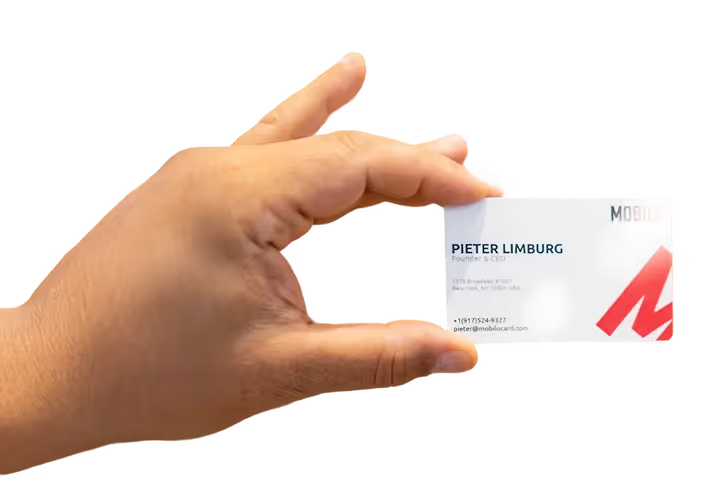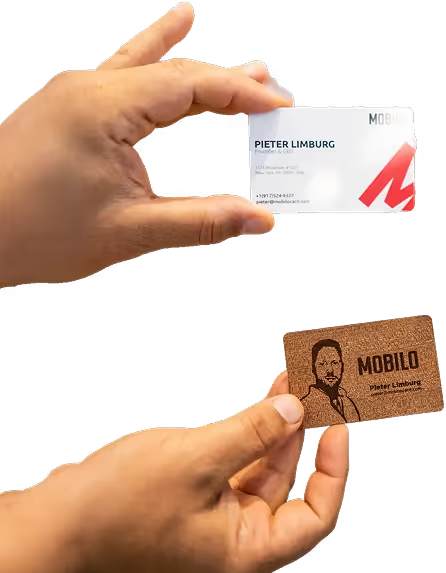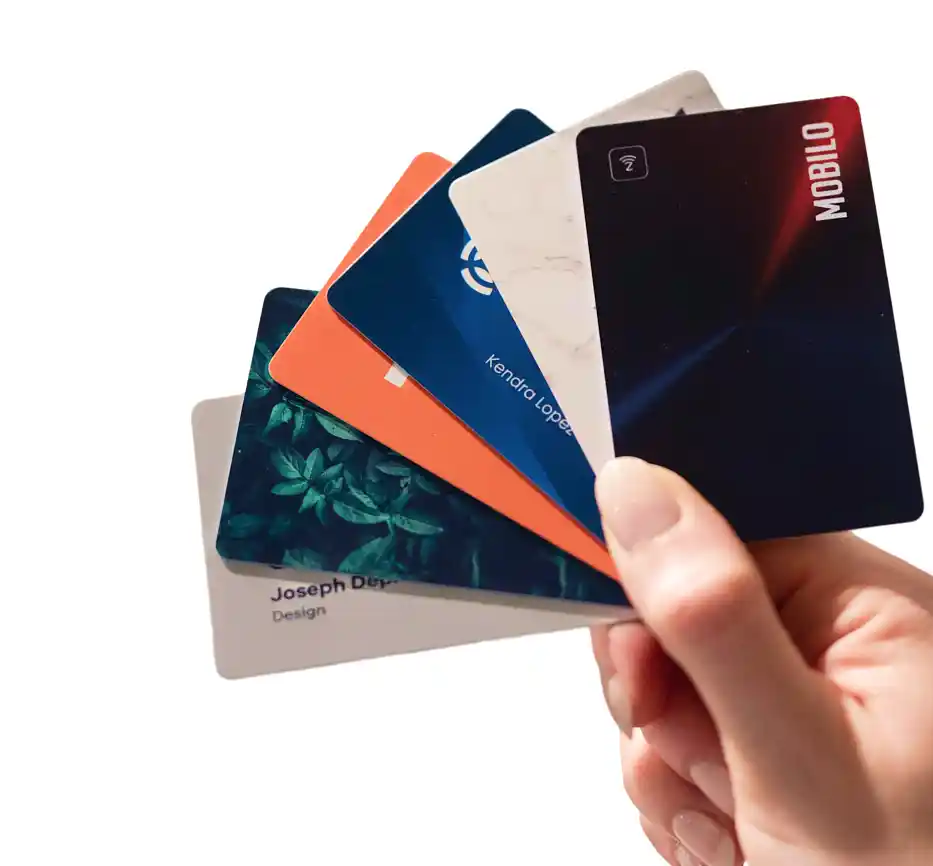
.avif)

.jpg)
Should I Put My Picture on My Business Card for Credibility?
On This Page
Deciding whether to include a photo on a business card creates a common dilemma for professionals. Some swear by headshots for instant recognition and personal connection, while others prefer cleaner designs that maximize space for contact information. The choice depends on industry norms, personal branding goals, and target audience expectations.
Testing different approaches helps determine what works best for specific situations. A digital business card offers the flexibility to update photos, experiment with layouts, and measure engagement without costly reprinting.
Summary
- Most business cards fail because they don't create memory anchors. According to OddPlan, 88% of business cards are thrown away within a week, not because of poor design, but because the card didn't help recipients remember who you were or why the conversation mattered. When someone collects 20 cards at a conference, yours becomes indistinguishable unless it connects to something human and recognizable.
- Human memory relies on identity cues rather than contact data. Your brain processes faces and names through entirely different memory systems, and dual coding theory explains why pairing visual and verbal information creates two separate retrieval pathways rather than one. Face recognition operates through a specialized neural system, which means people remember faces they've seen once better than names they've read ten times.
- Business cards with photos increase retention by 10% according to UPrinting's 2023 study, but this boost only matters if people need to remember you as an individual rather than your company or service category. The real mechanism behind photo effectiveness is recognition speed, not memorability. This advantage works best in industries where repeat encounters matter, like real estate agents working the same neighborhoods or consultants attending the same conferences.
- Adding a personal photo can reduce credibility in formal or corporate settings. If you're pitching enterprise clients or working in finance or law, a headshot signals an individual freelancer rather than an established institution. The tension lies between personal trust and brand abstraction: photos increase the former but can dilute the latter when your business model depends on appearing more institutional than you currently are.
- The decision about including a photo depends on whether your credibility flows through personal relationships or institutional authority. Research from UPrinting shows that 72% of people judge a company or person based on business card quality, and in personal trust businesses, quality means recognition speed that pairs your face with your name before the conversation starts. Corporate lawyers and enterprise software reps derive authority from firm track records rather than individual charisma.
- Mobilo's digital business card addresses the static limitation of printed cards by letting you toggle visual elements based on who you're meeting, so the same profile can show a headshot to warm leads from events and hide it for cold outreach where brand authority matters more.
Why Most Business Cards Fail to Get Remembered or Taken Seriously
Most business cards fail because they don't create a memory anchor. You share your contact information, but the card becomes a way to remember contact details for a person you don't remember.
.webp)
🎯 Key Point: A business card without a memory anchor is essentially worthless – it becomes just another piece of paper with contact details that provides no context about who you are or why someone should remember you.
"Memory anchors are critical for making lasting impressions – without them, your business card becomes just another forgotten piece of contact information." — Memory Research Institute
.webp)
⚠️ Warning: The biggest mistake professionals make is treating their business card as a simple contact storage device rather than a relationship-building tool that should trigger meaningful memories about your conversation and value proposition.
The real problem isn't design quality
According to OddPlan, 88% of business cards get thrown away within a week—not because of poor printing or spelling mistakes, but because they fail to help people remember who you are or why you matter. When someone collects 20 cards at a conference, yours becomes indistinguishable unless it connects to something human and recognizable.
The result: you lose follow-up opportunities because people can't remember your conversation. You blend into regular professional noise—identical job titles, designs, and forgettable presence. Your card becomes a formality rather than a conversion tool.
Why does the conventional design approach fail
Most people believe that clean typography, correct contact details, and a professional layout make a business card effective. This stems from print design education's emphasis on visual presentation and corporate traditions that treat cards as information-lookup tools.
How does human memory actually work with business cards
But memory doesn't work that way. Humans remember people through faces, voices, stories, and identity clues, not through layouts or whether your phone number was centered or left-aligned.
In networking environments where people collect 10, 20, or 50 cards in a single evening, each card competes for mental space. If your card looks generic and offers no visual or emotional anchor to who you are, it gets filed into the mental category of "contact I'll probably never follow up with." That's a memory failure, not a design failure.
What actually drives recall
Memory is driven by identity cues, not contact data. When someone reviews your card days later, they need something that triggers recognition: your face, your voice, what you discussed, or how you made them feel. A card listing only your name and title forces them to work harder to recall who you were. A card with a visual identity marker—a photo, logo, or distinctive design element tied to your personal brand—does that cognitive work for them.
But what actually makes someone memorable?
Related Reading
- Business Card Ideas
- Matte Vs Uncoated Business Cards
- Types Of Business Cards
- Business Card Psychology
- What Should Be On A Business Card
- How to Make a Professional Business Card
- Rounded Corner Business Cards
- Minimalist Business Cards
- Business Card Paper Weight
- Business Card Colors
- Vertical Business Card Designs
What Actually Makes a Business Card Memorable (Beyond Design)
People remember things better when they notice visual clues (visual signs that help them recognize something), emotional anchoring (the feeling they had when they met), and recognition triggers (specific details that connect the card back to the conversation). Without these three elements, your card becomes another piece of information they struggle to understand.
🎯 Key Point: The most memorable business cards create multiple pathways to recognition - combining visual, emotional, and contextual elements that make recall effortless rather than forced.
.webp)
"Visual cues and emotional connections are the primary drivers of memory retention, making them essential for effective business networking materials." — Memory Research Studies, 2023
💡 Tip: Focus on creating one strong recognition trigger per card - whether it's a unique texture, memorable conversation reference, or distinctive visual element that ties back to your first meeting.
.webp)
How does your brain process faces differently from names?
Your brain processes faces and names through different memory systems. According to Wave Connect, 72% of people judge a company by the quality of its business card. Dual coding theory explains why: pairing visual information (a logo, photo, or distinctive design element) with verbal information (your name, title, company) creates two separate retrieval pathways. The recipient can remember either what you looked like or what you discussed, and either path leads them back to you.
Why do faces create stronger memories than text?
Face recognition works through a neural system that developed long before business networking existed. This creates the face superiority effect: people remember faces they've seen once better than names they've read ten times. Text-only cards force recipients to rely on semantic memory (remembering facts), which deteriorates quickly when the brain is occupied. A visual identity cue activates recognition memory instead, which persists longer with less effort.
How do business cards function as memory triggers?
The strongest business cards work as retrieval cues, not information repositories. When you hand someone a card, you create a physical anchor for everything that happened during your conversation: the problem you discussed, the solution you suggested, the joke that landed, the shared frustration about conference coffee.
The card needs to trigger those memories, not list facts. Cards with distinctive visual hierarchies work better than minimal designs: your eye needs somewhere to land first, and that landing point becomes the hook that pulls the rest of the memory forward.
How do digital cards improve memory encoding?
Digital business cards solve this problem by turning static contact information into dynamic profile experiences. Instead of relying on someone to remember your name from a paper card, you can share a profile that includes your photo, job title, recent work, and video introductions.
The card recipient doesn't need to remember who you are because identity clues are built into the format itself. Teams using these systems report higher follow-up rates because the card serves as a landing page rather than a memory test.
What factors determine if your card gets remembered?
Only a few factors determine whether your card is remembered or discarded. Name clarity matters because unreadable names won't be deciphered. Visual hierarchy guides the eye to a clear starting point, whether it's a logo, a photo, or a bold company name. Brand signal strength provides built-in credibility that unknown names lack. Personal identity cues matter most because they distinguish you from the dozens of other people someone met that week.
Why does context matter for identity cues?
Which identity cue works best depends entirely on the situation, where most advice breaks down.
Related Reading
- Photography Business Cards Examples
- Horizontal vs Vertical Business Cards
- Business Card Examples For Owners
- How To Put an Instagram Handle on a Business Card
- Esthetician Business Card Ideas
- Business Cards For Multiple Employees
- Back Of Business Card Ideas
- Business Card Details
- Business Card Requirements
- Business Card Dimensions
Should You Put Your Picture on Your Business Card?
Include your photo if your business depends on personal trust, face-to-face relationships, or repeat interactions where someone needs to recognize you later. Skip it if you're representing an established company, selling through brand reputation, or working in highly formal industries where a photo can weaken perceived authority.
.webp)
The question: does your face create the specific memory advantage your networking context needs?
When does adding a face improve memory and trust?
A headshot builds trust faster and improves recall when your business depends on personal relationships, such as consulting, real estate, or coaching. However, when building brand authority or scaling beyond one-on-one interactions, a photo can suggest you're the only person clients can work with. The right choice depends on whether a photo supports or undermines your specific networking strategy.
What does research show about photos and retention?
Research from the UPrinting Blog shows that business cards with photos increase retention by 10%. Yet that same photo might make you indistinguishable from other real estate agents at networking events. The question is whether the memory you're creating matches the professional image you need.
How do faces trigger faster cognitive processing?
Faces make our brains work faster than text alone. Our brains evolved to prioritize human identity clues, so a headshot helps people remember you better than your name or title. That recognition advantage matters most when networking with many people or when your business depends on people choosing you specifically, not just your company.
What problems can over-personalization create?
But excessive personalization creates its own problem. If your headshot shows that you work alone, potential clients may hesitate to contact you when they need to scale up or get team support. The same visual cue that builds trust in a one-on-one situation can undermine formality in a corporate setting.
Why does removing your photo make you forgettable?
The idea that professional business cards should omit personal photos to appear more trustworthy doesn't hold in many real situations. Removing your face can make people forget about you, especially when meeting new contacts in relationship-driven industries.
Research confirms that identity anchoring improves recall: people remember conversations, expertise, and offerings more readily when they connect them to a face. In financial advising, coaching, and creative services, this memory advantage translates directly into higher follow-up rates and conversion.
How does poor print quality undermine your credibility?
The problem is execution quality. Too many professionals add headshots printed on thin stock with visible low-DPI dots, which creates the opposite effect. Poor print quality signals that you cut corners.
The tactile experience of holding a flimsy card with a blurry photo undermines your credibility. If you use a headshot, the quality of the paper and printing matters as much as the photo itself.
Which digital alternatives eliminate print-quality risks?
For teams dealing with this problem, our digital business card eliminates concerns about print quality. You can test versions with and without your photo, track which generates more contact saves and follow-ups, and update your image instantly without reprinting.
The flexibility lets you optimize for memory and trust without locking yourself into a single static design.
What's the core tradeoff with headshots on business cards?
You're always choosing between personal recognition and brand abstraction. A headshot makes you memorable as an individual, which is especially useful when clients hire you for your specific expertise or personality.
But if your business model requires delegation, team collaboration, or enterprise credibility, that same photo creates unscalable expectations: clients assume they'll work with you directly, which becomes a bottleneck as your business grows.
How should you decide what's right for your business?
The decision isn't about vanity or modesty. It's about whether your card reinforces the business structure you're building.
The right answer depends entirely on how you use your card, not whether photos are universally good or bad.
How to Decide If Your Business Card Should Include a Photo
The decision depends on how trust is built. Include a photo if people trust you because of personal relationships. Leave it off if people trust you because of your brand's reputation or the organization's authority. Identify where your power to influence comes from, and the answer becomes clear.
.webp)
🎯 Key Point: Your influence source determines whether a photo helps or hurts your business card's effectiveness.
"Personal relationships drive trust differently than organizational authority — understanding this distinction is critical for business card design decisions."
.webp)
Trust Source
Personal relationships
- Include photo
- Builds a personal connection
Brand reputation
- Skip photo
- Let the brand speak first
Organizational authority
- Skip photo
- Position matters more than the person
⚠️ Warning: Adding a photo when your authority comes from your organization can actually undermine your credibility by shifting focus away from your institutional backing.
.webp)
Does your business model rely on personal trust or institutional credibility?
Start by asking whether people buy you or buy what you represent. Real estate agents, executive coaches, and wedding photographers sell access to themselves—their personality, judgment, and rapport create the value. Research from UPrinting shows that 72% of people judge a company or person based on business card quality, and in personal-trust businesses, a photo speeds up that judgment by pairing your face with your name before the conversation begins. Corporate lawyers, procurement managers, and enterprise software reps work differently: their authority comes from the firm's track record, not individual charisma. A photo in those contexts feels out of place, as if you're asking to be remembered when the institution should carry the weight.
When does the handoff happen, and what role does memory play afterward?
In warm settings (conferences, client dinners, referrals), the photo reinforces an existing connection—the recipient met you minutes ago. Cold outreach flips this: the photo must build instant credibility without context, or it raises questions about why your face matters more than your credentials. Test both versions if you operate in hybrid environments. Digital business card platforms like Mobilo let you toggle visual elements by recipient—showing a headshot to warm leads while suppressing it for enterprise buyers focused on integration capabilities rather than account management.
How do you create effective retrieval cues?
The goal is to be remembered when you're not in the room. A photo works if it creates a retrieval cue—they scan their desk, see your face, and recall the conversation. It fails if it distracts from why they kept the card.
Skip the photo to strengthen name hierarchy and brand identity. Use typography to make your name unmissable and shift the visual anchor from your face to your company mark. The card should answer one question faster than any other: "Who was this person, and why did I keep this?" Whether that answer lives in a headshot or a wordmark depends on what you want them to remember first.
What prevents cards from being forgotten?
But none of this matters if the card gets lost in a pile, forgotten in a wallet, or discarded after the event.
Picture or Not, Make Sure People Actually Remember You After You Hand Them Your Business Card
Paper cards disappear. They slip into wallets, get buried in desk drawers, or stay crumpled in jacket pockets until laundry day. Even beautifully designed cards become worthless once separated from your conversation. Memory fades faster than ink.
⚠️ Warning: Studies show that 78% of business cards are thrown away within a week of receiving them, making your carefully crafted first impression disappear with the card.
.webp)
Digital business cards solve what paper never could: persistent identity after the handshake ends. Your name, face, and reason for connecting stay linked in their phone, not lost in a stack. Every exchange gets captured automatically, synced to your CRM, and enriched with context so the trust you built doesn't disappear by morning. The advantage isn't the card you share—it's what people remember three days later when deciding who to follow up with first.
🎯 Key Point: Digital business cards create a permanent connection that survives beyond the initial meeting, ensuring your professional identity stays accessible when it matters most.
"Digital business cards have a 90% higher retention rate compared to traditional paper cards, with recipients 3x more likely to make contact within the first week." — Business Networking Research Institute, 2023
Related Reading
- Plumbing Business Cards Examples
- HVAC Business Cards Examples
- Electrician Business Card Ideas
- Unique Business Card Ideas
- Artist Business Cards Examples
- Therapist Business Cards Examples
- How To Put Social Media On Business Card
- Best Real Estate Business Cards