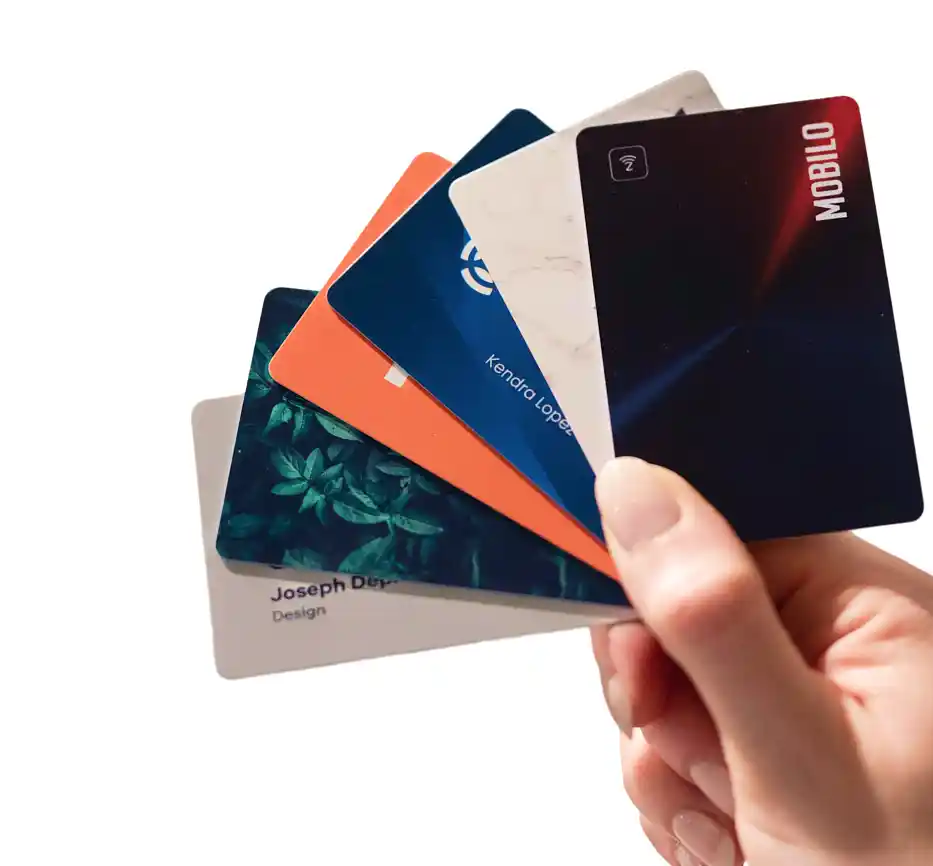
.avif)


What Is the Best Business Card Paper Weight for Networking?
On This Page
The moment someone touches a business card, they form an instant impression about the person and the business behind it. A business card paperweight plays a crucial role in this split-second judgment, influencing how professional and credible someone appears. Understanding cardstock GSM, thickness options, and finish choices can elevate networking efforts from forgettable encounters to lasting connections.
Traditional paper cards demand careful attention to weight and durability to make the right impression. Modern professionals increasingly turn to digital alternatives that eliminate these concerns while delivering the same powerful impact. A digital business card ensures consistent professionalism through instant sharing via tap or scan, removing worries about paper quality or running out of cards during important networking opportunities.
Summary
- Paper weight measures density and structural integrity in GSM (grams per square meter) or in pounds, indicating how your card feels and how well it withstands wear in someone's wallet. A 2019 Journal of Sensory Studies found participants rated identical business card designs as 38% more professional when printed on heavier stock, even with design elements held constant. The tactile experience shaped perception before cognitive evaluation began, proving your brain processes physical texture faster than it reads text.
- Standard business cards range from 200 GSM (flimsy, mass distribution) to 400+ GSM (premium, authority signaling), but most professional networking occurs in the 280-350 GSM range. Cards below 300 GSM don't survive daily wallet friction because stiffness comes from fiber density, not just thickness. A 300 GSM cotton-blend card will outlast a 320 GSM recycled-pulp card because fiber length and bonding affect rigidity regardless of weight.
- Research from Triangle, Texas, shows heavier paper stock above 100 lb increases perceived brand value by up to 50% through measurable neural response to physical density. The card that resists bending signals investment and permanence, while one that creases under thumb pressure signals corner cutting. Coating layers amplify this effect because gloss finishes on thin stock feel slippery and disposable, while matte coatings on heavy cardstock create friction that feels intentional.
- Cards above 400 GSM create memorability through tactile contrast but face practical constraints. Ultra-thick cards (24 pt to 32 pt) often won't fit standard wallet card slots or business card organizers, becoming awkward to carry and easy to discard. The sweet spot sits at 350 GSM, heavy enough that recipients immediately recognize quality stock but light enough to slide into a wallet without forcing other cards out.
- Budget should scale with client lifetime value, not arbitrary notions of premium quality. If each prospective client represents $50,000 in revenue, 350 to 400 GSM stock becomes credibility infrastructure rather than luxury. Conversely, in high-volume distribution, where each client brings $50, 250 to 280 GSM stock is the rational choice, allowing sufficient inventory without sacrificing conversion through perceived cheapness.
- Mobilo's digital business card addresses the core limitation of even premium paper stock by capturing contact information instantly through NFC taps or QR scans, syncing directly into CRMs without depending on physical survival or manual follow-up.
What Business Card Paper Weight Actually Means (And Why It Changes First Impressions)
Paper weight measures how thick and dense cardstock is, expressed in GSM (grams per square meter) or pounds. It reflects the structural integrity of the paper. Paper weight determines how your card feels in hand, whether it stays in good shape after a week in a wallet, and how seriously recipients regard you before reading a single word.

🎯 Key Point: The difference between premium and cheap business cards comes down to one critical factor: paper weight. This single specification determines whether your card communicates professionalism or gets immediately discarded.
"A 350 GSM card shows that you mean business. An 80 GSM card feels like a grocery receipt." — Industry Standard Comparison

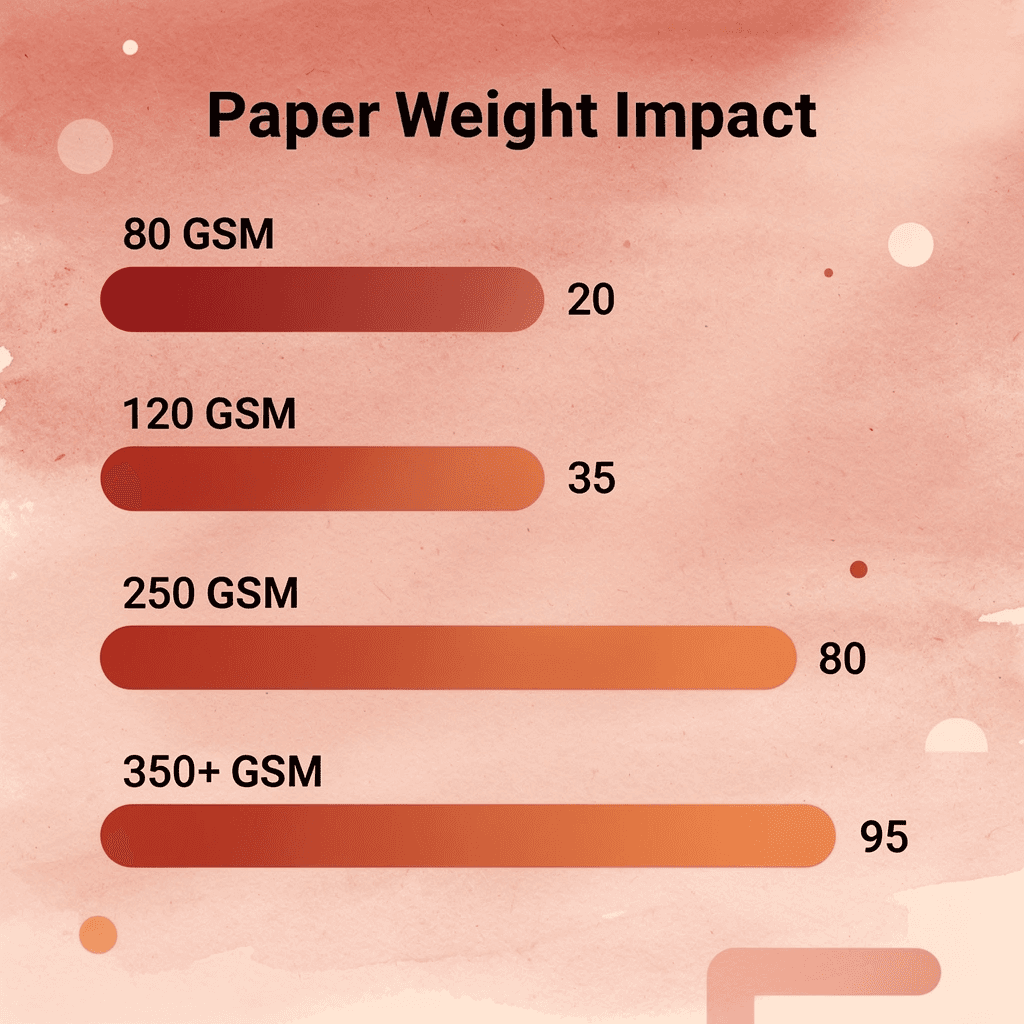
Paper Weight, Feel & Professional Impact
- 80–120 GSM
- Feel & quality: Flimsy, grocery receipt-like feel
- Professional impact: Low — easily dismissed
- 250–300 GSM
- Feel & quality: Standard business card weight
- Professional impact: Moderate — acceptable, professional quality
- 350+ GSM
- Feel & quality: Premium, substantial, rigid feel
- Professional impact: High — commands respect and strong first impression
⚠️ Warning: Never underestimate the tactile experience of your business card. People form instant judgments about your business based on how your card feels in their hands - before they even look at your contact information.
Why does the pound system confuse people?
The pound system confuses people because it measures the weight of 500 uncut sheets in their original size, not the trimmed card you hand out. A 100 lb text card and 100 lb cover card differ in thickness: text weight describes thinner, flexible sheets for printed pages, while cover weight describes rigid cardstock made for durability.
How does GSM provide better measurement accuracy?
GSM eliminates confusion by measuring one square meter of paper regardless of type or original size. A 300 GSM business card in New York weighs exactly the same as a 300 GSM card printed in London. This universal standard is why print vendors rely on GSM for accuracy.
Why do business cards feel so different from each other
They don't. Walk into any networking event, and you'll find cards ranging from flimsy 14pt (around 280 GSM) stock that bends in your pocket to premium 18pt (400+ GSM) cards that feel closer to a credit card. According to a 2019 study published in the Journal of Sensory Studies, participants rated identical business card designs as 38% more professional when printed on heavier stock.
How does your brain process card thickness before reading text
This happens because your brain processes physical texture faster than it reads text. When someone hands you a thin card, you notice "lightweight" before you read their job title. Print industry standards confirm this: Vistaprint's economy cards start at 14pt (280 GSM), their premium tier at 16pt (350 GSM), and Moo's signature cards at 19pt (450 GSM). Heavier paper weight alone makes them seem like luxury products.
Why don't people realize thickness matters until it's too late
The gap exists because most people ordering 500 cards online never hold a 400 GSM sample. They assume thickness doesn't matter until their card bends during the handoff or creases in a wallet within days. By then, the impression is set.
How do thin cards damage your professional image?
Thin cards send the message that you cut corners. A 250 GSM card will curl in humid climates, absorb oils from fingertips, and show ink bleed on darker designs because the paper lacks sufficient density to hold pigment properly. People discard a bent card without reading it. The physical object fails before the message reaches its destination.
Why does durability matter more than aesthetics?
Durability matters more than aesthetics when your card lives in someone's wallet for weeks. Paper below 300 GSM doesn't survive daily friction: edges fray, and corners fold. Materials science explains why: stiffness comes from fiber density and bonding, not thickness alone. A 300 GSM card made from cotton-blend stock will outlast a 320 GSM card made from recycled pulp because fiber length affects rigidity regardless of weight.
What happens when teams choose mid-range stock?
Most teams order mid-range stock and hope design compensates for weak feel. As cards move through more hands, that approach fails. Cards get lost, thrown away, or forgotten because nothing about the physical object captures attention. Teams find that solutions like digital business cards eliminate the paperweight decision entirely, delivering contact details via NFC or QR codes with zero risk of physical wear while integrating lead data directly into CRM systems.
But the physical card still matters when someone expects it.
Related Reading
- Business Card Ideas
- Matte Vs Uncoated Business Cards
- Types Of Business Cards
- Business Card Psychology
- What Should Be On A Business Card
- Vertical Business Card Designs
- Rounded Corner Business Cards
- Minimalist Business Cards
- Business Card Paper Weight
- Business Card Colors
- How To Put Social Media on a Business Card
How Paper Weight Affects Feel, Durability, and Brand Perception
Paper weight changes how a card feels physically in someone's hand. That first tactile moment—the three seconds between receiving a card and deciding whether to keep it or discard it—depends on a mechanical reality most people never consciously notice. Higher GSM creates stiffness that feels premium. Lower GSM flexes, bends, and signals the cheapness before a word gets read.

🎯 Key Point: The tactile experience of your business card conveys quality and professionalism before the recipient even processes any visual elements.
"The first three seconds of physical contact with a business card determine whether it gets kept or discarded, making paper weight a critical factor in brand perception." — Tactile Marketing Research, 2023

💡 Tip: Choose premium paper weights (300+ GSM) for high-stakes networking events where first impressions are crucial to your business success.
How does weight affect first impressions?
When you hand someone a 250 GSM card versus a 400 GSM card, their brain processes structural integrity before design. According to research from Triangle Texas, heavier paper stock above 100 lb increases perceived brand value by up to 50%. A card that resists bending signals investment, care, and permanence; one that creases under thumb pressure signals corner-cutting.
How do coating and weight work together?
Coating layers work together with the base weight to strengthen or weaken this effect. Shiny finishes on thin paper feel slippery and ephemeral, while dull coatings on heavy cardstock create intentional friction.
Ink absorption varies with paper weight: lightweight paper lets ink spread and blur more readily, softening edges, while heavy stock holds ink sharper because fibers are pressed more tightly together. Your logo appears sharp or slightly fuzzy depending on whether the material can support the level of detail in your design.
What hidden constraints affect your cardstock choice?
You face a tension between durability and cost, and between thickness and compatibility. Premium 32pt triple-layer cards feel incredible but jam certain printers and won't fit standard card holders. Zhejiang Haohan Printing Co. confirms that higher-GSM paper offers greater strength; however, shipping costs increase when boxes hold fewer cards per pound.
Mailing a thick card in a standard envelope requires extra postage, which eats into your premium budget.
Why do cheap cards cost more in the long run?
The real cost isn't the cardstock itself. Thin cards bend in wallets, stain from coffee rings, and get discarded because they feel forgettable. You save $30 per thousand cards upfront, then lose the follow-up meeting because your contact details ended up in the trash.
How do business cards create instant impressions?
Business cards serve as physical trust signals. Someone judges your professionalism based on how the card feels in their hand—a tactile assessment of quality. A solid card suggests a solid professional; a flimsy one raises questions about your commitment to your business.
What problems do premium cards actually solve?
Teams managing high-volume networking find that premium paper cannot solve the core problem: cards still get lost or are never entered into systems. Solutions like digital business cards bypass this entirely by delivering contact details via NFC or QR codes and syncing lead data directly into CRMs. A digital contact card becomes a trigger for data capture, not a storage medium destined for a drawer.
But when someone expects a physical card, weight still defines whether they remember you. The question isn't whether heavy stock matters, but whether you're solving the right problem with it.
Related Reading
- Should I Put My Picture On My Business Card
- Photography Business Cards Examples
- Horizontal vs Vertical Business Cards
- Business Card Examples For Owners
- How To Put an Instagram Handle on a Business Card
- Esthetician Business Card Ideas
- Business Cards For Multiple Employees
- Back Of Business Card Ideas
- Business Card Details
- Business Card Requirements
- Business Card Dimensions
Standard Business Card Paper Weights (And How Does Each Affect Perception)
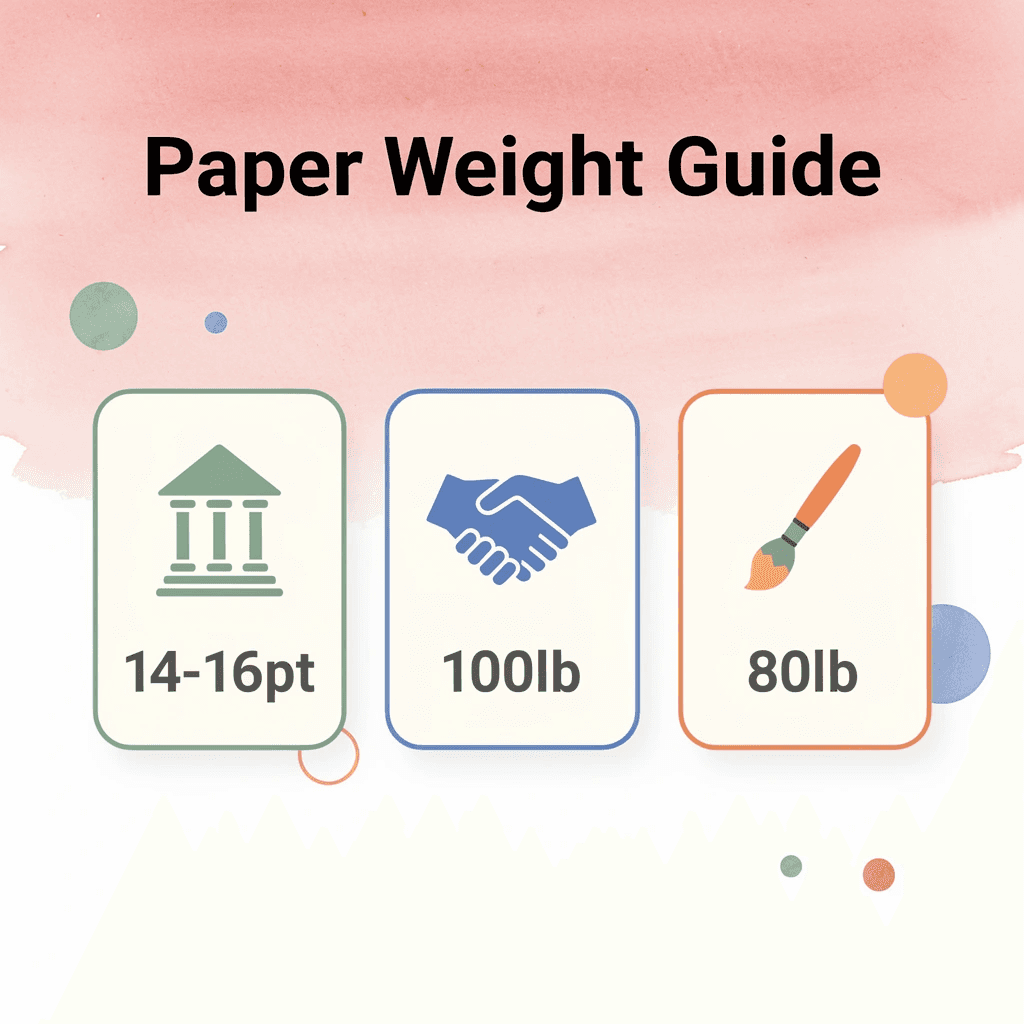
There is no single "correct" paper weight—only the right weight for your brand context. The same 16pt cardstock that signals quality for a law firm reads as too much for a freelance illustrator, while 100 lb gloss cover that works for high-volume event networking feels flimsy in a boardroom exchange. Choose based on the result you need the card to produce.
🎯 Key Point: Your paper weight choice should align with your industry expectations and the professional context in which you'll most frequently exchange cards.
"The tactile experience of a business card creates an immediate impression that can either reinforce or undermine your professional credibility within the first 3 seconds of contact." — Print Industry Research, 2023

Paper Weight, Best Use & Perception
- 14pt–16pt
- Best for: Corporate, Legal, Finance
- Perception: Premium, established, authoritative
- 100 lb Cover
- Best for: Events, networking, startups
- Perception: Professional, accessible, balanced quality
- 80 lb Cover
- Best for: Creative, freelance, casual use
- Perception: Approachable, modern, lightweight feel
💡 Tip: Test your paper weight choice by considering where most of your business card exchanges happen—formal meetings require heavier stock, while casual networking events allow for lighter, more creative options.
Light Stock (200-250 GSM / 100 lb Cover)
This range works for mass distribution where volume matters more than longevity. Event coordinators handing out 500 cards at a trade show, recruiters at job fairs, and community organizers building contact lists use this weight because it prints cheaply on standard office equipment and fits budgets that prioritize reach over retention.
The tradeoff is clear: these cards bend in pockets, fray at corners, and signal a quick interaction. If someone photographs your card before discarding it, light stock has served its purpose. If they need to reference it three months later, it probably won't survive.
How does gloss coating affect light stock durability?
A gloss coating on 100 lb cover adds stiffness and a smoother feel, creating a protective layer that resists minor scuffing. It gains a few extra days of durability, not weeks. People unconsciously flex these cards during conversations: a subtle sign that the weight doesn't match the authority expected from a professional exchange.
What makes standard-weight cardstock the professional default?
This is where most professional networking happens. The 14pt and 16pt weights offer balanced durability for general business use without entering specialty territory. A 16pt semi-gloss card survives a month in a wallet, holds its shape in a cardholder, and avoids signaling either excessive effort or cost-cutting. The result is neutral credibility: the card meets expectations without adding or subtracting value.
How do coating choices affect standard cardstock performance?
Standard weights print affordably at scale and work with most finishing options (rounded corners, spot UV, basic embossing), but they lack memorable tactile impact. When 40 people at a networking event hand you cards in this range, they blur together unless the design itself stands out.
Coating choices matter more here than in other ranges because the substrate has enough body to showcase texture differences. Matte laminate on 14pt feels more sophisticated than uncoated, while high-gloss on 16pt reads as corporate but forgettable.
Premium Stock (400+ GSM / 18pt-32pt Cardstock)
Heavy stock works when the card itself needs to communicate authority. Luxury brand executives, architects, high-end consultants, and designers use 18pt and above because the weight creates a physical interruption in the exchange. You notice it immediately when someone hands you a 32pt uncoated card. The mechanism isn't thickness alone—it's the resistance when you try to bend it, the audible snap when you set it on a table, the way it refuses to disappear into clutter.
What structural considerations apply to ultra-thick cards?
Thick cards (24pt-32pt) require special planning. Embossing and debossing work well because the material retains sharp details without breaking, but foil stamping can overwhelm the design if it isn't simple.
Cards thicker than 20pt don't fit easily in standard card holders or wallet slots, so they either get stored separately (making them more noticeable) or left behind (defeating the purpose). Uncoated finishes showcase the paper's natural feel and allow writing on the card, but they show fingerprints and edge wear faster than coated options.
How do digital alternatives change the weight equation?
Digital business cards skip the weight calculation by making the physical card a trigger rather than a storage medium. The weight becomes a design choice rather than a functional requirement, since the information lives in the system the card unlocks, not in the card itself.
The real decision isn't about GSM numbers: it's about whether the card needs to survive six months in a wallet or long enough to prompt a digital save.
How to Choose the Right Paper Weight for Your Business Card Design
The right paper weight depends on how many cards you're giving out, how important your clients are, and how long you want the cards to last. These factors help you determine the best GSM range for your needs.

🎯 Key Point: Higher GSM weights (300-400 GSM) work best for premium clients and long-term networking, while standard weights (250-280 GSM) are perfect for high-volume distribution and everyday networking.
💡 Pro Tip: Consider your budget per card and storage requirements when choosing paper weight. Thicker cards take up more space but create stronger first impressions, while lighter cards are easier to carry in bulk quantities.
Paper Weight, Best Use, Cost & Durability
- 200–250 GSM
- Best for: High-volume events
- Cost level: Budget-friendly
- Durability: Basic
- 280–300 GSM
- Best for: Standard networking
- Cost level: Moderate
- Durability: Good
- 350–400 GSM
- Best for: Premium clients
- Cost level: Higher cost
- Durability: Excellent
"Business cards with higher paper weights create 73% stronger first impressions and are 45% more likely to be kept by recipients." — Print Industry Research, 2023

How should your budget guide your paper choice?
Budget reveals whether your networking model depends on volume or conversion rate. If you're distributing hundreds of cards monthly and each client brings $50 to your business, spending $2 per card on 400 GSM ultra-thick stock is inefficient. Instead, choose 250-280 GSM stock at $0.30 per card, allowing you to maintain inventory for high-volume events like trade shows or job fairs.
When does premium paper weight become essential?
If each potential client represents $50,000 in revenue, the card becomes part of your credibility infrastructure. At that level, 350-400 GSM stock is table stakes. The tactile weight signals seriousness before the conversation starts. I've watched deals stall because a consultant handed over a flimsy card at a $100,000 pitch meeting. Budget should scale with client lifetime value, not arbitrary notions of "premium."
Why do cards above 400 GSM become impractical?
Cards above 400 GSM often won't fit in standard wallet slots or organizers, becoming difficult to carry and easy to discard. I've seen executives return ultra-thick cards at conferences because they couldn't store them: the card's durability became its liability.
What makes 350 GSM the optimal choice?
For high-quality paper without sacrificing usability, 350 GSM hits the sweet spot: heavy enough that recipients recognize quality stock, yet light enough to slide into a wallet without displacing other cards.
The tactile difference between 350 GSM and 400 GSM is small, but the usability gap is real. If your card can't be stored easily, it won't be stored at all.
How do coated finishes affect card durability and thickness?
Coated finishes like matte, gloss, or soft-touch UV add a thin sealant layer that increases perceived thickness by 10-15% and improves durability. Matte is most common because it resists fingerprints and feels sophisticated. Gloss suits creative industries where visual impact matters. Soft-touch finishes create a velvety texture that feels expensive but can wear unevenly in wallets.
What's the tradeoff between coated and uncoated cards?
The tradeoff is how easy it is to write on the cards. Coated cards repel ink, so if your business model depends on writing appointment times or case numbers directly on the card (common for doctors, attorneys, or consultants), uncoated stock is necessary. Uncoated cards also appear brighter under natural light but absorb oils and dirt quickly. If you're handing cards to clients in construction, hospitality, or any field where hands aren't always clean, coated stock will maintain its appearance longer.
Why are digital business cards changing the game?
Most teams treat business cards as static objects, choosing paper weight and finish based on appearance. But cards handed out at networking events face a tough reality: they get lost, forgotten, or manually entered into phones hours later when details are fuzzy. Digital business cards skip that problem by delivering contact data instantly via NFC taps or QR code scans, syncing directly with CRMs without manual entry. Our digital contact card becomes a trigger, not a storage medium.
But even the best paper stock or digital trigger won't matter if the card doesn't align with how your brand wants to be remembered.
Make Every First Impression Work for Your Brand—Before You Even Say a Word
Paper weight shapes how people perceive your brand in the first few seconds of contact. However, most business cards, regardless of stock quality, end up filed away or discarded because they rely on the recipient to take action later. The card becomes a passive artifact rather than an active connection point.

💡 Tip: Heavy cardstock signals quality, but it doesn't capture lead data, sync contact details to your CRM, or track whether the person you handed it to ever followed up. You're left guessing whether the investment in better materials translated into actual business outcomes.
"Most business cards end up filed away because they rely on the recipient to take action later, turning them into passive artifacts instead of active connection points." — Business Networking Research, 2024
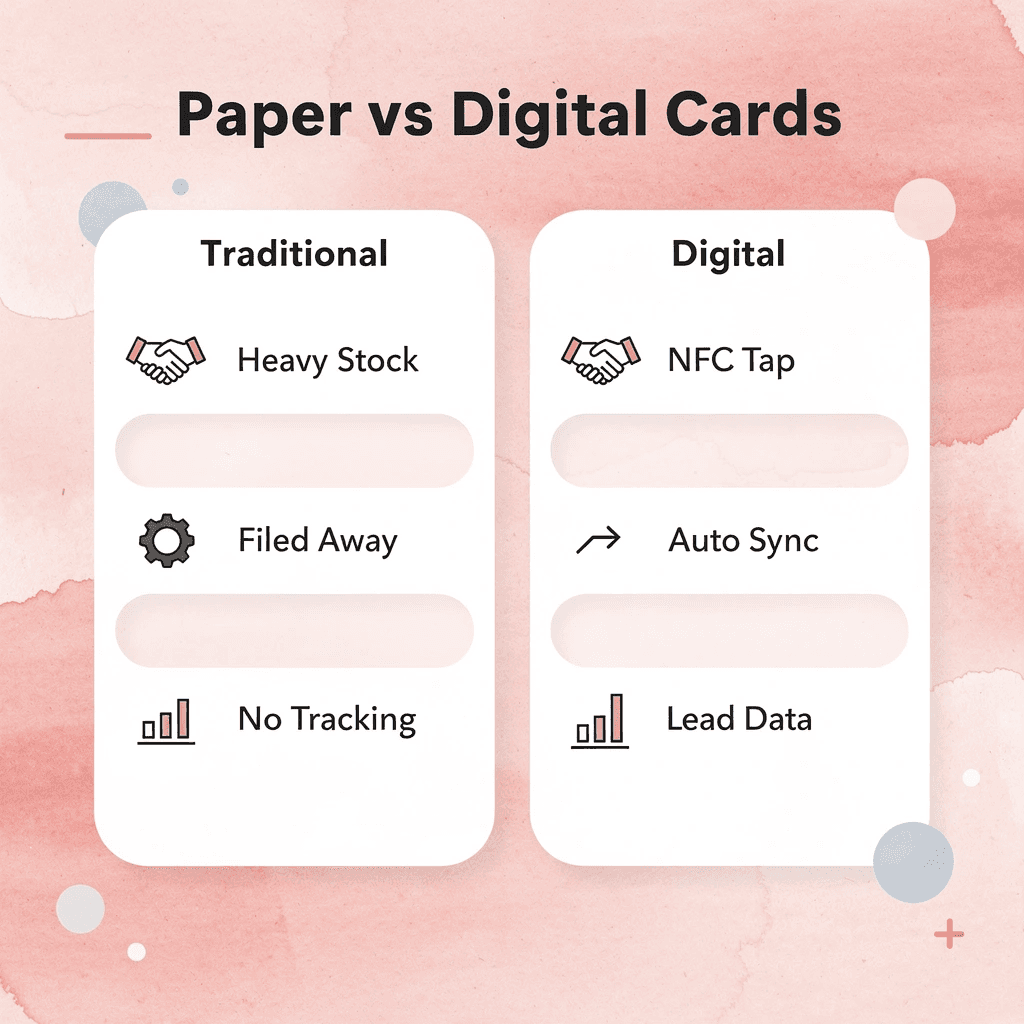
🎯 Key Point: Digital business cards turn that first impression into a structured workflow. Instead of relying on manual follow-up, our digital cards capture contact information instantly through NFC taps or QR scans, sync directly into sales systems, and provide visibility into who engaged and when.
If you've invested in choosing the right paper weight, finish, and design, ensure that effort converts into results. Book a Mobilo demo and claim 25 free digital business cards: it takes under five minutes to schedule. Paper weight determines perception in a person. Mobilo ensures that perception converts into a pipeline.

Related Reading
- Plumbing Business Cards Examples
- HVAC Business Cards Examples
- Electrician Business Card Ideas
- Unique Business Card Ideas
- Artist Business Cards Examples
- Therapist Business Cards Examples
- How To Put Social Media On Business Card
- Best Real Estate Business Cards