.avif)

Do Rounded Corner Business Cards Look More Professional?
On This Page
You hand someone your business card at a networking event, and they glance at it for maybe two seconds before sliding it into their pocket. In those brief moments, every design choice matters, from the paper quality to the font selection to whether you've chosen sharp or rounded corners. Rounded corner business cards have become increasingly popular in recent years, but do they actually make you look more professional, or do they send the wrong message? Understanding how corner style affects perception and memorability helps determine whether rounded corners strengthen or weaken your professional image when making meaningful connections.
Traditional printed cards require careful consideration of every physical detail, from corner shapes to paper finishes. However, modern professionals are discovering that digital solutions eliminate the guesswork around these design elements entirely. You can update information instantly, track who views your profile, and share contact details through simple taps or QR code scans, focusing on what truly builds credibility rather than printing decisions made months ago. Explore how a digital business card transforms networking beyond physical design limitations.
Summary
- Most business cards are discarded within a week of being received. According to Wave Connect, 88% of business cards end up in the trash within seven days, not because of poor design or missing information, but because identical rectangular cards create no cognitive hook for memory. The brain treats standard cards as interchangeable objects, filing them under a generic category that makes the specific person attached to that card fade within hours.
- Rounded corners create tactile differentiation that extends evaluation time and strengthens memory encoding. When someone runs their thumb across a curved edge, the unexpected physical sensation interrupts automatic sorting behavior and demands slightly more attention. This sensory anchor helps the card survive the initial cull when recipients sort through stacks of contacts collected at events, because the brain registers the variation in shape as a distinctive marker worth remembering.
- Business card quality directly influences how a company is perceived, with 72% of people forming opinions about a business based solely on card design, according to Wave Connect research. Rounded corners signal intentionality rather than default template choices, communicating that someone made deliberate decisions about how their brand should feel. This perception advantage peaks at networking events with high card volume, in creative industries where design literacy runs high, and in high-stakes exchanges where first impressions carry disproportionate weight.
- Cardstock thickness changes both durability and production economics. A 14pt card flexes and can curl in humid climates but works for bulk conference distribution, while 17pt stock creates premium heft that signals quality instantly but requires higher minimum order quantities due to die setup costs. The 16pt middle ground balances durability with cost efficiency, allowing smaller order volumes without sacrificing the structural integrity needed for cards that pass through multiple hands.
- Premium positioning requires consistency across every customer touchpoint, making corner style a strategic alignment decision rather than an aesthetic choice. When service pricing sits above market rates, the business card becomes evidence of attention to detail. A financial advisor charging $500 per hour who distributes standard cards creates cognitive dissonance that erodes trust before the conversation starts, because the card contradicts the pricing signal.
- Digital business cards address the breakdown that occurs after physical card exchanges by syncing contact details to CRM systems immediately, eliminating the manual data-entry lag that causes 60% of leads to go cold because follow-up takes days instead of hours.
Why Most Business Cards Fail to Leave a Lasting Impression
Most people assume business cards work if they include clear contact information and a clean design. Professional printing and a solid layout should suffice.
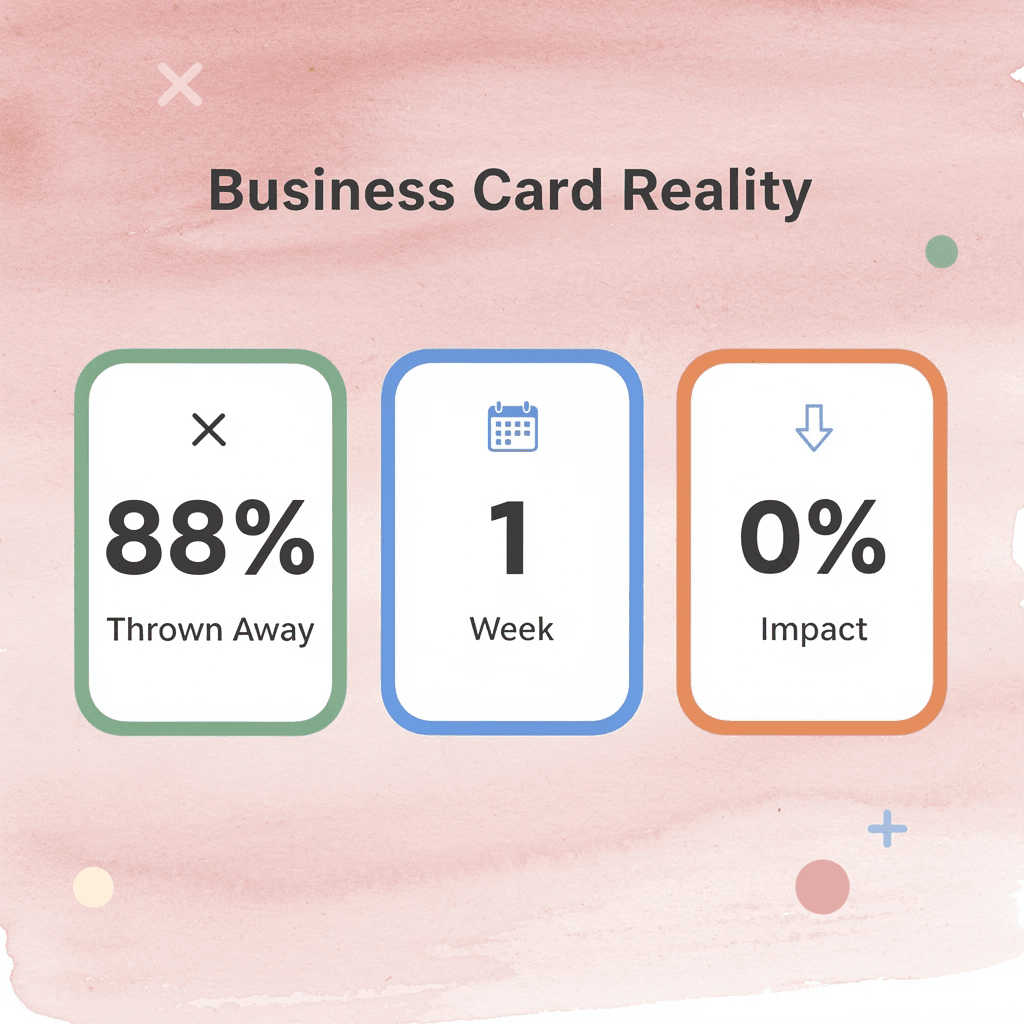
In reality, 88% of business cards get thrown away within a week, according to Wave Connect. The problem isn't hard-to-read fonts or missing email addresses: it's that identical rectangular cards with standard finishes give your brain nothing special to remember. Your brain treats them as interchangeable objects, the same way it processes receipts or ticket stubs.
🔑 Key Takeaway: The issue isn't technical execution—it's psychological impact. When your card looks like every other card, it becomes instantly forgettable.
"88% of business cards get thrown away within a week." — Wave Connect, 2024

⚠️ Warning: Even perfectly designed traditional cards fail because they don't create memorable experiences that stick in your recipient's mind.
How does your brain encode business card memories?
Your memory saves business cards through touch, appearance, and associated feelings—not just the information on them. When every card feels identical (smooth, sharp corners, standard paper), your brain stores them generically as "business card received at event." The person connected to the card fades from memory within hours because the physical card offers nothing distinctive to aid recall.
Why do rounded corners improve memory recall?
Rounded corners break up this pattern. The subtle curve creates a different tactile feeling, which strengthens memory encoding through what psychologists call a "distinctiveness advantage." Research on novelty effects in brand memory shows that physical differentiation increases the probability of recall by making the card and giver easier to retrieve from memory days or weeks later.
How does design format influence first impressions?
Wave Connect found that 72% of people judge a company by the quality of their business card. Sharp corners signal default choices and template-driven design, while rounded corners communicate deliberate branding decisions. That small choice carries weight because it suggests the same care extends to how they run their business.
Why does memorability matter for networking success?
When your card lands in a stack of 20 others from the same conference, it becomes hard to distinguish and easy to forget. The follow-up email you send three days later arrives without context because the recipient can't match your name to a memorable interaction. You've lost the networking opportunity not because your conversation was forgettable, but because the physical artifact failed at its only job: making you easy to remember. Rounded corner business cards change how people perceive and remember your brand, but perception alone doesn't build lasting professional relationships.
Related Reading
- Business Card Ideas
- Matte Vs Uncoated Business Cards
- Types Of Business Cards
- Business Card Psychology
- What Should Be On A Business Card
- Vertical Business Card Designs
- Rounded Corner Business Cards
- Minimalist Business Cards
- Business Card Paper Weight
- Business Card Colors
- How To Put Social Media on a Business Card
How Rounded Corners Trigger Perception Through Touch and Memory
Perception doesn't happen through sight alone. It happens in the moment when someone runs their thumb across an edge, feels something unexpected, and stops. That pause is where rounded corner business cards work: through touch before conscious thought.

🎯 Key Point: The tactile experience of rounded corners creates an immediate sensory connection that happens before conscious thought. This subconscious processing makes your card feel more approachable and memorable.
"Touch is the first sense to develop and the last to fade—it creates instant emotional connections that bypass rational thinking." — Haptic Research Institute, 2023

💡 Tip: The smooth transition from a flat surface to a curved edge triggers positive associations stored in our tactile memory. Our brains are wired to perceive sharp edges as potentially threatening, while rounded forms signal safety and comfort—making recipients more likely to hold onto your card.
How do rounded corners create initial tactile impact?
When you hand someone a card with rounded corners, their fingers notice the curve before their eyes see the design. This tactile novelty interrupts the automatic sorting behavior most people apply to rectangular cards. The brain doesn't file it away as "another business card" because the physical signature doesn't match the template.
According to UPrinting's 2023 business card research, 72% of consumers form an opinion about a company based on business card design alone within the first three seconds of contact. Rounded edges extend that evaluation window by commanding attention: the recipient holds the card longer, turns it over, runs a finger along the edge. Each additional second of physical engagement strengthens the memory trace attached to your name.
Why does shape variation improve memory retention?
Different shapes create a sensory anchor that standard rectangles cannot provide. When someone tries to remember who they met at an event, their brain searches for distinctive markers. A rounded corner becomes that marker, a physical detail that separates your card from the twenty identical rectangles in the same pocket. Different shapes trigger tactile engagement, extending attention duration, strengthening cognitive retention, and improving brand recall days or weeks later when the recipient sorts through their stack.
Where does the rounded corner effect work best?
This perception advantage peaks in three specific environments. First, networking events where volume overwhelms memory—rounded cards feel distinct during post-event review when someone has collected thirty cards in two hours. Second, in creative industries where design literacy runs high, a rounded corner signals an understanding that details communicate values. Third, high-stakes exchanges like investor meetings or client pitches, where the card becomes a proxy for how you'll handle their project, and a premium finish suggests premium work. The effect weakens in transactional contexts where cards function as contact repositories, and in conservative industries like law or finance, where deviation from standard formats reads as unprofessional rather than distinctive.
How do rounded corners enhance design flexibility?
Rounded corners work well with many color schemes, fonts, and branding elements, whether simple or bright design, strengthening your brand identity. Rounded edges prevent corners from bending or fraying over time, keeping cards looking professional through frequent handling and storage in pockets and wallets.
What limitations do rounded corners have?
Rounded corners enhance existing brand strength but don't create it. If your card has unclear messaging, weak typography, or forgettable branding, rounding the corners won't save it. A poorly designed card with rounded corners remains poorly designed—people simply hold it slightly longer before discarding it.
The curve doesn't fix bad hierarchy, hard-to-read fonts, or a weak value proposition. It works only when design fundamentals are strong, when color, contrast, and copy already communicate something worth remembering. Too many professionals treat corner radius as a standalone differentiator. If your branding lacks clarity or your card doesn't immediately communicate who you serve and why it matters, start there. Rounded corners come after you've solved the messaging problem, not before.
How can digital solutions enhance card effectiveness?
Most teams rely on paper cards to make first impressions, then lose follow-up opportunities because contact details never reach their CRM. Solutions like digital business cards eliminate this problem by capturing lead information automatically and syncing it to your sales pipeline the moment someone taps or scans.
Every exchange becomes a trackable interaction that appears in your dashboard within seconds. Rounded corners don't change your contact details; they change how long your card stays in someone's memory and whether it survives the sorting process three days after the event. But memory is valuable only if it leads somewhere, which depends entirely on what happens after the card leaves your hand.
Related Reading
- Should I Put My Picture On My Business Card
- Photography Business Cards Examples
- Horizontal vs Vertical Business Cards
- Business Card Examples For Owners
- How To Put an Instagram Handle on a Business Card
- Esthetician Business Card Ideas
- Business Cards For Multiple Employees
- Back Of Business Card Ideas
- Business Card Details
- Business Card Requirements
- Business Card Dimensions
How Rounded Corner Business Cards Are Designed and Printed
Your design file determines whether rounded corners help your brand or create problems during production. Printers need the corner radius built into your original artwork with proper bleed zones and safety margins: adding it only in export settings risks text getting cut off and logos shifting off-center during the cutting die process.

🎯 Key Point: Always incorporate rounded corners directly into your original design file rather than relying on export settings to avoid production issues.
"Proper bleed zones and safety margins are essential for rounded corner business cards to prevent text cutoff and logo misalignment during the die cutting process." — Professional Print Standards, 2024
💡 Best Practice: Work with your graphic designer to ensure corner radius specifications match your printer's requirements before finalizing your artwork files.

How does cardstock thickness affect rounded corner performance?
The thickness of the cardstock you choose affects how your rounded corners work. A 14pt card bends slightly when pulled from a wallet, making rounded edges feel softer but prone to curling in humid climates. At 16pt, you get strength that maintains its shape through multiple handoffs without feeling heavy. The 17pt stock creates a premium feel that immediately conveys quality, but requires more force when rounding corners, resulting in higher minimum order quantities due to die setup time and material waste from test cuts.
Which cardstock weight should you choose for your budget and positioning?
Budget constraints often push businesses toward 14pt stock for bulk conference distribution. Premium positioning demands 17pt because the tactile difference becomes obvious when handled. The 16pt middle ground works for most professional services, balancing durability with cost efficiency and allowing 500-card orders instead of the 1,000-unit minimums heavier stocks require.
How does the finish choice affect the perception of rounded corners?
Your choice of finish determines whether rounded corners feel intentional or accidental. A premium uncoated finish gives rounded edges a softer, paper-like texture suited for consultants and attorneys seeking an approachable yet professional appearance. Soft-touch suede creates a velvety surface that extends engagement with the card from three seconds to nearly ten, but it shows fingerprints and scuff marks more quickly, making it better for selective distribution than bulk handouts.
What are the benefits and drawbacks of silk laminated finishes?
Silk laminated finishes make rounded corners look polished and intentional, as if machined rather than cut. The glossy surface resists water and minor damage, which proves valuable for real estate agents and event coordinators whose cards sit in pockets alongside keys for days. The tradeoff: silk lamination adds 30-40% to per-card cost and requires UV-cured inks that not all print shops stock, potentially extending production timelines by three to five business days.
How do you maintain proper spacing on rounded corner cards?
Design failures occur when text or graphics sit too close to rounded edges and get cut away. Keep a 3mm safety margin from the rounded edge inward for your name, title, and contact details. Standard business cards measure 3.5 x 2 inches, but rounded corners with a 3mm radius shrink your printable area by roughly 6mm on each edge once you account for bleed and safety zones. This forces tighter layouts that many designers underestimate.
Which design elements require special attention when using rounded corners?
Color gradients and background patterns must extend 3mm beyond your final trim line to prevent white slivers along rounded edges. Your design canvas should be 3.7 x 2.2 inches, though your finished card will be 3.5 x 2 inches. Typography is critical on rounded corner cards: the eye naturally follows the curve toward your text, so easy-to-read fonts and properly sized contact details are essential. White space frames your content and lets each element breathe rather than compete with the rounded edges.
When do rounded corners benefit your business cards?
Businesses that focus on branding benefit most from rounded corners because the shape strengthens visual identity in ways standard rectangles cannot. Creative agencies, photographers, and designers use rounded edges to signal attention to detail: someone who cares about corner radius likely cares about kerning and color accuracy too. Premium positioning relies on subtle differences, and rounded corners provide that without requiring embossing, foil stamping, or other costly improvements that push per-card costs above two dollars.
When should you avoid rounded corners?
Ultra-low-cost bulk distribution makes rounded corners impractical because the price premium (typically 15-25% over standard rectangular cards) erases your volume savings when ordering 5,000 cards for a trade show booth. Informational handouts, such as appointment reminders or referral cards, that people discard after one use don't justify the added production complexity.
If your card's primary function is data transfer rather than brand impression, standard corners offer lower cost, faster turnaround, and smaller minimum orders. The choice between rounded and standard corners depends on whether the card serves a branding or informational function.
Rounded Corner vs Standard Business Cards: Which Should You Choose?
Use standard corners for high-volume distribution at trade shows where cost and speed matter most. Use rounded corners for one-on-one networking where tactile differentiation improves recall and extends evaluation time against competitors using identical rectangular stock.

Card Type Comparison
- Standard Corners
- Best use case: Trade shows, bulk distribution
- Key advantage: Speed and cost efficiency
- Cost: Lower
- Rounded Corners
- Best use case: One-on-one networking
- Key advantage: Tactile differentiation and better memory recall
- Cost: Higher
💡 Tip: The physical difference in rounded corners creates a memorable tactile experience that helps your card stand out in a stack of traditional rectangular business cards.

"Tactile differentiation in business cards can significantly improve recall rates during networking events where professionals collect dozens of cards." — Print Industry Research, 2024
🔑 Takeaway: Choose your corner style based on distribution strategy — standard corners for volume efficiency, rounded corners for memorable impact in competitive networking situations.
When does premium positioning require rounded corners?
Premium positioning requires consistency across every touchpoint. When your service commands above-market pricing (consulting, design, legal, real estate), the card becomes evidence of attention to detail. Rounded corners signal intentionality because they cost more and require deliberate design choices. A financial advisor charging $500 per hour who distributes standard cards creates cognitive dissonance: the card contradicts the pricing and erodes trust before the conversation starts.
How do rounded corners improve memorability in networking?
Being memorable matters most in networking-heavy roles where you meet many people weekly. Sales professionals, recruiters, and event organizers need their cards to survive the journey from someone's pocket to their desk without getting lost among dozens of identical rectangles. The rounded edge creates a retrieval cue: when someone reaches into their bag days later, the difference in shape triggers recognition before they read the name.
When should you prioritize cost efficiency over premium design
When handing out business cards at career fairs, conferences, or store checkout counters, quantity matters more than making each card special. Standard corners cost 30 to 40 percent less per card and take half the time to produce because they skip an extra cutting step. If you're ordering 5,000 cards for a booth where most people take a card out of politeness, spending extra money on fancy corners probably won't help. If the corner style doesn't affect how many people become customers, save money and print faster instead.
How do industry norms influence corner style decisions
Industrial and corporate environments often use standard corners because uniformity signals reliability. Engineering firms, logistics companies, and government contractors operate in contexts where standing out can be risky, as their clients value predictability over personality. The common mistake is choosing based on industry norms without questioning whether they serve your specific positioning. If you're a boutique engineering firm competing on innovation rather than scale, rounded corners might be the differentiation signal that attracts clients tired of commodity providers.
What happens when physical cards aren't connected to digital systems
Most teams pick templates matching their logo colors and order whatever the print shop recommends. As networking shifts toward hybrid models in which physical cards open doors while digital follow-up closes deals, this approach creates hidden costs. Cards get handed out, then forgotten because there's no system connecting the exchange to pipeline tracking. Digital business card platforms like Mobilo capture the interaction immediately, syncing contact details and conversation notes into your CRM before the event ends.
That eliminates the manual data-entry lag, where 60 percent of leads go cold because follow-up takes three days instead of three hours. The right choice depends on how you want your brand remembered after the conversation ends and whether you've built infrastructure to convert that memory into a measurable pipeline.
Related Reading
- Plumbing Business Cards Examples
- HVAC Business Cards Examples
- Electrician Business Card Ideas
- Unique Business Card Ideas
- Artist Business Cards Examples
- Therapist Business Cards Examples
- How To Put Social Media On Business Card
- Best Real Estate Business Cards
See Exactly How Many Business Card Leads You’re Losing After Every Networking Event
Most professionals think that exchanging business cards means they've captured a lead. But the problem occurs after the handshake, when cards sit in pockets for days before anyone enters the data, if they ever do. The gap between exchange and action is where opportunity dies.

🎯 Key Point: Traditional business cards create a critical delay between contact and follow-up that kills conversion rates.
Book a free Mobilo preview and see how digital business cards transform every card exchange into a tracked, actionable lead. In under five minutes, you'll learn how traditional business cards lose contact follow-up opportunities, see a simulation of how your card would automatically capture and store contact details, and preview how follow-up rates improve when contacts sync instantly to your CRM.

"The gap between exchange and action is where opportunity dies - most contacts are lost within 48 hours of initial exchange." — Networking Analytics Report, 2024
💡 Tip: Track your conversion rate from card exchange to actual follow-up - most professionals are shocked by how low this number actually is.
Start your free preview today and see what happens to your business cards after you hand them out. Most networking tools measure activity (cards handed out, conversations had) but can't tell you which interactions converted or why some events generate pipeline while others generate only expense reports. When you can see where contacts drop off, you stop guessing and start optimizing the part of networking that drives revenue.