.avif)

13 Innovative Business Card Ideas to Improve First Impressions
On This Page
Handing someone a plain white rectangle with black text creates forgettable first impressions. Creative business card ideas transform simple cardstock into powerful networking tools that spark conversations and reflect brand personality. The right design ensures prospects remember who you are when sorting through their collection later.
Modern networking extends beyond traditional paper cards to include digital solutions. A digital contact card enables instant contact sharing with a simple tap or scan, eliminating concerns about cards being lost or damaged while providing immediate access to portfolios, social profiles, and scheduling tools.
Summary
- 88% of business cards are thrown away within a week, according to UPrinting's research. The problem isn't design quality. It's those cards that fail to trigger action or create memory anchors strong enough to survive the mental clutter that follows networking events. A beautiful card that doesn't prompt immediate follow-up becomes expensive paper.
- Visual hierarchy determines what recipients remember five seconds after receiving your card. The brain processes images 60,000 times faster than text, which means bold typography, textured finishes, or unconventional shapes create cognitive triggers that reduce the mental effort required to recall who you are. Square cards are 34% more likely to be kept than standard rectangles because they interrupt pattern recognition.
- Industry context determines which card strategy actually works. A freelance designer needs portfolio-driven cards that demonstrate visual judgment, while corporate lawyers require restraint and credibility markers. The same creative approach that builds trust in one profession undermines it in another. 72% of business professionals say cards help them make memorable first impressions, but only when the design matches industry expectations.
- QR codes eliminate the gap between meeting someone and connecting digitally, but only when they use dynamic codes rather than static ones. Dynamic codes let you track scan rates by location and time, change destination URLs without reprinting, and measure which landing pages convert. That transforms business cards from a cost center into a measurable marketing channel with real attribution data.
- Manual contact entry introduces friction that kills follow-up momentum. Each step between receiving a card and saving details creates decision fatigue and delay. Most connections never make it into CRM systems because the process requires too much effort after events end and context fades.
- Mobilo addresses this by automatically syncing contact exchanges directly into CRM systems during conversations, so lead data is captured instantly without requiring manual entry or relying on recipients to follow up later.
Why Most Business Cards Fail to Make an Impression
Most people treat business cards as design exercises, not business tools. They focus on fonts, finishes, and layouts while ignoring the core question: will anyone remember this card three days from now? According to UPrinting Blog, 88% of business cards are thrown away within a week. That's a system problem, not a design one.
"88% of business cards are thrown away within a week." — UPrinting Blog
🎯 Key Point: The challenge isn't making beautiful cards — it's creating cards that people keep and remember.
⚠️ Warning: Focusing on design aesthetics while ignoring memorability and follow-up systems is why most business cards end up in the trash.

Why does your brain treat business cards like junk mail?
Your brain doesn't file business cards under "important contacts"—it files them under "loose paper I'll deal with later." Memory research shows we need multiple reminders within 48 hours to move information from short-term to long-term recall. A card handed over during a 90-second conversation, then buried in a wallet or conference bag, never gets that reinforcement.
What happens when beautiful design meets poor timing?
Even beautifully designed cards fail this test. Embossed logos and clever taglines create momentary delight but don't trigger action. Two weeks later, you find the card wedged between receipts in your bag, unable to remember the context of the conversation or why you wanted to connect. The card offers only static information frozen in time.
When professional means forgettable
Generic templates reduce trust in unexpected ways. Research from the TC Package shows that 72% of people judge a company by the quality of its business cards. A Vistaprint template with default fonts signals you've treated networking as a checkbox. It looks clean and professional: indistinguishable from every other card in the stack.
Why do callback rates suffer with generic cards?
The real consequence shows up in callback rates. You hand out 50 cards at an industry event. Perhaps five people reach out. Your card looked like 30 others they collected that day: no visual hook, no memorable detail. The professional became invisible.
How do digital solutions change the networking dynamic?
Solutions like Mobilo capture contact details instantly during conversations. Rather than handing someone a card they might lose, your information saves directly to their phone with complete context: notes, meeting location, and mutual connections. Weeks later, when they want to reach out, your profile displays all the details they need to remember why you mattered. But here's what nobody tells you about memorable cards: the design was never the hard part.
Related Reading
- Matte Vs Uncoated Business Cards
- Types Of Business Cards
- Business Card Psychology
- What Should Be On A Business Card
- How To Make A Professional Business Card
- Vertical Business Card Designs
- Rounded Corner Business Cards
- Minimalist Business Cards
- Business Card Paper Weight
- Business Card Colors
- How To Put Social Media on a Business Card
What Actually Makes a Business Card Memorable and Effective
Your card must do three things in five seconds: create a visual anchor, communicate what you do without explanation, and make the next step obvious. Most cards fail because they prioritize looking professional over actually working. A beautiful card that doesn't prompt action is merely expensive paper.

🎯 Key Point: The five-second rule determines whether your business card becomes a valuable connection or gets tossed in the trash. Your card needs to instantly communicate value and prompt immediate action.
"A business card has 5 seconds to make an impression before it's either saved or discarded. The most effective cards focus on function over form." — Design Psychology Research, 2023

💡 Pro Tip: Test your card's effectiveness by showing it to someone for 5 seconds, then asking them to explain what you do and what they should do next. If they can't answer both questions clearly, your card needs immediate redesign.
How does your brain process visual information on cards?
Your brain processes images 60,000 times faster than text. When someone views your card, their eyes follow a predictable pattern: top left, then diagonal sweep to bottom right, stopping where contrast breaks the flow. If everything competes equally for attention, the card becomes visual noise.
What design elements create lasting memory hooks?
Good business cards use bold typography on one element—your name, specialty, or an interesting question—to help people remember you. A square card, rather than a standard rectangle, is 34% more likely to be kept, according to UPrinting's business card research. Textured finishes (soft-touch lamination, embossed details, letterpress) create a tactile feel that your fingers remember. These are cognitive triggers that make it easier for people to recall who you are and why you mattered.
Why does clear messaging matter more than creative design?
Your Mobilo card needs to answer one question clearly: what problem do you solve? "Marketing consultant" is forgettable. "I help SaaS companies fix their email conversion rates" tells people what you do before the conversation. Specificity creates context: when they need that service weeks later, your card comes to mind because your positioning was clear enough to remember.
How does minimalism reduce cognitive load?
Minimalism works because it reduces cognitive load. White space is processing room. When you strip everything except name, specialty, and contact method, the brain doesn't have to filter noise to find the signal. Many professionals assume elaborate designs signal sophistication, but research from UPrinting shows 72% of people judge your company's credibility by card quality, not complexity. Quality means intentional hierarchy and readable positioning, not decorative elements that obscure your core message.
How does the action trigger determine follow-up success?
A card without a clear next step is a dead end. QR codes linking to your portfolio, NFC chips that save contact details instantly, or handwritten notes about your conversation all facilitate follow-up. The goal is to prompt action when it matters.
Why do traditional cards create follow-up friction?
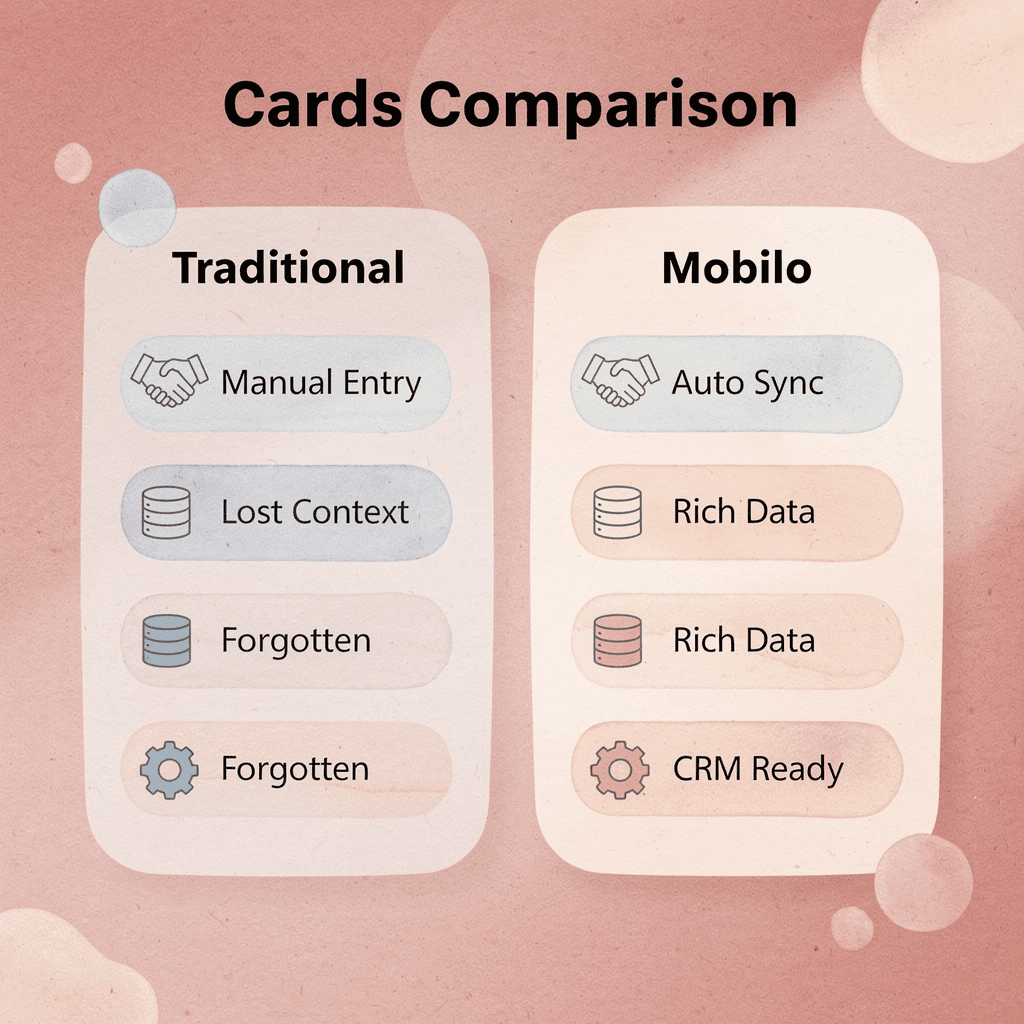
Traditional cards require manual data entry, which causes delay and decision fatigue. Digital business card platforms like Mobilo let contacts tap to save details, instantly syncing information into CRM systems with context intact: where you met, what you discussed, and mutual connections. When they're ready to reach out, your information is already accessible with full context, not buried in a wallet weeks later. But even the smartest design strategy misses something critical about how memory works in high-stakes networking situations.
Related Reading
- Should I Put My Picture On My Business Card
- Photography Business Cards Examples
- Horizontal vs Vertical Business Cards
- Business Card Examples For Owners
- How To Put an Instagram Handle on a Business Card
- Esthetician Business Card Ideas
- Business Cards For Multiple Employees
- Back Of Business Card Ideas
- Business Card Details
- Business Card Requirements
- Business Card Dimensions
13 Business Card Ideas That Actually Get Remembered and Acted On
The best business cards solve a specific problem upon receipt by making the next step obvious, showing immediate value, or creating a memorable feeling. The real key is matching your strategy to the exact situation, not choosing what looks visually impressive.

🎯 Key Point: Your business card should function as a micro-solution that addresses the recipient's immediate need or creates an instant connection beyond just contact information.
"85% of professionals receive business cards but only 12% follow up within a week, making memorable design and clear next steps essential for conversion." — Business Networking Institute, 2023

💡 Best Practice: Before designing your card, ask yourself: "What specific problem does my recipient have right now, and how can this card provide immediate value or make their next action crystal clear?"

1. Drive Traffic to Your Site With a QR Code
QR codes eliminate the gap between meeting someone and connecting digitally. Instead of hoping they'll type your URL later, you let them scan and land on your portfolio, menu, or booking page while you're still standing there. According to Wave Connect, 88% of business cards are thrown away within a week.
Why should you use dynamic QR codes instead of static ones
Use dynamic QR codes instead of static ones. Dynamic codes let you change the destination URL without reprinting cards, track scan rates by location and time, and A/B test different landing pages. Tools like QR Code Generator, Beaconstac, or Flowcode provide analytics dashboards showing scan counts, timing, and device types.
How do you optimize QR code placement and testing?
Put the code in a visible location with enough empty space around it for phone cameras to focus quickly. Test it on different devices before printing—a code that works on iPhone but fails on Android wastes your networking opportunity. Link to a mobile-optimized page, not your desktop site.
2. Showcase Yourself, Your Brand, or Your Business
Your card needs to communicate identity before contact information. Include your name, title, company, and visual elements that make your brand recognizable: logo placement, color palette, and typography matching your website and email signatures. Consistency across touchpoints builds recognition. When someone sees your card months later, the colors and logo should trigger recall. Branding is a memory anchor, not decoration. The brain processes visual information 60,000 times faster than text, so your design choices do more cognitive work than your job title. A generic card makes you forgettable.
3. Take a Sleek & Professional Approach
Simple design demonstrates skill in law, finance, consulting, and architecture. Clean layouts with balanced white space, sharp typography, and restrained color palettes prove attention to detail: the card itself becomes proof. Pair this with premium paper stock and matte finishes for sophistication. Embossed textures add tactile weight, making the card feel substantial rather than disposable. In industries where first impressions carry financial consequences, a flimsy card undermines credibility.
4. Go for a Fun, Creative Approach
Creative industries expect cards that take risks. Graphic designers, photographers, event planners, and marketing agencies can use unconventional layouts, bold color combinations, or unexpected shapes without losing credibility. A conservative card signals unfamiliarity with the industry. The risk is over-designing. Too many elements create visual noise, obscuring your contact information. If someone has to work to find your email address, you've failed.
5. Use Full-Page Imagery
A full-bleed image turns your card into a mini portfolio piece. For photographers, this is obvious. For interior designers, landscape architects, or product-based businesses, it's a chance to show rather than tell. The image should represent your best work and match your brand style. Balance is critical. The image needs enough visual interest to be memorable, but not so much detail that text becomes hard to read. Test readability by printing a sample under different lighting conditions. If you must squint to read your phone number, the image is too busy.
6. Make a Photo Collage
Collages work when your business has multiple parts worth showing off. Real estate agents can display different property types, wedding planners can showcase ceremony, reception, and detail shots, and fashion designers can feature various collections. This gives recipients a clear sense of your capabilities without requiring a visit to your website. Organization matters more than quantity. A well-structured grid of four images looks cleaner than a messy arrangement of eight. Each photo should be high resolution and properly color-corrected.
7. Feature a Photo of Your Craft
Showing your actual work removes abstraction. A chef's card featuring a signature dish, a woodworker's card showing a finished piece, or a jeweler's card displaying a custom ring all provide immediate proof of skill. The card becomes a sample of what you deliver. This approach fails when image quality is poor or the work doesn't photograph well. Abstract services—consulting, coaching, financial planning—struggle here because there's nothing tangible to show. Know when your work translates visually and when it doesn't.
8. Show Off Your Self-Portrait
A professional headshot makes you easier to remember, especially in relationship-driven industries such as coaching, consulting, real estate, and sales. People connect with faces, and yours will trigger recognition when they review your card later. Your portrait must match your actual appearance. If your hair or weight has changed significantly since the photo was taken, update it. Refresh your headshot every two years or whenever your appearance changes noticeably.
9. Freebies
Useful cards that do more than one thing get kept longer. A landscaper's card with seeds attached, a restaurant's card doubling as a 10% discount coupon, or a trainer's card printed on a workout tracker all provide immediate value beyond contact information. The free item must meaningfully match your business. A tax accountant offering a calendar makes sense. A graphic designer offering a calendar feels out of place.
10. Evoke a Luxe Feeling With Color, Layout & Finishes
Black and gold communicate premium positioning across cultures and suit luxury real estate, high-end consulting, wealth management, and businesses targeting wealthy clients. The card itself becomes proof of the quality they can expect.
How do you maintain visual consistency across touchpoints?
Luxury positioning requires visual consistency across all touchpoints: the same color palette, typography, and finish quality should appear on your card, website, proposals, and packaging. Inconsistency breaks the illusion. Solutions like Mobilo let teams maintain that visual coherence while adding digital functionality, so the premium aesthetic extends from physical card to digital profile without requiring separate design work.
What printing techniques enhance luxury positioning?
Foil stamping and metallic inks cost more but deliver the tactile experience that luxury customers expect. Cheap printing undermines your brand positioning regardless of design quality. For budget-conscious clients, this approach backfires, inflating perceived pricing.
11. Use Texture to Make a Tactile Impression
Textured paper stock, embossed lettering, or raised ink create sensory experiences that flat cards cannot match. The brain encodes tactile memories differently from visual ones, so a distinctive-feeling card provides an additional memory anchor. Construction paper, linen, or cotton stock registers as premium without metallic finishes. Texture works best when aligned with your brand identity. A construction company that uses textured stock that mimics building materials reinforces its expertise, while a tech startup that uses the same texture might seem misaligned.
12. Let Your Logo & Brand Colors Do the Work
Simple cards with bold logos and signature colors work when your brand is established or building recognition strategically. Icons for phone, email, and website improve usability by creating a visual hierarchy and directing attention to key information. If you lack design confidence, hiring a freelance designer on platforms like Fiverr costs as little as $5 and helps prevent amateur mistakes. A professional understands spacing, color theory, and typography in ways templates cannot capture.
13. Double Down on Color
Bold, contrasting colors replace imagery for maximum visibility in a stack of neutral cards. One side uses negative space to make text stand out; the other uses white space to make the color itself memorable. Over time, that signature color becomes associated with your brand, and people recognize your cards before reading your name.
How do you maintain color consistency across all materials?
This strategy requires consistency across all marketing materials. If your card is bright orange but your website is blue, you're creating confusion rather than recognition. The color becomes an asset only through repetition.
Which strategy fits your industry and client expectations?
But knowing these thirteen strategies doesn't answer the harder question: which one fits your industry and client expectations?
How to Choose the Right Business Card Strategy for Your Industry
Your industry determines which business card strategy works. A freelance designer needs a portfolio-driven card showcasing visual taste, while a corporate lawyer needs restraint and credibility markers. According to VistaPrint Business Card Trends 2026, 72% of business professionals say business cards help them make a memorable first impression, but that impression lands only when the card matches industry expectations.
🎯 Key Point: Your business card strategy must align with your industry's professional standards and clients' expectations to maximize the effectiveness of networking.
"72% of business professionals say business cards help them make a memorable first impression." — VistaPrint Business Card Trends, 2026
💡 Pro Tip: Research your top 3 competitors' business cards before designing yours to understand what resonates with your target audience and how to stand out without breaking industry norms.

Freelancers and Creatives Portfolio-Driven Cards
Your card is your first work sample. Photographers, designers, illustrators, and writers need cards that demonstrate visual judgment before listing services. A graphic designer handing out a text-heavy card in Times New Roman signals they don't trust their own design skills. Use your signature color palette, demonstrate typographic hierarchy, or include a miniature portfolio element such as a QR code linking to case studies. Your visual identity persuades more effectively than your job title.
Consultants and Agencies Positioning Plus Proof
Consultants sell expertise, so your card must communicate specific positioning and credibility. Generic titles like "business consultant" create doubt. Instead, lead with the problem you solve: "I help SaaS companies reduce churn by 30%." Include one proof element—a client logo, certification, or metric—that validates your claim. According to The Ultimate Guide to Custom Business Cards in 2026, 72% of people judge a company by the quality of its business cards, and for consultants, quality means clarity about what you fix and why someone should believe you.
Corporate Professionals Clarity, Credibility, Restraint
In corporate environments, business cards that demonstrate professionalism through simplicity are rewarded. Executives, lawyers, accountants, and financial advisors need cards that communicate stability and institutional trust. Use clean typography, company branding guidelines, and minimal contact information. Flashy finishes or unconventional shapes damage credibility in risk-averse industries. Your card should reinforce your understanding of professional norms; deviation signals poor judgment rather than innovation.
Sales and Networking Roles Action-First Cards
Sales professionals need cards set up for quick follow-up. Include a clear QR code linking to your calendar booking system, lead capture form, or personalized video introduction. Solutions like Mobilo turn business cards into lead-capture systems by automatically syncing contact exchanges with your CRM and tracking engagement. Every networking interaction becomes trackable pipeline data instead of a lost connection. But knowing which strategy fits your industry doesn't answer the harder question: how do you turn that card into something people act on instead of filing it away?
Turn Your Business Card Ideas Into a Lead Capture System
Most business card ideas focus on design and memorability, but they have a critical flaw: they rely on manual follow-up. In practice, most connections never enter a CRM, and opportunities are lost before they begin. As networking volume increases, the manual process creates a growing gap between contacts exchanged and leads actually captured. Cards pile up, context fades within hours, and planned follow-ups never happen.
🎯 Key Point: The biggest networking challenge isn't making connections—it's actually capturing and following up on them systematically.

"Manual follow-up processes create a growing gap between contacts exchanged and leads actually captured, with context fading within hours of initial contact."
Mobilo replaces this with a connected business card system that turns every interaction into a captured, enriched lead. Instead of handing someone a static card, our digital contact card automatically exchanges contact details, enriches lead data, and syncs everything directly into your CRM for instant follow-ups.
💡 Tip: Automated contact capture eliminates the manual data entry that causes most networking leads to fall through the cracks.
Book a demo today to see how Mobilo transforms your networking flow. You'll receive your first 25 Mobilo business cards free (worth $950) to test automated contact capture in real environments before rolling it out across your team.
Related Reading
- Plumbing Business Cards Examples
- HVAC Business Cards Examples
- Electrician Business Card Ideas
- Unique Business Card Ideas
- Artist Business Cards Examples
- Therapist Business Cards Examples
- How To Put Social Media On Business Card
- Best Real Estate Business Cards