.avif)

16 Trade Show Follow Up Best Practices and Email Templates
On This Page
Most follow-up fails before the first email is sent. Here is how to fix the data pipeline, segment leads at the booth, and stop losing $20K-plus in event spend to a spreadsheet no one uploads.
The common assumption is that the fix is better email templates and stricter follow-up cadence rules so reps stay disciplined after the show. But the contacts collected at the booth never make it into the CRM at all. If you have watched your team return from a show with a stack of cards and a badge-scan CSV, only to find Salesforce looking exactly the same two weeks later, the issue is not rep discipline.
It is a structural gap between lead capture and CRM entry that no email template can fix. Tools like tap-to-share cards exist precisely because this gap is predictable and repeatable, not a one-off failure. The failure is quiet and fast.
A rep collects 30 contacts across two days. The badge-scan CSV lands in an inbox. The paper cards go into a jacket pocket. See our digital business card for how this works in practice. Back at the office, the week fills up. What most teams report consistently confirms that 90% of new contacts never enter the CRM after events, not because reps are careless, but because manual entry is slow, tedious, and competes with every other post-show priority. By the time anyone opens that CSV, the contacts are already cold.
The financial stakes make this failure hard to ignore. According to broader market estimates, B2B exhibitors spend an average of $20,000 to $100,000 or more per trade show, covering booth space, materials, and rep travel. When collected contacts never enter the CRM, that spend generates no attributable pipeline and no rep-level accountability.
Research found that 79% of trade show leads never convert to sales, with inadequate follow-up process cited as the primary driver. The process failure starts at data capture, not at the email. B2B leads go cold fast, and a broken data pipeline consumes most or all of the critical 24-to-48-hour contact window before a single email is drafted. The structural fix is to eliminate the manual handoff entirely. When every tap or scan routes contact data directly into the CRM at the moment of exchange, the post-show data-entry backlog disappears and the 48-hour follow-up window stays open, because the lead already exists in the pipeline before the rep walks to the next booth.
79% of trade show leads never convert to sales
90% of event contacts never enter the CRM
Key takeaways
- 90% of new contacts never enter a CRM because manual data entry is too much friction, that structural failure kills more pipeline than bad email copy ever will.
- Most trade show follow-up collapses before the first email is sent: badge-scan CSVs sit in downloads folders, paper cards disappear into jacket pockets, and reps reconstruct conversations from memory.
- Three compounding failure modes, broken capture, missing segmentation, and no assigned rep, explain why roughly 80% of trade show leads never receive any follow-up at all.
- Fix the data pipeline first. Every best practice here, 48-hour follow-up rules, tiered sequences, A/B-tested subject lines, only works if the contact is already in the CRM, correctly tagged, and assigned.
- The KPIs that actually prove event ROI live at the rep-activity layer, not in badge-scan counts or raw lead totals.
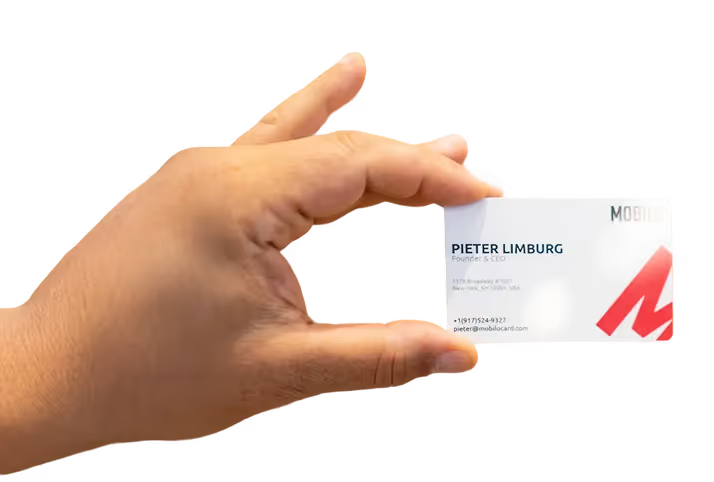
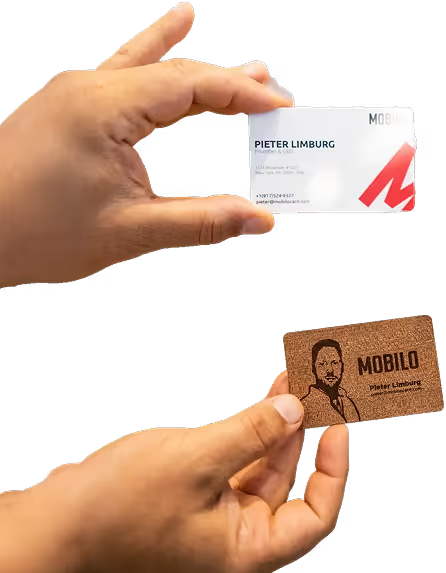
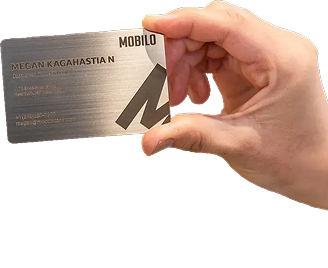
- When someone taps or scans a Mobilo card, their contact information is captured and fed directly into your CRM in real time, closing the data gap that causes every other best practice on this list to break down.
The Three Follow-Up Failure Modes That Kill Trade Show Pipeline
Three failure modes sit between your trade show investment and actual pipeline. They compound quietly across every event, and none of them show up in your email open rates. Most sales directors think the fix is better email templates and stricter follow-up cadence rules so reps stay disciplined after the show. That assumption misses where the real breakdown happens.
Failure Mode 1 - The Data Black Hole
Badge scans and paper cards feel like progress on the show floor. The problem surfaces Monday morning, when a junior rep realizes 168 of 180 contacts are still in a CSV no one uploaded. Research on post-event workflows consistently finds that a significant share of trade show contacts never make it into a CRM at all, and the manual entry burden is a core reason why: sales reps spend meaningful time after each event keying in contact details that could have been captured automatically.
That labor cost is invisible on the event budget, but the lost pipeline is not. The teams we work with at Mobilo solve this at the point of contact. Rather than collecting paper cards or relying on badge-scan exports, field marketing and event teams use tools that capture leads efficiently and feed data directly into the CRM pipeline, so the contact record exists before the rep even leaves the booth.
The Mobilo Teams plan ($4/month per member, billed annually) includes lead capture and management, lead enrichment, and 6,000 integrations through Zapier, which means captured contacts flow into whatever CRM your team already uses without a manual upload step.
Failure Mode 2 - The Flat-Blast Trap
Without lead segmentation at the point of capture, every contact looks identical inside the CRM. The rep who spent 20 minutes walking a VP through a product demo sends the same generic email as the one who handed a card to someone passing by. Post-trade show marketing built on a flat, unsegmented list wastes follow-up cycles on low-intent contacts while genuinely hot leads cool off waiting for a message that actually reflects the conversation they had.
Custom lead capture forms, included in both the Teams and Business plans, let reps tag intent, note conversation context, and segment contacts the moment the exchange happens, not two days later when memory has faded. Unlimited leads and contacts means the team never has to choose which conversations to record, and the paper business card scanner means even contacts who hand over a printed card still enter the same structured pipeline rather than a separate stack.
Failure Mode 3 - The Visibility Void
Sales pipeline visibility collapses entirely after most shows. According to industry research, most post-show workflows give managers zero attribution data: no view into which reps followed up, what response rates looked like, or whether the event generated measurable pipeline. Follow-up failure becomes invisible until the quarter closes and the numbers disappoint.
The Teams and Business plans both include insights and analytics and full team management, so managers get a real-time view of rep activity and lead flow, not a retrospective spreadsheet. The Business plan ($5/month per member, billed annually) adds HR directory sync, enterprise SSO, central billing, and a custom domain, along with white-glove onboarding for teams of 100 or more seats and a custom-built landing page at that same threshold. That combination means event attribution doesn't have to be reconstructed after the show; it's captured and visible as it happens.
These three failure modes do not fix themselves after the show ends. They have to be engineered out of the workflow before the first booth conversation happens. That is exactly where the next section starts: building a follow-up plan that is already running before you pack up the display.
Build Your Post-Show Follow-Up Plan Before the Show Ends
The debrief flight home is already too late. By the time the team lands, badge-scan exports are sitting in someone's downloads folder, paper cards are buried in jacket pockets, and reps are reconstructing booth conversations from memory. The same pattern emerges time and again, not because reps lack discipline, but because the data pipeline that should move contacts into the CRM was never built before the show opened. This problem compounds for teams that attend events regularly; the ones who benefit most from structured lead follow-up are also the ones most exposed to a broken pipeline repeating itself show after show.
Fix the Data Pipeline First, Before You Write a Single Email
The failure point is structural, not behavioral. When a rep exchanges contact details manually, there is no automatic CRM entry, no intent tag, and no sequence trigger. Someone has to process that data before any outreach can begin, and that processing almost never happens cleanly under post-show pressure.
Across the market, sales reps spend an average of 4+ hours on manual data entry after a typical event, which is precisely the window when first-touch outreach should be going out instead. Research on CRM data quality reinforces this: messy or incomplete CRM records don't just slow follow-up, they actively cause client attrition, because contacts that land without an owner, a source tag, or a next-step field simply stall and go cold. Mobilo's Teams plan ($4/month per member, billed annually) addresses this at the infrastructure level.
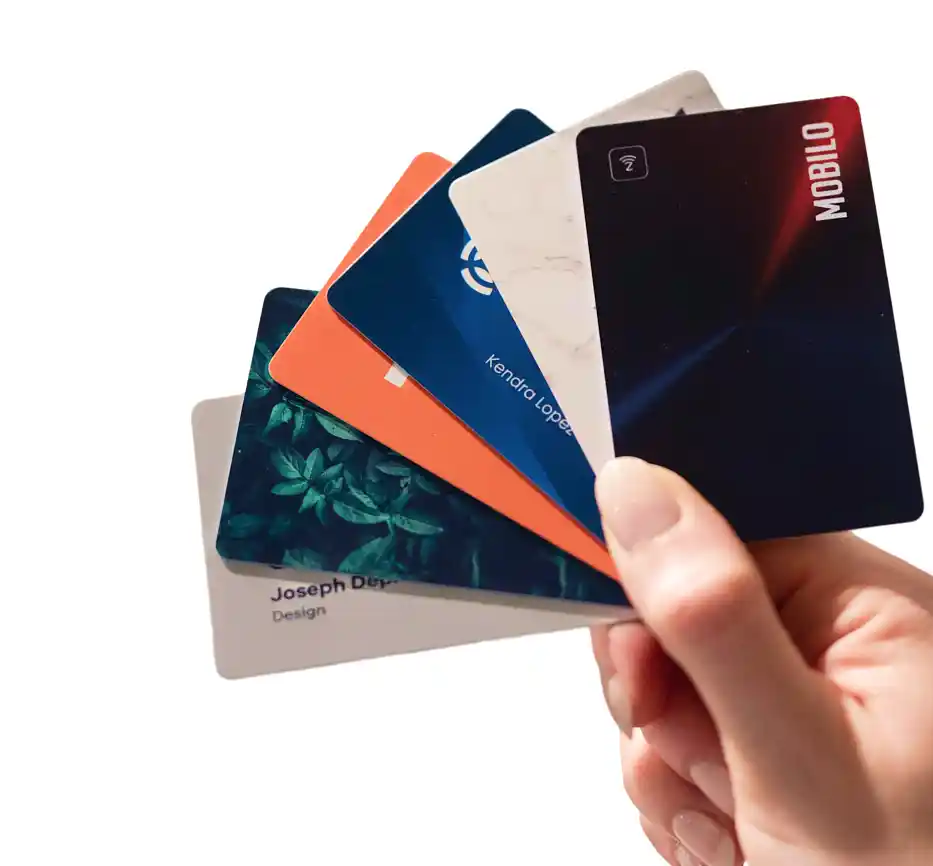
Every tap or scan on a Team, Custom Design Card or Team, Digital Wallet Card feeds directly into the CRM through any of 6,000 integrations available through Zapier, eliminating the manual export step entirely. Fix the pipeline architecture before day one of the show, and the follow-up problem shrinks considerably on its own.
Tag Lead Intent on the Show Floor, Not in a Post-Show Spreadsheet
Segmentation done retroactively is guesswork. The rep who spoke to 40 people over two days cannot reliably reconstruct which contacts were ready to buy and which were browsing. Custom lead capture forms, available on both the Teams and Business plans and defined before the show opens, let reps tag each contact as hot, warm, or cold at the moment of exchange.
That single field determines which sequence fires, which rep priority queue the contact enters, and how quickly a manager expects to see a meeting booked. Without it, every contact gets the same generic email, and the hot leads who were ready to move go quiet while the team wastes cycles on low-intent prospects. Teams that attend events regularly feel this acutely: poor CRM hygiene at the point of capture is one of the leading reasons clean pipelines degrade over time.
The Teams plan's team management and data-field control, which lets managers lock and override data fields across all cards, means intent tags and lead tiers are standardized before a single rep walks the floor, not debated in a post-show Slack thread.
Pre-Schedule Your 48-Hour Outreach Sequence Before Day One of the Show
The 48-hour follow-up rule is widely cited, but broader industry trends on lead response time show conversion rates drop by more than 80% when first contact is delayed beyond that window. The average company takes 47 or more hours to respond to any inbound lead under normal conditions. Add manual data entry, an unexported CSV, and a Monday debrief, and the window is not closing slowly.
Pre-scheduling sequences before the show opens means reps trigger outreach, not compose it under pressure. The Business plan ($5/month per member, billed annually) extends this further with lead enrichment and unlimited leads and contacts flowing automatically through the same Zapier integrations, so the CRM record that arrives is already populated, already owned, and already queued for the pre-built sequence. For organizations running 100 seats or more, white-glove onboarding is available to ensure this architecture is in place before the first badge is scanned.
Assign Rep Ownership and CRM Field Mapping as Pre-Show Infrastructure
It closes the moment the rep leaves the booth without a clean CRM entry. A contact that enters the CRM without an owner assigned is a contact that stalls. The connection between CRM cleanliness and client retention is direct: records missing ownership or standard field mapping create the exact gaps that let warm leads go unworked until it is too late. Rep ownership, lead tier fields, and booth-conversation notes should all be mapped in the CRM before the first badge is scanned, not reconstructed from memory on a Tuesday.
Both the Teams and Business plans include central billing, team management, full insights and analytics, and the ability to control, lock, and override data fields across every card on the account. That combination makes pre-show CRM mapping a one-time setup that governs every subsequent event, not a task that has to be repeated from scratch each time the team loads the van. Teams that complete this setup before the first badge scan find that post-event reporting runs automatically rather than requiring a manual reconstruction effort that rarely happens with full fidelity, which is precisely why this approach is most valuable for teams that attend events on a regular cadence.
Related Reading
- Etiquette For Networking In Online Conferences
- Measuring Event Roi
- Trade Show Sales Tips
- How Do You Find The Roi Of A Trade Show
- Trade Show Sales Funnel
- What Is Trade Show Marketing
- Event Lead Management
- B2b Trade Show Best Practices
- Conference Lead Generation
- B2b Trade Show Marketing
- Trade Show Lead Follow Up
16 Trade Show Follow Up Best Practices - From Lead Capture to Closed Deal
A substantial share of trade show contacts never make it into a CRM, and that structural failure explains more collapsed follow-up sequences than any poorly written subject line ever could. The 16 practices below map directly onto that pipeline, capture first, segment second, sequence third, measure last, because the templates, cadence rules, and A/B tests that come later are only as reliable as the data moving through the infrastructure built before the show floor opened.
1. Follow Up Within 24: 48 Hours While the Conversation Is Still Fresh
Image: Trade Show Follow Up Best Practices - within 24 48 hours
Speed is the single biggest predictor of trade show follow-up success. Leads contacted within 24–48 hours of the show close at dramatically higher rates because your booth interaction is still vivid in their memory. B2B sales teams that wait a week lose the emotional context of the conversation entirely. The tradeoff: rushing without personalization produces generic emails that get ignored, so speed must be paired with relevance.
2. Segment Leads Into Hot, Warm, and Cold Tiers Before You Send Anything
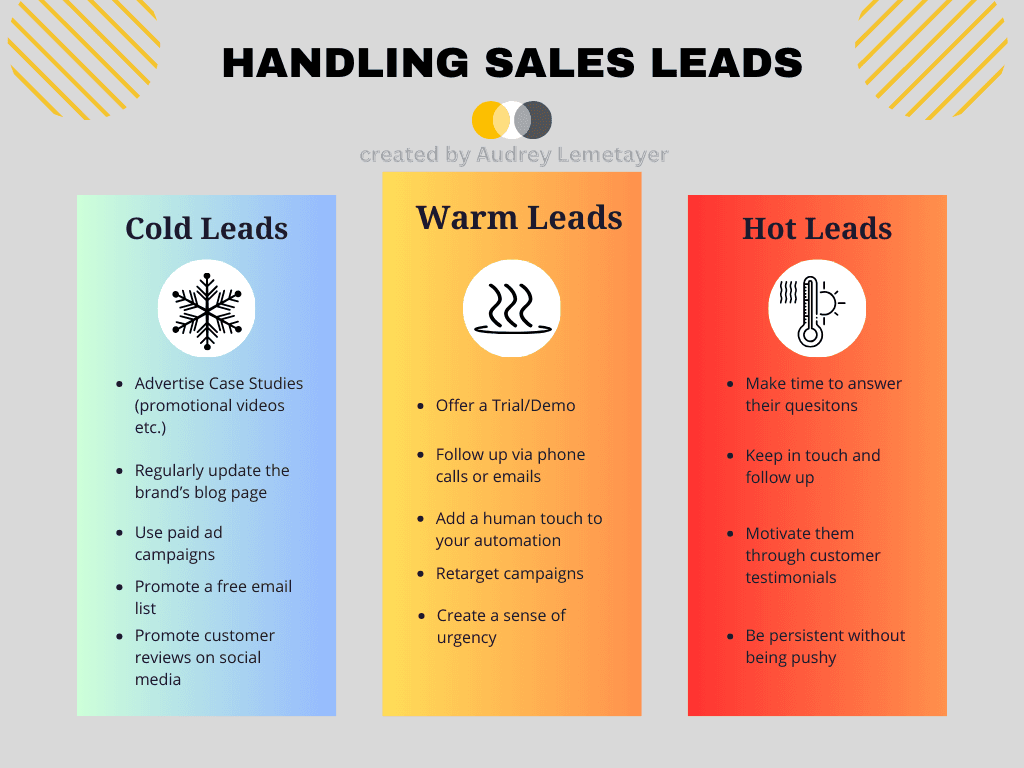
Not every badge scan deserves the same follow-up sequence. Segmenting leads into hot (requested demo or pricing), warm (engaged conversation), and cold (casual passerby) tiers lets your team prioritize effort and tailor messaging. Hot leads need a direct next-step ask; cold leads need nurture content first. The limitation is that this requires disciplined note-taking at the booth, something most teams skip under show-floor pressure.
3. Capture Booth Conversation Notes in Real Time Using a Digital Lead Form
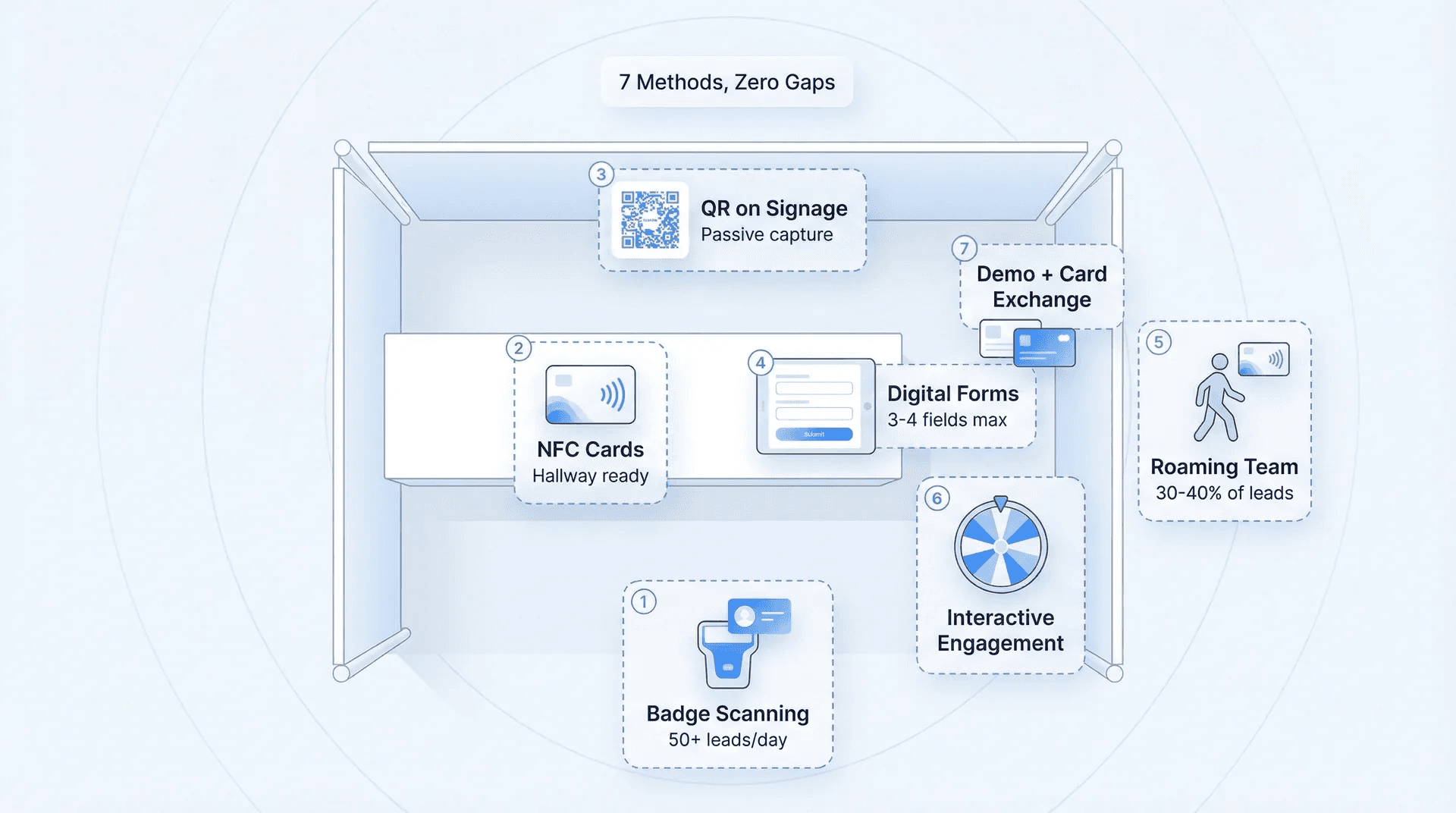
Relying on memory or paper business cards after a 3-day show is a guaranteed way to lose context. Digital lead forms completed at the moment of conversation, capturing pain points, product interest, and next steps, transform vague contacts into actionable CRM records. This is especially critical for teams with multiple booth staff. The tradeoff: staff need training and discipline to complete forms during busy floor periods without disrupting the conversation flow.
4. Sync Lead Data Directly to Your CRM Before Leaving the Show Floor
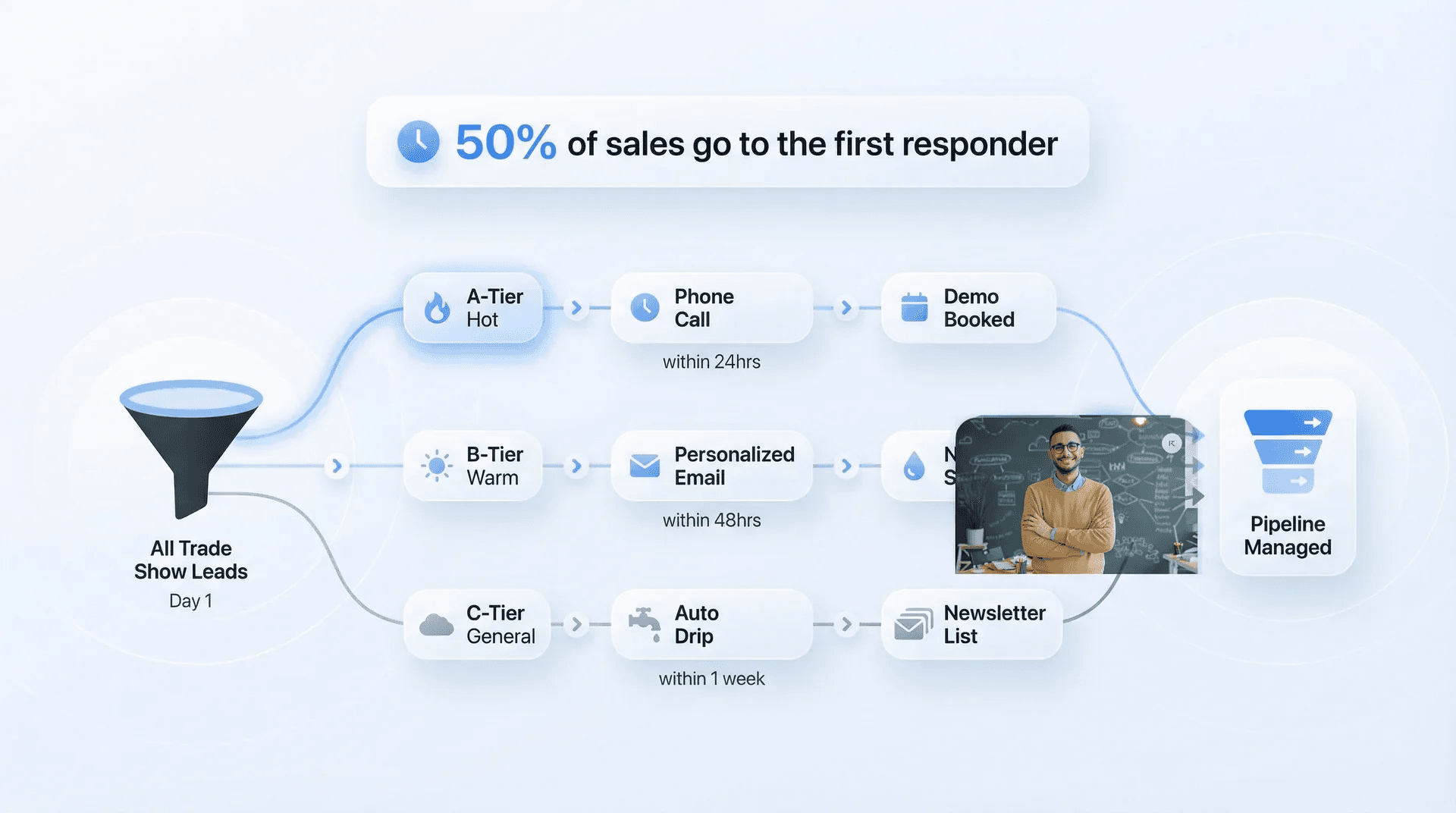
Manual data entry after a trade show introduces errors, delays, and dropped leads. The best practice is to use a lead capture app that syncs directly to your CRM, HubSpot, Salesforce, or Pipedrive, in real time or within hours of capture. This ensures your sales team can begin follow-up sequences immediately without waiting for a data-entry sprint. The limitation: CRM sync quality depends heavily on field mapping setup done before the show, not after.
5. Personalize Every First Email With a Specific Detail From Your Booth Conversation
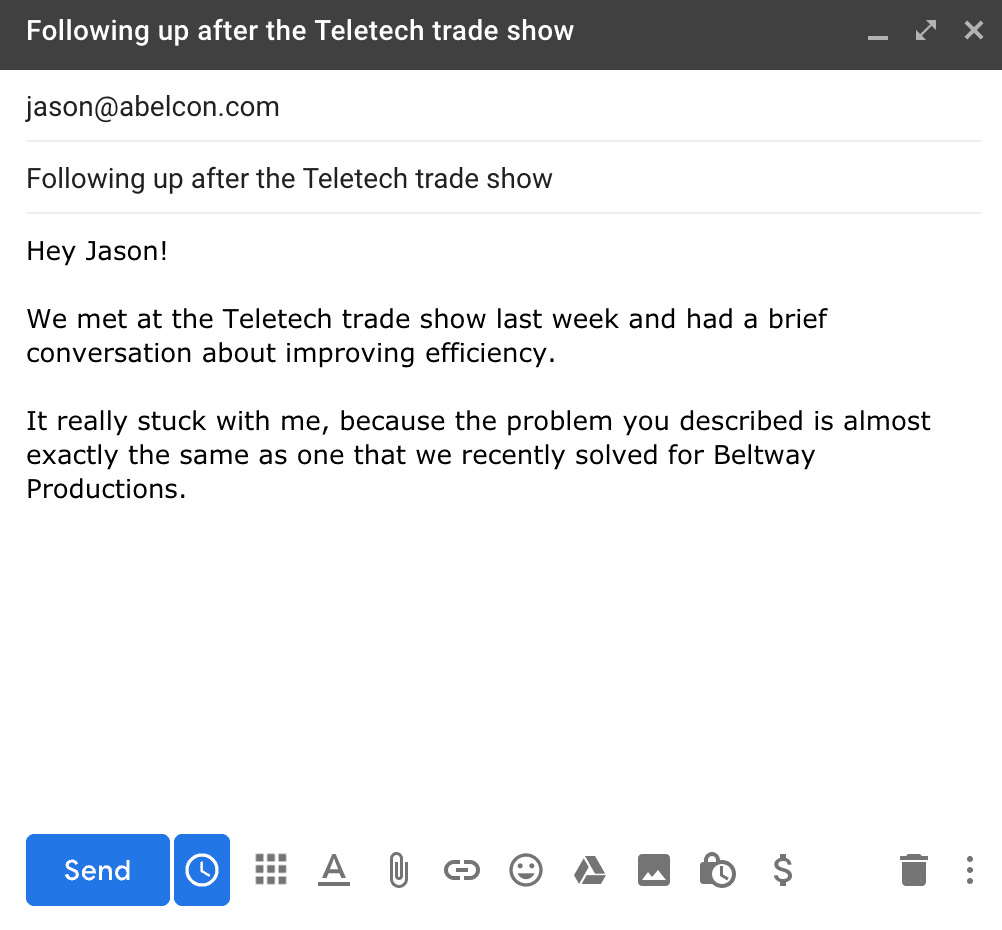
Generic 'Great meeting you at [Show Name]' emails are deleted on sight. High-converting follow-ups reference something specific, a challenge the prospect mentioned, a competitor they brought up, or a product feature they reacted to. This one tactic separates a 5% reply rate from a 25% reply rate. The tradeoff is time: personalizing at scale requires good booth notes and a team willing to invest 3–5 extra minutes per email, which is difficult with 200+ leads.
6. Use a Multi-Touch Sequence - Email, LinkedIn, Then Phone Call
A single follow-up email is rarely enough. Best-practice sequences combine an initial email (day 1–2), a LinkedIn connection request with a personal note (day 3–4), and a phone call (day 5–7) for hot leads. This multi-channel approach dramatically increases contact rates because different prospects respond to different channels. The limitation: this sequence requires coordination across your sales team and a CRM that tracks cross-channel touchpoints to avoid duplicate outreach.
7. Send a LinkedIn Connection Request With a Personalized Note Within 48 Hours
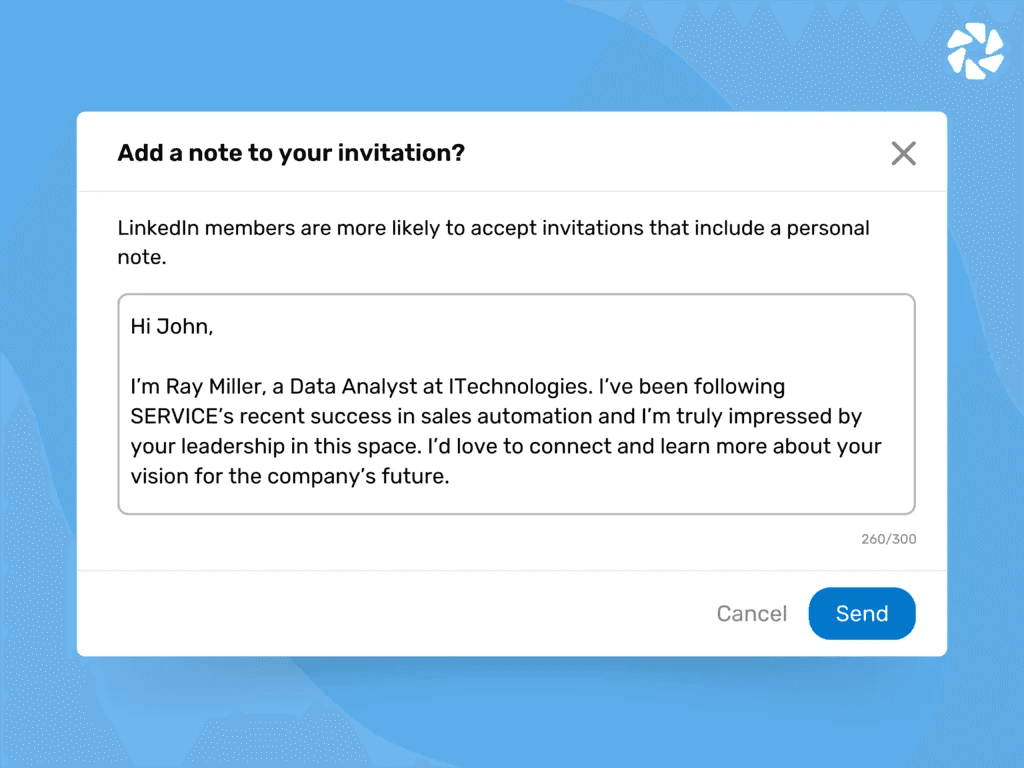
LinkedIn is the highest-trust post-show channel for B2B audiences. A connection request sent within 48 hours, referencing the specific show and a detail from your conversation, achieves acceptance rates far above cold outreach. Once connected, you gain a persistent channel for content-based nurturing. The tradeoff: LinkedIn InMail and connection limits mean this tactic doesn't scale infinitely, and over-automation of connection messages triggers spam filters and damages your sender reputation.
8. Pre-Schedule Follow-Up Meetings at the Booth Before the Show Ends
The highest-converting trade show follow-up is one that's already booked before you leave the floor. Training booth staff to end every strong conversation with a calendar invite, not a 'I'll email you', eliminates the follow-up friction entirely. Hot leads who book a post-show call at the booth show up at dramatically higher rates than those who receive a cold follow-up email days later. The limitation: this requires confident closing skills from booth staff and a mobile scheduling tool on hand.
9. Write Subject Lines That Reference the Show Name and a Specific Pain Point
Subject lines are the gatekeeper of your entire follow-up effort. 'Following up from [Show Name]' alone achieves modest open rates, but pairing the show name with a specific pain point the prospect mentioned, 'Re: your CRM migration challenge from [Show]', can double open rates. This is especially powerful for warm leads who remember the conversation. The tradeoff: writing individualized subject lines at scale is time-intensive and requires quality booth notes as the raw material.
10. Assign Every Lead to a Named Owner in Your CRM Before the Show Closes
Unassigned leads are dead leads. One of the most common post-show failures is a pile of contacts sitting in a shared inbox with no clear owner. Best practice is to assign every lead to a specific sales rep, ideally the person who had the conversation, before the show floor closes on the final day. This creates accountability and prevents the 'I thought you were following up' dynamic. The limitation: for small teams, one rep may be overwhelmed with 150+ leads from a major show.
11. Include a Single, Clear Call-to-Action in Every Follow-Up Email
Follow-up emails that ask prospects to 'check out our website, download our guide, and book a call' convert poorly because they create decision paralysis. Every follow-up email should contain exactly one CTA, book a 20-minute call, download a specific case study, or reply with a yes/no answer. This is especially important for hot leads where you want to advance the deal, not educate. The tradeoff: a single CTA means you must correctly diagnose where the lead is in their buying journey.
12. Use Badge Scanning Apps to Capture Lead Data Accurately and Instantly
Image: Trade Show Follow Up Best Practices - use badge scanning apps
Manual business card collection is error-prone and slow to process. Badge scanning apps, either the official show app or a third-party tool, capture verified contact data instantly and eliminate transcription errors. For high-traffic booths processing 50+ contacts per day, this is a non-negotiable efficiency gain. The tradeoff: official show scanning apps often provide minimal data fields and don't integrate with your CRM, requiring a secondary data enrichment step before follow-up can begin.
13. Deliver a Promised Resource or Demo Recording as the Follow-Up Hook
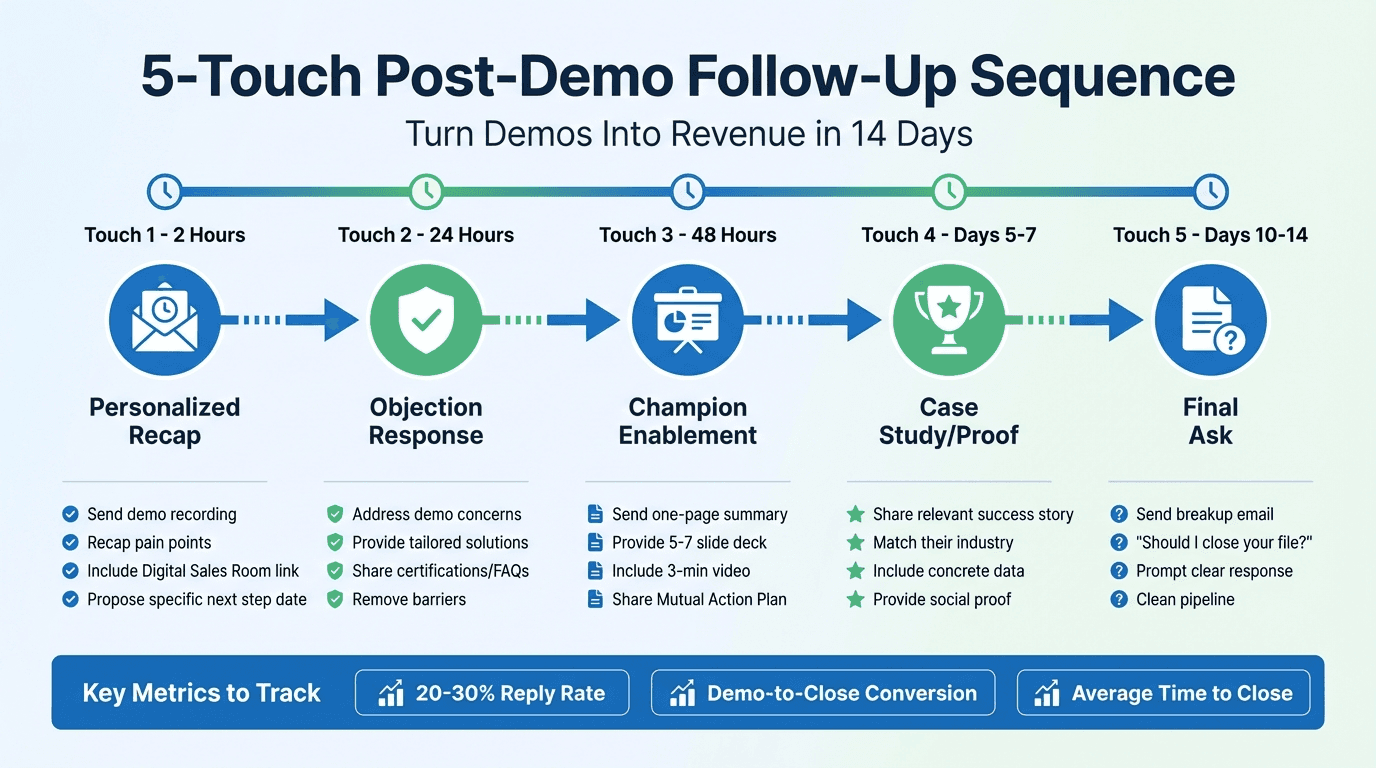
The strongest follow-up emails fulfill a promise made at the booth, 'I'll send you that case study' or 'here's the demo recording you asked about.' This transforms a cold outreach into an expected, welcomed message. It also gives your email a concrete reason to exist beyond 'just checking in.' The limitation: this only works if booth staff consistently make and document specific promises during conversations, which requires a structured booth conversation framework and real-time note-taking discipline.
14. Set a 30-Day Nurture Sequence for Cold Leads Who Aren't Ready to Buy
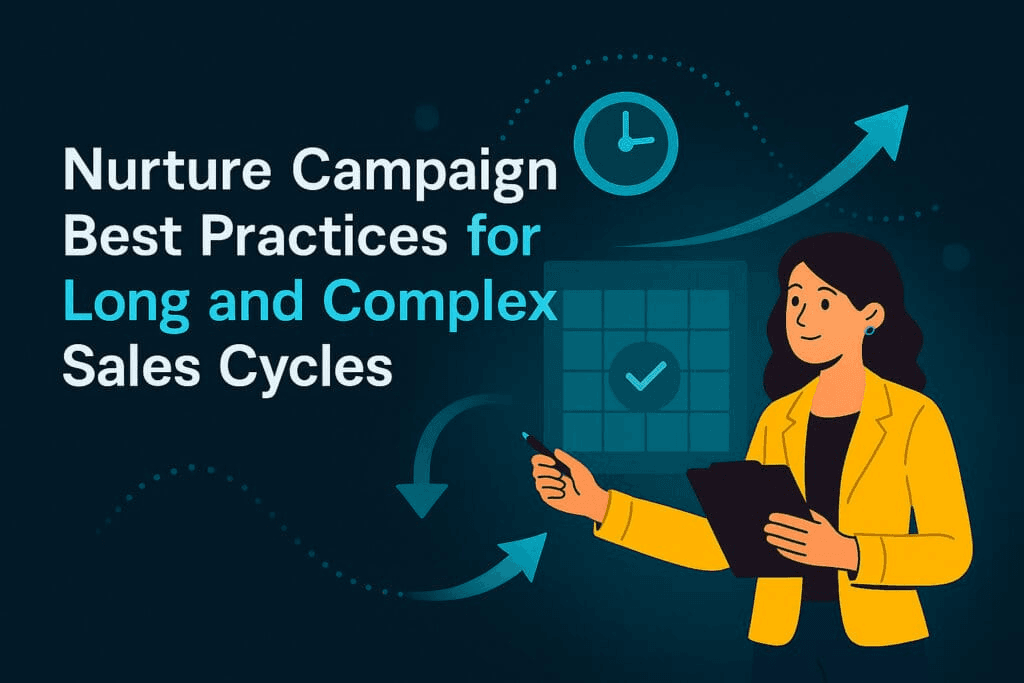
Cold leads from trade shows, badge scans with no meaningful conversation, shouldn't be abandoned or hammered with sales emails. A 30-day nurture sequence delivering educational content (industry reports, how-to guides, relevant blog posts) keeps your brand visible until they enter an active buying cycle. This is particularly valuable in long B2B sales cycles where the show contact may not have budget for 6–12 months. The tradeoff: nurture sequences require content investment and marketing automation infrastructure to execute at scale.
15. Conduct a Post-Show Team Debrief to Score Lead Quality Before Outreach Begins
Before any follow-up email goes out, the booth team should spend 60–90 minutes reviewing every lead together, scoring quality, and aligning on context. This debrief surfaces details that one rep captured but another missed, prevents duplicate outreach, and ensures the right message goes to the right tier. It's the quality-control step most teams skip in the rush to follow up fast. The tradeoff: this debrief delays outreach by a few hours, which must be weighed against the accuracy gains it provides.
16. Track Follow-Up Response Rates by Show to Calculate True Event ROI
Most companies measure trade show ROI by leads collected, not by deals closed from those leads. Tracking follow-up response rates, meeting conversion rates, and pipeline generated per show, tagged in your CRM by event source, reveals which shows actually produce revenue and which produce only business cards. This data drives smarter event budget decisions for the following year. The limitation: accurate attribution requires consistent CRM tagging discipline from day one of follow-up, which many teams implement too late.
Related Reading
- Which Networking Software Is Best For Conferences
- Trade Show Booth Ideas To Attract Visitors
- Conference Lead Capture
- How To Measure Trade Show Effectiveness
- Virtual Event Success Metrics
- Trade Show Roi
- Trade Show Lead Generation Ideas
- What's The Best Event Lead Generation Software
- Post-Trade Show Marketing Strategies
- Best Trade Show Giveaways
How Automated Lead Capture Turns These Best Practices Into a Repeatable System
The playbook you built for your team is only as strong as the data flowing into it. Every best practice in this guide, from 48-hour follow-up rules to tiered email sequences, assumes one thing: that the contact is already in the CRM, correctly tagged, and assigned to the right rep. When that assumption breaks, the playbook does not fail loudly. It just quietly stops working.
Why Every Best Practice Has a Hidden Dependency on Clean CRM Data
According to broader industry trends, a consistent pattern emerges across major US shows. That number persists even at companies that already have email templates and cadence rules in place. The failure is not discipline. It is structural. Manual card-and-CSV workflows introduce transcription errors, duplicate records, and missing fields that corrupt CRM segmentation, making intent-based sequence triggers impossible to fire reliably. Without clean upstream data, every best practice in this list requires a rep to manually compensate for what was never captured.
One Tap, One CRM Record - How to Eliminate the Manual Entry Bottleneck
Most teams collect cards at the booth and schedule a Sunday-night data entry session that, in practice, never happens. The hidden cost is not just lost time; it is a corrupted pipeline. What most teams report is that manual contact entry carries a significantly higher error rate than automated capture, and across the market, manually entered CRM records consistently carry materially higher error rates than automatically captured ones, often affecting a significant share of fields, meaning the records that do make it into the CRM are frequently incomplete or inaccurate.
A digital business card workflow changes the mechanic entirely: one tap or scan at the moment of exchange creates a structured CRM record with contact details, intent tier, and rep attribution attached. No Sunday-night import. No missing fields.
From Capture to Cadence - How Pre-Mapped CRM Fields Make Lead Segmentation Automatic
Mobilo's Contact Exchange and Lead Capture feature maps custom fields directly to CRM records at the point of exchange, so intent tiers, conversation notes, and sequence triggers arrive with the contact, not days later. One honest caveat: setup requires a CRM admin to configure field mapping before the show. Skipping it means the automation captures contacts without the intent-tier and sequence-trigger fields populated, which puts you back in the same position as a manual import, data in the CRM, but not actionable without a cleanup pass. Budget thirty to sixty minutes of admin time before each event and the workflow runs as designed.
Measure Trade Show Follow-Up Success - The KPIs That Prove Event ROI
Badge scans and lead counts feel like progress. They are not. Teams return from trade shows with badge scans and business cards only to find that follow-up sequences generate near-zero reply rates, making it structurally impossible to measure meaningful post-event ROI. The KPIs that actually predict whether your event spend turns into pipeline operate one level deeper, at the rep-activity layer, and most post-show dashboards never surface them at all.
The Five Follow-Up KPIs Every Sales Director Should Pull After Every Show
"Teams rarely have a structured post-show review process, making it difficult to capture learnings and assess whether an event was successful, directly undermining the ability to measure trade show follow-up success and prove event ROI."
The metrics worth tracking are contact-to-email-sent rate, contact-to-meeting-booked rate, follow-up lag time per rep, lead tier conversion rate, and event-attributed pipeline value. Marketers who stop at surface-level counts like total visitor numbers or badge scans find those numbers don't reliably predict ROI or follow-up success; they're vanity signals dressed up as performance data. Teams consistently below the low end of their historical contact-to-meeting-booked range should look first at lag time and segmentation before adjusting email copy; if your team is below that range, the problem is almost always lag time or flat segmentation, not email copy. Pull these five after every show and you have an actual diagnostic, not a vanity count.
Rep-Level Signal Yield - Why Aggregate Pipeline Numbers Lie Until It Is Too Late
Aggregate pipeline numbers hide the real story. One rep who books eight meetings can mask three reps who sent zero follow-ups, and by the time that shows up in a pipeline review, the window to intervene has closed. Rep-level signal yield, the ratio of contacts captured to meaningful outreach actions taken per rep, is what separates a coaching conversation from a post-mortem. This problem is most acute for client-facing professionals who attend frequent in-person networking events, where the volume of exchanges makes rep-by-rep accountability easy to lose track of and most beneficial to measure precisely.
How to Build a Post-Show CRM Dashboard That Surfaces Stalled Follow-Up Before Deals Die
Dashboards that omit upstream activity signals, such as emails sent and contacts updated, leave managers with no way to intervene before follow-up stalls entirely. Compounding this, teams rarely have a structured post-show review process at all, which means learnings go uncaptured and it becomes nearly impossible to assess whether an event was worth attending, let alone prove ROI to leadership. The fix is a view filtered by event source tag, sorted by follow-up lag time, with a rep-assignment column visible at a glance. If a contact has no logged outreach within 48 hours of capture, it should surface automatically, not appear weeks later in a cold-lead pile.
Why Automated Capture Data Makes These KPIs Measurable
The core problem here is not that attribution models are unsophisticated; it is that manual lead capture destroys the metadata required to build any attribution model at all, making trade show ROI structurally unmeasurable in most CRMs before a single dashboard is ever opened. Manually chasing down attendee data post-show is a recognized operational burden that directly degrades follow-up success; the time spent reconstructing who spoke to whom, and when, is time not spent in outreach. When capture timestamp, intent tier, and rep assignment are written into every CRM record at the moment of exchange, rather than reconstructed days later from memory or a badge-scan export, the five KPIs above become pull-and-read metrics rather than month-end archaeology projects.
This is precisely where Mobilo's team plans close the gap. The Teams plan ($4/month per seat, billed annually, marked Popular) includes full team data analytics, CRM integrations via Zapier-connected apps, lead enrichment, custom lead capture forms, unlimited leads and contacts, and team management controls, including the ability to control, lock, and override data fields, so rep-level records arrive in your CRM clean and consistent from the first tap. For organizations that need enterprise-grade controls, the Business plan ($5/month per seat, billed annually) adds enterprise SSO, HR directory sync, central billing, and 24/7 customer support, with white-glove onboarding available for larger deployments.
Both plans support unlimited team members and unlimited taps, meaning the per-contact data quality doesn't degrade as event volume scales. The value of these controls is highest for professionals in frequent client-facing or networking roles, exactly the reps whose post-show follow-up velocity most directly determines whether event spend turns into pipeline.
Related Reading
- Best Tech Conferences For Networking
- Best Networking Apps for Trade Show Attendees
- Best Finance Conferences For Networking
- Trade Show Booth Ideas For Small Budgets
- Virtual Conference Booth Ideas
- Networking Activity Ideas For Conferences
- What Are The Top Trade Show Lead Retrieval Tools
- Trade Show Follow Up Email Examples
- Conference Lead Capture Tools
- Trade Show Lead Capture App
Next steps
If your reps are returning from shows with badge-scan CSVs that never reach the CRM, the path forward starts with eliminating the manual handoff between capture and pipeline entry. No cadence rule or email template fixes leads that were never logged in the first place. Start with our digital business card.
The 48-hour follow-up window closes the moment a rep leaves the booth without a clean CRM record, not Monday morning when the CSV finally surfaces. That structural gap means the five-minute response advantage that makes a rep 100 times more likely to reach a lead is simply inaccessible to most teams. And without capture timestamp, intent tier, and rep assignment written into every record at the point of exchange, the post-show dashboard measures only the leads that survived the pipeline, not the ones lost inside it. Those two realities together point to one action: fix the capture infrastructure before the next show opens.
Start with a digital business card that routes every tap directly into your CRM with intent tier and rep attribution attached. Every downstream best practice in this guide, from tiered sequences to rep-level attribution dashboards, runs on that clean upstream data.
Frequently Asked Questions
Why do so many trade show leads never get followed up on?
The root cause is a structural gap between lead capture and CRM entry, not rep discipline. When contacts are collected as paper cards or badge-scan CSVs, the manual data entry required after the show competes with every other post-show priority, and 90% of new contacts never end up in the CRM at all.
How soon should I reach out to a lead after a trade show?
You should send the first touchpoint within 48 hours of capturing the lead. Industry lead-response research shows that conversion rates drop by more than 80% when first contact is delayed beyond that window, and the average company already takes 47 or more hours to respond to any inbound lead under normal conditions, so the teams that move fastest operate in a different conversion bracket entirely.
What's the best way to sort leads after a trade show so reps know who to prioritize?
Tag each contact with an intent tier, hot (active buying conversation), warm (expressed interest, no timeline), or cold (general inquiry), at the moment of exchange on the show floor, not days later from memory. That single tag determines sequence length, tone, and how much rep time the contact receives, and it takes under ten seconds to apply.
How do I make sure contacts actually get into the CRM after the event?
The key is eliminating the manual handoff entirely. When every tap or scan routes contact data directly into the CRM at the moment of exchange, the post-show data-entry backlog disappears and the 48-hour follow-up window stays open, because the lead already exists in the pipeline before the rep walks to the next booth.
What should be set up before the show even starts to avoid a broken follow-up process?
Three things should be in place before the first badge is scanned: a direct CRM integration so contacts are captured automatically, custom lead capture forms with intent tags already defined, and pre-scheduled outreach sequences so reps trigger follow-up rather than compose it under post-show pressure. Rep ownership and CRM field mapping should also be assigned as pre-show infrastructure, not reconstructed from memory at a Tuesday debrief.