.avif)

23 Best Virtual Conference Booth Ideas to Boost Engagement
On This Page
Your virtual booth can log 300 interactions and still hand reps a cold spreadsheet. Here is why the gap is a data routing problem, and how to wire every booth element directly into your CRM pipeline.
Virtual conference booths have become genuinely impressive productions. Branded backgrounds, animated banners, live polls, trivia games, prize wheels, the experience looks polished and the engagement numbers climb. But most sales directors operate under a widespread assumption: they believe the booth itself is the deliverable: if attendees are engaged and having fun, the event was a success and follow-up is a rep-execution problem, not a booth-design problem. See our digital business card for how this works in practice.
This is precisely the belief that leaves teams staring at cold spreadsheets after the event closes. A booth can log 300 chat interactions and still hand your sales team a cold spreadsheet that syncs nowhere. The gap between a great-looking virtual expo booth and one that actually feeds your CRM is not a design gap. It is a data routing gap, and it starts with how the booth was architected before the first attendee ever arrived. The primary job of a virtual conference booth is not to entertain. It is to generate CRM-ready contacts that your sales team can act on within 48 hours.
Every poll vote, game play, and raffle entry that does not produce a structured lead record is activity, not pipeline. Across the market, 90% of new contacts collected at events never enter a CRM because the manual effort required is simply too high. The reframe that changes everything: treat every booth element as a capture trigger, not just an experience moment. A demo request, a swag claim, a game completion should each fire a CRM record automatically. When a sales rep shares a digital business card during a virtual booth interaction, the contact's details route directly into the CRM with zero manual entry, turning every exchange into a trackable pipeline event, a benefit that is most impactful when a team attends events regularly and needs structured lead follow-up across a high volume of contacts.
90% of new contacts collected at events never enter a CRM beca
Key takeaways
- 90% of new contacts collected at virtual booths never reach a CRM, that's a capture architecture failure, not a follow-up execution problem.
- Engagement metrics measure attention, not intent; a packed booth with no structured data layer produces traffic statistics, not pipeline.
- Gamification drives a 48% lift in engagement, but only converts to revenue when every game interaction is wired to a timestamped lead capture event.
- Behavioral signals, rotating a 3D product model, zooming into a spec, raising a hand in Q&A, are the sharpest buying intent data in the booth, and most teams discard them entirely.
- 85% of trade show leads go cold after the event because the capture window closes the moment the conversation ends; the fix is architecture, not cadence.
- Budget and visual production value don't determine pipeline outcome, whether every interaction becomes a CRM record before the event ends does.
- Mobilo's Contact Exchange and Lead Capture closes the loop: when someone taps or scans a Mobilo card at your virtual booth, their information is captured and synced directly into your contact list or CRM, no manual entry, no data loss.
The Hidden Cost of Virtual Booth Engagement That Never Reaches Your CRM
Most virtual booth strategies are evaluated on engagement metrics that measure attention rather than intent, which means a visitor who explored your product tabs and started a conversation can look identical to someone who clicked in and left after ten seconds. The real problem surfaces after the event, when reps are expected to follow up from memory and most of those interactions never produce a CRM record at all. This section breaks down why that gap exists at the booth-design level and how the right contact-capture approach, including digital business cards that feed directly into your pipeline, closes it before the event ends.
Why High Booth Traffic Numbers Don't Always Mean More Leads
Most sales directors believe the booth itself is the deliverable: if attendees are engaged and having fun, the event was a success and follow-up is a rep-execution problem, not a booth-design problem. But engagement metrics measure attention, not intent. A visitor who spent four minutes in your booth, clicked three product tabs, and dropped a chat message is indistinguishable from someone who entered a raffle and left.
Without a CRM record tied to each interaction, both contacts look identical in post-event reporting: invisible. A significant majority of event leads never enter a CRM at all, meaning most of that booth traffic you celebrated was never actionable to begin with. The root issue is a gap in the field-marketing toolkit.
Event and field marketing teams need instruments that capture leads efficiently and feed data directly into the CRM pipeline, not a workflow that depends on a rep remembering to type notes at the end of an exhausting event day. Every customer-facing touchpoint at your booth should consistently reflect your brand identity and drive measurable engagement, which is only possible when the capture mechanism and the CRM record are one seamless motion, not two separate steps.
Pros and cons at a glance
✓ Pros
✗ Cons
Multi-stage hunts encourage exploration of every booth corner
Requires meaningful content at each stop
Each clue completion is a natural contact-capture checkpoint
Rewards booths with product depth, punishes thin booths
Lead decay is not gradual. com's analysis of post-event follow-up patterns, the window where a prospect remembers the conversation and responds to outreach is concentrated in the first 24 to 48 hours after an event. Every hour a rep spends reconstructing notes and manually entering a contact record is an hour the lead is cooling.
By the time the data entry is done, the competitive advantage of that live conversation is largely gone. That time pressure is exactly why the capture tool itself must do the CRM work. When field marketing teams are armed with tools that capture leads efficiently and feed data directly into the pipeline, the follow-up clock starts the moment the card is shared, not the morning after, when a rep finally gets back to their desk.
Automating Post-Event Contact Capture - A Core Virtual Conference Booth Idea
The field reps who struggle most after events are not poor closers, they are individual card holders who were never given a system that removes manual data entry from the equation. When sharing a contact means handing over a paper card that gets pocketed and forgotten, the CRM record simply never gets created. That failure produces data gaps, time lag, and zero accountability for which conversations actually happened on the booth floor.
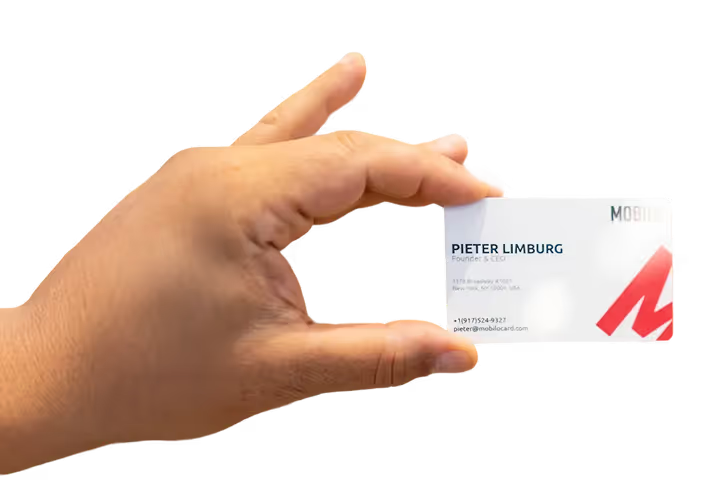
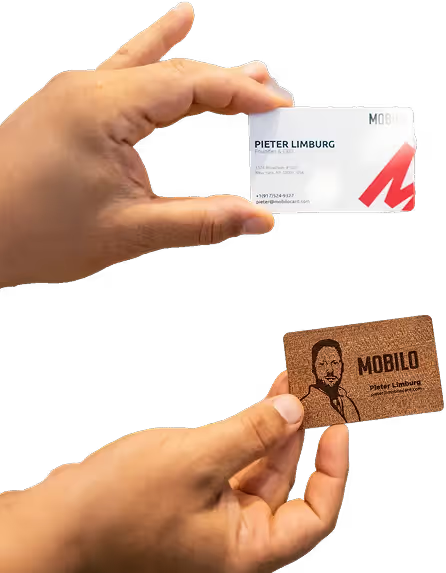
Mobilo's digital business card platform is built to close that gap at the team level. The Teams plan ($4/month per seat, billed annually), the platform's most popular subscription tier, includes full team management, lead enrichment, lead capture and management, unlimited leads and contacts, custom lead capture forms, and 6,000 integrations through Zapier, so every tap or scan a rep makes on the event floor routes directly into your CRM pipeline without a single manual entry step. The plan also includes brandable QR codes, an Apple/Google QR code widget, no-internet QR sharing (critical for convention-center Wi-Fi dead zones), insights and analytics, email signatures, central billing, and 24/7 customer support, all for unlimited team members.
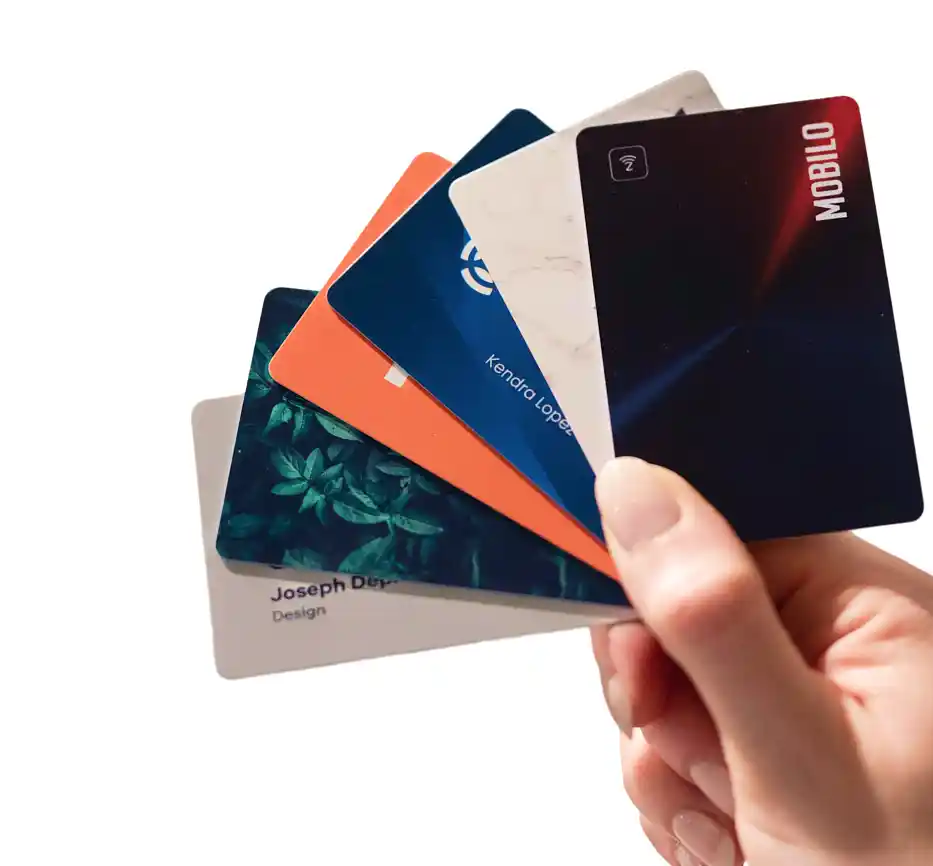
For teams that need enterprise-grade controls, custom domain, enterprise SSO, HR directory sync, and white-glove onboarding (available for deployments of 100 seats or more), the Business plan adds those capabilities at $5/month per seat, billed annually, while preserving every feature in Teams including the full Zapier integration library and 24/7 support. On the hardware side, teams can pair either subscription with physical cards that reinforce brand identity at every handoff. 00, and includes unlimited taps and scans, full team data analytics and CRM integrations, team management, and field-level data controls that let administrators lock and override data fields to ensure every rep's card reflects approved, on-brand information.
00), both carrying the same unlimited-taps, full-analytics, and data-field-control feature set. 00) round out the lineup, so every member of the field team, regardless of role or event context, has a capture-ready touchpoint that feeds the same shared analytics dashboard. The CRM admin responsible for integration setup also gains something equally important: a single, clean data source. Com's trade-show research becomes a system constraint you can actually engineer around, not a race your reps have to win manually after an exhausting event day.
Gamification and Interactive Games That Drive Traffic: and Feed Your Pipeline
Gamification can spike booth engagement, but without the right architecture behind it, every leaderboard point and scavenger hunt completion disappears into an event platform dashboard that never touches your pipeline. The mechanics covered here are built to do two things simultaneously: give attendees a genuine reason to participate, and fire a structured contact record the moment they do. That second part, the CRM wiring, is what separates a traffic bump from a revenue signal.
Gamification as a Revenue Driver, Not a Vanity Metric
The most effective gamification techniques for virtual conference booths combine attendee delight with automatic lead capture, turning every game interaction into a structured pipeline event rather than a traffic statistic. The core synthesis claim here is worth stating plainly: gamification's 48% engagement lift is structurally worthless without CRM wiring, because every interactive touchpoint only becomes a revenue signal when it fires a scored contact record at the moment of interaction, making the architectural connection between game mechanics and pipeline logic the actual product, not the game itself. Gamification increases attendee engagement at virtual events by up to 48%, according to EntrepreneursHQ's virtual event data.
The problem surfaces three days later, when the sales team is staring at an event platform dashboard full of game completions that never wrote a single record to the CRM. Dwell time without data capture is just entertainment with a budget line. The fix is architectural, not cosmetic. Every mechanic below is designed to do two things at once: create a moment attendees genuinely want to participate in, and fire a contact record the instant they do.
1. Branded Virtual Spin-to-Win Prize Wheel With Gated Lead Capture
A digital prize wheel embedded directly in your virtual conference booth forces attendees to submit contact details before spinning, turning prize excitement into a qualified lead pipeline. It works best for high-traffic booths targeting broad awareness audiences. The real tradeoff: prize-motivated leads vary wildly in intent quality, so pair wheel entries with a follow-up qualification question to separate tire-kickers from genuine prospects.
2. Live Exhibitor Trivia Challenge Tied to Product Knowledge
Embedding product- or industry-specific trivia inside your virtual booth keeps attendees engaged for longer dwell times while organically educating them about your solution. Whova's exhibitor trivia format shows this drives measurable lead volume and ROI lift. The limitation is content creation overhead, questions must be refreshed per event to avoid repeat attendees gaming the system, and poorly written questions can inadvertently confuse rather than educate prospects.
3. Multi-Booth Virtual Scavenger Hunt With Stamp-Card Rewards
A cross-booth scavenger hunt requires attendees to visit multiple exhibitor spaces and collect digital stamps to unlock a grand prize, dramatically increasing booth dwell time and repeat visits. This format is ideal for conferences with five or more exhibitors willing to coordinate. The tradeoff is dependency on organizer buy-in, if neighboring booths drop out mid-event, the hunt breaks down and attendee frustration can reflect poorly on your brand.
4. Real-Time Leaderboard Competition With Points for Booth Interactions
Assigning points to specific booth actions, watching a demo video, downloading a whitepaper, booking a meeting, and displaying a live leaderboard creates sustained competitive engagement throughout the event day. This approach is best suited for B2B teams targeting technically engaged buyers who respond to achievement mechanics. The key limitation is that leaderboard fatigue sets in after roughly four hours, so cap the competition window and announce winners before momentum drops.
5. Interactive Challenge Bar With Skill-Based Mini-Games and Demo Unlocks
A challenge bar presents attendees with a rotating set of short skill-based tasks, reaction games, quick polls, or timed quizzes, where completing a challenge unlocks an exclusive product demo or gated content piece. This format converts passive booth visitors into active participants and naturally segments high-intent leads who complete multiple challenges. The tradeoff is technical setup complexity; poorly optimized challenge interfaces on mobile browsers will frustrate attendees and inflate bounce rates.
6. Spin-to-Win Prize Wheel With Tiered Branded Merchandise Rewards
Structuring prize wheel segments into tiers, branded swag, discount codes, and a top-tier grand prize, creates perceived value differentiation that keeps attendees talking about your booth across social channels. This works especially well for consumer-facing B2B brands where merchandise visibility matters. The honest limitation is shipping logistics for physical prizes at virtual events; digital reward alternatives like gift cards or software credits sidestep fulfillment headaches but reduce the tactile brand impression.
7. Gamified Digital Badge and Achievement System for Booth Milestones
Issuing verifiable digital badges when attendees hit specific booth milestones, completing a product tour, attending a live Q&A, or referring a peer, creates shareable proof of engagement that extends your brand reach beyond the event itself. Badgecraft-style credentialing is particularly powerful for training-adjacent or certification-focused B2B brands. The tradeoff is that badge programs require post-event infrastructure to honor and display credentials, adding operational lift that smaller teams may underestimate.
3D Product Showcases and Live Demo Ideas That Turn Viewers Into Buyers
Gating a landing page captures the name behind an inbound share, but the sharper intelligence lives inside the booth itself. When a prospect rotates your product model, zooms into a component, or raises their hand during a live Q&A, they are not passively browsing. They are showing you exactly where they are in the buying process.
The problem is that most virtual booths treat that behavioral moment as an experience metric rather than a sales signal, and the intent data disappears before any rep ever sees it. 3D product showcases use 360-degree interactive models that visitors can rotate, zoom, and explore at their own pace. Across the market, this exploratory format holds attention significantly longer than static product images, because the attendee controls the path.
That path choice is itself a signal: which angle they examined, which hotspot they clicked, how long they stayed. Platforms like vFairs have built lead capture logic directly into their virtual booth infrastructure, connecting each hotspot interaction to a CRM record in real time so that demo engagement becomes pipeline data, not just applause. The live video demo raises the intent level further.
A 20-minute product walkthrough with a structured Q&A puts a rep in direct, real-time conversation with a prospect who chose to show up. What most teams report is that live demo webinars consistently produce some of the highest conversion rates to sales pipeline of any virtual event format. The tradeoff is execution risk: multi-presenter handoffs that stall, Q&A queues that go unanswered, or a session that runs long and loses the audience before the closing CTA.
The deeper structural problem is what happens at the close of a session. A rep delivers a strong demo, the room is warm, and then the contact exchange still relies on someone manually typing a name into a spreadsheet. That is where intent evaporates.
Teams that attend events regularly and need structured lead follow-up get the most value from a contact capture layer wired directly to their CRM: when a demo attendee taps or scans a rep's digital business card at the close of a session, their information routes automatically into the pipeline record instead of a forgotten note.
1. Spin-and-Zoom 360° Product Viewer with Hotspot Annotations
Embed an interactive 360° viewer directly inside your virtual conference booth so attendees can rotate, zoom, and tap labeled hotspots that reveal specs, pricing, or video clips. This is the right pick for hardware, medical device, or industrial equipment brands whose physical product complexity can't be conveyed through static images. The real tradeoff: high-fidelity 3D asset creation requires professional photogrammetry or CAD export time, making last-minute product updates costly.
2. Self-Running Guided Demo Loop That Adapts to Viewer Persona
Deploy a self-running demo that plays continuously in your virtual booth but branches into persona-specific story paths when a visitor clicks a role selector, 'I'm in Finance,' 'I'm in Operations,' etc. Ideal for SaaS platforms with multi-stakeholder buying committees where one generic demo loses half the room. The limitation is upfront story-mapping effort; teams without a dedicated demo engineer often underestimate the scripting and branching logic required.
3. Live Multi-Presenter Product Demo Webinar with Real-Time Q&A Handoff
Run a structured live demo inside your virtual booth where sales, product, and engineering each own a segment, then hand off to a live Q&A moderator who routes attendee questions to the right expert in real time. This format converts skeptical technical buyers who need to hear from engineers, not just sales reps. The tradeoff is coordination overhead, misaligned handoffs or audio issues between co-presenters visibly erode credibility in front of a live audience.
4. AR Overlay Demo That Places Your Product Inside the Attendee's Own Environment
Give virtual booth visitors a browser-based AR experience that uses their device camera to render your product, furniture, machinery, signage, at true scale inside their actual workspace. This is the strongest conversion tool for products where spatial fit or aesthetic context drives the purchase decision. The key limitation is device fragmentation: older Android browsers and some corporate-locked devices block camera permissions, reducing the accessible audience by 15–25%.
5. 360° Demo Video with Embedded Lead-Capture Gate at Peak Engagement Moment
Produce a cinematic 360° product demo video and insert a lead-capture form or calendar-booking widget at the moment of highest viewer engagement, typically 60–75% through the runtime when feature payoff peaks. This approach works best for consumer electronics, automotive accessories, or lifestyle products where tactile realism and visual drama drive desire before a rep ever speaks. The tradeoff: gating too early kills completion rates, so placement timing requires A/B testing to avoid destroying the conversion you built.
Networking and Meeting Scheduling Features Every Virtual Booth Needs
The meeting-scheduling infrastructure inside a virtual booth determines whether a prospect moves forward or disappears. Integrated calendar tools that let attendees book time directly from the booth eliminate the friction that kills momentum between interest and conversation. When scheduling is native to the booth environment, the booking event itself becomes a contact attribute, writing the appointment type, the requested product area, and the chosen time slot directly into the CRM record alongside the poll responses and session-view data already captured. That single record then carries enough context for a sales rep to walk into the first call knowing what the prospect watched, what they answered, and what they specifically wanted to discuss.
Attendees who book a 1-on-1 meeting slot, join a virtual lounge, or step into a breakout room have just done something no poll vote or leaderboard entry can replicate: they self-selected as high-intent prospects. That moment of self-selection is the highest-quality lead signal in the entire booth. The problem is that most virtual booth teams treat it as hospitality rather than a capture event, and the contact record evaporates the moment the session ends, a struggle that is especially acute for teams who attend events regularly and need structured lead follow-up but have no systematic way to capture and act on what they collect in the field. The core claim this section argues: embedded meeting schedulers are among the highest-impact virtual booth mechanics for eliminating lead decay, creating an auditable CRM-ready contact trail, and converting passive booth visits into committed, timestamped pipeline conversations, what most teams report is that scheduled 1-on-1 meetings consistently outperform walk-in interactions on post-event contact rate, while formats that rely on rep-side logging leave follow-up to execution variance.
Across the market, roughly 90% of new contacts never enter a CRM after an event because manual logging is simply too much friction for reps to complete consistently. In a virtual environment where a single event can produce 2 to 3 times the registrant volume of its in-person equivalent, that leakage compounds fast. A hundred high-intent conversations that never reach your pipeline are not a rep-execution problem.
They are a booth architecture problem, and it becomes a team-wide problem after the very first networking event or card tap where a warm contact slips through because no one logged the exchange. This is exactly where pairing a structured scheduling layer with a tool built to capture and follow up on leads more efficiently at networking events and in the field changes the outcome. Mobilo's Teams plan ($4/month per member, billed annually) gives unlimited team members a shared lead-capture and management workflow, including a paper business card scanner, custom lead capture forms, and CRM-ready lead enrichment, so the contact data collected at every scheduled meeting flows into a single auditable record rather than scattering across personal inboxes and spreadsheet tabs.
For enterprise teams, the Business plan ($5/month per member, billed annually) adds HR directory sync, enterprise SSO, a custom domain, and central billing, along with 6,000 integrations through Zapier to push every captured lead directly into the downstream tools your sales team already uses.
1. AI-Powered Attendee Matchmaking That Surfaces the Right Leads Automatically
For virtual conference booth teams drowning in unqualified traffic, AI matchmaking filters attendees by interest, role, and intent before a conversation even starts. It's the right pick when your booth staff is limited and every minute counts. The real tradeoff: algorithm quality varies by platform, and poorly configured interest tags can produce irrelevant matches that waste more time than they save.
2. Pre-Scheduled One-on-One Meeting Slots with Personalized Magic Login Links
Virtual conference booths that rely on walk-in traffic miss high-value prospects who plan their day in advance. Pre-scheduled 1:1 meeting slots let attendees self-book directly from a personalized link, eliminating friction and no-shows. This approach works best for B2B exhibitors targeting decision-makers. The limitation: it requires attendees to engage with the scheduling system before the event, which demands strong pre-event email outreach.
3. Live Chat and Asynchronous Messaging Hub Embedded Directly in the Booth
Not every booth visitor is ready for a live video call, but an embedded messaging hub captures intent from attendees who prefer to browse first and engage later. This feature is ideal for high-traffic virtual booths where simultaneous conversations are unavoidable. It supports async follow-up without losing context. The tradeoff is that without proactive staff monitoring, messages can go unanswered during peak hours, eroding the lead quality advantage.
4. Structured Breakout Rooms for Small-Group Product Demos and Roundtables
Virtual conference booths that only offer one-to-many presentations miss the intimacy that drives purchase intent. Scheduled breakout rooms let booth hosts run concurrent small-group demos, segmented by buyer persona or product line, creating a consultative feel at scale. Best for SaaS and enterprise exhibitors with complex offerings. The key limitation is scheduling complexity, running multiple simultaneous rooms requires dedicated facilitators for each session.
Related Reading
- Etiquette For Networking In Online Conferences
- Measuring Event Roi
- Trade Show Sales Tips
- Trade Show Follow Up Best Practices
- How Do You Find The Roi Of A Trade Show
- Trade Show Sales Funnel
- What Is Trade Show Marketing
- Event Lead Management
- B2b Trade Show Best Practices
- Conference Lead Generation
- B2b Trade Show Marketing
How Virtual Booths Can Capture and Nurture Leads - Without Manual Data Entry
Eighty-five percent of trade show leads go cold after the event ends, according to industry research. That figure is not a follow-up cadence problem. It is a capture architecture problem: the moment of contact is the only window in which intent, interaction history, and prospect identity can all be recorded without friction. Once that window closes, no outreach sequence can fully recover what was lost. Virtual booth lead capture works best when every touchpoint writes a structured record to the CRM the moment it happens, with zero human triage required. The four mechanisms below do exactly that.
1. Embedded Lead Capture Forms with Instant CRM Push
Virtual conference booths that embed native lead capture forms, collecting name, company, and intent signals in real time, eliminate the post-event data-entry bottleneck entirely. This approach suits B2B marketing ops teams running high-volume events where speed-to-follow-up is a competitive advantage. The real tradeoff: form friction can suppress submission rates, so keeping fields to five or fewer is critical for conversion.
2. Gated Content Downloads as Passive Lead Qualifiers
Placing whitepapers, product one-pagers, or demo videos behind a lightweight registration gate inside your virtual booth lets attendees self-qualify by content interest, no rep intervention required. This works best for demand-gen teams targeting mid-funnel buyers who browse asynchronously across sessions. The limitation is that download intent doesn't always signal purchase readiness, so lead scoring rules must be configured before the event goes live.
3. Automated Post-Session Email Sequences Triggered by Booth Visits
Virtual booth platforms that fire segmented follow-up email sequences automatically, based on which booth sections an attendee visited or how long they engaged, remove the manual triage step that kills post-show momentum. This is the right approach for revenue teams managing dozens of simultaneous leads across a multi-day event. The tradeoff is over-automation risk: generic sequences sent too fast can damage brand perception if messaging doesn't match actual booth interaction context.
4. Live Chat Transcripts Auto-Logged as CRM Contact Records
Virtual booths with integrated live chat that automatically converts conversation transcripts into structured CRM contact records, tagging intent keywords, rep notes, and engagement timestamps, give sales teams a rich, actionable lead profile with zero manual entry. This is ideal for enterprise event teams where booth reps handle dozens of conversations per day. The key limitation is that chat-to-CRM mapping requires upfront field configuration and may need periodic auditing to stay accurate.
Photo Booths, Social Sharing, and Immersive Experiences That Extend Booth Reach
That social feed extension begins with something as simple as a single branded photo. According to photo booth industry statistics from Kande Photo Booths, photo booth images shared on social media generate an average of 6x more reach than the original event attendance, turning each booth interaction into a peer-amplification moment that lands in front of prospects who never registered. The critical insight most booth teams miss: when your sharing flow requires an email or SMS delivery step, that delivery moment is also a first-party data capture event.
Teams that recognize this design the sharing flow as a lead entry point, not an exit point. Every share becomes a contact record rather than an untracked impression disappearing into a feed. The platforms that build delivery-gated sharing into the experience are the ones that convert organic reach into measurable pipeline, not just hashtag volume.
Most booth teams treat this layer as a brand awareness play, measuring hashtag volume and impression counts after the event closes. The hidden cost is that every AR interaction, social wall post, and photo share carries a named individual's behavioral signal, and without a contact capture layer wired to those moments, that signal evaporates before any rep can act on it. Field marketing and event teams need tools that capture leads efficiently and feed data directly into the CRM pipeline, not a manual follow-up process pieced together after the booth closes.
Mobilo's lead capture and contact exchange tools give booth staff a single tap or scan mechanism to collect warm prospect details at the moment of engagement, routing them directly into the CRM before the session ends. Teams on the Teams plan ($4/month, billed annually) get full lead capture and management, lead enrichment, unlimited leads and contacts, custom lead capture forms, and integrations through Zapier, so every contact captured at a photo booth moment moves into your existing CRM workflow automatically, with no manual re-entry. The Business plan ($5/month, billed annually) adds enterprise SSO, HR directory sync, a custom domain, and white-glove onboarding for teams of 100 or more, making it the right fit for larger field marketing organizations running high-volume event programs.
1. AI-Powered Branded Virtual Photo Booth with Instant Social Sharing
A virtual conference booth idea that lets attendees generate AI-styled branded photos directly in their browser, no app download required, then share instantly to LinkedIn, Instagram, or Twitter. Best for B2B and B2C brands that need measurable social amplification from remote audiences. The real tradeoff: AI photo quality depends heavily on webcam resolution, which varies wildly across attendee devices and can undermine brand consistency.
2. Live Social Wall Feed Aggregating Attendee Hashtag Posts in Real Time
Embedding a moderated live social wall inside your virtual conference booth aggregates attendee posts from multiple platforms under a single event hashtag, creating visible social proof and community momentum during the event. This approach works especially well for large-scale virtual summits where peer validation drives booth dwell time. The key limitation is moderation overhead, without active filtering, off-topic or inappropriate content can surface publicly and damage brand perception.
3. Augmented Reality Product Showcase Booth for Immersive Remote Demos
Integrating AR into a virtual conference booth allows remote attendees to visualize 3D product models in their own physical space via smartphone camera, dramatically increasing engagement beyond passive video demos. This is the right pick for hardware, manufacturing, or design-forward brands whose products lose impact in flat presentation formats. The significant tradeoff is development cost and lead time, custom AR assets require specialized production that smaller teams may find prohibitive without a dedicated budget.
Budget-Friendly vs. Premium Virtual Booth Options: and Which Industries Need Which
That logic, spend more on the booth, get more pipeline, drives most virtual booth budget conversations, yet it consistently fails in practice. Visual production value is not the real variable. What determines pipeline outcome is whether your capture architecture turns every interaction into a timestamped CRM record before the event ends.
Budget-Friendly Booth Tier - Digital Wallet Cards, Chatbots, and Live Polling
A chatbot that qualifies intent and writes a lead record automatically does more pipeline work than a visually impressive 3D environment that exports to a spreadsheet no rep opens. Digital wallet cards shared via QR code at the booth entrance capture two-way contact data instantly, feeding CRM fields without any manual logging. Mobilo's Team, Digital Wallet Card is available at $0 + $4/month per seat (billed annually under the Teams plan), making it a near-zero marginal cost addition to any booth setup, and it ships with unlimited taps and scans, full team data analytics, CRM integrations, and the ability for team admins to control, lock, and override data fields across every rep's card. Live polling works the same way when each response is tied to an attendee identity rather than an anonymous vote count.
Premium Booth Tier - When Custom 3D Environments and NFC Card Programs Justify the Spend
Custom 3D environments increase dwell time and create memorable brand moments. NFC card programs give enterprise sales reps a physical tap-to-sync mechanism that routes contact data directly into the CRM, eliminating the post-event manual entry problem entirely. This is where a structured NFC card program earns its keep most clearly, and where Mobilo's Team tier is purpose-built to deliver it.
Teams of 5 or more employees benefit most from the centralized control the Teams and Business plans provide: admins can lock and override contact fields across the entire team, ensuring every tap from every rep at the booth writes clean, consistent data to your CRM. 00), all with unlimited taps and scans, full team data analytics, and CRM integrations included. The Teams plan also layers in brandable QR codes, custom lead capture forms, lead enrichment, a paper business card scanner, that same figure integrations through Zapier, no-internet QR sharing, and 24/7 customer support at $4/month per seat billed annually.
For enterprise deployments of that same figure seats or more, the Business plan ($5/month per seat, billed annually) adds enterprise SSO, HR directory sync, a custom domain, white-glove onboarding, and a custom-built landing page, features that turn a premium booth investment into a fully governed lead capture program. Without CRM sync underneath, a $15,000 environment produces screenshots, not pipeline.
Industry-to-Tier Match - SaaS, Financial Services, and Consumer Brands
Virtual booth ROI varies sharply by industry, and the right tier follows the buying behavior of your audience, not your design budget. SaaS buyers respond to AI-driven qualification and instant scheduling; financial services teams need auditable, field-locked contact records that satisfy compliance requirements, exactly the use case Mobilo's data field control and central billing address. Consumer brands running high-volume events can take advantage of the Teams plan's bulk discounts for events, keeping per-rep card costs manageable while maintaining full team analytics across every interaction. What most teams report bears out the same principle: capture infrastructure matched to audience behavior, not booth aesthetics, is what separates events that generate pipeline from events that generate badge scans.
Virtual Conference Booth Ideas - Lead Capture Readiness Checklist
Use this checklist before booth build begins to confirm your capture architecture is wired before experience layers are added.
- 1 — CRM field mapping confirmed (name, company, role, intent score) — RevOps
- 2 — Every gamification mechanic fires a CRM record on completion — Marketing
- 3 — Meeting scheduler writes booking type + time slot to contact record — Marketing
- 4 — Digital business card / NFC tap routes directly to CRM, no manual entry — Sales
- 5 — Gated swag / photo-booth share requires email or phone for delivery — Marketing
- 6 — AI chatbot writes first-touch record at session start, not post-event — Marketing
- 7 — Post-event follow-up sequence queued and triggered within 24 hours of event close — Sales
- 8 — Lead scoring thresholds set before event goes live — RevOps
Related Reading
- Which Networking Software Is Best For Conferences
- Trade Show Booth Ideas To Attract Visitors
- Conference Lead Capture
- How To Measure Trade Show Effectiveness
- Virtual Event Success Metrics
- Trade Show Roi
- Trade Show Lead Generation Ideas
- What's The Best Event Lead Generation Software
- Post-Trade Show Marketing Strategies
- Best Trade Show Giveaways
Next steps
If your virtual booth keeps generating impressive engagement numbers that never make it into your CRM, the path forward starts with treating every interactive moment as a capture trigger, not just an experience moment.
Gamification's 48% engagement lift is structurally worthless without CRM wiring, because game completions and leaderboard entries only become revenue signals when they fire a scored contact record at the moment of interaction. And 85% of trade show leads going cold is not a follow-up cadence problem but a capture architecture problem, where the moment of contact is the only window to record intent before decay makes the lead unworkable. Together, they point to one logical next step: understanding exactly which booth mechanics close that capture window before the event ends. For a deeper look at how NFC contact exchange fits into that architecture, see the digital business card as further reading on the capture layer.
Frequently Asked Questions
What actually is a virtual conference booth?
A virtual conference booth is a branded online exhibit space where attendees can interact with your content, games, demos, and team during a virtual event. The post frames its primary job not as entertainment but as generating CRM-ready contacts that your sales team can act on within 48 hours.
How do scavenger hunts work in a virtual event booth?
Virtual scavenger hunts encourage attendees to explore every corner of your booth environment in search of clues, with each clue completion acting as a natural contact-capture checkpoint synced directly to your CRM. They work best for booths with genuine product depth, since each stop needs meaningful content to hold attention.
How do I make sure leads from my virtual booth actually get into my CRM?
The post says the gap is architectural, not a design problem, every booth element like a poll, game, or demo needs to be wired to fire a CRM record automatically at the moment of interaction. Tools like Mobilo's digital business card platform route every tap or scan directly into your CRM via Zapier with no manual entry, so the follow-up clock starts the moment a card is shared rather than the next morning.
Why does the post keep mentioning a 48-hour follow-up window?
According to the post, the window where a prospect remembers the conversation and responds to outreach is concentrated in the first 24 to 48 hours after an event, and every hour a rep spends on manual data entry is an hour the lead is cooling. That time pressure is why the capture tool itself must do the CRM work automatically, not leave it to the rep after an exhausting event day.
Can a prize wheel or giveaway genuinely capture leads, or is it just a traffic gimmick?
When structured correctly, giveaway mechanics turn the act of entering a contest into the lead generation moment itself, gating the spin or entry behind a contact submission means every participant becomes a named record before any follow-up step is needed. The post notes this mechanic is especially useful when booth staff are stretched thin and need passive lead capture running in the background.