.avif)

7 Best Trade Show Booth Ideas for Small Budgets in 2026
On This Page
Most small booths don't lose deals on the show floor. They lose them in the three days after it. Here's what the data says to spend on instead.
The common assumption among small-budget exhibitors, and even among many heads of marketing and chief marketing officers, is that manual lead capture (paper cards, badge scanners, handwritten notes) is just the unavoidable cost of doing a trade show on a tight budget: a back-office nuisance to clean up after the show rather than a front-line conversion problem. That assumption feels reasonable, even pragmatic. But the data points somewhere else entirely.
The real failure rarely happens on the show floor. It happens in the three days after it, when a pile of paper cards sits on someone's desk and a badge-scan CSV waits in an inbox that nobody has time to process. By the time anyone reaches out, the prospect has already booked a demo with a faster-moving competitor.
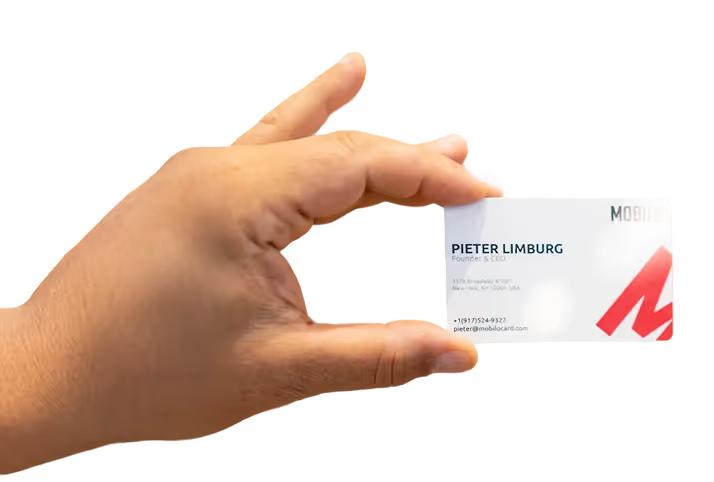
See our digital business card for how this works in practice. Tools like smart digital business cards exist precisely to close that window before it costs you the deal. Speed of follow-up is not a nice-to-have. It is the conversion variable that separates pipeline from noise. When contact capture depends on manual methods, the window between a warm conversation and a cold lead stretches from hours into days. Every hour of delay is a compounding cost on an already lean event budget. According to Cleverframe, 80% of trade show leads are never followed up on.
That number is not a reflection of lazy sales teams. It is a structural outcome of capture methods that require manual data entry before any outreach can begin. A four-person team returning from a regional expo with 80 cards faces a data-entry backlog before a single email goes out.
Data-smart does not mean expensive. It means every interaction at the booth becomes a pipeline entry before the exhibitor moves on to the next visitor. When a rep uses an NFC business card or a QR code lead form that auto-populates the CRM in real time, the follow-up window collapses to zero.
That capability was once reserved for enterprise teams with dedicated post-show data-entry staff. Mobilo brings it to lean teams at a fraction of the per-event cost of dedicated post-show data-entry labor, with no enterprise procurement cycle required.
80% of trade show leads are never followed up on
Key takeaways
- Manual lead capture, paper cards, badge scanners, handwritten notes, isn't a back-office nuisance; it's a front-line conversion problem that kills ROI before the show floor closes.
- Roughly 80% of trade show leads never receive a follow-up, which means most of the budget you spent on display, staffing, and giveaways is feeding a pipeline that leaks.
- Printed collateral carries a hidden tax: reprints, stale contact details, and zero attribution data that make it impossible to know which booth moment drove real pipeline.
- The right order of investment is lead-gen infrastructure first, display aesthetics second, not the reverse.
- A tight budget is a forcing function: every dollar redirected away from a flashy backdrop and toward automated lead capture compounds faster than any banner upgrade.
- The metrics that matter after a show aren't badge-scan totals, they're cost per CRM-ready contact, rep-level conversion rate, and pipeline sourced per dollar spent.
- Mobilo's NFC digital business cards close the loop by syncing every tap or scan directly into your CRM in real time, no batch uploads, no manual entry, no contacts lost in a jacket pocket.
The Hidden Tax on Small Booth Budgets - Printed Collateral, Stale Cards, and Zero Attribution
Printed collateral looks like a line item until you add up the reprints triggered by a title change, a personnel swap, or a brand refresh mid-cycle. For small booths operating on tight trade show budgets, that treadmill runs quietly in the background, draining spend that could go toward something measurable while leaving lead capture dependent on paper that goes stale. The sub-sections below break down where those costs actually accumulate and how switching to a digital card removes the reprint cycle entirely.

The Reprint Treadmill - Why Printed Cards Cost More Than the Invoice Shows
The common assumption is that manual lead capture (paper cards, badge scanners, handwritten notes) is just the unavoidable cost of doing a trade show on a tight budget, a back-office nuisance to clean up after the show rather than a front-line conversion problem. The invoice is only the beginning. According to Vistaprint's business card cost analysis, a standard run of 1,000 cards can cost anywhere from $10 for basic stock to $500 or more for premium finishes.
Order in bulk to save per-unit cost, and you simply increase the sunk cost exposure when details change before the batch runs out. What most small businesses report bears this out: cards get reprinted multiple times per year, driven by personnel turnover, title changes, and brand updates. Each cycle resets the clock and burns budget that could fund something measurable.
That structural drain disappears from the first tap. Mobilocard's Team tier starts at $4/month (billed annually) per member and covers unlimited team members, meaning the cost of onboarding a new hire or updating a title is zero. There is no reprint, no lag, and no budget hit. Teams that have handed out a Mobilo card even once at a networking event report the shift is immediate: upon card delivery and first use, the reprint treadmill stops and the spend that was quietly funding waste starts demonstrating marketing's contribution to pipeline instead.
Stale Collateral on a Live Show Floor Quietly Erodes Brand Consistency
A marketing team that reprints 500 brochures mid-campaign because a key sales rep left spends roughly $400 it had earmarked for post-show email follow-up. That is not a one-time misfortune; it is a structural flaw. Brand consistency depends on every touchpoint reflecting current information, and printed collateral cannot be updated centrally. The moment one rep hands out a card with an old title or a disconnected number, the brand impression takes a quiet hit that no amount of booth design recovers.
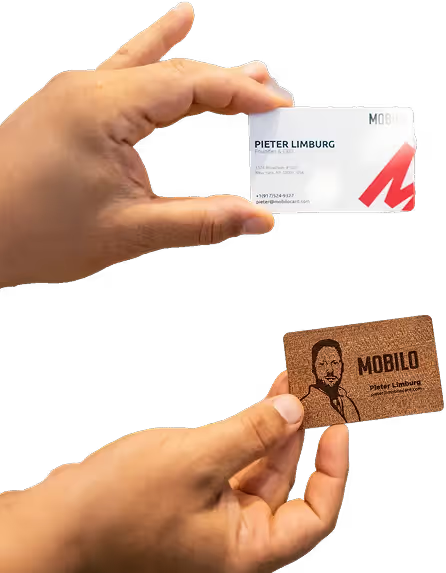
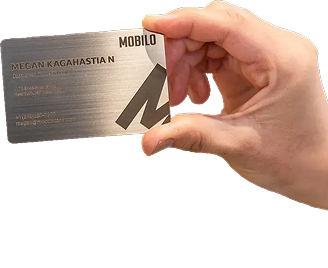
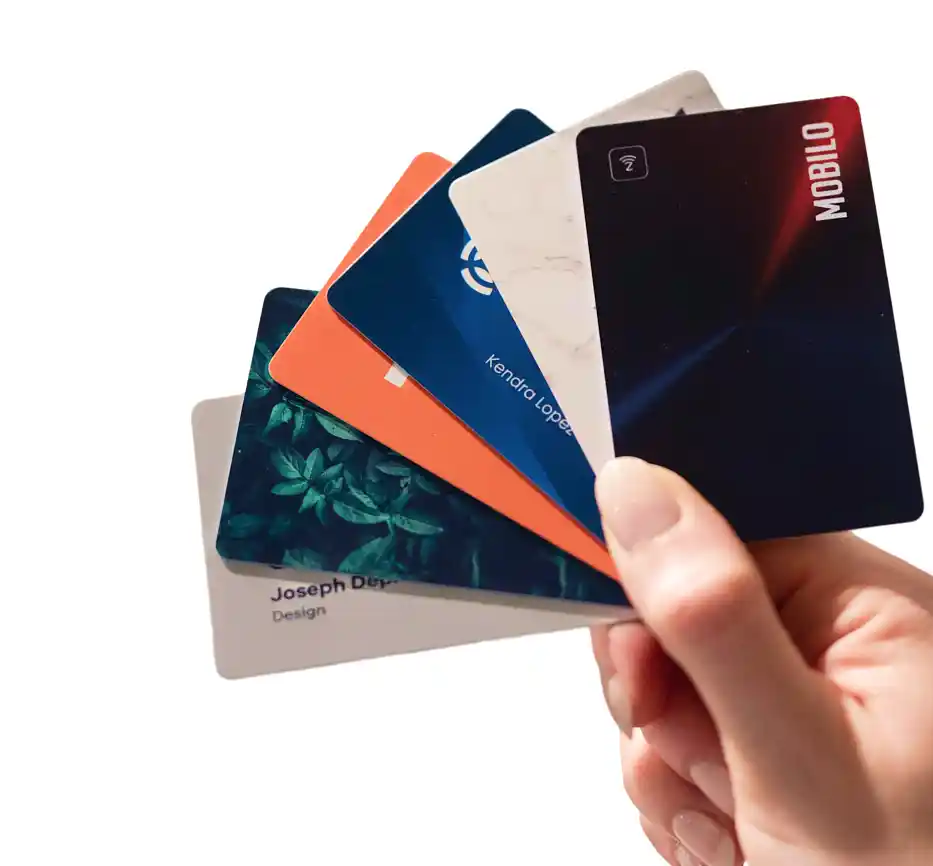
Mobilo's team management features address this directly. Administrators can control, lock, and override data fields across every card in the team, so when a rep's title changes or a phone number is updated, the correction propagates instantly to all active cards without issuing a single new physical card. The Team, Custom Design Card (available at a promotional price of $29.50 + $4/month, down from $39.00) and the Team, Wood and Metal Custom Design Cards carry the same field-control capability, regardless of material. Even the Team, Digital Wallet Card, which carries no hardware cost beyond the $4/month plan fee, gives administrators the same central override. Brand consistency is no longer contingent on catching every rep before they walk onto the show floor.
The Attribution Black Hole - When You Can't Trace a Card to a Closed Deal
Physical cards carry no signal. There is no mechanism, as Vistaprint's cost analysis confirms, to measure whether any card distributed at a booth contributed to a downstream conversion. Across the market, a significant share of trade show leads are never entered into a CRM at all, because manual data entry creates enough friction that contacts fall out of the pipeline before sales can act. Zero tracking data means zero learning, and zero learning means the next show starts from the same baseline of uncertainty. Without a closed-loop capture method, teams cannot attribute revenue to specific interactions, making it structurally impossible to optimize spend across future events. Mobilo closes that loop after the very first card tap. The Teams plan includes:
- insights and analytics
- lead capture and management
- lead enrichment
- unlimited leads and contacts
- custom lead capture forms
- 6,000 integrations through Zapier
Every contact captured flows directly into the CRM without manual re-entry. Central billing and team management mean finance and marketing operate from the same data set rather than reconciling siloed spreadsheets after the show. The result is what marketing teams we work with describe as the core unlock: after the first networking event or card tap, they can finally trace a specific interaction to a specific deal, reduce wasteful spend on printed collateral, and demonstrate marketing's contribution to pipeline and revenue with data that already lives in their CRM.
The Buyer's Criteria - How to Evaluate Trade Show Booth Ideas Before You Spend a Dollar
Choosing a booth idea based on how good it looks in a vendor catalog is the fastest way to overspend and underperform. One of the most common mistakes small business exhibitors make is not knowing which booth element to prioritize first, display design, giveaways, interactivity, or lead-gen tools, and ending up spending across all of them without excelling at any. Before you commit a dollar to any display, giveaway, or interactive element, run it through a three-part filter that reflects what small-budget exhibitors actually need: materials that earn their cost across multiple shows, a setup process that does not eat into your labor budget, and a lead-capture output you can measure in real time.
The Three-Filter Test Every Booth Idea Must Pass Before You Buy Anything
"Small business exhibitors struggle to evaluate what booth elements are actually worth investing in before spending money, e.g., unsure whether to prioritize display design, giveaways, interactivity, or lead gen tools."
Every booth idea should clear three gates before it earns a place in your budget. Use the table below to score each idea before committing budget.
Strong event assets should be reusable, easy to deploy, and directly tied to measurable lead capture:
- Reusability → Ask: Can this asset work at your next 3 events without reprinting or rebuilding? → Pass: Same hardware with swappable graphics or digital updates.
- Portability & setup speed → Ask: Can 1–2 people move and assemble it without freight or a union crew? → Pass: Fits in a rolling case and assembles in under 30 minutes.
- Measurable lead-capture output → Ask: Does it create a trackable CRM entry rather than a pile of paper? → Pass: Contact data syncs to the CRM at the moment of interaction.
Any idea that scores zero on all three is a sunk cost, regardless of how well it photographs. Reusability is where digital networking cards earn their place on this checklist. A Mobilo Team card, available in Custom Design, Metal, Wood, Paper Plus, or as a free Digital Wallet Card, ships once and taps unlimited times across every show you attend.
The team admin controls, locks, and overrides data fields centrally, so when a rep's title or phone number changes between events, your design team updates it once and every card in the field reflects the new information immediately. There is no reprint, no reproof, no freight. For individual buyers, the Pro plan starts at $3/month and includes unlimited taps and scans from day one, meaning the card earns its keep whether you exhibit once or eight times a year.
If you exhibit once a year, portability matters most because you are paying for setup labor as a percentage of a single event's total budget. If you exhibit four or more times annually, reusability becomes the dominant filter: a modular pop-up display that packs into one rolling case and reuses across eight shows amortizes its cost to a fraction of a single-use banner. The same logic applies to your contact-capture infrastructure, the Teams plan at $4/month (billed annually) includes full team data analytics and CRM integrations, so the same lead-management system travels with your team to every event without reconfiguration.
Why Lead-Capture ROI Is the Non-Negotiable Primary Lens for Any Digital or Interactive Investment
Key takeaway: At $811 per lead, trade shows rank among the most expensive lead-generation channels across all industries, meaning any friction in your capture process structurally guarantees your most expensive leads never reach the CRM.
This is the trap many small-budget exhibitors fall into, investing heavily in booth aesthetics or expensive giveaways to drive foot traffic, only to walk away with a stack of paper cards and no reliable way to follow up. Mobilo addresses this at the moment of interaction: every tap or QR scan from a Team or Business card feeds directly into lead capture and management, enriches the lead record automatically, and pushes into any of 6,000 integrations available through Zapier, including the CRM your sales team already uses. The Teams plan includes a built-in paper business card scanner as well, so even contacts who hand you a traditional card get pulled into the same pipeline without a manual data-entry step.
For teams managing multiple reps across a show floor, the Teams and Business plans both include team management, central billing, and insights and analytics, meaning a team admin can see in real time which reps are generating taps, which leads are being captured, and where follow-up is stalling, all without waiting until the post-show debrief. That visibility turns your $811-per-lead channel into one you can actually optimize mid-event, not after it.
7 Best Trade Show Booth Ideas for Small Budgets That Actually Build Pipeline
The vast majority of trade show leads are never followed up on, a figure cited consistently across B2B event marketing research. For a small-budget exhibitor, that reality reframes every dollar already spent: the display, the bulk-ordered swag, the banner reprinted for the third time this year are all feeding a pipeline that leaks before Monday morning arrives. The booths that win on lean budgets are not the most visually impressive ones. They are the ones where every physical element connects directly to a lead-capture action, so the pipeline fills in real time rather than from a pile of paper cards sorted on the flight home. Here are seven ideas scored against that single standard: does this element end with a CRM entry, or just a compliment?
1. Retractable Banner Wall - High-Impact Backdrop on a Shoestring
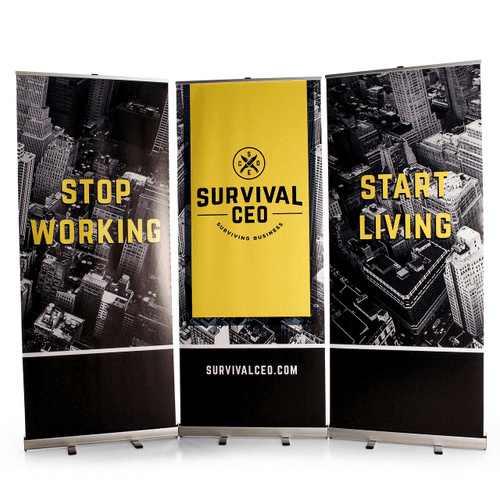
A quality retractable banner runs between $80 and $150 for print and hardware, making it the most cost-efficient branded backdrop available for a 10x10 space. The real advantage is reusability: swap only the printed graphic between shows while the hardware stays identical, cutting per-event cost to roughly $80 per refresh versus a full rebuild. The trade-off is rigidity. A single banner communicates one message, so if your offer changes show to show, you will reprint more often than you planned.
2. Tension Fabric SEG Display - Premium Look Without the Premium Price Tag
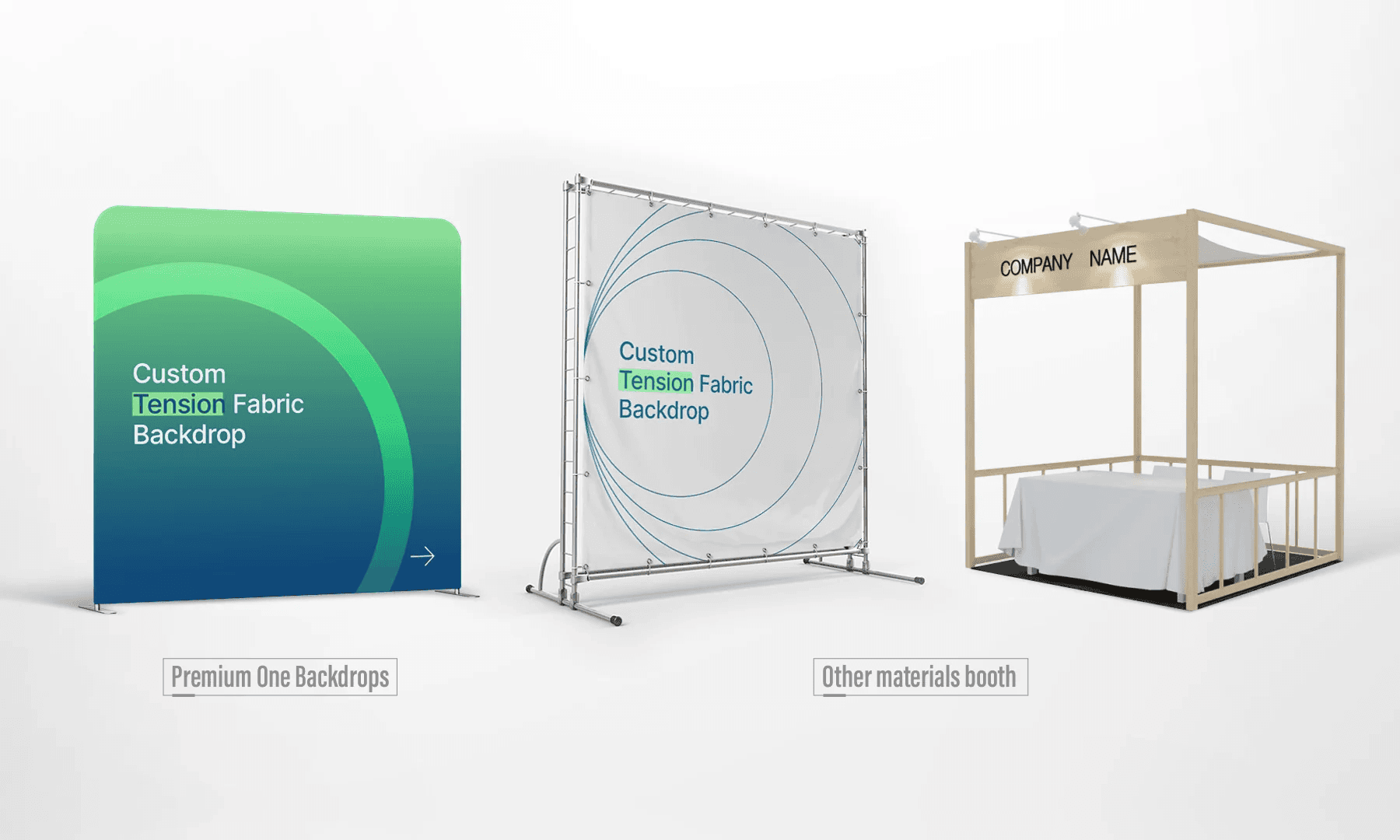
Silicone edge graphic (SEG) frames produce a seamless, backlit appearance that reads as significantly more polished than a vinyl banner, yet a basic 8-foot kit lands between $300 and $500 when sourced through direct display vendors. The fabric graphic ships flat, weighs almost nothing, and swaps in minutes, which matters when your setup crew is two people and a rolling suitcase. The limitation: SEG frames require precise graphic sizing, so last-minute copy changes still mean a reprint. Budget for at least one spare graphic if your messaging evolves mid-season.
3. Interactive Spin-to-Win Wheel - Gamified Lead Capture That Fills Your Pipeline
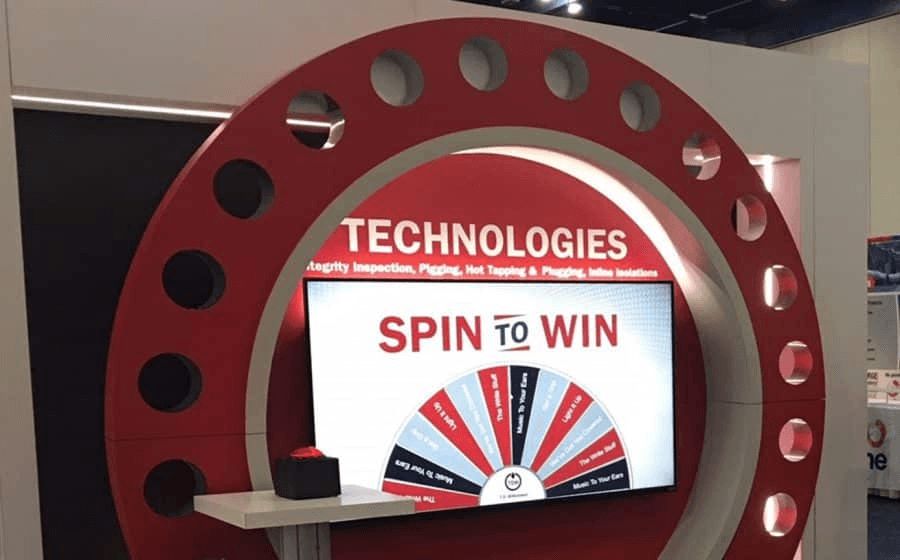
A physical prize wheel costs $60 to $120 and consistently outperforms passive badge-scan approaches on opt-in rate. Gamified mechanics can meaningfully lift lead-capture opt-in rates compared to static giveaway bowls, because the interaction creates a moment of genuine anticipation that keeps visitors at the booth long enough for a real conversation to start. The critical failure point, though, is what happens after the spin. Most exhibitors assume collecting a business card or scanning a badge is capturing a lead. It is not. That data sits in a bag until someone manually keys it in days later, and by then the conversion window has narrowed significantly.
Research on B2B lead follow-up speed consistently shows that contacting a lead within an hour of first interaction produces dramatically higher qualification rates than follow-up attempted 24 hours later. A smart digital business card paired with the spin mechanic closes that gap at the moment of interaction: one NFC tap or QR scan from the rep's Mobilo card auto-populates the visitor's details into the CRM before the wheel stops spinning, so the pipeline entry exists before the conversation ends.
4. Folding Tabletop Display with Demo Station - Compact Booth That Converts
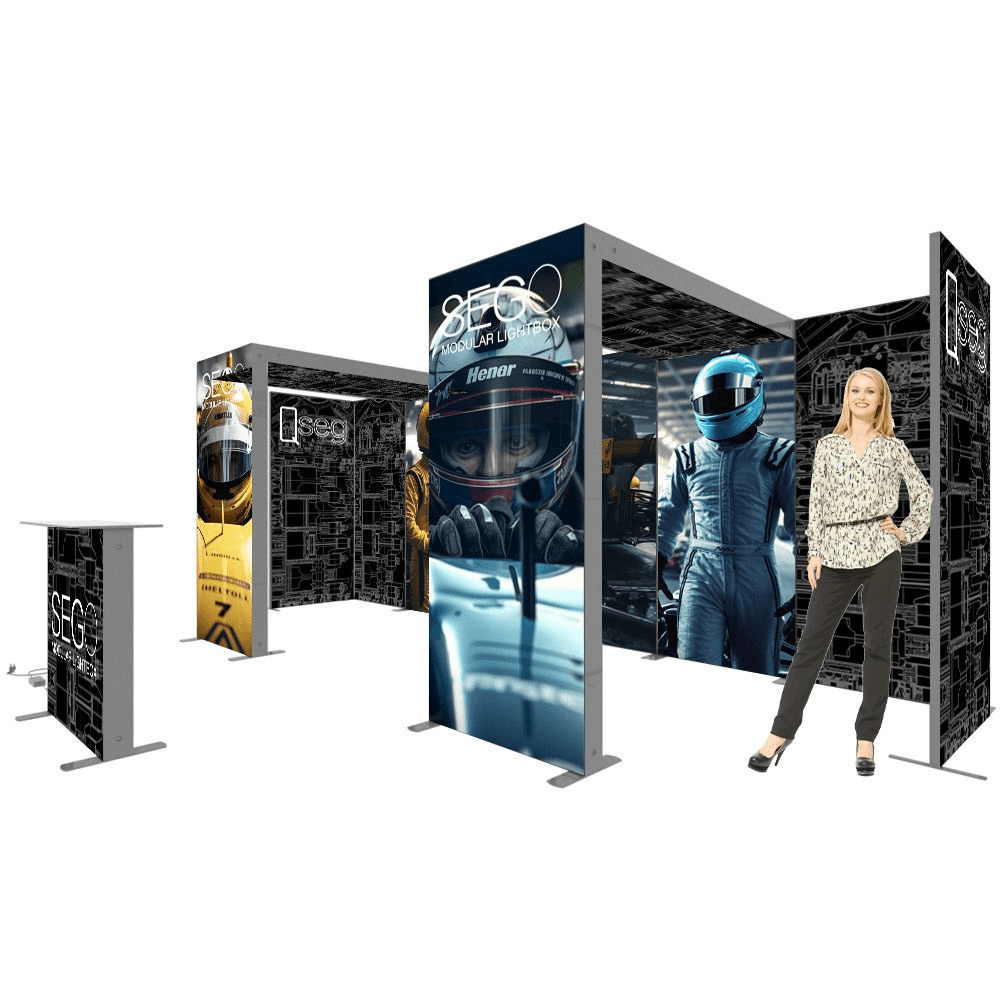
A folding tabletop display (typically $100 to $200) combined with a single tablet running a live product demo or interactive form transforms a small booth footprint into a structured conversion path. Exhibit design best practices consistently recommend dedicating distinct zones within even a 10×10 space, a branded focal point, a conversation area, and a capture station, because structured flow measurably improves the quality of interactions compared to a single undifferentiated table setup. The honest trade-off: a demo station demands a rep who can facilitate it confidently. If your team is one person working the booth solo, the tablet becomes a distraction rather than an asset.
5. Live Social Media Wall - Real-Time UGC That Extends Booth Reach Beyond the Floor
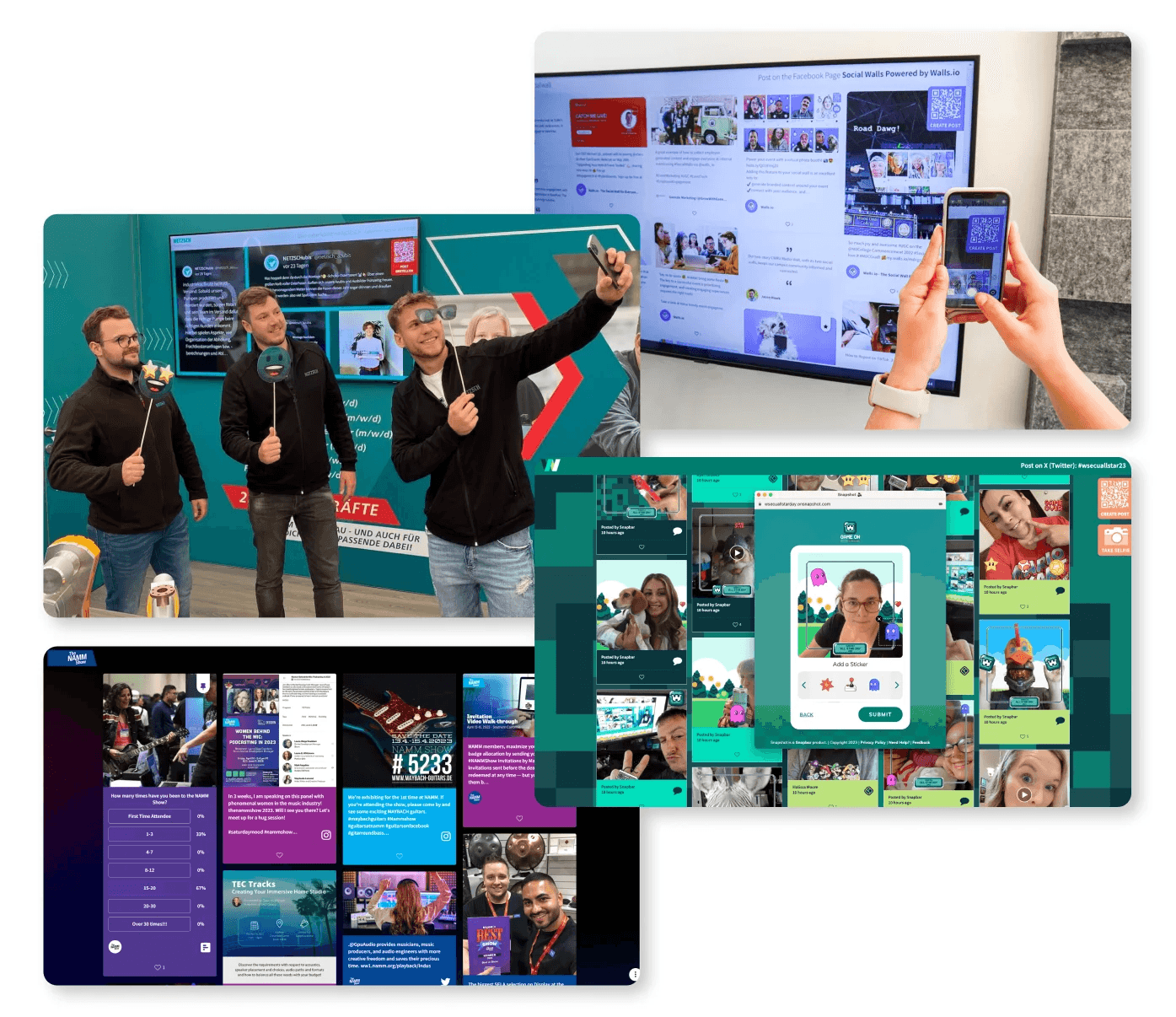
A live social wall, displayed on a monitor or tablet, aggregates tagged posts and mentions in real time, turning your booth into a broadcast node that reaches audiences who never set foot on the show floor. Tools that power this typically run $0 to $50 per event for basic plans. The strategic value for a small-budget exhibitor is amplification: each visitor post extends your brand's presence without additional spend. The limitation is dependency. If your product or brand does not already have an active social following, a live wall shows an empty feed, which signals low credibility to walk-by traffic. Seed it with pre-show posts from your own team before doors open.
6. Pre-Scheduled Meeting Booth - Appointment-Only Setup That Prioritizes Pipeline Over Traffic
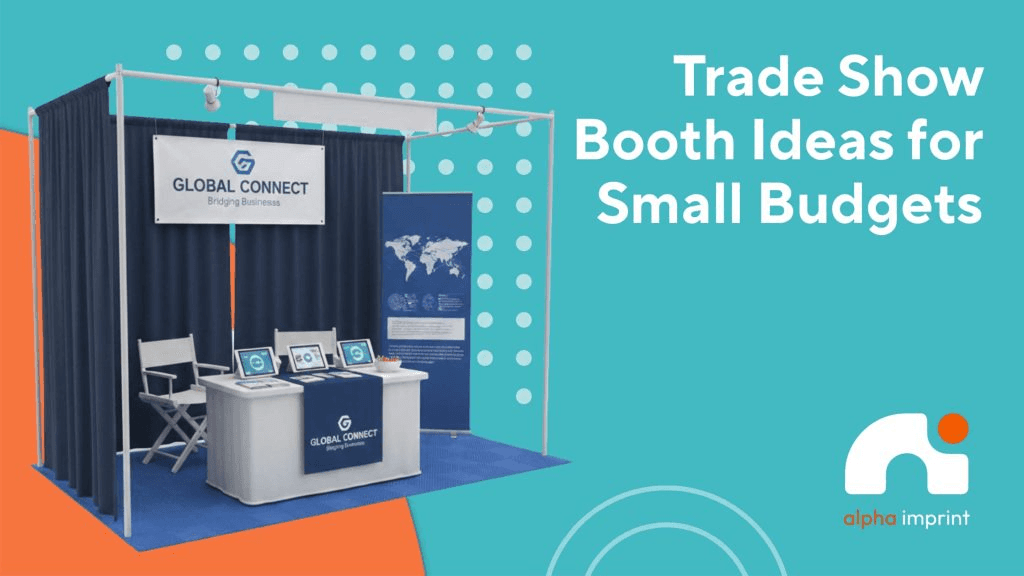
Pre-scheduled meetings consistently outperform walk-by traffic on qualified pipeline metrics. Based on our understanding of B2B event strategy, pre-booked appointments convert to pipeline at substantially higher rates than cold walk-in conversations, because both parties arrive with context and intent. An appointment-only booth requires almost no additional display spend: a clean table, two chairs, a branded backdrop, and a calendar link sent in advance.
The entire setup can cost under $200. The operational risk is the same one that kills spin-wheel leads: the meeting happens, the conversation is strong, and then the contact details live in a notebook or a badge-scan CSV until someone processes them. That processing gap is where conversion velocity dies.
Mobilo's NFC business card closes the loop at the moment of the handshake. Every meeting ends with a tap or scan that syncs directly to the CRM through Zapier's 6,000-plus integrations, so the rep walks out of the meeting with a CRM-ready contact rather than a stack of cards to sort later. For a five-person event team, that difference compounds across every conversation across every day of the show.
7. DIY Branded Charging Station - Utility-Driven Dwell Time That Earns Extended Conversations
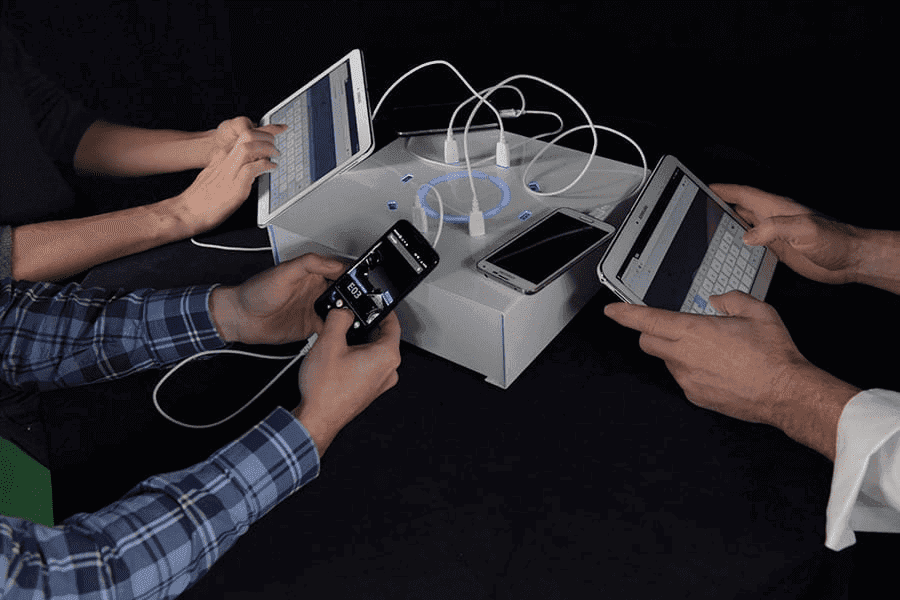
A charging station built from a branded tablecloth, a multi-port USB hub ($25 to $40), and a simple sign costs under $100 and solves a genuine visitor problem: dead phones on a busy show floor. Visitors who stop to charge stay for three to seven minutes on average, which is long enough for a qualified conversation that a walk-by glance never produces. The trade-off is that dwell time alone does not capture a lead.
Pair the charging station with a visible QR code or a rep stationed nearby; otherwise you generate goodwill with no pipeline output. Utility without capture is just a free service. The through-line across all seven ideas is straightforward. In the next section, we will show exactly how a single digital business card becomes the operational layer that makes ideas 3, 5, and 6 close the pipeline loop automatically, with no manual entry, no Monday-morning catch-up, and no leads left behind.
Related Reading
- Etiquette For Networking In Online Conferences
- Measuring Event Roi
- Trade Show Sales Tips
- Trade Show Follow Up Best Practices
- How Do You Find The Roi Of A Trade Show
- Trade Show Sales Funnel
- What Is Trade Show Marketing
- Event Lead Management
- B2b Trade Show Best Practices
- Conference Lead Generation
- B2b Trade Show Marketing
How a Digital Business Card Turns Your Booth's Best Moments Into CRM Pipeline Automatically
Capturing a lead at a busy booth comes down to what happens in the two seconds after a conversation ends. A digital business card collapses contact exchange, lead capture, and CRM entry into a single tap or scan, so the pipeline builds itself while the rep moves to the next visitor. This section breaks down exactly how that workflow operates on a live show floor, what it actually costs compared to printed cards and manual entry, and how small teams can maintain consistent branding across every interaction without micromanaging each rep.
One Tap, One Scan - How Contact Exchange and Lead Capture Work on a Live Show Floor
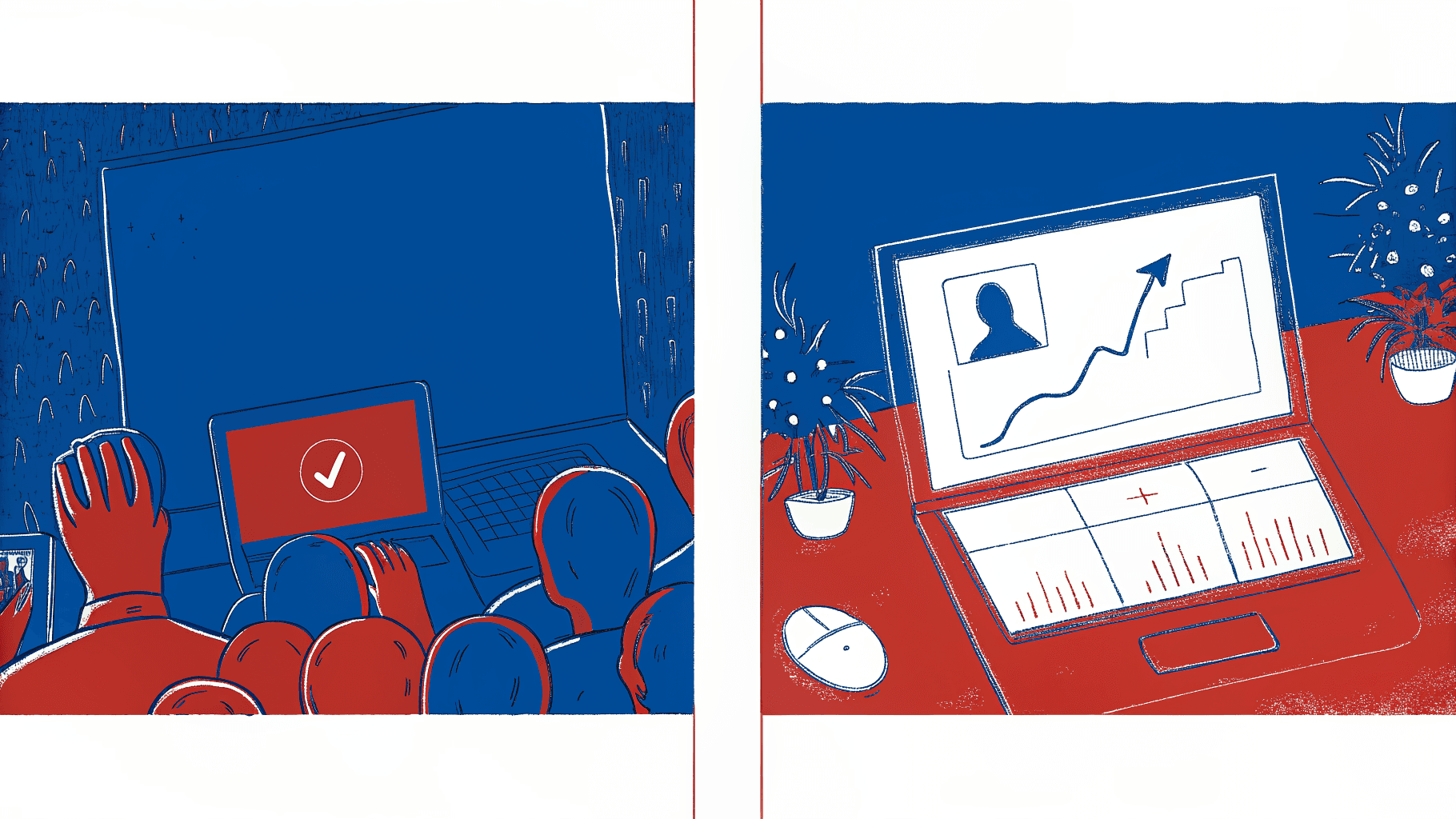
A single NFC tap or QR scan with a digital business card does two things simultaneously: it pushes the rep's contact details to the visitor's phone and pulls the visitor's information into a custom lead form that syncs to the CRM the moment the interaction ends. There is no batch upload, no stack of cards to sort, no memory required. The rep moves to the next conversation while the pipeline entry writes itself. This matters most when booth traffic spikes. A rep managing five conversations in twenty minutes cannot also be a reliable data-entry clerk. The capture workflow has to be automatic, or it simply doesn't happen consistently.
The Cost Math - Digital Business Cards vs. Printed Card and Manual Entry Costs
Teams running printed card cycles absorb recurring costs across design, print runs, and inevitable reorders after role changes or rebrands, costs that compound with headcount and event frequency. The Mobilo Teams plan runs $4 per month per seat, billed annually, with unlimited taps, custom lead capture forms, and full team analytics included. For a five-person booth team, that is $240 in annual software cost, a figure that the operational value of a single avoided post-show data-cleanup sprint typically justifies on its own. The honest trade-off: this math works best for teams attending events regularly. For a company doing one show every two years, the upfront habit change may outweigh the savings. The ROI compounds with frequency.
Central Brand Control - Lock Fields, No Reprint Required
Administrators on the Teams plan can lock and override data fields across every rep's card from a single dashboard. A title change, a new phone number, a rebranded logo: one update, propagated instantly. No card is ever out of date on the show floor because no card is ever static.
From Scan to CRM in Seconds - Automated Integrations and Why Follow-Up Lag Kills ROI
Here is the core synthesis this section builds toward: a 5-minute lead-response window and a 48–72 hour post-show data-cleanup delay are not just operationally incompatible, they are mutually exclusive conversion outcomes.
Key takeaway: Consistently shows that responding within minutes rather than hours produces dramatically higher contact and qualification rates, meaning any capture method that delays CRM entry by even one business day structurally eliminates the conversion probability that justified attending the event. Instant sync is not a convenience feature; it is the mechanism that makes the rest of the follow-up motion possible.
Related Reading
- Which Networking Software Is Best For Conferences
- Trade Show Booth Ideas To Attract Visitors
- Conference Lead Capture
- How To Measure Trade Show Effectiveness
- Virtual Event Success Metrics
- Trade Show Roi
- Trade Show Lead Generation Ideas
- What's The Best Event Lead Generation Software
- Post-Trade Show Marketing Strategies
- Best Trade Show Giveaways
What to Measure After the Show - Booth Performance Metrics Every Lean Marketing Team Needs
Counting badge scans after a show feels productive. It is not. A thick stack of contacts tells you nothing about whether the event paid for itself, which reps drove real pipeline, or whether you should book the same floor space next year.
Those answers come from three specific numbers, and most lean marketing teams are not tracking any of them. Post-show metrics only produce actionable decisions when the capture method has already generated clean, attributed, per-rep data, which means a team using paper cards or badge scans has structurally disqualified itself from the ROI conversation before the show floor even opens. This is most acutely felt by the IT admin, marketing manager, or operations lead responsible for standing up a repeatable event program, the person who discovers, after initial team setup is complete, that the capture method chosen weeks earlier now determines what analytics are even possible.
The teams that benefit most are those that attend events regularly and need structured lead follow-up baked in from the start, not bolted on afterward.
The Three Non-Negotiable Numbers for Small-Budget Exhibitors
The three metrics that actually close the ROI loop are:
- leads captured per rep
- lead-to-pipeline conversion rate segmented by days post-show
- cost-per-qualified-lead versus total show cost
Badge scan volume is not on that list. It measures activity, not outcome.
How to Track Leads After the Show
After show one, a team that tracks per-rep tap counts discovers something useful fast. If Rep A generated three times the qualified pipeline of Rep B from the same number of interactions, that gap is not personality. It is a conversation script problem, a positioning problem, or a qualification problem, and it is fixable before the next show. Without per-rep attribution, that signal is invisible. Badge scanners record who was scanned, not who converted. Mobilo's Teams plan ($4/month per member, billed annually) is built for exactly this moment.
Because every card tap is logged to the individual rep, full team data analytics are available the moment the show floor closes, with no manual reconciliation and no data cleanup sprint. The plan includes team management, the ability to control, lock, and override data fields across the whole team, and insights and analytics that make per-rep performance visible to whoever owns the post-show debrief. For teams that want a physical artifact with that infrastructure underneath it, options range from the Team Digital Wallet Card (included at $0 + the $4/month software fee) up through custom-designed NFC cards with QR codes in standard, Wood, and Metal finishes.
Lead-to-Pipeline Conversion Rate - Why Day-Post-Show Timing Matters
Key takeaway: Responding to a lead within five minutes makes you 100 times more likely to reach that prospect than waiting just 30 minutes, and that decay curve steepens after the show floor closes.
Manual capture methods structurally guarantee you are already on the wrong side of that curve before the show floor closes, because the data cleanup that precedes any outreach consumes the hours that matter most. Teams using Mobilo sidestep that cleanup window entirely. Lead enrichment, lead capture and management, and unlimited leads and contacts are included on both the Teams and Business plans, meaning captured contacts flow directly into follow-up workflows, through Zapier's 6,000+ integrations or custom lead capture forms, without a manual import step eating into the five-minute response window that research consistently identifies as the difference between a conversation and a cold trail.
Next steps
If your booth conversations keep evaporating before your team can act on them, the path forward starts with recognizing that the capture method, not the display budget, is the highest-leverage cost variable in your entire show strategy. Start with our digital business card.
The body established two facts that point in the same direction. At an average of $811 per lead, any friction between a conversation and a CRM entry structurally writes off the most expensive contacts your team will generate all year. And because responding within five minutes makes a rep 100 times more likely to reach a prospect than waiting 30 minutes, a 48-to-72 hour data-cleanup delay does not just slow follow-up, it eliminates the conversion probability that justified attending the show in the first place. Together, they point to one action: replace any capture method that requires manual entry with one that syncs to your CRM the moment the interaction ends.
Start with a digital business card from Mobilo, where the Teams plan runs $4 per month per seat and includes custom lead capture forms, unlimited contacts, and CRM integrations across 6,000-plus connections through Zapier. Every tap writes a pipeline entry automatically, so your follow-up motion starts before the next visitor reaches the booth.
Frequently Asked Questions
If I update a rep's title or phone number, do I have to order new cards for the whole team?
No. With Mobilo's team management features, administrators can control, lock, and override data fields across every card in the team centrally, so a title or phone number change propagates instantly to all active cards without issuing a single new physical card.
We use a spin-to-win wheel to collect business cards at our booth, isn't that enough to capture leads?
Collecting a card or scanning a badge is not the same as capturing a lead that reaches your CRM. That data typically sits in a bag until someone manually keys it in days later, and research cited in the post shows that contacting a lead within an hour of first interaction produces dramatically higher qualification rates than follow-up attempted 24 hours later. Pairing the spin mechanic with an NFC tap or QR scan that auto-populates the CRM at the moment of interaction closes that gap before the conversation ends.
What's the real cost of reprinting business cards every time something changes?
Beyond the print invoice, which can run from $10 to $500 or more per thousand cards depending on finish, the post identifies the compounding cost: cards get reprinted multiple times per year due to personnel turnover, title changes, and brand updates, and each cycle burns budget that could fund something measurable. Mobilo's Team tier starts at $4/month per member billed annually, and updating a title or onboarding a new hire costs nothing because there is no reprint.
How do I know which booth elements are actually worth buying on a tight budget?
The post recommends running every idea through a three-filter test before committing budget: reusability (can it appear at your next three events without a reprint or rebuild?), portability and setup speed (can one or two people move and assemble it without a freight quote?), and measurable lead-capture output (does it produce a trackable CRM entry, or a pile of paper?). Any idea that scores zero on all three is a sunk cost regardless of how well it photographs.
Can a small team really use a live demo station instead of a large custom installation?
Yes, the post describes a folding tabletop display costing $100 to $200 combined with a single tablet running a live product demo or interactive form as a way to transform a small booth footprint into a structured conversion path, without the expense or logistics of a large custom build.