.avif)

How to Build a Professional Network Without Cold Networking
On This Page
The best career opportunities rarely come from cold emails to strangers or desperate LinkedIn connection requests. Building a professional network that delivers real results requires genuine relationships, strategic connections, and consistent follow-through. Success comes from expanding your professional circle through meaningful interactions, not from awkward cold outreach that makes everyone uncomfortable.
Modern networking tools can transform how professionals connect and maintain relationships. Instead of fumbling with paper business cards that get lost or manually entering contact details, seamless digital exchanges help maintain organization and enable prompt follow-up. This approach preserves the momentum that turns brief introductions into valuable long-term connections, which you can achieve with Mobilo's digital contact card.
Summary
- Learning how to build a professional network fails for 90% of people because they optimize for contact volume instead of relationship depth. The Negotiate Anything Podcast found that this failure rate stems from treating networking like collecting trading cards rather than creating genuine value exchanges. Meanwhile, 84% of US job seekers recognize networking matters, but 59% don't know where to begin according to an Express Employment Professionals-Harris Poll survey, revealing the gap between knowing networking is important and understanding how to do it effectively.
- Referred candidates are 4-5 times more likely to be hired than non-referred applicants, according to Wave Connect's 2025 data. This advantage exists because referrals carry built-in credibility that cold applications lack. When someone stakes their reputation on recommending you, hiring managers pay attention in ways they never would to a resume submitted through an applicant tracking system.
- Consistency matters more than charisma in professional networking. Research shows that 85% of jobs are filled through networking, but that statistic is only relevant if your contacts remember you exist when opportunities arise. Staying visible requires predictable presence through quarterly check-ins, thoughtful comments on their work, or sharing resources that solve problems they mentioned weeks earlier, not daily spam that creates noise instead of value.
- McKinsey research found that referrals have a 40% higher retention rate than other hires, which reveals something critical about how trust works in professional networks. People who get recommended tend to work out because the person making the introduction has already filtered for competence and reliability through repeated interactions, not guesswork based on a single coffee meeting.
- Most networking attempts fail at the follow-up stage because friction kills momentum between meeting someone and maintaining the relationship. Paper business cards get lost, LinkedIn profiles lack context about what you discussed, and good intentions to reconnect dissolve when you can't remember whether they were hiring, launching a product, or exploring partnerships. Digital contact card addresses this by capturing contact details instantly, syncing them directly into your CRM with notes and context, so follow-ups happen on schedule instead of disappearing into forgotten to-do lists.
Why Most People Fail at Building a Professional Network
Most people approach networking like collecting trading cards—attending events, exchanging contact information, and adding LinkedIn connections. They assume more contacts yield more opportunities. Yet according to research from the Negotiate Anything Podcast, 90% of people fail at networking. The problem isn't effort; it's pursuing the wrong goal entirely.
"90% of people fail at networking. The problem isn't how hard they try—it's that they're working toward the wrong goal entirely." — Negotiate Anything Podcast
🔑 Key Takeaway: Successful networking isn't about quantity of connections—it's about building meaningful relationships that create mutual value.
⚠️ Warning: The "trading card approach" to networking creates shallow connections that rarely lead to real opportunities or professional growth.

What forces keep the volume approach alive?
Three forces keep this flawed approach alive. First, social pressure convinces us that successful professionals must constantly "put themselves out there"—we see massive LinkedIn networks and assume they're winning. Second, outdated 1990s career advice still circulates, treating networking as a numbers game in which quantity translates to quality. Third, fear drives impression management over value creation. When worried about others' opinions, people seek validation from new contacts rather than figuring out how to help someone.
Why does most networking feel transactional?
Most networking feels transactional because it is. Someone approaches you at an event, asks what you do, waits their turn to talk about themselves, then moves on. No follow-up happens because there was no real connection to begin with: two people performing professional socializing without creating any reason to stay in touch.
What happens when networking stays surface-level?
This approach creates predictable failures: a contact list full of people you barely remember meeting. When you need help, reaching out feels awkward after months or years of silence. Opportunities flow through networks built on reciprocity and trust, where people know what you're good at and think of you when relevant situations arise. The measurement problem compounds this issue. People track business cards collected or connections added—metrics that feel productive but measure nothing meaningful. What matters is whether anyone in your network would vouch for your work, introduce you to their contacts, or think of you first when an opportunity matches your skills. Those outcomes require depth, not breadth.
Why do most people struggle with a networking strategy?
An Express Employment Professionals-Harris Poll survey found that while 84% of US job seekers recognize the importance of networking, 59% don't know where to begin. The confusion isn't about how to do it—it's about strategy. The familiar advice to attend more events and meet more people leads to exhausting cycles of superficial interactions that yield nothing. A strong network is built by becoming useful and memorable to the right people, which requires a different approach. But knowing you need a different approach and understanding what that approach looks like are two separate challenges.
Related Reading
- Benefits Of Business Networking
- Digital Networking
- Types Of Business Networking
- Professional Networking
- Digital Presence
- Virtual Networking Tips
- Business Networking
- Networking Business Card
The Five Elements of Strong Professional Networking
A real network isn't a list of contacts—it's people who know what you're good at, trust your work, and refer or work with you when it matters. This develops through five core behaviors that make you helpful, credible, and worth staying connected to.
🎯 Key Point: Professional networking isn't about collecting business cards—it's about building mutual trust and demonstrating value through consistent actions.

"85% of jobs are filled through networking, yet most professionals focus on transactional connections rather than relationship building." — LinkedIn Career Advice, 2024
Relationship-Building Framework
- Trust Building
Purpose: Establish credibility
Key action: Be consistent in follow-through - Value Creation
Purpose: Show expertise
Key action: Share relevant insights - Active Listening
Purpose: Understand needs
Key action: Ask thoughtful questions - Strategic Follow-up
Purpose: Maintain connection
Key action: Schedule regular check-ins - Mutual Support
Purpose: Build reciprocity
Key action: Offer help first
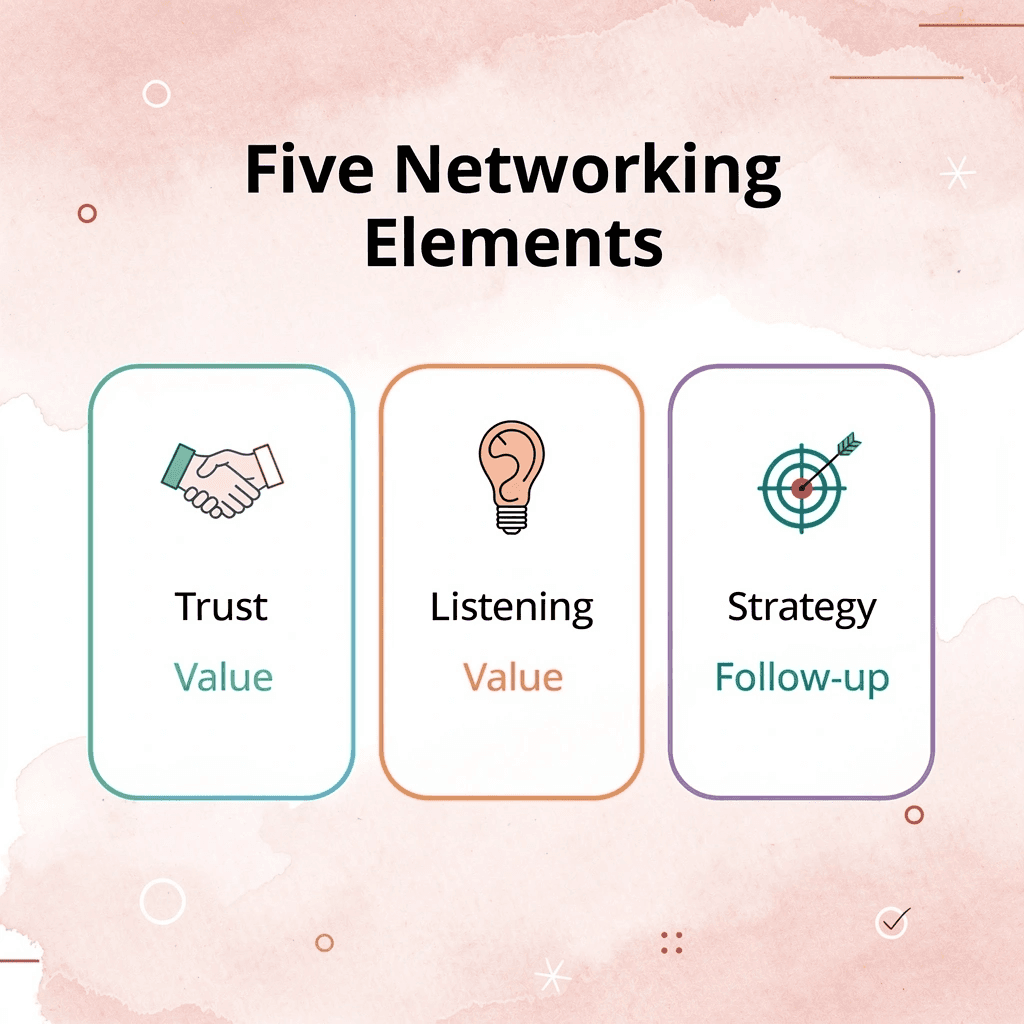
These five drivers work together. Miss one, and the relationship stops moving forward. Master all five, and you create a network that brings opportunities without asking.
💡 Tip: Focus on being genuinely helpful to others before you need anything from them—this creates lasting professional relationships that benefit everyone involved.

1. Value Give Before You Need
Value means providing something useful without expecting immediate return. It's the introduction that closes a deal, the article solving a problem they mentioned weeks ago, or the insight that saves time or opens new possibilities. Most people reach out only when they need something—like asking a stranger for a favor. Professionals who build strong networks work differently. They track what matters to their contacts and help first. When you solve problems before people ask, you become someone they remember. When you do it consistently, you become someone they can't do without.
2. Initiative Don't Wait for Permission
Initiative is the willingness to start the conversation, make the introduction, or suggest collaboration without waiting for someone else to go first. It's reaching out to congratulate someone on a new role, proposing a call to discuss a shared challenge, or following up after an event with a specific message rather than a generic one. People who wait for others to initiate contact fade into the background, while those who take initiative stay visible. This doesn't mean being pushy; it means being intentional about maintaining the connection and creating reasons to engage that benefit both sides.
3. Consistency Show Up Regularly
Consistency transforms a one-time interaction into a relationship: the regular check-in that asks for nothing, the thoughtful comment on their content, the quarterly coffee where you catch up and find ways to help. According to Elements of Networking, 85% of jobs are filled through networking, but this statistic means nothing if your network forgets you exist. Staying top of mind requires predictable presence: not daily noise, but rhythm. Professionals who excel set reminders, create systems, and treat relationship maintenance as a priority.
4. Relatability: Make It Easy to Connect
Relatability is how quickly someone understands what you do, why it matters, and how you might help them. It means explaining your work in simple language, sharing challenges alongside wins, and being human enough that people remember you as a person, not a job title.
How can you make yourself memorable when networking?
When you exchange business cards, whether someone remembers who you are depends on making it easy to recall your name. Most people fail by using confusing words or generic descriptions. Those who succeed tell a short story, connect their work to a problem everyone understands, and give people reason to remember and recommend them.
5. Credibility Prove You Deliver
Credibility is the proof that you follow through: meeting deadlines, delivering quality work, and being accurate. Every interaction either builds or erodes trust, and credibility compounds over time. The fastest way to lose credibility is to promise too much and deliver too little. The fastest way to build it is to do exactly what you said you would do, when you said you would. When someone consistently delivers, they stand out. This foundation of every strong network rests on people who trust that when you say something, it will happen. But knowing these five elements and turning them into a repeatable system are two different challenges.
Related Reading
- How To Use Social Media For Networking
- Social Networking For Business
- Icebreaker Examples Business Networking
- Business Networking Ideas
- How To Get Business Contacts
- Small Business Networking
- Networking Mistakes
- Networking Follow-Up Email
How to Build a Professional Network From Scratch
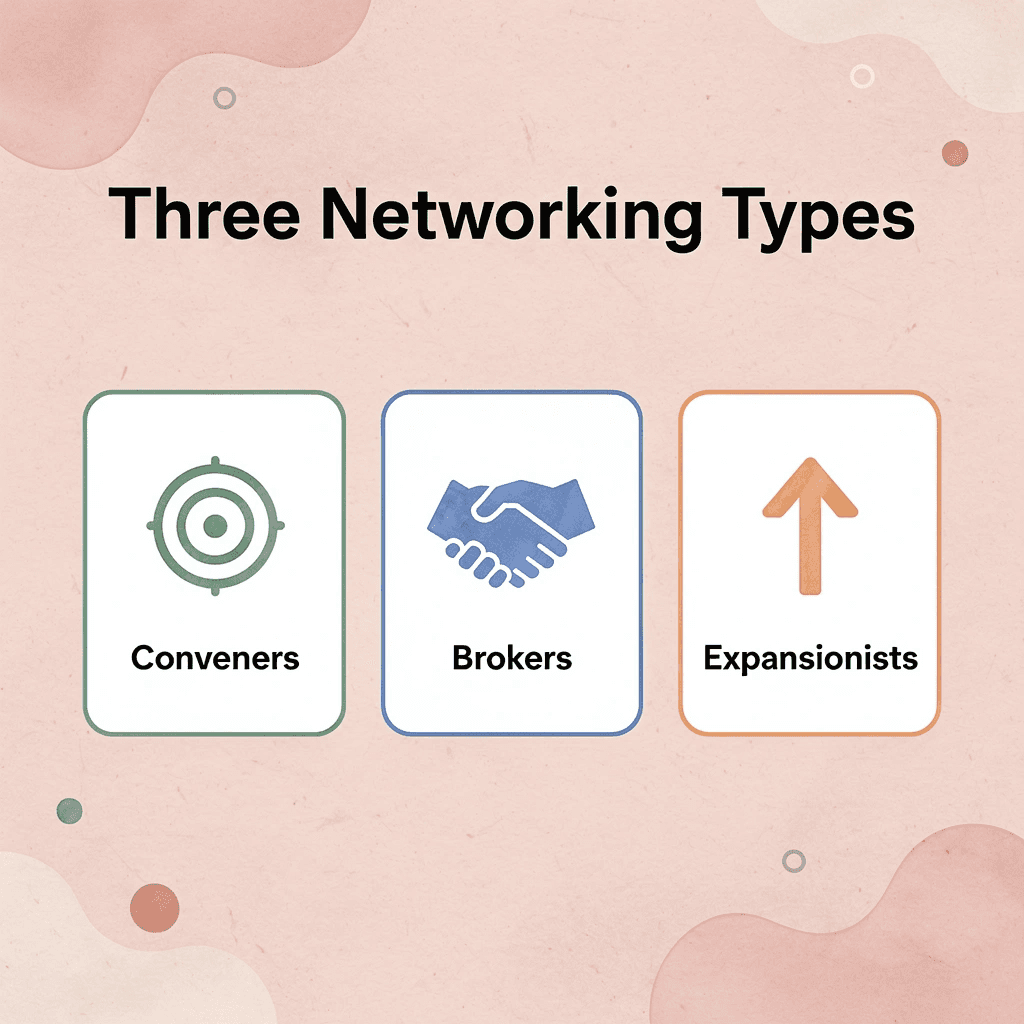
Building a network requires a system, not a wish list. Start by identifying your networking type (conveners build tight circles, brokers span different worlds, expansionists collect broadly), then map your base network: family, former colleagues, classmates, neighbors. These people may not be in your industry, but they know someone who is. Reach out with personalized messages that reference shared context, ask for 10 minutes of specific advice, and follow through on every commitment. According to research from Forbes, 85% of jobs are filled through networking, which means the system you build now determines the opportunities you'll access later.
🎯 Key Point: Your existing connections are the foundation of your network - they may not be in your field, but they're your fastest path to people who are.
💡 Pro Tip: When reaching out, be specific about what advice you need. Instead of "Can we chat?", try "Could I get 10 minutes of your insight on transitioning from marketing to product management?"
"85% of jobs are filled through networking, which means the system you build now determines the opportunities you'll access later." — Forbes Research
1. Find Your Networking Type
Not every networking approach works for everyone. According to research published by Forbes, 85% of jobs are filled through networking. Conveners build closed, interconnected networks with people they already know, creating tight circles that share similar experiences. Brokers adapt across different social worlds, moving between industries and demographics, making them more innovative. Expansionists thrive on meeting new people and developing wide networks across sectors, though these relationships tend to be shallower. Understanding which type you are determines where you'll invest your energy and which environments will feel natural rather than forced.
2. Start with who you already know
Your first 20 connections already exist: people you studied with, worked alongside, met at conferences, or trained with years ago. Write their names down. Focus on people you get along with, whose judgment you trust, and whose ideas challenge you. Identify who you'd want to hear from when they message you, and who would feel the same about you.
How do you reconnect without seeming pushy?
Reach out to three people this week. Start with a shared memory or recent observation: "I remember how much you made me laugh when we worked together on that project," or "I saw your post about the new role, congratulations." Then add something specific: an article they'd find useful, a question about their work, or a genuine compliment about something they've built. No ask. No agenda.
3. Craft outreach messages that people actually answer
Most connection requests fail because they sound templated. A strong outreach message includes three elements: context (how you know them or why you're reaching out), specificity (what you're asking for and why), and respect for their time (a clear boundary, usually 10 minutes).
For example: "Hi Sarah, my colleague mentioned you're excellent at managing distributed teams. I'm building a remote team for the first time and hitting friction around async communication. Could you spare 10 minutes next week to share what's worked for you?" That message works because it flatters without fawning, asks for something concrete, and makes it easy to say yes.
Why does follow-through matter in networking?
When someone suggests you reach out to one of their connections, do it within 48 hours. When you say you'll send a follow-up email, send it. People notice who follows through and who doesn't, and that reputation grows faster than expected. Building a professional network from scratch requires a continuous system, not a one-time push. Identify your networking style, map your existing contacts, then expand strategically through in-person and online channels. Success comes from consistent, non-transactional interactions that keep you visible and relevant over time.
4. Reframe Networking as Conversation
Networking feels overwhelming when you picture pitching yourself to a room full of strangers. But networking is two people finding common ground. When you relax into conversation, opportunities arise naturally, or you stay in someone's mind for future needs. Many people avoid networking because they feel they're asking for something, making the interaction feel difficult. But if you approach it as a genuine conversation—curious about the other person—the dynamic shifts. You're no longer performing. You're connecting.
5. Network In Person and Online
Industry conferences offer easier entry points: start with small talk in the coffee line or with someone sitting next to you at a workshop, then exchange details to continue the conversation elsewhere.
What's the best approach for online networking?
LinkedIn is designed for professional networking; personalize connection requests and explain why you want to connect, focusing on what you have in common rather than pursuing the largest network. Other social media platforms help you stay up to date on your network's activities so you can join conversations naturally. Email remains a personal, effective way to stay in touch without the noise of public platforms.
Why should you consider digital contact cards?
Teams that rely on traditional business cards often lose track of who they met and where they met. Cards get misplaced, contact details go unrecorded, and follow-up becomes inconsistent. Digital contact cards solve this by letting you share information instantly, track interactions, and automate CRM updates so no connection falls through the cracks.
6. Craft Your Elevator Pitch
Your elevator pitch should clearly convey your current role, qualifications, relevant experience, and target position or company type. The better people understand your situation, the more they can help you. You should deliver your answer in two or three sentences without hesitation when asked what you do or what you're working toward. This prepares you to make the most of introductions to the right contacts.
7. Don't Get Spammy
Networking isn't about getting something in return. If you approach every conversation with a clear plan of what you want, people will notice and pull away. Be clear about what you're asking for, how much time it will take, and why you're reaching out to this specific person. If someone doesn't respond after two tries, let it go. Trying too hard becomes bothersome to someone. Respect what people are comfortable with, and move on if someone isn't interested or doesn't have time.
8. Keep in Touch
Networking is like farming, not hunting. Hunting is about quick trades and short-term gains. Farming requires ongoing cultivation: you water plants, remove some, plant new ones, and trim them back as needed. Building your network is an ongoing process, something you do even when you don't need anything. Keep in touch by messaging after seeing someone's social media post, sharing an article they'd find interesting, or recalling a memory that makes them smile. Send two or three of these messages daily. It takes five minutes and keeps you present in people's minds without asking for anything in return.
9. Follow-up cadence that builds familiarity without being pushy
Consistent follow-up means staying in touch over time: some contacts need messages monthly, while others need them every 3 months. You can reach out via email, LinkedIn comments, or texts after someone changes jobs. The goal is to stay visible enough that when opportunities arise, they think of you first because you've been part of the conversation.
When should you stop following up with unresponsive contacts?
If someone doesn't respond after two attempts, let it go. Trying harder after that feels like pressure and breaks trust. Not every connection starts immediately; some take years. The system works because you keep running it consistently, not because every thread pays off right away.
How can digital tools streamline your follow-up process?
Tools like digital contact card let you capture new connections instantly at events and automatically sync them into your CRM. Paper cards sit forgotten in your pocket, but when you tap your phone, their information flows directly into your system with tags and notes, and follow-up happens because friction disappears. But having a system matters only if you use it.
How to Turn Your Network Into Real Opportunities
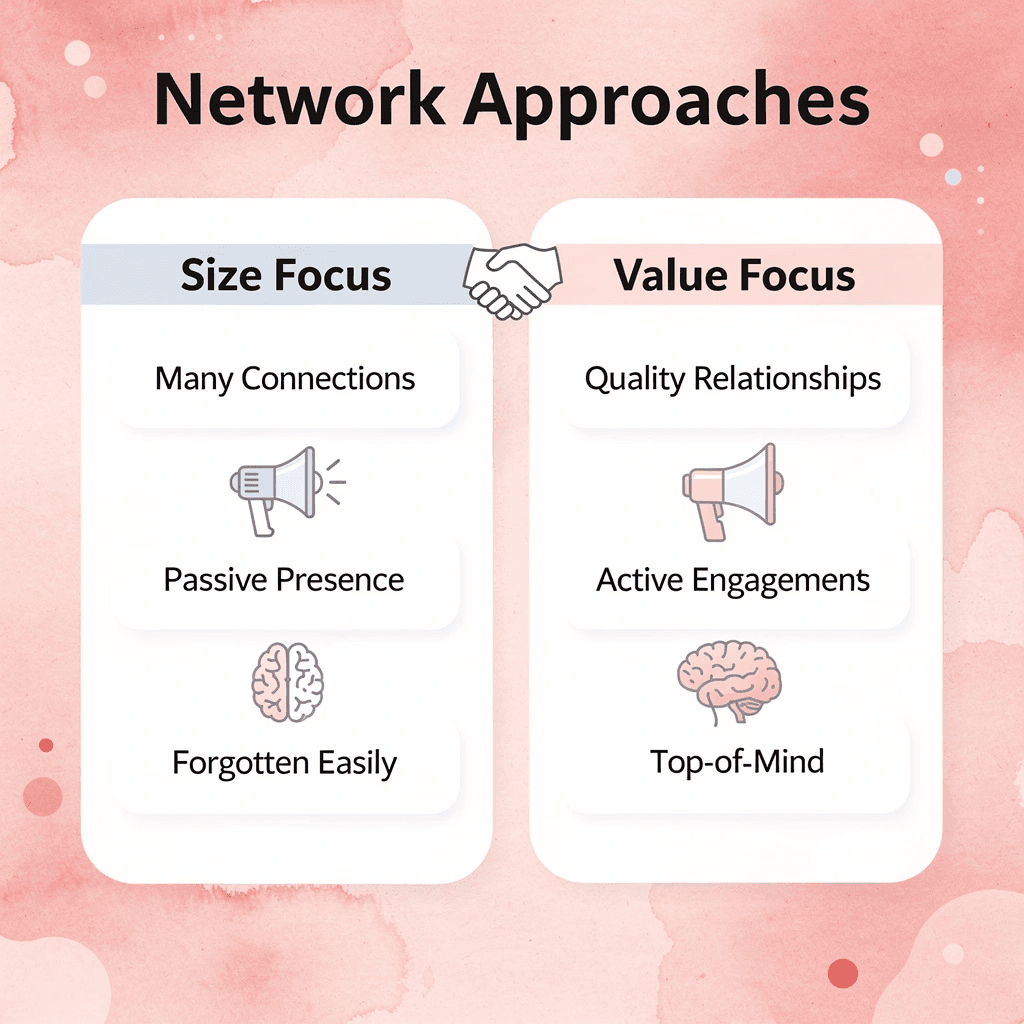
Opportunities come from being remembered when it matters. The difference between a network that generates results and one that sits idle isn't size—it's whether people think of you first when something relevant crosses their desk. That happens when you've stayed visible, made your value clear, and built enough trust that recommending you feels safe.
🎯 Key Point: Your network's value isn't measured by the number of connections you have, but by how quickly people think of you when opportunities arise. Focus on being memorable rather than just being present.

"The most successful professionals aren't those with the largest networks, but those who are top-of-mind when opportunities emerge." — Professional Networking Research, 2024
💡 Pro Tip: Create a systematic approach to network activation by regularly sharing valuable insights, celebrating others' wins, and making strategic introductions. This keeps you visible without being pushy and positions you as someone who adds value to the network.
Why do referrals lead to better opportunities?
According to Wave Connect's 2025 networking data, referred candidates are 4-5 times more likely to get hired than non-referred applicants. Referrals happen because you stayed in touch, shared your work, and made it easy for them to explain what you do. When a hiring manager asks your former colleague for recommendations, your name comes up only if you've remained present in their world.
How do you stay visible to your network?
Someone referring you for a role starts with them remembering you exist. That means reaching out every few months with something worth sharing: an article they'd find useful, congratulations on their company's product launch, or a question about how their team handled a challenge you're facing. These reminders keep you visible as someone still active, still learning, and worth staying connected to.
Why does sharing your expertise matter?
A peer brings you into a project when they need help with something you're good at, and you've made your expertise visible. Share your progress: post about what you're building, talk through problems you've solved, offer perspective on industry shifts. The person who stays quiet until they need something gets forgotten; the person who contributes regularly becomes the obvious choice when opportunity appears.
Why do people recommend those they trust?
A contact recommends you to a client because they trust the outcome won't embarrass them. McKinsey found that referrals have a 40% higher retention rate than other hires. The person making the introduction has already filtered for competence and reliability, seen your work, watched how you handle pressure, and decided you won't make them look bad.
How do you build trust that leads to referrals?
Building trust takes time and consistent action: doing what you say you'll do, delivering good work, and being honest about limitations. Trust accumulates through small interactions that demonstrate dependability. When someone needs to recommend a designer, consultant, or developer, they choose the person they already know they can count on.
Making it easy to refer you
Most people want to help their network, but won't if it requires effort. Vague answers like "helping companies optimize processes" are forgotten immediately. Say "I help SaaS companies reduce churn by fixing their onboarding flows," and people can picture exactly who to introduce you to. Clarity makes your value instantly understandable, so people know when you're the right fit.
How can you reduce friction in the referral process?
Tools like digital contact card streamline sharing by ensuring people can quickly find your details, see what you're working on, and access your contact information without searching through old emails. When your information is accessible, and your value is clear, the gap between "I should introduce them" and doing it disappears. But presence alone isn't enough if your follow-through falls apart.
If You Want Your Network to Actually Create Opportunities, You Need a System
Most people fail at networking because they have no system to manage what happens after the conversation ends. You collect contacts, exchange pleasantries, then weeks pass, and the relationship dissolves into digital clutter. Without a way to capture details, track follow-ups, and maintain visibility, even your best connections become dormant files you'll never open again.

🎯 Key Point: The difference between successful networkers and everyone else isn't the number of people they meet—it's having a systematic approach to relationship management that prevents connections from going cold.
What kills most networks is friction. You meet someone at a conference and lose their business card. Or you save their LinkedIn profile but forget what you discussed. Or you intend to follow up but can't remember if they were hiring, launching a product, or exploring partnerships. The gap between intention and action widens until the opportunity disappears.
"Without a systematic approach to networking, 78% of professionals lose touch with valuable contacts within 30 days of meeting them." — Harvard Business Review, 2023
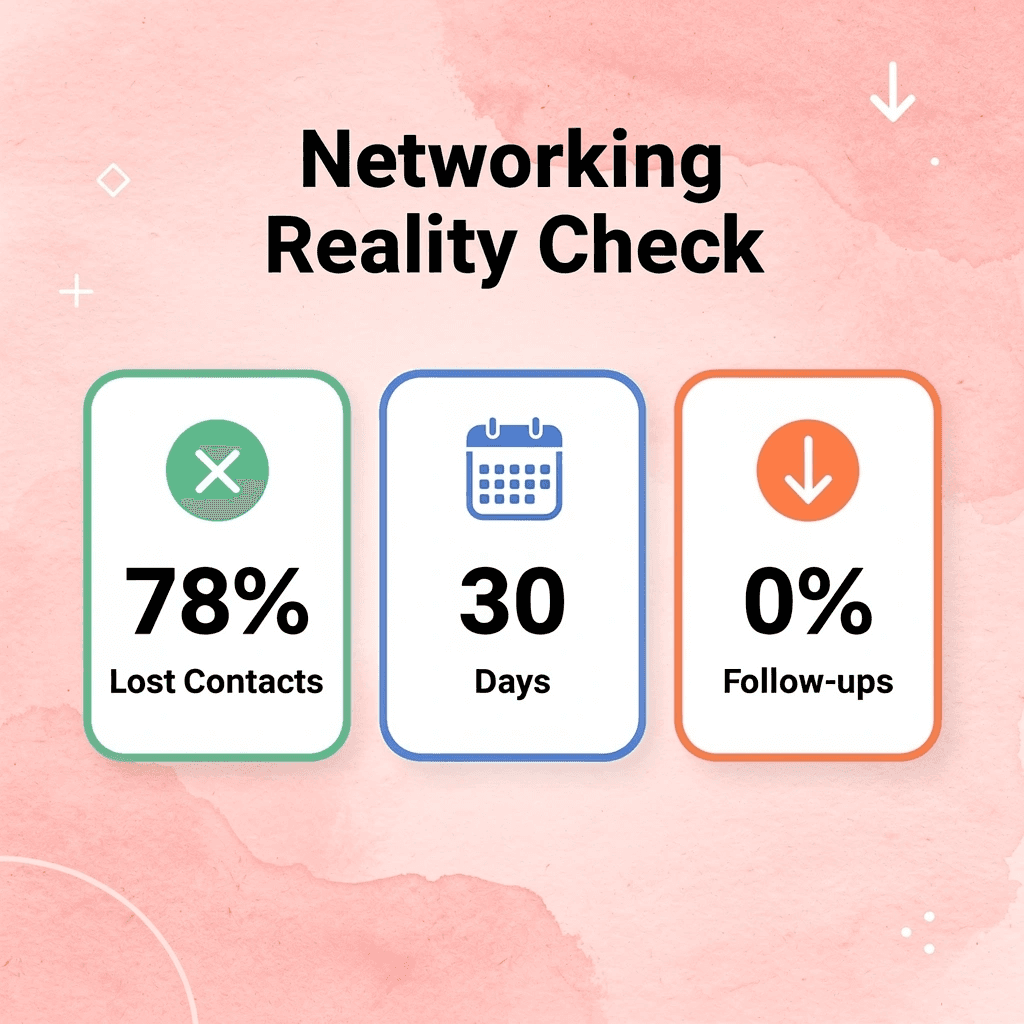
Mobilo solves that gap by turning every interaction into a structured, actionable entry in your network. Instead of relying on paper cards or scattered notes, your team can exchange contact details, automatically enrich lead data, and sync everything directly into your CRM. Every conversation becomes a usable relationship, not a forgotten contact. Your network becomes a living system where follow-ups happen on time, context stays visible, and opportunities surface when they matter most.
⚠️ Warning: Every day without a proper networking system means potential opportunities are slipping away. The connections you make today could be the partnerships, clients, or career opportunities you need tomorrow—but only if you can actually follow up on them.

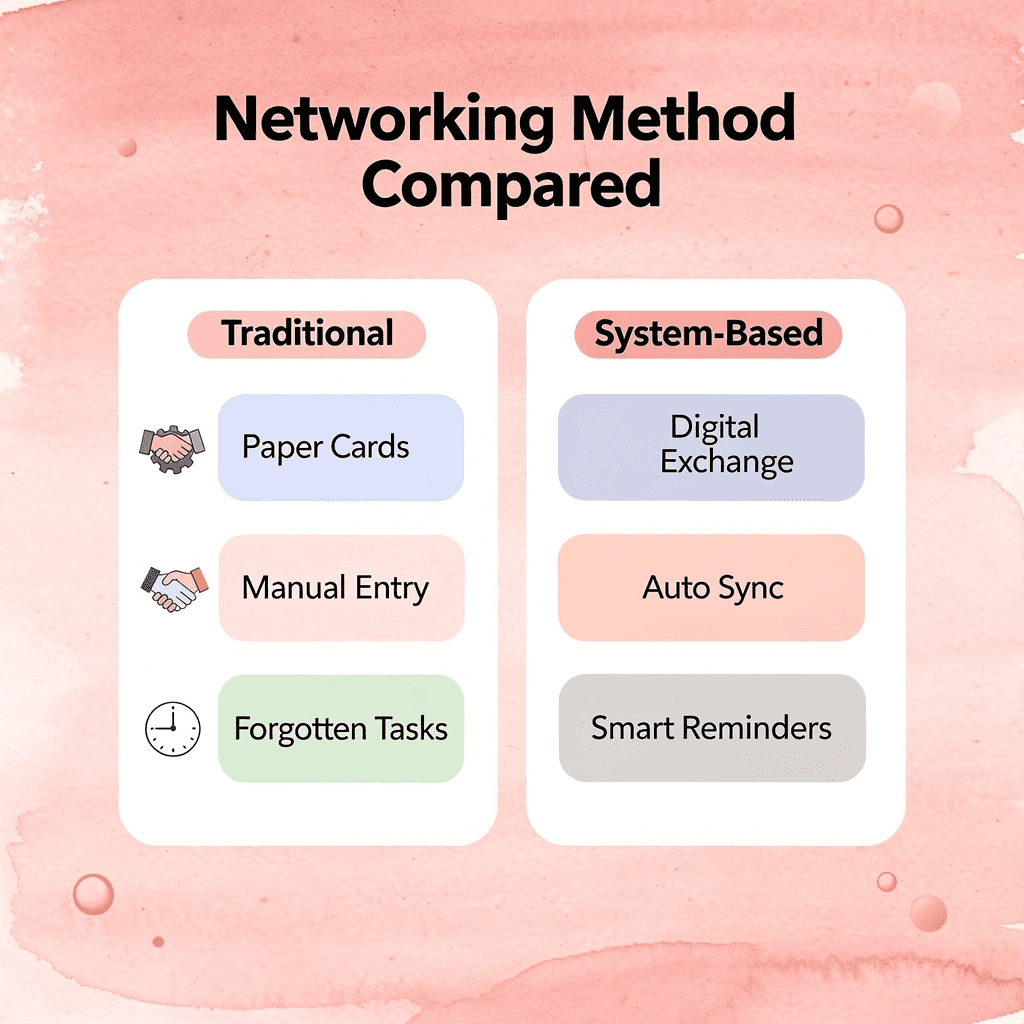
Traditional Networking
- Paper business cards
- Manual data entry
- Follow-ups often forgotten
- Context and details lost
- Connections go dormant over time
System-Based Networking
- Digital contact exchange
- Automatic CRM synchronization
- Scheduled follow-up reminders
- Conversation notes saved automatically
- Active relationship tracking
Book a demo today, and you'll get your first 25 Mobilo digital business cards free, so you can start capturing and managing your network immediately instead of letting opportunities slip through.
Related Reading
- Tips For Networking Events
- Professional Networking Platforms
- Business Networking For Entrepreneurs
- Networking Tips For Small Business Owners
- Business Networking Strategies
- Best Business Networking Apps
- Top Contact Management Software