.avif)


How to Manage Business Cards for Multiple Employees at Scale
On This Page
Managing business cards for multiple employees sounds straightforward until outdated titles, misspelled names, and stale contact details start piling up. Ordering in bulk, tracking design versions, and keeping every card up to date with each employee's actual role can quietly become a real operational burden. The good news is that smarter systems exist to handle this at scale without burying HR or admin teams in constant reprint requests.
Mobilo's platform addresses this directly by allowing organizations to update employee profiles instantly from a single central dashboard, eliminating the need to reorder physical cards whenever someone changes roles or contact details. Every team member carries a professional, accurate card, and every contact they share it with always receives the right information. Teams ready to simplify the process can get started with a digital business card.
Summary
- Brand consistency across a distributed workforce is harder to maintain than most companies expect. Small deviations, such as outdated logos, personal email addresses, or unlocked templates, compound quickly at scale. Research indicates that 72% of people judge a company by the quality of its business card, meaning every off-brand card handed out undermines the impression the company is trying to make.
- The hidden costs of poor business card management extend well beyond reprinting expenses. Physical cards do not expire when an employee leaves, meaning offboarded employees' cards continue circulating with no way to recall or correct them. Research also shows that 39% of people choose not to do business with a company if its card looks cheap or outdated, making contact information accuracy a revenue issue, not just an administrative one.
- Choosing a business card solution for multiple employees requires evaluating it as a system rather than a product. The most important capabilities are locked brand templates with role-based permissions, approval workflows that allow self-service ordering without sacrificing oversight, and integrations with HR and CRM platforms that automate card updates when employees are onboarded, promoted, or offboarded.
- Digital business card adoption among enterprise teams has grown by 40% since 2022, reflecting a broader shift toward solutions that do more than share contact information. The most effective implementations treat lead capture, analytics, and CRM sync as core features configured at rollout rather than added later. Every card distributed from day one then contributes to a measurable pipeline rather than functioning as a passive contact exchange.
- Multi-channel sharing removes friction for recipients in a way that single-format cards cannot. QR codes, NFC tap, Apple Wallet, Google Wallet, direct links, and email signature integrations each serve a different context, and combining them means a card reaches people whether the interaction happens in person, remotely, or asynchronously. Including a digital card link in every employee email signature turns routine correspondence into a passive distribution channel at no additional cost.
- Security and compliance considerations for contact data are consistently underestimated, particularly in regulated industries. Contact databases can contain personal information subject to GDPR and regional privacy laws, and organizations that store such data without encryption, access controls, or audit trails carry a risk that often goes unrecognized until an audit surfaces it. Role-based permissions and regular security reviews are baseline requirements, not advanced features reserved for enterprise deployments.
- Mobilo's digital business card platform addresses the operational gap between contact sharing and pipeline management by connecting centralized admin controls, locked brand templates, and automated CRM sync into a single system that scales across teams of any size.
Why Managing Business Cards for Multiple Employees Gets So Complicated
Most businesses think that ordering business cards for multiple employees is just about picking a design and placing a bigger print order. This works fine with ten employees, but it becomes significantly harder around fifty. By the time you have hundreds of employees, it turns into a brand governance problem instead of just a printing task — and the operational complexity can spiral fast.
⚠️ Warning: What starts as a simple print order at a small scale becomes a full-scale brand management challenge the moment your headcount crosses a critical threshold.
"By the time you have hundreds of employees, managing business cards stops being a printing task and becomes a brand governance problem entirely."
💡 Tip: If your team is approaching 50+ employees, now is the critical time to implement a scalable business card system — before the chaos compounds.
~10 employees
- Complexity Level: Low
- Primary Challenge: Simple bulk order
~50 employees
- Complexity Level: Medium
- Primary Challenge: Version control & updates
100+ employees
- Complexity Level: High
- Primary Challenge: Brand governance & consistency
🔑 Takeaway: The real problem isn't printing — it's maintaining brand consistency, accurate information, and operational control across a growing, constantly changing workforce.

Why scale turns a simple task into a system failure
The failure point is usually invisible at first. A new hire uses an old template with last year's logo. Someone unlocks the file to change the font. A third person uses a personal email instead of their work address. None of these feels serious on its own, but across a growing team, small deviations add up to something that damages how your company is perceived. According to Wave Connect's Business Card Statistics, 72% of people judge a company or person based on the quality of their business card—meaning every off-brand card your team hands out works against the impression you're trying to make.
Why do manual workflows break down as headcount grows?
Most teams handle this through email chains and spreadsheets, collecting employee details, routing them to designers or print vendors, and manually tracking who has cards. That workflow is fragile. As the team grows, approval delays stack up, errors slip through, and administrative burden lands on whoever has the least bandwidth. Our digital business card platform replaces that chain with a centralized system: templates are locked, employee profiles are managed from a single dashboard, and updates are pushed instantly across the team without reprints.
The hidden cost nobody budgets for
The problem worsens when employees leave. UPrinting's Business Cards Statistics research shows that 39% of people choose not to do business with a company if their business card looks cheap or outdated. An employee's card lingering in someone's wallet after departure qualifies as both. Physical cards don't expire and continue representing your brand long after that person has moved on, with no way to retrieve or update them.
What does the inconsistency between departments actually cost you?
Then there's the inconsistency between departments. Sales might use a glossy finish, while operations might use a matte finish. One team lists a direct line, another lists a general number. Brand consistency research from Marq (formerly Lucidpress) found that consistent brand presentation across all channels increases revenue by up to 23%, yet business cards remain a channel most companies fail to control.
But knowing why the problem exists is only half the answer; the other half is where most companies make their most costly mistake.
Related Reading
- Business Card Ideas
- Matte Vs Uncoated Business Cards
- Types Of Business Cards
- Business Card Psychology
- What Should Be On A Business Card
- How to Make a Professional Business Card
- Rounded Corner Business Cards
- Minimalist Business Cards
- Business Card Paper Weight
- Business Card Colors
What to Look for in a Business Card Solution for Multiple Employees
The most expensive mistake most companies make is treating the solution search like a product search—comparing price per card, turnaround time, or template editors. What they need is a system that requires entirely different evaluation criteria.
⚠️ Warning: Evaluating a business card solution on price per card alone is like evaluating a CRM on software license cost—you're measuring the wrong thing.
💡 Tip: Before comparing vendors, define your non-negotiables as a system: centralized management, brand consistency, and scalability across employees, not design features alone.
.webp)
"39% of people would choose not to do business with a company if they had a 'cheap looking' business card." — UPrinting Blog's Business Cards Statistics
According to the UPrinting Blog's Business Cards Statistics, 39% of people would choose not to do business with a company if they had a "cheap looking" business card. You are not buying cards. You are buying the perception your company makes on every single person your team meets.
🔑 Takeaway: A business card is a first-impression asset—and with 39% of prospects ready to walk away over poor quality, the real cost of cutting corners isn't the price per card. It's the lost revenue that never makes it into your pipeline.
What You Think You're Buying
- Price per card
- Template variety
- Turnaround time
- Design features
What You're Actually Buying
- Revenue per first impression
- Brand consistency at scale
- Team-wide readiness
- Perceived company credibility
What problems should the solution actually solve?
The right way to evaluate any multi-employee card solution is to start with the business problem, trace it to the feature that addresses it, then ask what result that feature produces. Most buying decisions skip the first step and start at the feature level, which is how teams end up with tools that look impressive in a demo but fail in real workflows.
How do locked templates protect brand consistency across every card?
Take brand governance as the clearest example. Marketing loses control the moment card ordering becomes self-service. Locked brand templates with role-based editing permissions solve this: employees can update their own name, title, and contact details, but cannot touch fonts, colors, or logo placement. The result is that every card your company distributes looks as if it came from the same organization. Without that structure, consistency is a hope. With it, consistency is a default.
How does self-service ordering eliminate the backlog problem for growing teams?
Most teams handle bulk ordering via procurement requests sent to a print vendor, which works well for a single-department refresh. But when new hires join weekly, roles change, or a rebrand happens mid-quarter, that process creates backlogs that slow onboarding and waste budget on reprints.
Solutions built for multi-employee environments handle this through employee self-service portals connected to approval workflows: a new hire submits their details, a manager or admin approves, and the card goes to print or activates digitally without email threads. Mobilo's digital business card platform operates on this model, connecting team-level admin controls to CRM integrations so that every card issued becomes a lead capture point, transforming what was once a logistics task into a measurable pipeline input.
Which capabilities separate basic tools from scalable systems?
Support for multiple locations, CRM and HRIS integrations, and analytics separate basic tools from systems that grow with your company. A company with offices in three cities needs a solution handling location-specific details without separate templates for each office. HRIS integrations ensure that employee card status updates are automatically triggered when people are hired and when they leave. According to the Spreadly Blog's Essential Guide to Business Card Management in 2025, digital business card adoption has grown by 40% among enterprise teams since 2022. Analytics and order tracking are now essential: procurement teams use them to justify spending, and marketing teams use them to measure whether their brand reaches the right audience.
The feature list tells you what a solution can do. The harder question is what it will do inside your specific organization.
Related Reading
- Should I Put My Picture On My Business Card
- Photography Business Cards Examples
- Horizontal vs Vertical Business Cards
- Business Card Examples For Owners
- How To Put an Instagram Handle on a Business Card
- Esthetician Business Card Ideas
- Photography Business Cards Examples
- Back Of Business Card Ideas
- Business Card Details
- Business Card Requirements
- Business Card Dimensions
How to Manage Business Cards for Multiple Employees
What separates organizations that see real results from those with cluttered portals and inconsistent cards is how well they execute in the first 90 days after deployment. The first 90 days are critical — this is when habits form, systems get stress-tested, and the gap between high-performing teams and struggling ones becomes impossible to ignore. Organizations that invest in structured onboarding, clear card ownership, and consistent brand standards from day one are the ones that turn deployment into a genuine competitive advantage.
"The first 90 days after any organizational rollout are the single greatest predictor of long-term adoption success — not the technology itself, but the execution around it." — LSA Global
💡 Tip: Assign a dedicated card administrator within the first week of deployment to own template management, employee onboarding, and brand consistency across all cards.
⚠️ Warning: Organizations that skip structured rollout planning in the first 90 days risk ending up with exactly what they were trying to fix — cluttered portals, off-brand cards, and low employee adoption rates.
Execution Factor: Card Ownership
- High-Performing Organizations: Assigned to a dedicated admin
- Struggling Organizations: Unclear or shared loosely
Execution Factor: Brand Standards
- High-Performing Organizations: Enforced via locked templates
- Struggling Organizations: Left to individual employees
Execution Factor: Onboarding Process
- High-Performing Organizations: Structured within the first 90 days
- Struggling Organizations: Ad hoc or nonexistent
Execution Factor: Consistency
- High-Performing Organizations: Uniform across all employees
- Struggling Organizations: Varies by department or role
.webp)
The Three Ordering Workflows You Need to Know
Business card portals work differently depending on the provider, but a good solution fits your workflow rather than forcing you to change it. The three most common ordering methods each solve a different problem, and choosing the wrong one for your team size compounds issues over time.
When does a single orderer workflow make sense?
The single orderer workflow keeps everything simple. One person starts, designs, and places all orders, maintaining brand consistency and catching mistakes before printing. The downside is a bottleneck: when that person is unavailable, the entire process stops. This model works for small teams or companies with a dedicated office manager, but it typically breaks down once a company exceeds 50 employees.
How does self-serve ordering shift responsibility to employees?
Self-serve ordering puts the responsibility on employees to order for themselves. An editable template is uploaded into the portal, a link is shared company-wide, and each person logs in, fills in their details, and submits their order without needing design skills or IT support. According to Wave Connect's Business Card Statistics, 88% of business cards handed out are thrown away within a week, meaning cards with wrong titles or misspelled names waste procurement costs and brand reputation. Self-serve eliminates the single-orderer bottleneck but introduces a new risk: without oversight, errors scale as fast as orders do.
How does an approval workflow make self-serve ordering safe at scale?
The approval workflow closes that gap. Employees can personalize and submit their cards, but an administrator reviews every order before it is confirmed. Typos get caught, rogue font choices get corrected, and brand standards hold. For mid-market and enterprise teams managing cards across departments, regions, or multiple brand lines, this structure provides the governance layer that makes self-serve ordering safe at scale. Combining self-serve ordering with an approval layer gives teams the speed of decentralization without sacrificing the control that brand and procurement teams require.
What makes centralized digital repositories essential for contact management?
Centralized repositories form the operational foundation for contact management. When employee contact data lives in a single, searchable database connected to your CRM and HR platforms, leads stop falling through the cracks, and duplicate profiles stop multiplying across systems. Sales teams report fewer missed follow-ups and cleaner pipeline data because contacts flow automatically into workflows rather than requiring manual transfer.
Why does integration planning determine whether centralized repositories succeed?
The critical failure point is integration planning. Organizations often assume synchronization with HR and CRM systems happens automatically after deployment; it does not. Deliberate setup during rollout, connecting the card platform to systems like BambooHR or Microsoft Entra ID, enables role-based updates to trigger automatically when employees are onboarded, promoted, or offboarded. Without that connection, outdated cards continue circulating long after someone leaves the company.
Scanning and Digitization of Physical Cards
Physical cards remain common at conferences, client meetings, and industry events. Without digitization, contacts languish in drawers until they lose value. AI-powered scanning tools extract contact data accurately within seconds, converting paper documents into searchable digital records that integrate directly with your CRM. For complex card designs or unusual formats, human transcription services address accuracy gaps that automated tools may miss.
Check each scanned record before it enters your database. Scanning reduces manual entry but doesn't eliminate the need for accuracy checks. Building that review step into your workflow prevents errors from compounding as they move through your system.
Real-Time Synchronization and Updates
Most teams handle employee information updates through email requests, spreadsheet edits, and manual reprints. Hidden costs emerge when turnover accelerates, a rebrand rolls out, or 200 people need updated titles after reorganization: outdated cards remain in circulation, still being handed to clients and prospects.
How does connecting your card platform to identity systems eliminate update lag?
Teams that connect their card platform to identity management systems eliminate that lag entirely. A role change in the HR system triggers an automatic update to the employee's digital card, with no need to reprint, submit a manual request, or wait. For organizations managing digital business cards at scale, real-time synchronization transforms a contact-sharing tool into an accurate, living representation of the company.
Multi-Channel Sharing and Accessibility
If a recipient must download an app to view your card, many won't. Sharing your card in multiple ways removes that barrier. QR codes, NFC tap, Apple Wallet, Google Wallet, direct links, and virtual meeting backgrounds each serve different situations, and a well-configured card works across all of them without requiring anything extra from the recipient.
Including a digital card link in email signatures is one of the easiest ways to share your card. Every email sent by every employee becomes an opportunity to extend their reach far beyond in-person interactions.
Customization and Branding
UPrinting's Business Cards Statistics reports that 72% of people judge a company or person based on business card quality—a credibility risk that compounds across a 500-person sales team. Centralized template control locks logos, fonts, and color palettes at the admin level while allowing employees to personalize only name, title, phone number, and direct link.
The balance between brand control and individual personalization determines success. Lock too much, and employees feel they're issuing a generic form; lock too little, and consistency erodes within weeks. The right configuration enforces non-negotiables while giving employees enough flexibility to feel a sense of ownership.
Lead Capture and Engagement Tools
A business card that only shares contact information is a missed opportunity. Putting lead capture forms, scheduling links, and product demo requests directly into a digital card transforms a passive exchange into an active engagement touchpoint. Analytics track who opened the card, which links were clicked, and when follow-up is most likely to convert—data that sales teams previously had to guess at.
Organizations seeing the strongest results set up engagement tools during deployment rather than adding them later, ensuring every card distributed from day one contributes to a measurable pipeline.
Security, Privacy, and Compliance
Security considerations for business card data are often underestimated, particularly in regulated industries. Contact databases contain personal information subject to GDPR, regional data laws, and industry-specific compliance requirements. Organizations that store this data without encryption, access controls, or audit trails face an unquantified risk.
What security controls should organizations have in place?
Role-based permissions, secure cloud storage, and regular security audits are basic requirements for any organization that takes managing contact data seriously. Building a review cycle into your yearly operations calendar, not just the initial setup, separates organizations that maintain compliance from those that discover gaps during audits.
How do ongoing operational checkpoints protect your organization?
Successful business card management requires ongoing operational checkpoints: quarterly brand reviews, onboarding and offboarding triggers, procurement audits, and periodic training for new employees. Organizations implementing these practices eliminate unnecessary reprints, prevent lost leads, and ensure consistent materials that protect brand integrity.
The question is which specific platforms can execute these strategies at your scale.
Top 12 Business Card Management Solutions for 2026
Pick a platform that matches how your team works right now, at your current size, with room to grow. Scalability, workflow fit, and team size are the critical filters that separate a tool you'll use from one you'll abandon.
💡 Tip: Before evaluating any platform, document your current team size, integration needs, and growth targets for the next 12–24 months. This step eliminates half the options immediately.
.webp)
"10 billion business cards are printed per year worldwide, yet 88% get thrown away within a week." — Digital Business Card Blog
According to the Digital Business Card Blog, 10 billion business cards are printed per year worldwide, yet 88% get thrown away within a week. The platforms below solve this by rethinking what a business card does — not by printing better ones. This is a fundamental shift in strategy: from physical distribution to digital engagement.
🔑 Takeaway: When 88% of printed cards are discarded within 7 days, the real problem isn't design or quality — it's the medium itself. Digital business card platforms eliminate this waste entirely.
Each solution below covers what it does, who it serves, what makes it different, and the real trade-offs. Use these as decision filters, not a popularity ranking. The goal is to match each platform's core strengths to your specific use case.
Evaluation Criteria
Why It Matters: Defines the core functionality and use case
What it does
Why It Matters: Defines the core functionality and use case
Who it serves
Why It Matters: Ensures team size and industry fit
What makes it different
Why It Matters: Identifies the unique competitive advantage
Real trade-offs
Why It Matters: Reveals hidden costs and limitations
⚠️ Warning: Choosing based on brand popularity alone is one of the most common mistakes teams make. A top-ranked tool that doesn't fit your workflow will deliver worse results than a lesser-known platform that does.
.webp)
1. Mobilo
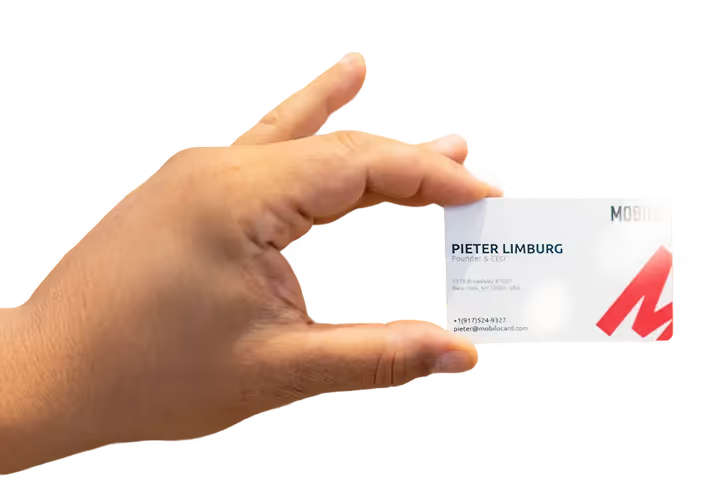
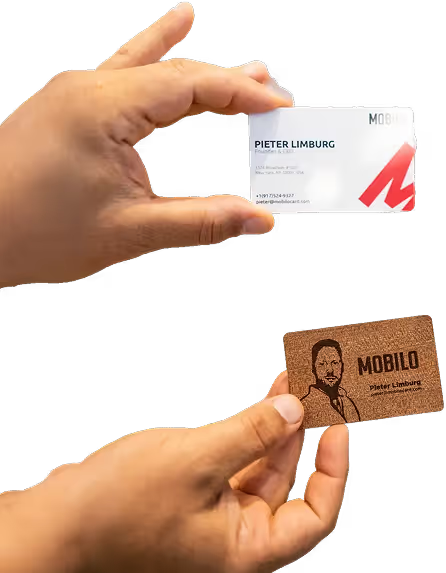
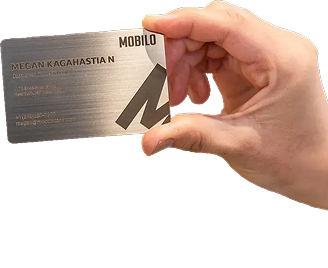
What it does: Mobilo is a digital business card platform that combines smart physical cards (classic, wood, metal) with a centralized admin dashboard managing cards across all employees. When someone taps or scans a Mobilo card, the contact is captured, enriched, scored against your ICP, and pushed directly into your CRM without manual entry.
Who it's built for: Small businesses seeking enterprise-ready presence, mid-market sales teams scaling their operations, and enterprise organizations managing hundreds of employees across multiple locations.
Primary differentiator: Mobilo turns every employee card interaction into a tracked, automated lead event. Most platforms stop at contact sharing. Our digital contact card connects the handshake to the pipeline, with built-in lead scoring, CRM sync, and productivity analytics.
Pros: Centralized card management with locked brand templates, automated CRM workflows that eliminate manual data entry, real-time analytics showing which employees and events generate the most leads, and premium physical options (wood and metal) for high-value client settings.
Cons: Teams without a CRM or lead tracking process cannot access the platform's most powerful features. Full value requires setting up admin controls and integrations.
Customer Rating: Trusted by over 55,000 companies. Book a demo to receive your first 25 Mobilo cards free (a $950 value).
2. Doorway
What it does: Doorway offers HR-integrated digital business cards that sync with HR systems and automatically generate cards for new hires during onboarding.
Who it's built for: HR-led organizations managing employee lifecycle and card issuance at scale.
Primary differentiator: Unlimited sharing paired with HR system sync eliminates the administrative gap between hiring and card deployment.
Pros: Reduces onboarding friction, automates card creation from HR data, and supports unlimited card sharing without per-send fees.
Cons: Limited design customization makes it unsuitable for brand-sensitive organizations requiring precise visual control.
Integrations: HR platforms, CRM systems.
Pricing: Tiered.
3. Sansan
What it does: Sansan is an enterprise contact management platform that converts scanned business cards into shared organizational intelligence rather than siloed individual contact lists.
Who it's built for: Large enterprises, particularly in Japan and Asia-Pacific markets, where relationship mapping across departments is a strategic priority.
Primary differentiator: Cards become company-wide assets. When one employee scans a contact, that relationship becomes visible and searchable across the entire organization.
Pros: Powerful relationship intelligence, collaborative contact database, and strong enterprise-grade data governance.
Cons: Steeper learning curve than most platforms and enterprise pricing that excludes smaller teams.
Integrations: CRM, marketing platforms.
Pricing: Enterprise.
4. HubSpot Card Scanner
What it does: HubSpot has a built-in card scanner that lets users photograph physical business cards and add contacts directly into HubSpot CRM, with information filling in automatically.
Who it's built for: Teams already working in the HubSpot ecosystem who want to eliminate manual contact entry.
Primary differentiator: Zero friction for HubSpot users: no new platform to learn, no separate subscription, no data migration.
Pros: Free for HubSpot users, seamless CRM sync, and minimal setup required.
Cons: No branding options are available. This is a scanning tool, not a card management platform, so it does not support designing cards for multiple employees, distributing cards, or managing brand standards.
Integrations: HubSpot CRM.
Pricing: Free with HubSpot.
5. Knowee
What it does: Knowee offers eco-focused digital business cards with straightforward sharing via QR code or link, targeting professionals seeking a simple, sustainable alternative to paper cards.
Who it's built for: Freelancers, small teams, and sustainability-conscious organizations prioritizing simplicity over advanced features.
Primary differentiator: Eco-friendly positioning with emphasis on ease of use: minimal setup and no technical knowledge required.
Pros: Fast to deploy, environmentally positioned, and easy for non-technical users to manage independently.
Cons: Limited advanced features; doesn't scale well for teams requiring brand governance, approval workflows, or CRM automation.
Integrations: Email, CRM (basic).
Pricing: Tiered.
6. HiHello
What it does: HiHello provides customizable digital business cards with built-in analytics that track views and shares.
Who it's built for: Individual professionals and small teams seeking design flexibility and performance data without enterprise complexity.
Primary differentiator: Strong card customization paired with engagement analytics that show which contacts interacted with the card after receiving it.
Best for: Remote teams, sales professionals, and small businesses seeking visibility into networking ROI.
Pros: Flexible card design, contact management, and analytics beyond simple contact sharing.
Cons: Limited enterprise controls make it difficult to enforce brand consistency across large teams or lock templates for specific roles.
Integrations: CRM, Apple Wallet, Google Wallet.
Pricing: Free and tiered plans.
What happens when teams lack centralized card control?
Most teams stick with their current card tool because they believe switching costs too much. Problems arise when a salesperson shares a card with the wrong title, logo, or outdated contact information—often unnoticed until a customer calls a defunct number. Platforms like Mobilo solve this by giving admins central control over employee cards, with locked templates and real-time updates that spread instantly across the team without requiring new prints or individual changes.
7. ABBYY Business Card Reader
What it does: ABBYY uses AI-powered optical character recognition to scan physical business cards with high accuracy across multiple languages, converting card data into structured contact records.
Who it's built for: Sales teams and professionals who receive large volumes of physical cards at conferences and trade shows.
Primary differentiator: AI-driven scanning accuracy for complex card layouts, non-standard fonts, and multilingual cards.
Pros: High OCR accuracy, multilingual support, and direct CRM sync, including Salesforce.
Cons: Focused on scanning inbound cards rather than managing outbound card distribution. Teams seeking to control what their employees share will find their options limited.
Integrations: CRM, Salesforce.
Pricing: Tiered.
8. ScanBizCards
What it does: ScanBizCards converts physical business cards into digital files using your smartphone camera. You can also upload multiple cards at once to process large batches after events.
Who it's built for: Sales teams and event marketers who collect dozens or hundreds of business cards at conferences and need to process them quickly afterward.
Primary differentiator: The bulk scanning feature reduces manual data entry work after trade shows.
Pros: Fast scanning, bulk upload support, and straightforward CRM export.
Cons: The interface looks outdated compared to newer platforms. It also lacks tools for sending cards or maintaining consistent branding across teams.
Integrations: CRM platforms.
Pricing: Tiered.
9. Covve
What it does: Covve combines digital business card sharing with contact enrichment, automatically updating contact records when professional information changes.
Who it's built for: Relationship-driven professionals and small teams who want their contact database to stay accurate without manual maintenance.
Primary differentiator: Automatic contact enrichment keeps existing records current, reducing the decay problem that renders most contact databases unreliable within 12 months.
Best for: Professionals in consulting, financial services, or fields where relationship longevity and contact accuracy directly affect business outcomes.
Pros: Contact enrichment reduces database decay, offers a clean interface, and integrates with Outlook.
Cons: Fewer integrations than enterprise platforms and limited tools for managing cards across distributed teams.
Integrations: CRM, Outlook.
Pricing: Free and tiered plans.
10. CamCard
What it does: CamCard scans physical business cards and organizes them into a searchable digital contact library, with multilingual OCR that supports non-Latin scripts and global card formats.
Who it's built for: People and teams working across different languages and regions need a reliable way to convert cards into digital information.
Primary differentiator: Multi-language OCR handling cards in non-Latin scripts makes it one of the more capable tools for global networking contexts.
Pros: Strong support for many languages, wide global reach, and wallet integration for quick access to contact information.
Cons: Some users have worried about privacy and data handling. This matters for organizations that must follow strict data regulations.
Integrations: CRM, Apple Wallet, Google Wallet.
Pricing: Free and tiered plans.
11. Scan to Salesforce
What it does: Scan to Salesforce pushes contact data directly into Salesforce records, eliminating delays between receiving a card and logging the contact in your CRM.
Who it's built for: Salesforce-native sales teams seeking frictionless contact capture without leaving their existing workflow.
Primary differentiator: Direct, native Salesforce integration with no intermediary platform or data mapping required.
Pros: Frictionless Salesforce sync, free for Salesforce users, and minimal setup.
Cons: Requires Salesforce; outside that ecosystem, the tool has no function. It doesn't address outbound card design or team-level brand management.
Integrations: Salesforce only. Pricing: Free.
12. MagneticOne Mobile Business Card Reader
What it does: MagneticOne focuses on CRM and ERP integration, business card scanning, and routing contact data to multiple business systems via a configurable integration layer.
Who it's built for: Enterprises with complex system environments that require contact data to flow into multiple platforms simultaneously.
Primary differentiator: Broad integration coverage across CRM and ERP systems, supporting non-standard tech stacks that competitors don't handle natively.
Pros: Wide integration range, configurable data mapping, and support for complex enterprise architectures.
Cons: Setup complexity requires dedicated IT support, which smaller teams may struggle to manage.
Integrations: CRM, ERP platforms.
Pricing: Custom.
The right platform narrows fast once you identify your actual constraint: brand governance, CRM sync, scanning accuracy, or scale. Most teams discover only after deployment that the constraint they assumed wasn't the one that slowed them down.
Related Reading
- Plumbing Business Cards Examples
- HVAC Business Cards Examples
- Electrician Business Card Ideas
- Unique Business Card Ideas
- Artist Business Cards Examples
- Therapist Business Cards Examples
- How To Put Social Media On Business Card
- Best Real Estate Business Cards
Standardize Every Employee's Business Cards Before Your Next New Hire
Most teams discover their actual limits only after bringing on a new employee, when the card ordering process breaks down—not from the tool failing, but from having no system at all.
"The breakdown rarely comes from the tool—it comes from the absence of a scalable system built before the next hire arrives." — Mobilo
⚠️ Warning: If your onboarding process exposes gaps in your business card workflow, waiting until the next new hire to fix it is costly. Every delay means inconsistent branding in the hands of your newest team members.

If your team manages business cards through scattered email threads and shared folders, a personalized digital business card demo with Mobilo takes under five minutes. You'll see how our centralized templates, automated CRM sync, and lead capture tools replace disorganized workflows with one scalable system—your first 25 cards are free.
💡 Tip: Use the free 25-card offer to standardize your entire team's brand identity before your next new hire arrives.
🎯 Key Point: Centralized templates eliminate guesswork—every employee gets a consistent, professional card without manual oversight from your team.