.avif)


15 Tips for Networking Events for First-Time Attendees
On This Page
Walking into a networking event for the first time can feel like stepping onto a stage without a script. You scan the room full of strangers, making easy conversation, and suddenly your mind goes blank when it's your turn to introduce yourself. These practical strategies will help you build genuine connections, start conversations that matter, and transform those brief introductions into opportunities that advance your career.
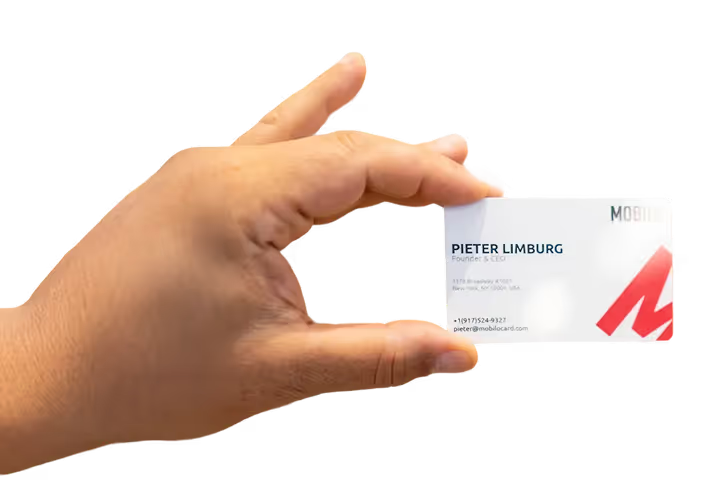
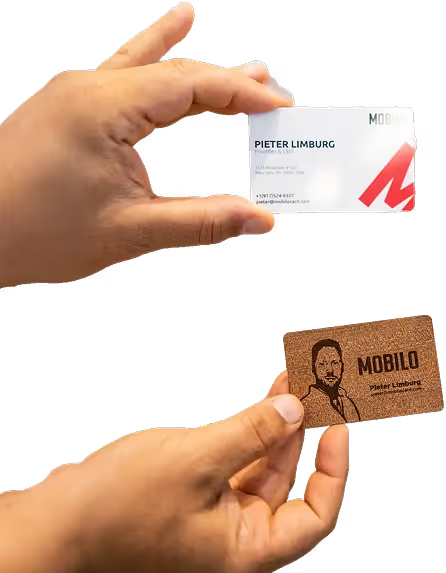
One challenge many people face is the awkward exchange of contact information when you've finally connected with someone interesting. Fumbling through pockets for business cards or typing numbers into your phone while trying to maintain eye contact breaks the natural flow of conversation. Sharing your complete professional profile instantly keeps interactions smooth and ensures you never lose touch with valuable connections. Mobilo's digital contact card eliminates that fumbling moment with a simple tap or scan.
Summary
- Nearly half of young professionals find networking awkward, according to workplace research, but the discomfort isn't the real problem. The issue is structural. Most events reward surface-level exchanges over substance, creating conditions where you meet dozens of people but leave with zero actionable relationships. The transactional format encourages quantity over quality, leading to pockets full of business cards that go unfollowed up on.
- Talking to more people doesn't produce better networking results. Research from McKinsey shows quality connections are 3x more valuable than quantity, yet professionals still optimize for volume. Someone with 10,000 followers who posts a launch gets 890 likes and 6 purchases (0.06% conversion), while someone with 340 followers who sends 80 personalized messages based on real conversations generates 52 purchases. The difference isn't effort or reach. Its relevance and depth.
- Eighty-seven percent of event professionals say networking is the primary reason attendees attend, but most interactions result in zero follow-through because no situational hook was established. Generic introductions die fast because they give people nothing to work with. Conversations that create reasons to reconnect include specific problems, metrics, or shared struggles that trigger recognition or curiosity rather than polite nodding.
- Follow-up failure happens at the exact moment when motivation is lowest. You collect business cards, tell yourself you'll send emails tomorrow, and tomorrow becomes never. The friction isn't laziness. It's that manual follow-up requires reconstructing context from memory, finding contact details, and crafting messages that don't sound generic, all while hoping the other person remembers you at all.
- Forty-eight percent of people say following up is the most challenging part of networking, but the real challenge starts earlier. If you didn't listen well enough during the conversation to remember specific details, you have nothing meaningful to reference when you reach out later. Within an hour of meeting someone, you'll forget half the details they shared. Within a day, you'll struggle to remember their name.
- Digital contact card addresses this by syncing contact details directly into your CRM the moment you exchange information, eliminating the manual data entry that kills momentum and letting follow-up happen while conversations are still fresh.
Why Most Networking Events Feel Awkward and Unproductive
You arrive on time, put on your nametag, and look around the room. Everyone stands in tight groups, talking among themselves. You walk toward the drinks table, pretend to check your phone, and wait for a chance to join in that never materializes. When you finally get into a conversation, it stops after the second question. You exchange pleasantries and perhaps a business card, then you both look around for a way to leave. An hour later, you go home with a pocket full of cards you will never follow up on.

What makes traditional networking events fail so consistently?
A report highlighted in Workplace Insight found that 48 percent of young people find networking awkward. The problem isn't your skill. Most networking events rest on a flawed premise: proximity creates connection. They assume nametags and wine foster meaningful work relationships. The structure rewards surface-level conversations over substance.
What's the real issue behind networking struggles?
Yes, walking into a room full of strangers triggers discomfort: your mouth goes dry, your palms sweat. But that initial nervousness isn't what makes networking unproductive. The deeper issue is what happens after the introduction. You meet someone, exchange job titles, ask "What brings you here?" and the conversation stalls.
Neither of you knows how to move from small talk to something meaningful. You stick to safe topics—the weather, the venue, how crowded it is—until one of you leaves.
Why doesn't pushing through fear solve the problem?
The advice to "push through the fear" misses the point. Showing up despite anxiety doesn't solve the structural problem. You can arrive early, bring a colleague, practice your elevator pitch, and still leave with nothing actionable.
The event format itself—time pressure, noise, and lack of context about attendees—makes depth nearly impossible.
Why does manual follow-up fail so often?
You collect six business cards and write notes on the back: "Interested in supply chain automation" or "Mentioned expanding into APAC." You get home, toss the cards on your desk, and promise yourself you'll send emails tomorrow.
Tomorrow becomes next week. Next week becomes never. Manual follow-up takes effort when motivation is lowest: finding each person's email, recalling your conversation, writing a personalized message, and hoping they remember you.
How do digital tools solve the follow-up problem?
Most networking events treat contact exchange as the finish line when it's merely the starting point. Traditional business cards create a gap between making a connection and taking action.
Tools like digital contact card close that gap by syncing contact details directly into your CRM when you exchange information, eliminating manual data entry that disrupts your momentum. When follow-up is automated, the conversation you started at the event can continue the next morning without relying on memory.
Why do networking events feel like performance theater?
Networking events often feel like performance theater. Every interaction carries the unspoken question: "Is this person worth my time?" That calculation happens within the first thirty seconds, and it's almost always wrong. You dismiss someone because their job title seems irrelevant, they're awkward, or you're tired. Later, you realize they were connected to exactly the person you needed to meet.
How does optimizing for quantity hurt networking quality?
The transactional nature of these events trains people to prioritize quantity over quality. You're encouraged to "work the room," having ten shallow conversations instead of two meaningful ones. Collecting contacts without context creates clutter. What matters is whether the person remembers you, understands what you do, and sees reason to stay in touch. That rarely happens when you're both scanning the room for someone more important.
But knowing why networking events fail doesn't make them easier to navigate, especially when the real obstacle isn't the event itself.
Related Reading
- Benefits Of Business Networking
- Digital Networking
- Types Of Business Networking
- Professional Networking
- Digital Presence
- Virtual Networking Tips
- Networking Business Card
Why Talking to More People Doesn't Lead to Better Networking Results
Most people believe networking success comes from talking to as many people as possible. They arrive at events with a mental scorecard: ten conversations equals ten opportunities. But that math doesn't work. Quantity does not equal outcomes. The belief that more interactions automatically create better results is one of the most expensive mistakes professionals make.

🎯 Key Point: The quantity-over-quality approach to networking creates surface-level connections that rarely translate into meaningful opportunities or lasting professional relationships.
"Quality networking focuses on depth rather than breadth, creating stronger professional bonds that yield measurable career benefits." — Professional Networking Research, 2023

⚠️ Warning: Chasing conversation counts at networking events often leads to forgettable interactions where neither party remembers the other's name or value proposition by the next day.
What specific points cause networking failures?
The failure happens at four specific points. First, shallow conversation depth. When optimizing for volume, every exchange becomes a surface-level script: name, company, what you do, nice to meet you. According to LinkedIn, 85% of jobs are filled through networking, but those positions don't go to the person who collected the most business cards—they go to someone who was remembered, trusted, and understood well enough to be recommended.
Second, no directional intent. Racing through introductions means you never identify who matters to your goals or who you could help. Third, no follow-up structure. When you meet thirty people in two hours, you can't remember what made each conversation meaningful, leaving your inbox full of names without stories. Fourth, cognitive overload. Your brain wasn't designed to process and remember thirty new faces, job titles, and company names in one evening while appearing engaged and interesting.
What do the numbers reveal about shallow networking
The numbers tell a tough story. Someone with 10,000 social media followers posts a launch announcement and gets 890 likes, 23 comments, 47 link clicks, and 6 purchases: a 0.06% conversion rate. Meanwhile, someone with 340 followers sends 80 personalized messages based on previous conversations and generates 52 purchases. Same product, same timeline, wildly different outcomes.
The person with fewer connections made more money because those connections were real. Research from McKinsey confirms this pattern: quality connections are 3x more valuable than quantity.
Why do professionals struggle with targeting the right people
I've watched professionals spend entire conferences moving between groups, introducing themselves to anyone nearby, then wondering why nobody remembers them three weeks later. One person described spending years in marketing Facebook groups, talking to other marketers, building hundreds of connections, and gaining zero clients.
The problem wasn't effort—it was targeting. Those conversations lacked direction because the rooms were filled with peers rather than buyers. When they shifted to smaller communities where actual decision-makers gathered, ten conversations generated multiple deals.
What creates lasting professional memory
You can have 10,000 people who think you're interesting but have no idea what you actually do, or you can have 240 people who know your face, voice, values, and the specific problems you solve. One group gives you vanity metrics. The other gives you referrals, introductions, and revenue. Memory grows stronger with repetition, context, and emotional resonance, not quantity.
But knowing this doesn't solve the harder problem: what creates the depth that makes someone remember you when it matters.
What Actually Makes Networking Conversations Work at Events
Networking conversations work when they create a reason to reconnect: something specific that makes following up feel natural. This trigger comes from structuring the interaction so memory has something concrete to hold onto, not from exchanging pleasantries or contact details.
🎯 Key Point: The most effective networking conversations end with a clear next step or mutual commitment that makes reconnecting feel like completing an ongoing conversation rather than starting a new one.
"Successful networking isn't about collecting contacts—it's about creating memorable interactions that give both parties a genuine reason to continue the relationship." — Harvard Business Review, 2023

💡 Tip: Instead of asking "What do you do?" try "What's the most interesting project you're working on right now?" This creates specific talking points and natural opportunities to offer relevant connections or resources.
Why do most networking conversations fail to create connections?
Most networking conversations fail because they lack an anchor point. You meet someone, discuss what you both do, mention the conference food or keynote speaker, then part ways with a vague "let's stay in touch." Three days later, neither of you remembers why reconnecting matters.
According to Bizzabo's 2025 event industry research, 87% of event professionals say networking is the primary reason attendees attend events, yet most interactions result in zero follow-through because no situational hook was established during the exchange.
What makes conversation intent-driven instead of random?
Walking up to someone and asking "What do you do?" fills the silence rather than building genuine connections. Real networking starts with a clear goal before you begin. Are you seeking a referral to a specific client type? Do you want to understand how a company solves a problem you're facing? Are you exploring a new market? When you know what you want, it transforms every question you ask and every detail you share.
How should you open conversations with clear direction?
Your opening should signal direction, not friendliness. "I noticed your company works with healthcare startups. I'm trying to understand how compliance affects product timelines in that space. What's been your experience?" creates substance. "Hey, how's the event going for you?" creates a transaction that ends when small talk runs out.
Why do generic introductions fail to create connections?
Generic introductions don't last long. "I work in marketing" gives people nothing to consider. "I help SaaS companies figure out why their trial-to-paid conversion stops at 8% when the benchmark is 14%" presents a problem, a number, and a reason to care. Context isn't about using more words—it's about being specific in ways that make people recognize something or get curious.
What makes networking conversations memorable?
People remember conversations where they felt something, learned something, or recognized a shared struggle. EventMB's 2025 research found that 78% of attendees say they made valuable connections at in-person events. "Valuable" doesn't mean talking to many people; it means the interaction had enough substance that both people could remember why it mattered days or weeks later. That substance comes from framing your work, challenge, or question in a way that gets a reaction beyond polite nodding.
How do you create concrete follow-up opportunities?
The conversation should end with a built-in reason to continue it. Not "we should grab coffee sometime," which translates to never. Something concrete: "You mentioned that compliance bottleneck. I'm curious how your team handled the data residency piece. Can I send you a quick email next week to ask about that?" Now the follow-up has a topic, a timeframe, and mutual interest.
How can digital tools eliminate follow-up friction?
Solutions like digital contact card remove friction in capturing context. Instead of scrambling for a pen or typing notes after the conversation ends, a digital contact card enables instant exchange with tags, notes, and follow-up reminders attached. The anchor point you created verbally gets locked into a system that won't let it disappear.
This only works if you stop treating networking as a numbers game. Once you understand this system, networking becomes a set of repeatable actions instead of random encounters. The question isn't whether these principles work, but whether you're willing to slow down enough to apply them when the room is crowded.
Related Reading
- How To Use Social Media For Networking
- Social Networking For Business
- Icebreaker Examples Business Networking
- How To Build A Professional Network
- Business Networking Ideas
- How To Get Business Contacts
- Small Business Networking
15 Tips for Networking Events That Help You Get Real Follow-Ups
Most people leave networking events with business cards but no real next steps. The difference between networking that works and wasted time comes down to specific actions that keep the conversation moving forward.

🎯 Key Point: The goal isn't collecting contacts—it's creating meaningful connections that lead to actual follow-up conversations and business opportunities.
"Only 23% of networking event attendees receive meaningful follow-up within 48 hours of initial contact." — Harvard Business Review, 2023

⚠️ Warning: Without a clear follow-up strategy, even the best networking conversations become missed opportunities that fade into forgotten business card collections.
1. Prepare a Context-Driven Introduction, Not a Rehearsed Pitch
You need a short answer to "What do you do?" that invites questions rather than ending the conversation. Instead of "I'm a copywriter specializing in brand voice optimization," try "I help companies sound like themselves when they write." The second version creates curiosity and prompts "How does that work?" rather than polite disengagement.
Why does plain language work better than industry jargon?
Unclear job titles trigger preconceived biases, according to research from Oakwood International, as people fill in blanks with assumptions. Plain language explanations help control the narrative and reduce confusion.
Common mistake
Delivering a three-paragraph professional history that sounds rehearsed.
Corrected behavior
Answer in one clear sentence, then stop talking. Let them ask the follow-up question.
2. Bring More Business Cards Than You Think You Need
Running out of business cards forces you to write contact information on napkins, which signals disorganization and undermines your professional credibility.
Pack at least 30 cards, even if you plan to talk to only five people. Someone may ask for extras to pass along to a colleague, or a conversation may lead to unexpected introductions.
You'll never apologize for being unprepared and can close every meaningful interaction with a physical exchange that facilitates follow-up.
3. Attend with a Networking Partner
Walking into a crowded room alone can worsen anxiety. Bringing someone you trust provides built-in social proof and makes it easier to approach groups already talking.
Work the room together, but split up strategically. Introduce your partner to someone you've met—this gives both of you credibility and makes the interaction feel less transactional. People trust social validation, so when someone already in the conversation introduces you, you're a welcome addition rather than an interruption.
4. Set Quality-Based Goals, Not Quantity Targets
Collecting 20 business cards creates pressure to bounce between conversations every few minutes, producing shallow interactions that go nowhere. Instead, set a goal of having three meaningful conversations—exchanges where you learn something specific about the other person's current projects, challenges, or interests that you can reference later.
Common mistake
Treating networking as a numbers game where more contacts automatically yield better results.
Corrected behavior
Measure success by whether you created genuine anchor points for follow-up, not by how many people you briefly spoke to.
5. Embrace Small Talk as the Foundation
Small talk isn't filler—it's how people determine whether they want a deeper conversation. Skipping it for serious questions shuts down those who need time to feel comfortable first.
Start with situational questions like "Have you been to this event before?" or "How do you know the organizers?" These help you find common ground without putting pressure on. Once someone feels comfortable answering lighter questions, they're more likely to open up when you move to deeper topics.
6. Maintain Eye Contact and Open Body Language
Eye contact and open posture—shoulders back, arms uncrossed, genuine smile—signal that you are present and interested, building trust faster than words alone.
People judge your engagement through non-verbal cues. Scanning the room or crossing your arms signals disinterest regardless of your words. Mirror neurons respond to body language before processing speech, so your posture shapes how people understand everything you say.
7. Ask Questions That Tap Into Passion, Not Just Job Titles
"What do you do?" gets you basic answers. "What's the most interesting thing you've been working on lately?" lets people talk about what excites them, creating real connections and memorable conversations that stand out from dozens of other talks.
Common mistake
Asking safe, predictable questions that lead to forgettable answers.
Corrected behavior
Use questions that demonstrate genuine curiosity and give people permission to discuss what they care about.
8. Treat Every Conversation Like It's Already Valuable
The moment you treat networking like a business deal, people pick up on it immediately. Instead, ask yourself, "How can I make this person happy they talked to me?" rather than "What can this person do for me?"
When you invest effort into conversation, people become more interested in you. They remember how you made them feel, which makes them want to respond when you follow up later.
9. Go Beyond Your Job Title When Explaining What You Do
Job titles trigger assumptions. "I'm a chiropractor" makes people think they know what you do, even if their mental model is wrong. Add one specific sentence that clarifies your actual work: "I'm a chiropractor who focuses on rehabilitation for athletes recovering from repetitive stress injuries." Specificity replaces vague assumptions with a clear understanding, making it easier for people to identify relevant connections or opportunities.
10. Target People Standing Alone or on the Edge of Groups
Walking up to groups of people who are already talking can feel intimidating. Instead, look for people standing alone, checking their phones, or positioned near the edge of groups—they're usually receptive when someone initiates conversation.
This makes talking to people feel less stressful. You're not interrupting awkwardly; you're connecting with someone who wants to talk.
11. Listen More Than You Talk
Most people treat networking as a chance to pitch themselves. The better approach is to make the other person feel heard, which makes them more interested in you.
How can you show genuine interest in conversations?
Ask follow-up questions based on what they said. Reflect back key points to show you're tracking the conversation. Let them discuss their work, challenges, and interests before shifting focus to yourself.
Why does listening help with follow-up?
According to Forbes research, 48% of people say following up is the most challenging part of networking. Without listening carefully for specific details, you'll have nothing meaningful to reference when you reach out later.
Common mistake
Waiting for your turn to talk instead of processing what the other person is saying.
Corrected behavior
Take mental notes during the conversation about specific projects, challenges, or interests they mention. These become your follow-up anchors.
12. Commit to Follow-Up Before You Attend
If you're not willing to spend at least one hour the next day following up with people you met, don't go to the event. Networking without follow-up is performance art: it creates the illusion of productivity without actual results.
Block time on your calendar the morning after the event for sending personalized messages. Treat it as non-negotiable, just like the event itself.
Relationships form from consistent, intentional follow-through that demonstrates you meant what you said.
13. Take Notes Immediately After Each Conversation
Your memory fades quickly. Within an hour of meeting someone, you'll forget half the details they shared. Within a day, you'll struggle to remember their name.
Step away after meaningful conversations and write down key details: their name, company, specific projects, challenges they're facing, and personal details such as upcoming vacations or recent promotions. Use your phone's notes app or the back of their business card.
When you follow up three days later and reference the compliance challenge they mentioned for their healthcare startup, you're not sending another generic "nice to meet you" message. You're someone who listened.
14. Personalize Every Follow-Up Message
Generic follow-up templates destroy the connection you built in person. Reference something specific from your conversation in the first sentence—"I've been thinking about the compliance challenge you mentioned with healthcare startups" immediately proves you remember the interaction and found it worth continuing.
Personalized messages get replies. Generic ones get ignored or deleted.
How can you capture contact information without creating awkward pauses?
Typing contact information by hand creates awkward pauses and mistakes. Business cards only work if you enter that information into a system you'll use later.
Teams managing high volumes of networking interactions use digital contact card solutions to eliminate manual data entry. One tap exchanges information, automatically syncs to CRM systems, and creates follow-up reminders without manual processing.
What happens when administrative friction disappears?
When administrative friction disappears, you can focus entirely on the conversation instead of worrying about follow-up.
These fifteen behaviors aren't about personality or natural charisma; they're about creating specific conditions that make follow-up feel natural instead of forced. Most people struggle because they didn't create anything worth following up about during the conversation itself.
Turn More Networking Conversations Into Real Business Opportunities
Most networking advice focuses on meeting more people, but the real problem is what happens after the conversation ends. Paper business cards get lost, follow-ups get forgotten, and valuable connections never make it into your CRM. That gap between meeting someone and taking action is where most networking ROI disappears.
🎯 Key Point: The biggest networking challenge isn't making connections—it's actually converting them into business opportunities.

Digital contact cards solve this by instantly exchanging contact information, capturing enriched lead data, qualifying prospects against your ICP, and syncing new connections directly into your CRM while conversations are fresh. More than 59,000 companies use Mobilo to turn networking events into measurable pipeline opportunities.
"More than 59,000 companies already use digital contact solutions to transform networking events into measurable business results." — Mobilo Platform Data, 2024

When your team can see which networking conversations convert, which events produce qualified leads, and which follow-ups move prospects through the pipeline, networking becomes a strategic channel you can measure instead of a social obligation you guess about.

💡 Tip: Setup takes just minutes. Book a demo with Mobilo today and get your first 25 digital business cards free (worth $950).
Related Reading
- Professional Networking Platforms
- Business Networking For Entrepreneurs
- Networking Tips For Small Business Owners
- Business Networking Strategies
- Best Business Networking Apps
- Top Contact Management Software