.avif)

15 Innovative Virtual Networking Tips to Build Real Connections
On This Page
Virtual networking often feels like shouting into a void, with participants exchanging pleasantries and collecting names they'll forget by tomorrow. Most professionals struggle to transform fleeting digital interactions into genuine connections that lead to real opportunities and collaborations. The key lies in using practical strategies that make conversations memorable and follow-up seamless.
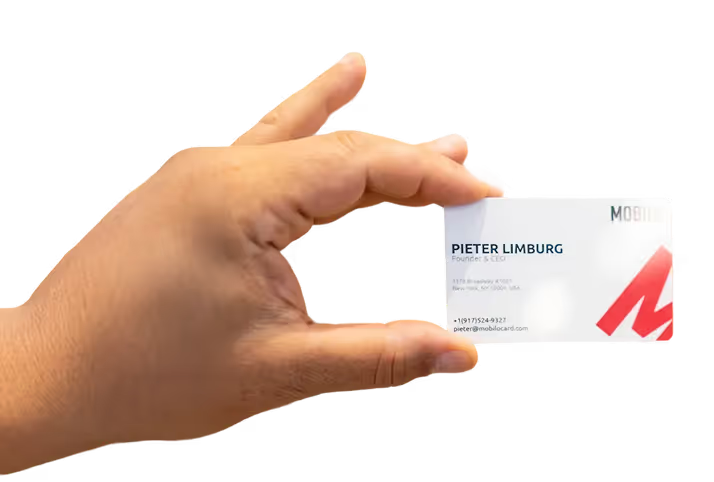
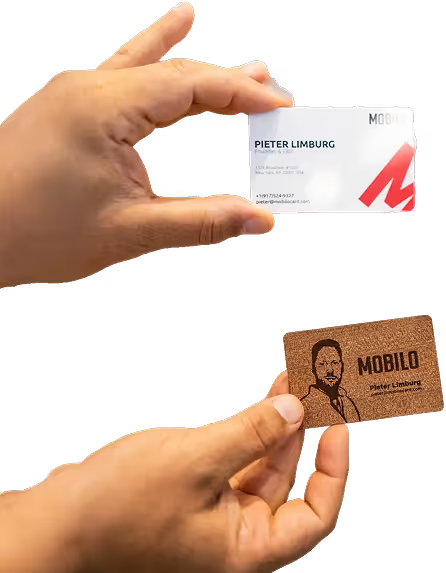
The difference between forgettable encounters and lasting professional relationships often comes down to how contact information gets shared and preserved during online events. When people can easily reach you and recall your conversation, those initial introductions become the foundation for meaningful partnerships that advance careers. Mobilo's digital contact card solves this challenge by letting you instantly share your details with new connections in a memorable way, ensuring your information stays accessible long after the virtual meeting ends.
Summary
- Virtual networking fails when treated like in-person networking through a screen. Research shows that four in five professionals now describe networking as transactional, a shift driven by digital formats that strip away environmental cues like shared physical spaces and repeated exposure. Without spatial anchors or natural continuity, conversations dissolve the moment the call ends, leaving participants unable to recall who they spoke with just days later.
- Attention fragmentation destroys connection quality in virtual environments. Attendees multitask through emails, Slack messages, and phone notifications while on calls, absorbing only fragments of conversations. The standard advice to "be engaging" assumes full attention that simply doesn't exist when people are managing multiple browser tabs and back-to-back video calls that drain mental energy.
- Defining specific networking objectives before attending events eliminates wasted effort. Instead of vague goals like "expand my network," successful networkers identify concrete outcomes such as finding three freelance writers in technical content or connecting with five marketing directors in healthcare tech. This filter determines who to talk to, what to ask, and how to follow up, preventing scattered energy across connections that lead nowhere.
- Small, focused target lists outperform volume-based approaches by over 60% in response rates. Maintaining meaningful relationships with 20 to 30 carefully selected people who align with your objectives produces deeper connections than collecting 500 generic LinkedIn contacts. Tight lists enable personalized attention, better recall of conversation details, and the ability to spot genuine opportunities to provide value.
- Relationship maintenance requires consistent low-effort touchpoints rather than intensive monthly calls. Thoughtful LinkedIn comments, sharing relevant content twice annually, and brief updates with specific resources keep you visible without demanding significant time. Familiarity builds through repetition over months, ensuring you surface first when connections encounter opportunities aligned with your expertise.
- Mobilo's digital contact card addresses the gap between conversations and follow-through by automatically capturing complete contact details during virtual meetings and integrating them directly into your CRM, eliminating the manual data entry that typically prevents consistent relationship maintenance.
Why Virtual Networking Feels Awkward and Rarely Leads to Real Opportunities
You go to the event with your camera on and ready to connect. You have a few good conversations, exchange LinkedIn profiles, and promise to follow up. Then nothing happens. The connection disappears, and you're left wondering why you spent an hour for zero results.

🎯 Key Point: Virtual networking events often create the illusion of connection without the meaningful engagement that leads to real opportunities.
⚠️ Warning: Surface-level interactions in virtual environments make it nearly impossible to build the trust and rapport that drive genuine business relationships.

What makes virtual environments strip away networking advantages?
This pattern repeats because virtual environments lack the structural advantages that make in-person networking effective. There's no shared physical space to anchor memory, no repeated exposure from walking past someone at the coffee station or sitting together during lunch, and no natural continuity that transforms a single conversation into something more. Each interaction exists in isolation, disappearing when the screen goes black. Without those environmental cues, people forget your name, your company, and what you discussed within days.
Why doesn't common networking advice work virtually?
The common advice doesn't help. "Be personable." "Put yourself out there." "Follow up within 24 hours." These suggestions assume the problem is your personality or effort level. It's not. The issue is that you're operating within a system designed for one-time exchanges, not for relationship-building. Charm cannot compensate for a lack of structure. Without a way to stay visible or create touchpoints after the event, even the best conversationalists struggle to turn introductions into opportunities.
How has virtual networking become transactional?
Express Employment Professionals found that four in five professionals describe networking as transactional. People approach virtual events with a "what can I get?" mindset because the format itself feels transactional. There is no room for unexpected moments when everyone performs for the camera, aware that the interaction ends the moment someone clicks "leave meeting." Trust builds through repetition and context, neither of which virtual platforms naturally provide.
What system creates continuity in virtual networking?
The real problem is that most people copy in-person strategies in an environment with completely different rules. You can't rely on physical proximity to stay top of mind. You need a system that creates continuity, captures information immediately, and makes reconnecting easy when the timing is right.
Tools like Mobilo's digital contact card solve this by letting you share complete contact details in seconds during virtual meetings, ensuring your information stays accessible long after the call ends. When connections can easily reach you weeks later without digging through chat logs or LinkedIn searches, those initial conversations have a chance to become something more.
Virtual networking fails when you treat it like in-person networking with a camera. The environment is different, the psychology is different, and the follow-through requirements are different. Once you understand why the system doesn't support relationship building by default, you can design around it instead of relying on personality alone.
Related Reading
- Benefits Of Business Networking
- Types Of Business Networking
- Business Networking
- Networking Business Card
- Digital Presence
- Virtual Networking Tips
- Professional Networking
Why Most Virtual Networking Advice Fails (And What People Get Wrong)
Virtual networking advice fails because it treats online interaction as in-person networking through a screen. The psychology, attention dynamics, and memory formation work differently online. Yet guides tell you to "be authentic," "follow up quickly," and "build rapport" as if these tactics can overcome the structural disadvantages of digital environments. They don't.

🎯 Key Point: Most virtual networking strategies ignore the fundamental differences between digital and face-to-face human interaction, leading to ineffective connection attempts.
"Online networking requires completely different psychological approaches than in-person meetings due to altered attention dynamics and memory formation patterns." — Digital Communication Research, 2023
⚠️ Warning: Following traditional networking advice in virtual settings often results in forgettable interactions that fail to create lasting professional relationships.
Why do virtual interactions fail to create lasting impressions?
In physical spaces, people remember you because they connect your face with a location, a conversation near the coffee station, or the seat you chose during the panel. Virtual events remove those spatial anchors. You exist as a thumbnail in a grid, a name in a participant list, and then nothing. According to research from The Introverted Networker, 85% of jobs are filled through networking, yet most virtual attendees cannot recall who they spoke with two days after an event. Digital interactions create no sensory hooks; your conversation disappears the moment the call ends.
Why does standard follow-up advice fall short in virtual settings?
Standard follow-up advice ignores this reality. "Send a personalized follow-up within 24 hours" assumes people will remember you enough to care. Your LinkedIn request arrives in an inbox flooded with identical messages from other attendees. No one has context. The connection request becomes another notification to dismiss, not an opportunity to continue a relationship that barely started.
How do virtual environments fragment attention
Virtual environments require active focus in ways that physical rooms don't. People join calls while checking email, Slack messages, or their phones—half-present at best, absorbing fragments rather than understanding the full picture. You can see it in their eyes, drifting mid-sentence or slow responses, revealing divided attention. You're competing with every open tab, every notification, and the mental fatigue after three consecutive Zoom calls.
Why does contact sharing fail in virtual settings?
When someone shares contact information during a virtual event, it typically means typing into a chat box, saving a screenshot, or manually entering details into their CRM later. Each step creates friction and increases the chance they'll forget or deprioritize the task. Tools like Mobilo's digital contact card solve this by letting you share complete contact details instantly during virtual meetings and automatically capture information, so connections don't depend on someone remembering to follow through hours after the call ends. When the barrier to staying connected drops to a single click, those fragmented conversations have a chance to become something more.
Follow-up moments don't happen naturally
In-person events create natural touchpoints: repeated exposure at sessions, shared meals, and accidental encounters. Virtual events offer none of that. Once the session ends, you're gone. There's no hallway to linger in, no shared meal to extend the conversation.
Why do traditional networking tactics fail in virtual environments?
The advice to "stay visible" lacks practical guidance. You're left sending cold emails into the void, hoping someone remembers your name. The problem isn't in the tactics themselves, but in the assumption that personality and persistence can compensate for a system designed for one-time exchanges.
What actually works when the environment resists relationship building?
Virtual networking works when you stop treating it like in-person networking with worse lighting and start building structures that create continuity, capture information immediately, and enable easy reconnection when timing aligns. What works when the environment itself resists relationship building?
Related Reading
- How To Use Social Media For Networking
- Social Networking For Business
- Icebreaker Examples Business Networking
- How To Build A Professional Network
- Business Networking Ideas
- How To Get Business Contacts
- Small Business Networking
- Networking Mistakes
- Networking Follow-Up Email
15 Innovative Virtual Networking Tips That Actually Lead to Real Connections
Virtual networking works when you build systems that last longer than a single conversation. These tools address problems inherent to digital spaces: connections that don't continue, missing signals you'd normally receive in person, and barriers to follow-up. Each tip targets where virtual connections typically break down.
🎯 Key Point: The difference between successful and failed virtual networking isn't the platform you use—it's whether you have repeatable systems that turn single interactions into lasting professional relationships.
💡 Pro Tip: Virtual networking requires more intentional follow-up than in-person events because you lose the natural conversation flow and visual cues that make connections stick in face-to-face settings.
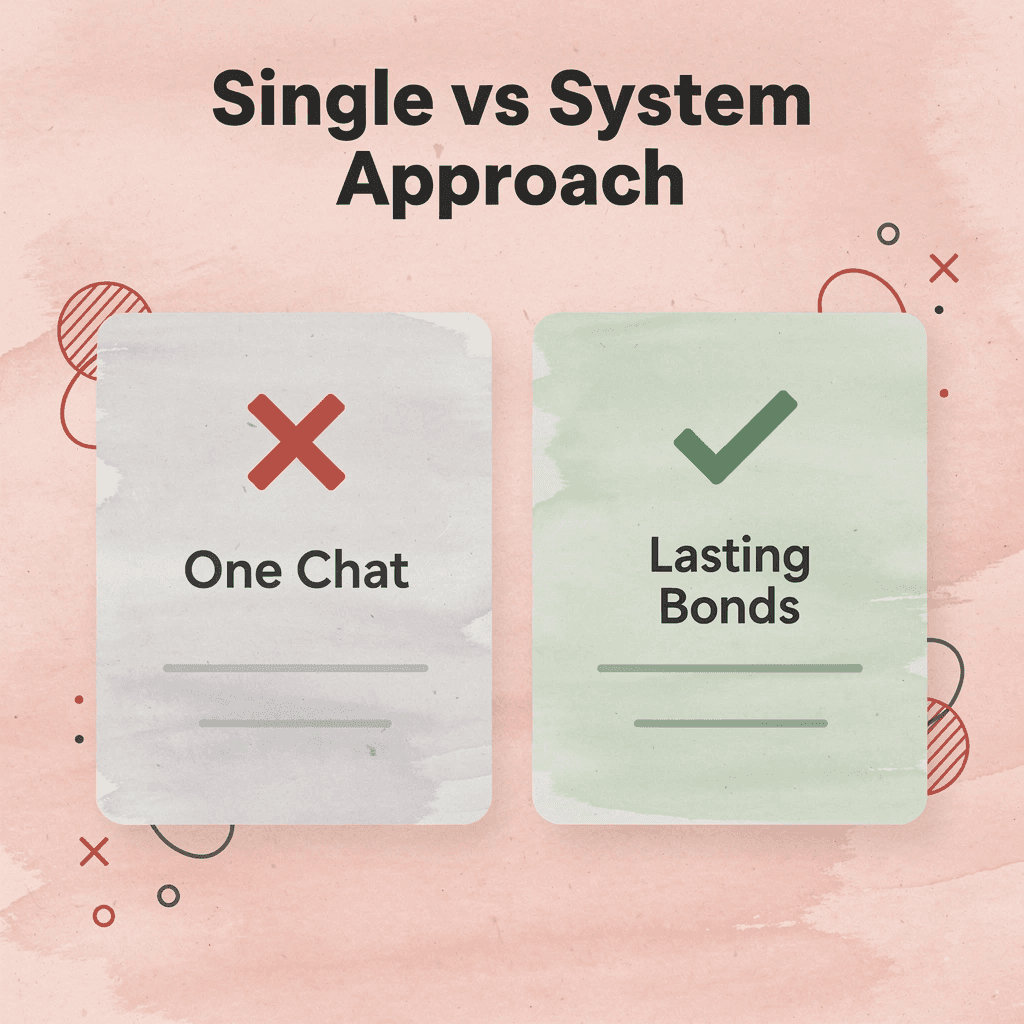
1. Define your networking objective before attending anything
Most people network without knowing what they're trying to achieve. They show up, have nice conversations, and wonder why nothing happens. The problem isn't effort—it's focus.
How do you set specific networking objectives that work?
Before you join another virtual event, write down what success looks like. Not vague aspirations like "expand my network" but specific outcomes: land a product design role at a Series B SaaS company, find three freelance writers who specialize in technical content, or connect with five marketing directors in healthcare tech. This filter determines who you talk to, what you ask, and how you follow up. Revisit your objectives quarterly as your clarity evolves. The goal is to stop scattering energy across connections that lead nowhere, not to lock yourself into one path forever.
2. Build target personas after you know what you need
Once you understand your goal, identify who matters. Create one to three profiles that include job titles, industries, company stages, and, if relevant, specific organizations.
What emotional signals indicate good networking targets?
Pay attention to patterns in what captures your interest. Which LinkedIn profiles make you stop scrolling? Whose work triggers professional envy? That emotional response signals alignment: the people whose careers you want to emulate have navigated the path you're trying to walk.
Why should you target people two steps ahead instead of executives?
Connecting with someone a couple of steps ahead of you often produces better results than targeting executives decades into their careers. Recent experience translates into current, specific advice, and these people have more time to respond and remember you when opportunities arise.
3. Articulate the value you provide in one sentence
People can't help you if they don't understand what you do. Most professionals struggle with this because humility feels safer than clarity, leaving conversations where everyone walks away uncertain about your capabilities.
How do you write an effective value sentence?
Write a single sentence that explains who you are, what you do, and the value you create. "I help SaaS companies reduce churn through behavioral email campaigns." "I'm a product designer focused on accessibility features for enterprise software." "I connect B2B brands with podcast hosts in the fintech space." Simple. Specific. Memorable. This makes it easy for someone to think of you three weeks later when they encounter a relevant opportunity. Clarity converts passive goodwill into active referrals.
4. Approach every interaction asking what you can give
Networking feels transactional because most people treat it that way: they show up to extract value and disappear until they need something else. Relationships require giving and getting from both sides.
How can you shift from taking to giving?
Change your default question from "what can this person do for me?" to "what can I offer them?" Share job listings with strong candidates. Recommend them as podcast guests or conference speakers. Introduce them to someone in your network who solves a problem they mentioned. Send an article that relates to a challenge they're working through.
Why does generosity create lasting connections?
Being generous makes people remember you. When you help someone without expecting an immediate return, they reciprocate by recommending you to others when opportunities arise. This is how trust strengthens over time.
5. Combine outbound targeting with inbound visibility
Reaching out to specific people works, but it doesn't scale well: each connection requires research, personalization, and follow-up. Build visibility so the right people find you instead. Write articles about problems you've solved, share insights on platforms where your target personas spend time, contribute to open-source projects or industry forums, and post case studies demonstrating your expertise.
Why does passive visibility improve networking results?
According to QRCodeChimp, 85% of professionals say virtual networking events help them build meaningful connections. Passive visibility extends those connections beyond scheduled events. When someone sees your name repeatedly in contexts that matter to them, the barrier to reaching out drops, and your outreach lands differently once they've encountered your work.
6. Find communities where your target personas already gather
You can't network effectively in the wrong places. LinkedIn works for some industries, Twitter for others. Slack communities, Discord servers, and niche forums each attract different professional groups. Find where your target audience gathers and join communities that align with your goals. Contribute meaningfully by answering questions, sharing resources, and participating in discussions without self-promotion. Focus on two or three platforms at most. Spreading yourself across ten communities makes you invisible in all of them. Deep participation in fewer spaces builds recognition and trust. People remember consistent contributors, not occasional visitors.
7. Choose your outreach channel based on the person, not your preference
Email, Twitter DMs, LinkedIn InMail, Instagram messages, and newsletter replies each work differently depending on who you're trying to contact. Look for clues about how someone prefers to be reached: Do they share their email publicly? Do they actively use Twitter? Do they write a newsletter and ask people to reply? Use the channel they've already demonstrated they check. Replying to someone's newsletter or liking their tweets before you reach out cold makes your message feel more genuine: you've demonstrated care for their work, not just what they can do for you.
8. Personalize every message with specific context
Generic outreach fails because it signals indifference. Find a genuine connection point: reference something they wrote or mention a shared interest or challenge. Two sentences proving you've done basic research outperform three paragraphs of flattery. Include a clear, easy-to-answer request. "Would you be open to a 20-minute call about your transition from agency to in-house?" works better than "I'd love to pick your brain." Specificity reduces friction and increases yes rates.
9. Follow up twice if you hear nothing, then stop
Most people either give up after one message or become annoying with constant follow-ups. Both approaches fail. Wait two weeks and send a short follow-up confirming they received your first message. If still no response, wait another month and try once more. After that, move on. Persistence shows genuine interest; pestering burns bridges. You can always reach out again in six months with a new context. Sometimes timing doesn't work: people get busy, priorities shift, or your message arrives during a chaotic week. Giving them space preserves the possibility of connecting later.
10. Spend 90% of networking calls listening
If you asked for the call, you're responsible for running it—which means asking good questions and listening, not talking the whole time. Research them beforehand: understand their background, recent projects, and public work. Ask about their experience and challenges they've faced, not just their advice. People enjoy sharing expertise when someone genuinely wants to learn. The goal isn't to impress them with how much you know, but to learn something valuable and make them feel heard. You become memorable by making them feel good about the conversation, not by dominating it.
11. Send a specific thank-you within 24 hours
Generic thank-yous don't work well. "Thanks for your time" won't make you stand out from dozens of identical notes. Reference something specific from your conversation—an insight that shifted your thinking, an action you're taking based on their advice, or a resource you committed to sending. Do it within 24 hours. This proves you were paying attention, reinforces that the conversation mattered, and positions you as someone who follows through.
12. Reconnect once or twice annually with genuine updates
Relationships fall apart without care. Twice a year, contact important people in your network with something meaningful: share an article that reminded you of them, suggest a tool that solves a problem they mentioned, or tell them how you're doing, especially if their advice helped you. These check-ins don't require replies. They remind people you're still around and that your relationship extends beyond a single transaction. When opportunities arise, you're more likely to come to mind.
13. Build a simple CRM to track relationships
Your memory isn't sufficient to track dozens of work relationships. You'll forget who you talked to, when you last connected, and what you discussed.
How do you create a basic relationship tracking system?
Create a basic system to track this information. A spreadsheet works fine. Record the person's name, how you met, topics you discussed, and when you last reached out. Set reminders to reconnect periodically. Tools like Mobilo's digital contact card capture complete contact details instantly during virtual meetings and integrate them directly into your CRM. Automating information flow from the introduction to the follow-up system eliminates the manual data entry that prevents consistent relationship maintenance.
14. Look for opportunities to connect people in your network
The fastest way to strengthen relationships is to create value for others without expecting anything in return: connect job seekers with hiring managers, introduce freelancers to potential clients, recommend people for speaking opportunities, and share relevant job postings. Every introduction you make strengthens two relationships simultaneously. The person you're helping remembers the favor, while the person you're introducing sees you as a valuable connector. Both are more likely to think of you when opportunities arise.
15. Meet virtual connections in person when possible
Digital relationships feel more real after meeting in person. When you travel, reach out to people you know in that city and grab coffee or lunch. The in-person meeting transforms an abstract professional contact into someone you know.
Why does in-person interaction strengthen professional relationships?
According to Forbes, 85% of jobs are filled through networking, and those relationships are strengthened through in-person meetings. Face-to-face time with important connections creates real-world anchors that virtual interactions lack.
What practical benefits come from meeting connections locally?
These meetings also produce practical benefits. People in that city know the local market, the best companies to target, and who else you should meet—they become guides, not connections.
How do systems make networking more effective than personality alone?
The difference between networking that produces results and networking that wastes time comes down to systems. Most people treat each interaction as isolated, hoping personality alone will create lasting impressions. Virtual environments don't support this approach. You need mechanisms that capture information instantly, create regular touchpoints, and enable effortless reconnection when timing aligns.
How to Build a Simple Virtual Networking System That Works Over Time
Good tactics fall apart without a supporting structure. You can follow every piece of advice on personalization, follow-up timing, and value creation, but if each action stands on its own, you're rebuilding the process from scratch with every new connection. The system that works creates repeatable ways to turn scattered effort into relationships that strengthen over time.
🎯 Key Point: The difference between networking success and failure isn't in the tactics—it's in having a systematic approach that turns individual interactions into lasting professional relationships.
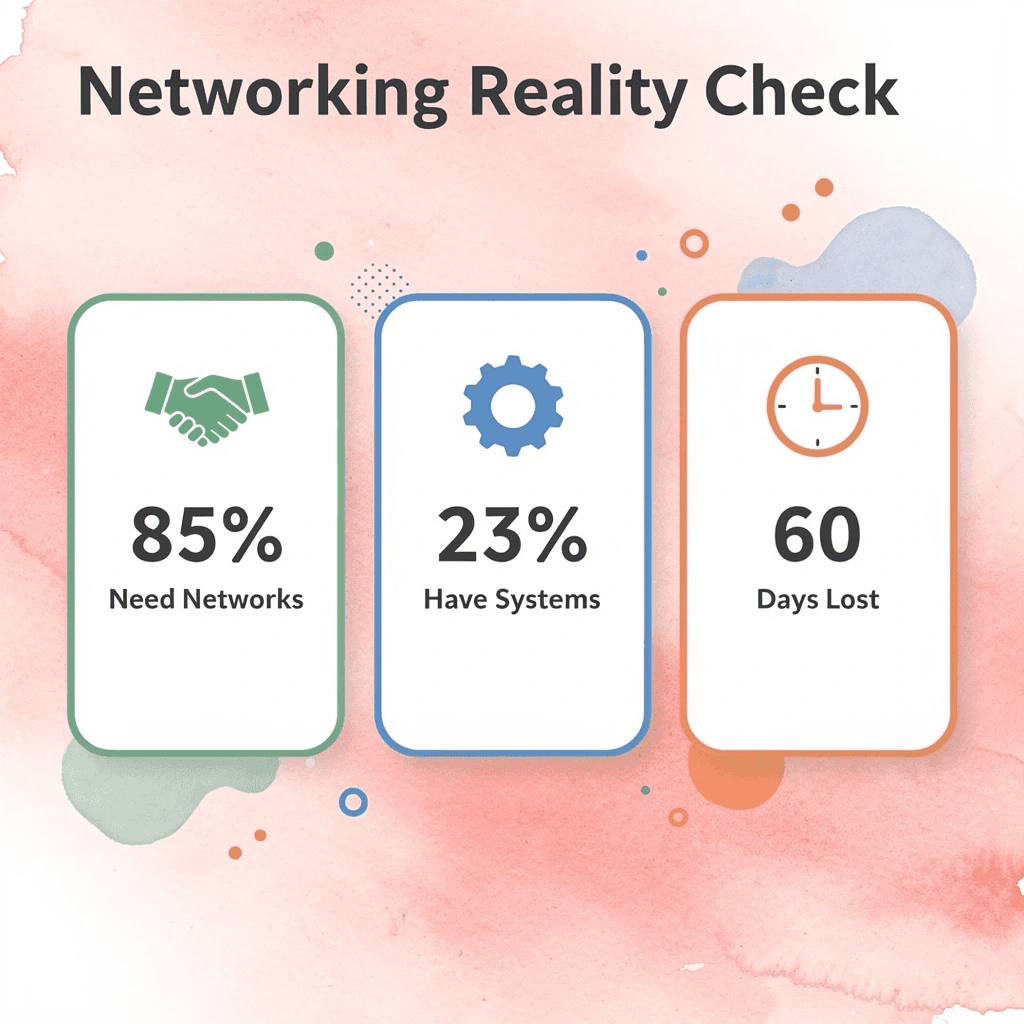
"85% of professionals** say networking is crucial for career success, yet only 23% have a structured system for maintaining their professional relationships." — LinkedIn Professional Network Report, 2023
⚠️ Warning: Without a consistent system, even your best networking efforts will fade into forgotten connections and missed opportunities within 30-60 days.
Start with a focused target list, not a volume goal
Most people approach networking as a numbers game: collect 500 LinkedIn connections and hope some turn into opportunities. This fails because you cannot maintain meaningful relationships with hundreds of people simultaneously. Your attention spreads too thin, follow-up becomes generic, and nobody feels like a priority.
How do you build an effective, focused target list?
Build a list of 20 to 30 people who align directly with your goals. Use the personas you defined earlier. These should be individuals whose work you respect, whose career path mirrors your own aspirations, or who work in adjacent spaces. Targeting this way increases response rates by over 60% compared to broad outreach because messages land with people who recognize their relevance. When your list is tight, every interaction receives proper attention: you remember details, spot opportunities to help, and relationships develop depth rather than become database entries.
Initiate with context, never cold
Generic messages get ignored because they signal you haven't invested effort. "I'd love to connect" means nothing—it tells the recipient you're running a script. Reference something specific: a recent article they published, a project they mentioned on LinkedIn, or a mutual connection who suggested you reach out. Context proves you've done basic research and provides a natural conversation starter beyond "pick your brain."
How can you streamline the sharing of contact information?
When you share contact information during the first conversation, keep it brief. Typing details into chat boxes or asking someone to manually save your information creates friction and forgotten follow-ups. Our Mobilo digital contact card eliminates that gap by letting you share complete contact details in seconds. Information flows directly into their system without manual entry, so the connection survives past the conversation.
Follow up within 24 to 48 hours with value or direction
This window is where most opportunities disappear. You had a productive conversation, and both parties wanted to stay connected. Then silence. Days turn into weeks. The momentum dies because no one has defined what happens next.
What should you include in your follow-up message?
Send your follow-up message within two days. Reference something specific from your conversation to demonstrate you were paying attention, then either add immediate value or suggest a clear next step. Value means sharing a resource they needed, making an introduction to someone relevant, or sending an article related to a challenge they described. A clear next step means suggesting a specific time to reconnect, defining what you'll prepare for that conversation, or outlining how you plan to act on their advice. Both approaches maintain momentum and give the recipient a reason to respond. Generic thank-you notes do neither.
Build ongoing visibility through low-effort touchpoints
Relationships fall apart without care, but you can't schedule monthly calls with 30 people. Regular, lightweight engagement keeps you visible without consuming significant time from either person. Comment thoughtfully on their LinkedIn posts. Share their content with your network when genuinely valuable. Send a brief message twice yearly with a relevant update or resource. These interactions ensure your name surfaces regularly in contexts that matter. When someone finds an opportunity matching your expertise, you're the person they think of first. Familiarity builds through repetition, not intensity. Small, consistent actions accumulate into trust over months.
Replace randomness with structure
This system works because it removes guesswork: you know who to target, how to start, when to follow up, and what to say. Each component addresses a specific failure point at which virtual connections typically fail. The approach works best for long-term relationship building, where value accumulates over months or years. It fails when you need immediate, transactional outcomes, such as closing a sale next week or filling an urgent role. But even the tightest system fails if information captured during conversations is lost to forgotten notebooks or unsaved chat logs.
Related Reading
- Networking Tips For Small Business Owners
- Tips For Networking Events
- Professional Networking Platforms
- Best Business Networking Apps
- Business Networking For Entrepreneurs
- Business Networking Strategies
- Top Contact Management Software
If You Do Not Capture and Use Connections, Networking Does Not Work
Virtual networking fails due to a breakdown between conversation, contact capture, and follow-up organization. Most opportunities die in that gap, not in the initial interaction. The fix isn't trying harder: it's removing the friction that causes connections to disappear.
Run this in under 5 minutes
Set up Mobilo's digital contact card and generate your first shareable card to automatically capture complete contact details in every new virtual conversation, eliminating reliance on memory, chat logs, or manual entry.
In that setup flow, you'll get
- A live digital contact card you can share instantly in any virtual meeting.
- Automatic contact capture ensures no one gets lost after the call ends.
- Direct syncing into your CRM or contact list ensures follow-ups don't depend on recall.
Once it's active, your next networking call becomes the test case: you share your card, the other person's details are captured instantly, and the contact is stored with context already attached.
From there, the system naturally continues
- Review captured contacts after each event
- Prioritize the top 20–30 relevant connections
- Follow up while the context is still fresh
Without that capture layer, everything else in virtual networking breaks down. With Mobilo, every conversation has a traceable path forward. Until your contacts are captured and structured, no networking strategy can compound into results.