.avif)


How To Use Social Networking for Lead Generation & Business Growth
On This Page
Building a successful business requires more than a great product or service. Prospects often slip away because companies aren't visible where their audience looks, don't show up consistently, or make it difficult for potential customers to connect at the right moment. Social networking for business creates genuine relationships that generate revenue by positioning companies as the obvious choice when ideal customers need their solutions. Strategic use of social platforms builds trust, maintains visibility with the right people, and transforms online connections into paying customers who refer others.
Every conversation and introduction can work more effectively when businesses make it easy for prospects to stay connected. Seamless contact exchange turns fleeting moments into lasting business relationships, ensuring companies never miss opportunities to grow their network and revenue. When someone meets a business representative online or offline, they should be able to instantly access contact details, social profiles, and take the next step toward becoming a customer through a digital contact card.
Summary
- Social networking for business is the strategic use of digital platforms to build, nurture, and activate professional relationships that drive measurable outcomes, such as pipeline growth, partnerships, and market access. Most businesses still measure success by impressions rather than conversions, despite social media ad spending increasing by 140% between 2019 and 2024. The belief persists that visibility equals value, but virality doesn't fill your calendar with qualified meetings.
- Trust compounds through repeated exposure rather than single viral moments. HubSpot's 2024 research on B2B buying behavior found that prospects who engaged with a brand's content at least 5 times before contact converted at a rate 3.2 times that of cold leads. The brain interprets repetition as social proof, and consistency signals stability that earns permission to sell.
- Passive consumption drives more value than engagement metrics suggest. LinkedIn's internal data shows that 95% of content consumption happens silently, with no likes or comments, just absorption. When that passive observer needs your service six months later, your name surfaces first because their brain has been primed through ambient exposure, making you the default option without ever having a conversation.
- Platform choice should align with business goals and decision-making environments, not popularity. According to research from S4 Marketing, 78% of consumers are willing to buy from a company after a positive social media experience, but the conversion mechanism isn't reached; it's recognition compounding into confidence in the right professional context.
- Brands that post consistently see 67% more leads than those that don't, but consistency within targeted communities matters more than frequency across all channels. Professionals who comment thoughtfully on five posts per week in their target communities generate more inbound messages than those publishing daily content to general audiences, because credibility builds faster through problem-solving contributions than promotional posts.
- The biggest leak in networking strategy happens in the 48 hours after a conversation ends, when most contacts from conferences or LinkedIn exchanges never enter your CRM. Digital contact card solutions address this by syncing every exchange directly into your CRM the moment it happens, capturing contact data automatically and enriching it with context so follow-up happens while the conversation is still fresh.
What Social Networking for Business Actually Means and Why Most People Get It Wrong
Social networking for business is the strategic use of digital platforms to build, nurture, and activate professional relationships that drive measurable results, such as pipeline growth, partnerships, and market access. It creates a system where every connection becomes a data point, every conversation advances toward a deal, and every interaction builds trust over time.

🎯 Key Point: Most professionals treat social networking as random relationship-building, but successful business networking requires systematic tracking, strategic follow-up, and measurable outcomes.
"Business networking isn't about collecting contacts—it's about creating a strategic system that turns every professional interaction into measurable business value." — Professional Networking Research, 2024
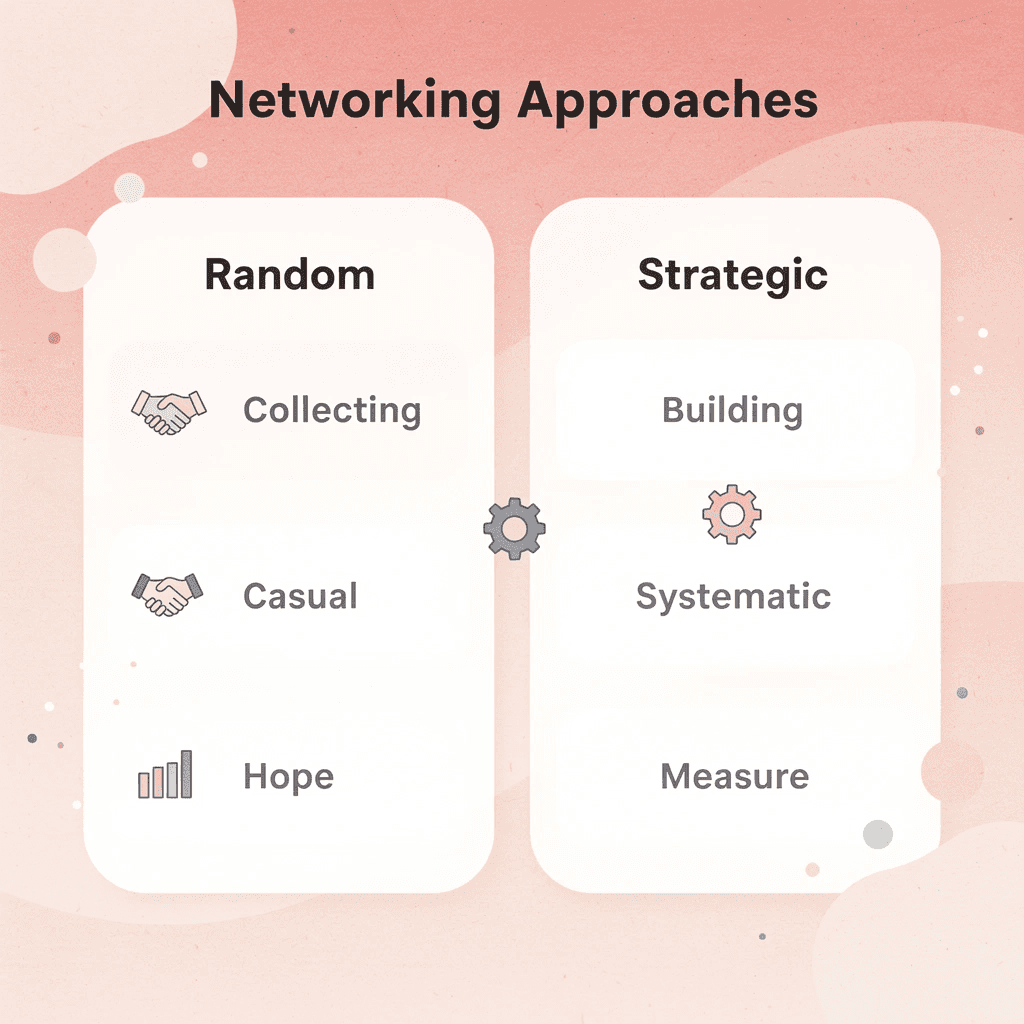
⚠️ Warning: The biggest mistake in business networking is treating it like casual social media. Without clear objectives, tracking systems, and follow-up processes, even the best connections become wasted opportunities.
Why do most businesses approach social networking incorrectly?
Most businesses treat social platforms as stages for performance rather than networks for exchange. According to Electro IQ, money spent on social media ads increased 140% between 2019 and 2024, yet many companies still measure success by impressions rather than conversions. The belief persists that visibility equals value—that being seen is the same as being remembered. It's not.
Why platform incentives create the wrong focus
Platform incentives reward attention, not relationship depth. Algorithms favor content that generates engagement, clicks, and reactions, pushing businesses to optimize for reach rather than resonance and to chase trending topics and viral moments. Yet virality doesn't fill your calendar with qualified meetings, and a thousand likes won't convert into signed contracts. The metrics platforms highlight—followers, shares, impressions—measure exposure, not connection quality or business intent.
Vanity metrics create a dangerous bias. When your dashboard shows follower growth climbing, it feels like progress—until sales teams can't trace leads back to social activity and marketing can't prove ROI. Sprout Social reports that 76% of consumers expect companies to understand their needs and expectations, yet most businesses use social platforms to broadcast messages rather than listen and respond. The gap between what audiences want (understanding, responsiveness, real dialogue) and what companies deliver (promotional posts, generic replies, one-way announcements) explains why engagement rarely converts.
How should businesses approach social networking differently?
The bigger mistake is treating social networking as marketing instead of networking. Marketing pushes messages outward; networking pulls relationships inward. When you meet someone at a conference, you exchange contact details, ask questions, and find common ground. Digital platforms should work the same way: every profile visit, comment reply, and direct message should move someone closer to a real conversation.
Solutions like digital contact card demonstrate this shift, treating connections as organized data rather than loose threads. When someone scans your Mobilo digital card, their details flow directly into your CRM, tagged with context (event name, conversation topic, follow-up priority), turning a quick interaction into an automated workflow that prevents opportunities from slipping through the cracks.
Social networking for business works like compound interest: one meaningful connection introduces you to three others, and your network grows over time. This only works if you treat relationships as assets that require care, not metrics that require celebration. The businesses winning on social platforms aren't those with the most followers, but those converting conversations into contracts, tracking every touchpoint, and measuring outcomes that matter: meetings booked, deals closed, revenue attributed.
What happens after the initial connection
But here's what almost no one talks about: the real power of social networking lies not in the connections you make, but in what happens after the handshake ends.
Related Reading
- Benefits Of Business Networking
- Digital Networking
- Types Of Business Networking
- Professional Networking
- Digital Presence
- Virtual Networking Tips
- Business Networking
- Networking Business Card
Why Social Networking Drives Business Growth Beyond Followers and Likes
Business value from social networking comes from trust built through repeated exposure, warm leads formed through familiarity, and network effects that generate referrals, shares, and introductions—not follower count. According to S4 Marketing, 78% of consumers are willing to buy from a company after a positive experience on social media. Recognition builds confidence.
"78% of consumers are willing to buy from a company after having a positive experience with them on social media." — S4 Marketing
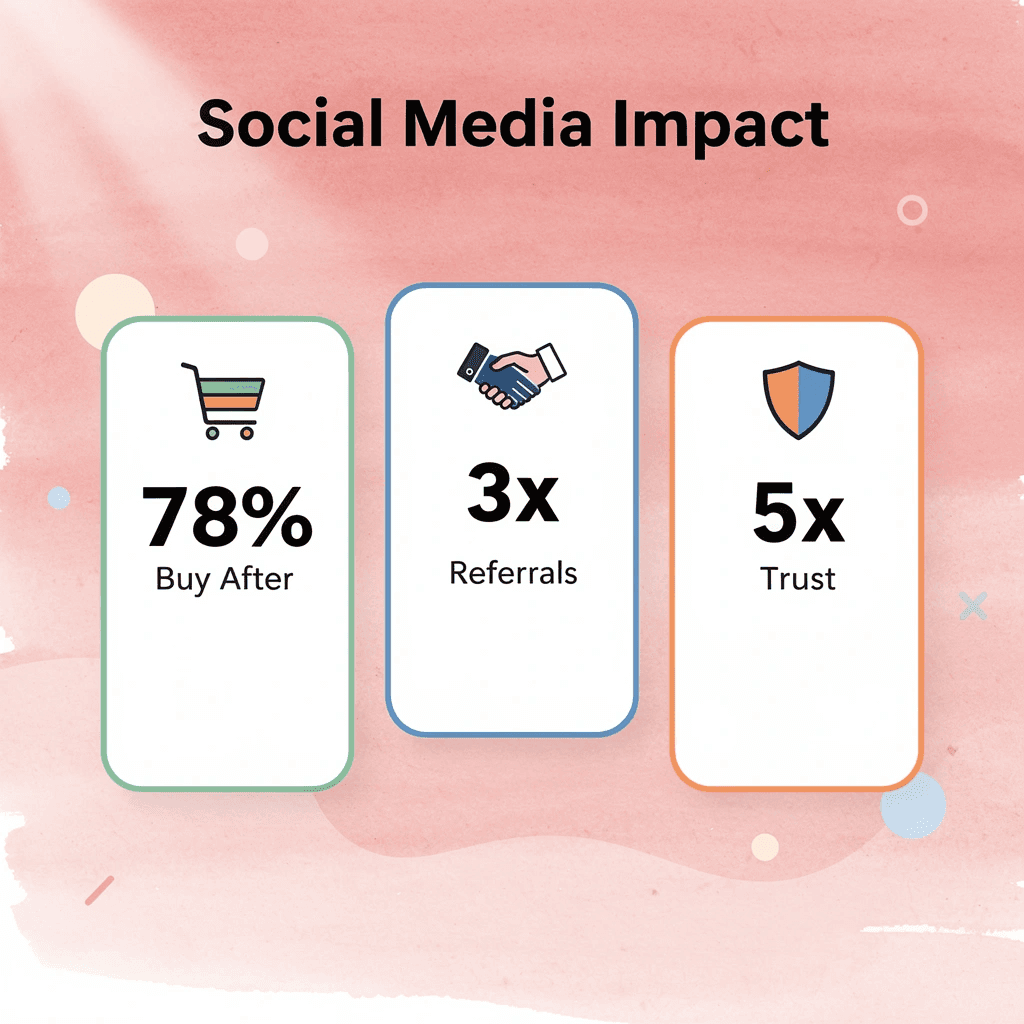
🔑 Key Takeaway: The real ROI from social networking isn't measured in follower counts or like metrics—it's built through consistent relationship-building that transforms strangers into trusted advocates who drive actual business growth.
💡 Strategic Insight: Network effects create a multiplier impact where each positive interaction doesn't just influence one potential customer, but generates ripple effects through referrals and word-of-mouth marketing that exponentially expand your reach.
Why does repetition build trust faster than volume
Cold outreach fails because it asks strangers to make quick decisions. Repetition changes perception: one message feels like noise, three messages over two weeks establish a pattern, and by the seventh exposure, people begin to trust it—even without clicks or sales. HubSpot's 2024 research on B2B buying behavior found that customers who viewed a brand's content at least 5 times before being contacted converted at a rate 3.2 times that of cold leads. Repetition signals trustworthiness, consistency demonstrates stability, and stability grants permission to sell.
How does network size affect trust building?
Trust grows through consistent presence with a specific group, not through reach. A founder posting weekly insights to 400 chosen connections builds more commercial trust than a brand account messaging 40,000 strangers. The first helps people know you; the second becomes background noise.
How do warm leads form without direct engagement?
You don't need someone to like your posts for them to remember you exist. Passive consumption—scrolling past content without interacting—still registers in their brain. LinkedIn's internal data shows that 95% of content consumption happens silently. When that passive observer needs your service six months later, your name comes to mind first because repeated exposure has prepared their brain. You've become the default choice without conversation.
Why do engagement metrics mislead businesses?
This explains why engagement metrics can be misleading. A post with 12 likes might generate no revenue, while a post with 3 views could close a $50,000 deal if one viewer was already interested. Businesses that use social platforms to build trust measure different results: reply rates on cold emails sent to people who have seen their content compared to those who haven't, and close rates between leads who engaged with three pieces of content versus zero. The conversion lift is structural.
How do network connections create exponential value growth?
Every connection represents access to their network through referrals, shares, and introductions. Research from S4 Marketing indicates that 90% of marketers say social media has increased their business exposure, though the real multiplier is speed. When a trusted connection shares your content or introduces you to their peer, that referral carries built-in credibility. You're not starting from scratch—someone has already vouched for you. The sales cycle shortens from months to weeks because trust transfers before you even meet.
What prevents most teams from maximizing network value?
Most teams treat business cards and LinkedIn connections as static assets, letting them grow stale. Trust requires continuous, easy touchpoints. Tools like digital contact card capture lead immediately and sync them into automated follow-up sequences, transforming the first interaction into the start of a trust-building loop rather than a one-time exchange. A personalized follow-up within 24 hours separates warm pipelines from forgotten leads. But none of this matters if you're measuring the wrong outcomes.
Related Reading
- How To Use Social Media For Networking
- Social Networking For Business
- Icebreaker Examples Business Networking
- How To Build A Professional Network
- Business Networking Ideas
- How To Get Business Contacts
- Small Business Networking
- Networking Mistakes
- Networking Follow-Up Email
Top Social Media Platforms for Small Businesses and Startups
Most small businesses choose social platforms by following the crowd, assuming popularity equals value. The smarter approach asks: "Where does my audience make decisions?" Platform choice isn't about presence—it's about matching your business goal to the environment where that outcome becomes probable. Awareness, lead capture, and relationship-building operate through different mechanics.
Misaligned platform choice costs more than wasted ad spend. Building content for Instagram's visual discovery engine while your buyers research vendors on LinkedIn means you're optimizing for metrics that don't convert, burning time on unused content formats, and measuring success with engagement numbers unrelated to pipeline growth. According to Electro IQ, money spent on social media ads increased 140% between 2019 and 2024, but most reflects businesses doubling down on platforms their audiences scroll past without intent.
Facebook, with its 2.9 billion monthly active users, stands as the titan of social media platforms. Marketers can reach a total potential audience of 2.249 billion users through Facebook. For small businesses and startups, this platform can drive brand awareness, customer engagement, and sales.
Benefits of Facebook for small businesses
- Facebook’s large user base allows small businesses to reach a different audience. 71% of U.S. adults use Facebook regularly, providing an unparalleled opportunity for exposure.
- Unlike traditional advertising methods, Facebook offers affordable options for businesses of all sizes. You can set your own ad budget and pay only when users engage with your ads.
- Facebook enables direct customer interaction through comments, messages, and posts. This helps build community and loyalty.
- The platform provides analytics tools that help you track performance and understand customer behavior, allowing for more informed marketing decisions.
Features of Facebook to leverage
- Pages: Creating a Facebook page is the first step for any small business. This page acts as a hub for your brand where you can share updates, engage with customers, and promote products or services.
- Groups: Facebook Groups offer a way to build a community around your business. By creating or joining groups in your industry, you can engage with potential customers directly.
- Events: The Events feature promotes upcoming activities, such as workshops and product launches, directly on the platform. You can also use this feature to announce events, activities, and offers, drive sign-ups through targeted ads, and increase organic reach.
- Ads: 89%of marketing specialists use Facebook Ads due to their effectiveness in reaching specific audiences. Facebook Ads are particularly powerful due to their micro-targeting capabilities. You can tailor your ads based on demographics, interests, and behaviors.
How AI can enhance Facebook management:
- With AI-driven tools, you can schedule posts at optimal times. This ensures consistent engagement even when you’re busy running your business.
- AI can analyze customer interactions on your posts to measure positive or negative sentiment, allowing you to adjust your strategies accordingly. For example, if feedback on a product launch is overwhelmingly positive, you might decide to invest more in similar offerings.
- Salesforce’s AI capabilities can analyze user data to recommend the best target audiences for your ads based on past performance metrics. This means better return on investment (ROI) on ad spend as you reach more relevant consumers.
Instagram is no longer just a visually driven platform for sharing pretty pictures. It has over 143.2 million users in the U.S. alone. It’s become a huge marketing platform for small businesses.
Benefits of Instagram for small businesses
- Instagram has one of the highest engagement rates among social media platforms, with posts receiving significantly more interactions than those on Facebook or Twitter. This makes it an ideal space for brands to build relationships with their audience.
- With 72% of users agreeing to make purchases after seeing products on Instagram, the platform is an effective channel for driving sales and increasing visibility.
- For small businesses with limited budgets, Instagram enables organic growth through engaging content without emptying pockets on expensive advertising campaigns. A simple smartphone camera can be enough to create good visuals.
- The platform attracts a wide range of demographics, making it easier for you to reach your target audience effectively.
Features of Instagram to leverage
- Stories: Instagram Stories are a fantastic way for businesses to share real-time updates and engage with followers. In fact, 50% of Instagram users have purchased a product or service after seeing it in Stories.
- Reels: Reels let you create short, engaging videos that can go viral. You can use Reels to share quick tips or showcase products, attracting your potential customers.
- Instagram Ads: Instagram Ads show your ads to specific demographics, interests, and behaviors. You can create photo, video, carousel, and collection ads to promote your products or services.
- Instagram Live: Live features let you connect with your audience in real-time. You can host Q&A sessions, product demonstrations, or live events to build a community around your brand. Not just this, you can invite influencers or other businesses to collab and join your live sessions to reach a wider audience.
How AI can enhance Instagram performance:
- AI can help analyze images posted by your brand and suggest similar visuals that resonate with your audience.
- AI can recommend relevant hashtags based on trending topics and user interests, ensuring your posts gain maximum visibility.
- AI can also analyze past post performance to predict which types of content will generate the most engagement in the future.
Twitter (X)
Twitter/X, with 50.5 million monthly users in the U.S. alone as of 2024, is a platform for SMBs seeking to engage with their audiences in real-time. It’s known for its fast-paced environment. Twitter/X allows businesses to participate in conversations, share updates, and respond to customer inquiries instantly.
Benefits of Twitter/X for small businesses
- Twitter/X excels at facilitating real-time conversations. 48% of U.S. Twitter/X users use it for news updates, which means businesses can join trending discussions and respond to customer inquiries as they happen.
- Many customers turn to Twitter or X for support. You can use the platform to address problems quickly, improving customer satisfaction.
- By tweeting regularly and engaging with followers, you can boost your visibility simply by joining the Tweets.
- By sharing links to your websites or blog posts, you can drive traffic directly from Twitter/X. Tweeting links can significantly increase website visits and lead generation.
Features of Twitter/X to leverage
- Tweets: The core feature of Twitter/X is the Tweet itself. These are short messages that can include text, images, videos, or links. You can focus on creating engaging and informative tweets that resonate with your audience.
- Threads: Threads allow businesses to share longer narratives by connecting multiple Tweets together. This feature is excellent for storytelling or providing detailed information about products or services.
- Polls: Polls are a fun, interactive way to engage followers and gather valuable feedback. You can use polls to ask followers about their questions, preferences, and choices.
- Moments: Twitter/X Moments is to curate Tweets around specific events or themes. You can create a moment that highlights its participation in a festival or event, showcases your community involvement, and drives interest.
How AI can streamline Twitter/X operations:
- AI can help generate engaging tweets based on trending topics or user interests, ensuring your content remains relevant.
- AI-driven analytics can identify trending topics within your industry, allowing you to craft timely content that resonates with your audience.
- Implementing AI chatbots on Twitter and X can streamline customer service by providing instant responses to common inquiries.
LinkedIn is the premier social media platform for professionals, boasting over 1 billion users globally. It’s the best platform for SMBs and startups looking to engage in B2B marketing and professional networking. It’s designed specifically for business interactions, making it an ideal environment for companies aiming to connect with potential clients, partners, and industry experts.
Benefits of LinkedIn for small businesses:
- LinkedIn users are mostly professionals seeking business opportunities, making it easier for you to target your ideal audience.
- By sharing valuable content and engaging in discussions, you can establish yourselves as thought leaders in your industry. For example, a tech startup might share insights into emerging technologies, position itself as an authority, and attract potential clients.
- LinkedIn facilitates connections with industry peers and potential customers. You can utilize your network to find leads through mutual connections.
- With tools like LinkedIn Ads and Sponsored InMail, businesses can reach decision-makers directly in their target market. In fact, 89% of marketers use LinkedIn for lead generation.
Features of LinkedIn to leverage
- Company page: Creating a Company Page is essential for establishing an online presence on LinkedIn. This page serves as a hub for sharing updates, job postings, and company news.
- Articles: Publishing articles on LinkedIn allows you to share in-depth insights and establish authority in your field. It also gives you additional reach to your LinkedIn account.
- Groups: LinkedIn Groups gives a platform for professionals with similar interests to engage in discussions. You can join or create industry-specific groups to facilitate networking and collaboration.
- Jobs: The Jobs feature enables you to post job openings and attract new talent. By showcasing your company culture and values through job postings, you can attract candidates who align with your mission.
- LinkedIn Learning: LinkedIn Learning offers a variety of courses to help you develop new skills. It can be a great tool for continuous professional development, helping you stay competitive and up to date on industry trends.
- LinkedIn Events: LinkedIn Events allows you to create and promote events, similar to Facebook’s events system. You can host webinars, workshops, or meetups to engage with your audience or learn within the industry.
How AI can boost LinkedIn presence
- AI can analyze engagement metrics to suggest the best types of content to share on your ’About Us’ page.
- AI can evaluate your existing network and suggest potential connections based on shared interests or industries.
- AI can analyze job postings to ensure they’re optimized for visibility and relevance. By suggesting SEO keywords or phrases that attract the right candidates, you can simplify your hiring processes.
Pinterest has become more than just a platform for sharing recipes and DIY projects now. With 522 million active monthly users, this platform allows you to showcase your products and services in visually appealing ways, driving traffic and sales. With its unique focus on discovery and inspiration, Pinterest is an ideal marketing tool for startups and SMBs looking to connect with potential customers.
Benefits of Pinterest for small businesses
- Pinterest users often browse with a purpose, seeking inspiration for their next purchase. According to research, 87% of Pinners have purchased a product because of Pinterest.
- Unlike posts on other social media platforms that quickly fade from visibility, Pinterest pins can continue to drive traffic for months or even years after being posted.
- Pinterest offers affordable advertising options, including Promoted Pins, that help businesses reach targeted audiences without breaking the bank.
- With a wide variety of users across different niches, from home decor to fashion, you can easily find your target audience.
Features of Pinterest to leverage
- Boards: Creating themed boards allows businesses to categorize their products or services effectively.
- Pins: Each pin is an opportunity to showcase products with eye-catching visuals and links back to the business’s website.
- Promoted Pins: Promoted Pins are a great way for you to increase visibility among targeted audiences.
How AI can improve Pinterest's strategy
- AI can analyze past pin performance data to predict which types of content are likely to resonate with your audience.
- By analyzing user behavior and emerging trends on Pinterest, AI can help businesses stay ahead of the curve by suggesting timely content ideas.
- AI can automate pin scheduling at optimal times based on user engagement patterns.
YouTube
YouTube is the second-most-visited website globally, with 2.5 billion monthly active users. This vast audience presents a unique opportunity for businesses to engage with potential customers through compelling video content.
Benefits of YouTube for businesses with video content
- YouTube videos can improve search engine optimization (SEO), as Google prioritizes video content in search results. By optimizing video titles and descriptions with relevant keywords, you can increase your chances of appearing in search results and driving organic traffic to your website.
- Video content tends to generate higher engagement compared to static content. This makes it an effective tool for nurturing leads and converting them into customers.
- YouTube allows you to showcase your products through tutorials, testimonials, and behind-the-scenes content. This transparency helps build trust with potential customers.
- Creating a YouTube channel is free, and you can produce videos with minimal equipment. Even SMBs with limited budgets can create engaging content that resonates with their target audience.
Features of YouTube to leverage
- Channels: Creating a dedicated YouTube channel lets you showcase your brand identity and curate all your video content in one place.
- Playlists: Playlists help organize video content into categories, making it easier for viewers to find related videos.
- Live Streaming: YouTube Live enables businesses to interact with their audiences in real time through Q&A sessions, product launches, and virtual events.
- Ads: YouTube Ads offer targeted options that let you reach specific demographics based on interests and behaviors. You can use skippable ads or bumper ads to promote products or services effectively without overspending.
- Monetization: YouTube’s Partner Program encourages its users to monetize their content by earning money from advertisements on their videos. To qualify, channels must reach specific thresholds (4,000 watch hours and 1,000 subscribers) within a year.
- YouTube Shorts: Shorts are like reels. You can create short-form videos (under 60 seconds) that engage viewers quickly. With short-form content’s rising popularity, YouTube Shorts can attract younger audiences and drive traffic to your longer videos.
How AI can enhance YouTube management
- AI can analyze which thumbnails attract the most clicks based on viewer behavior patterns. By optimizing thumbnails for visual appeal and importance, businesses can increase click-through rates on their videos.
- AI-driven analytics can suggest content ideas based on trending topics and viewer preferences.
- AI can automate the tagging process by analyzing video content and suggesting relevant tags.
Tumblr
Tumblr has over 345 million registered accounts and functions as both a blogging platform and a social network. It allows users to publish text, images, videos, and GIFs while interacting through likes, comments, and reblogs.
Benefits of Tumblr for businesses
- Tumblr offers a space for creative, less formal content that helps brands connect with audiences in a more authentic way. Its format supports storytelling through visuals and short-form posts, making it ideal for building brand personality.
- The platform skews younger, giving businesses access to audiences aged 18–34. This makes it useful for brands targeting trend-driven or niche communities.
- Tumblr’s reblogging feature helps content spread organically. When users reblog your posts, your content reaches new audiences without additional effort or cost.
- Tagging plays a major role in discoverability. By adding relevant, keyword-rich tags, businesses can improve visibility and attract users searching for specific topics.
Features of Tumblr to leverage
- Posts: Share a mix of text, images, videos, GIFs, and links to keep content varied and engaging.
- Reblogging: Amplify reach by encouraging users to reblog your content, helping it circulate across the platform.
- Tags: Use targeted tags to make posts searchable and easier for users to discover.
- Customization: Personalize your blog’s design to reflect your brand identity and create a consistent visual experience.
- Messaging and Asks: Engage directly with followers through messages or allow them to submit questions and content.
How AI can enhance Tumblr management
- AI can identify trending tags and topics, helping businesses align content with what users are currently engaging with.
- AI tools can suggest content ideas based on audience behavior and engagement patterns.
- AI can also optimize posting times and automate tagging to improve visibility and consistency.
How to Use Social Networking for Business Growth Without Relying on Algorithms
Find where the people who make decisions spend their time. Build trust by regularly sharing helpful information with them. Then turn those relationships into referrals and partnerships. This creates a system where more people know about you because they remember you and trust you, not because an algorithm is promoting you.

🎯 Key Point: The most effective social networking strategy focuses on relationship building rather than algorithm optimization. When you consistently provide value to decision-makers, you create a sustainable growth engine that doesn't depend on platform changes.
"Trust-based networking generates 3x more qualified leads than algorithm-dependent strategies because it builds on genuine human connections." — Social Media Marketing Institute, 2024
💡 Pro Tip: Start by identifying 5-10 key decision-makers in your industry and commit to sharing one piece of valuable content with them each week. This consistent approach builds top-of-mind awareness without requiring you to chase the latest algorithm updates.
Step 1: Map Your Audience's Existing Networks
Identify the three to five communities where your ideal customers already spend attention. These aren't platforms, they're specific groups: Slack channels for SaaS founders, LinkedIn groups focused on event marketing, subreddits for HR professionals navigating remote work policies. According to Socialinsider, brands that post consistently see 67% more leads than those that don't, but consistency in the right rooms matters more than frequency across every channel. One founder tracked where their last ten enterprise deals came from: seven came from two niche LinkedIn communities, not their company page. That insight shifted their strategy from broadcasting to participating in targeted discussions.
Step 2: Build Visibility Through Repeatable Interaction
Create a clear commenting strategy that demonstrates expertise without selling. When someone posts about a problem you've solved before, respond with the specific challenge you faced, the method you tried, and the measurable result you achieved. This cause-and-effect explanation separates truly helpful advice from generic praise. Research from Sprinklr Blog shows that 70% of consumers prefer to learn about products through content rather than traditional advertising. Professionals who comment thoughtfully on five posts per week in their target communities receive more inbound messages than those publishing daily content to general audiences.
Step 3: Convert Recognition Into Business Conversations
Once you've established pattern recognition, shift select interactions from public threads to direct messages. When someone responds positively to your comment, acknowledge it publicly, then message privately with a relevant resource or introduction. That private follow-up triggers the referral loop. Most teams treat social platforms as publishing channels rather than relationship infrastructure. The gap between "that was helpful" and "let's talk about working together" closes through intentional DM progression, not passive visibility.
What happens when manual follow-up becomes a bottleneck?
As your network grows from dozens to hundreds of real connections, manual follow-ups become a bottleneck. Response times lengthen, follow-ups slip through the cracks, and the system that worked at a smaller scale impedes growth. Solutions like digital contact card capture contact details at events and send them directly into follow-up sequences, turning days of office work into seconds.
Why does this system work independently of platform changes?
This system works independently of social media policy changes. You're building real value in your relationships and community standing—both of which remain strong regardless of platform shifts. The challenge lies in staying disciplined and working consistently, even when results come slowly initially. Once you build sufficient trust, growth accelerates and compounds on its own. But visibility and good relationships matter only if they translate into measurable results, which most networking efforts fail to deliver. They create goodwill without generating revenue.
Turn Every Networking Moment Into a Trackable Lead Pipeline
The biggest leak in your networking strategy isn't effort or visibility—it's what happens in the 48 hours after a conversation ends. Most contacts from conferences, LinkedIn exchanges, or partner introductions never enter your CRM, sitting instead in phone notes, scattered email threads, or forgotten business cards until the relationship cools and the opportunity disappears.

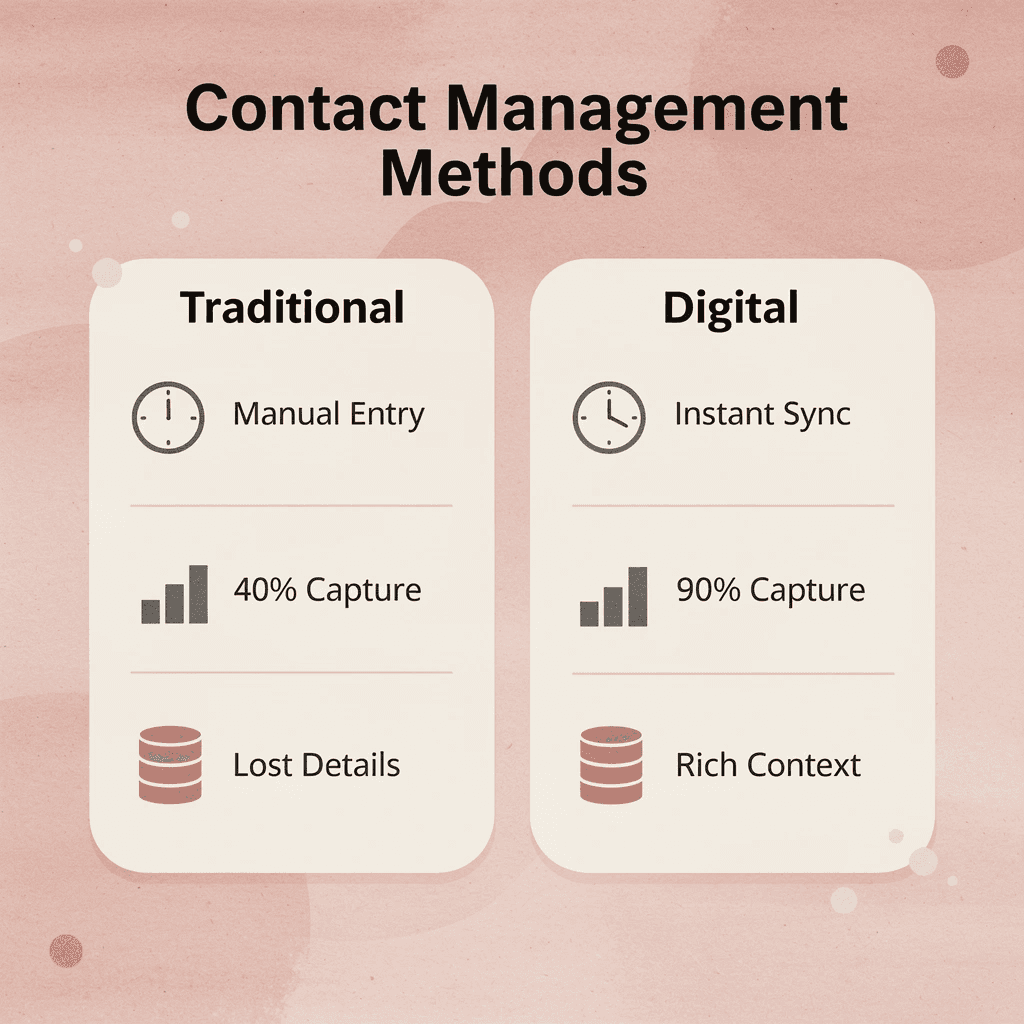
Most teams handle this manually. Someone takes a card, promises to follow up, then types the contact into Salesforce three days later if they remember. As event volume grows and team size expands, this approach breaks down: cards get lost, details go missing, and follow-up timing stretches from same-day to never. The conversion rate from handshake to pipeline entry drops below 40% because friction kills momentum.
"The conversion rate from handshake to pipeline entry drops below 40% because friction kills momentum." — Industry Analysis, 2024

🎯 Key Point: Digital contact solutions eliminate that gap by syncing every exchange directly into your CRM the moment it happens. Contact data flows automatically, enriched with context like where you met and what you discussed, so your team can prioritize high-fit prospects without guessing. Every interaction becomes structured, trackable data instead of goodwill that evaporates.
Digital vs traditional lead capture
- Traditional method
- Manual entry after 3+ days
- <40% conversion rate
- Lost context and details
- Scattered information
- Digital solution
- Instant CRM sync
- 90%+ capture rate
- Enriched data with meeting context
- Centralized pipeline
🔑 Takeaway: It takes under five minutes to set up. Book a demo, and we'll walk your team through creating digital business cards and capturing your first contacts. As a bonus, you'll receive your first 25 Mobilo business cards free. The gap between meeting someone and moving them into your pipeline should be seconds, not days.
Related Reading
- Tips For Networking Events
- Professional Networking Platforms
- Business Networking For Entrepreneurs
- Networking Tips For Small Business Owners
- Business Networking Strategies
- Best Business Networking Apps
- Top Contact Management Software