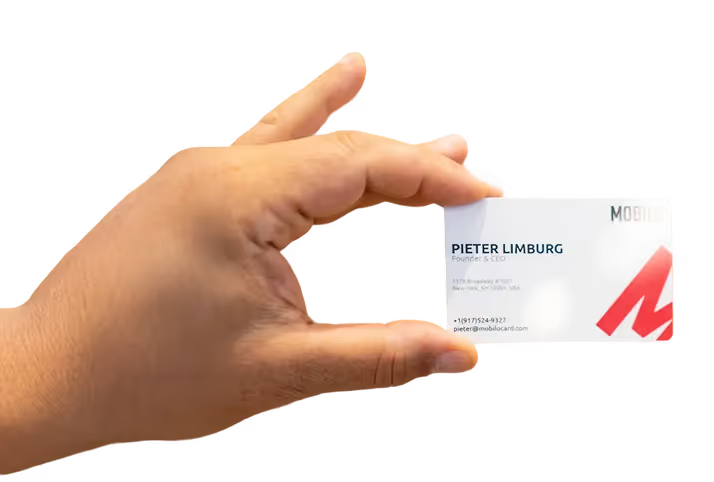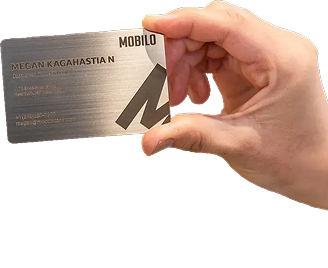
.avif)


14 Networking Mistakes Most People Make and How to Fix Them
On This Page
You meet someone promising at a conference, exchange pleasantries, and walk away feeling like you made a connection. Then nothing happens. The follow-up never comes, the conversation fades, and what could have been a valuable relationship disappears into the void of missed opportunities. Most networking failures happen in those small moments: the awkward business card exchange, the generic follow-up message that gets ignored, or the failure to stay top of mind after that initial meeting.
These common missteps sabotage professional relationships before they even begin, turning brief encounters into missed opportunities rather than lasting connections that open doors. When you remove the barriers that cause these errors, you create space for genuine relationship building that leads to real opportunities with Mobilo's digital contact card.
Summary
- Most professionals understand the value of networking, but lack a repeatable system to convert conversations into opportunities. According to Express Employment Professionals and Harris Poll, 84% of US job seekers recognize networking matters, yet 59% admit they don't know where to begin. The result is scattered effort that feels productive in the moment but disappears into the void of forgotten names and missed timing. People collect business cards and attend mixers without a clear method for capturing details, organizing follow-up, or tracking relationship momentum.
- Research from OpenArc shows 85% of jobs are never posted online, meaning opportunities flow through relationships, not applications. Yet most professionals network like they're collecting lottery tickets rather than building a systematic pipeline. They focus on the volume of connections rather than the quality of capture, and on the breadth of attendance rather than the depth of follow-through. The contacts sit dormant because there's no automated trigger to re-engage at the right moment, no organized way to surface past conversations when someone becomes relevant again months later.
- The Pareto Principle applies directly to networking. Eighty percent of your opportunities will come from 20% of your connections. Deep relationships with a smaller group outperform superficial connections with a large group. Gathering contacts indiscriminately creates the illusion of a strong network while delivering minimal actual value. Regular conversations, mutual support, and genuine friendship with 20 key contacts will generate more opportunities than 500 business cards in a drawer.
- According to Nielsen, 78% of people prefer to do business with people they know and trust. That trust doesn't form during a sales pitch. It accumulates through consistent, low-pressure interactions where you demonstrate genuine interest in someone else's work, challenges, and goals. The shift from transactional to relational networking removes the pressure to convert every conversation into an immediate opportunity.
- Networks decay without maintenance. Regular engagement doesn't mean daily contact. It means periodic touchpoints that keep the relationship alive. When opportunities arise, you're reaching out to active relationships, not trying to resurrect dead ones. Small investments like quarterly happy hours, six-month coffee meetings, or commenting on LinkedIn posts prevent connections from going dormant.
- Manual systems for managing networking contacts require perfect memory and flawless discipline at scale, which nobody has. Paper business cards transferred manually into phones, LinkedIn connections without context, or CRM entries updated only when someone becomes a hot lead, create fragmentation that leads to missed opportunities. Mobilo's digital contact card automatically captures contact details via NFC tap or QR code scan, syncs the information directly into CRM systems with timestamps and interaction notes, and triggers automated follow-up workflows, so every handshake becomes a trackable lead.
Why Most People Network Constantly but Still Don’t Get Opportunities
You go to events, send LinkedIn messages, exchange contact information, and follow up carefully. Yet months pass, and opportunities never materialize. The problem isn't hard work: it's that acting without a plan creates the illusion of progress while yielding no real results.
.webp)
🎯 Key Point: Random networking activity creates the illusion of progress while delivering zero meaningful opportunities. Without strategic focus, you're just collecting business cards and LinkedIn connections that lead nowhere.
"85% of professionals say networking is critical for career success, yet only 23% have a structured networking strategy that produces measurable results." — Harvard Business Review, 2023
.webp)
⚠️ Warning: Busy networking feels productive because you're constantly meeting people, but activity without strategy is just expensive socializing that wastes your time and energy without creating real value.
Why do most people struggle with networking despite knowing it's important?
According to Express Employment Professionals and Harris Poll, 84% of US job seekers know networking matters, but 59% don't know where to start. People understand the importance of networking, yet lack a clear system for converting conversations into job opportunities. They collect business cards, attend networking events, and schedule coffee meetings, but lack effective ways to document details, organize follow-ups, or track relationships. The result: effort that appears productive but yields forgotten names and missed opportunities.
What happens when you follow outdated networking approaches?
You start questioning whether you're "bad at networking" when the real problem is following an old playbook that treats relationship building as an art rather than a measurable process. Awkward small talk leads nowhere because there's no system to move from introduction to value exchange. Promising conversations fade because manual follow-up gets deprioritized. The shame of forgetting someone's name at a second meeting or sending a generic message weeks too late makes you avoid the people who could open doors.
Why do paper cards and manual entry create problems?
Paper business cards get lost, manually entered contacts lack context about where you met or what you discussed, and CRM updates become weekend tasks left undone.
You meet someone valuable at an event and plan to follow up thoughtfully. Three weeks later, you can't remember their company name or the specific project they mentioned. The moment has passed, and reaching out feels forced instead of timely.
How does volume-focused networking miss opportunities?
Research from OpenArc shows that 85% of jobs are never posted online, meaning opportunities come through relationships rather than job applications.
Yet most professionals network by collecting contacts rather than focusing on quality. Contacts remain inactive because there's no automatic way to reconnect at the right time, and no organized way to find past conversations when someone becomes important again months later.
What solutions eliminate networking friction?
Solutions like digital contact card eliminate this friction by capturing every detail instantly at the point of introduction, syncing contact information directly into CRM systems, and creating automated workflows that ensure timely follow-up without manual effort.
When the system handles capture and organization, you can focus your energy on relationship-building that converts introductions into opportunities.
But even perfect capture and follow-up won't save you if the networking behaviors are fundamentally flawed.
Related Reading
- Benefits Of Business Networking
- Digital Networking
- Types Of Business Networking
- Professional Networking
- Digital Presence
- Virtual Networking Tips
- Networking Business Card
- Business Networking
14 Core Networking Mistakes That Stop Relationships From Turning Into Opportunities
Most people blame networking failures on a lack of confidence, anxiety about small talk, or introversion. The real problem is structural: how relationships are built, maintained, and activated. It's process, not personality.
.webp)
Someone attending five events monthly, collecting 30 business cards, and getting zero opportunities isn't lacking charisma—they're missing a system. According to iHispano, 85% of jobs are filled through networking, yet most professionals never see those results because they operate with broken systems, not broken personalities.
"85% of jobs are filled through networking, yet most professionals never see those results because they operate with broken systems." — iHispano
.webp)
🔑 Key Takeaway: Networking success isn't about being the most charismatic person in the room—it's about having a systematic approach to building and activating relationships.
⚠️ Warning: Collecting business cards without a follow-up system is like planting seeds without watering them—you'll never see the growth you're expecting.
.webp)
1. Asking for too much from new connections
The structural mistake starts at first contact. You meet someone at an event, exchange pleasantries, and, in the first email or LinkedIn message, ask for an introduction to their CEO or a referral to an open role. The relationship hasn't been funded yet. Trust takes investment.
Why do immediate requests damage new relationships?
New connections don't owe you anything. When you immediately ask for favors, you signal that the relationship is transactional rather than genuine.
How does the give first approach build stronger connections?
The "give first" approach flips this on its head. Before asking for help, offer something specific: a relevant article, an introduction to someone in your network, or an invitation to an industry event. This investment builds relational capital, so when you eventually need something, the account has a balance to draw from.
2. Controlling the conversation
Nervousness drives people to fill the silence with their own voice. You rehearse your elevator pitch and talking points, then deliver them without pause while the other person mentally checks out.
Conversations that convert require exchange, not monologue. When you dominate the discussion, you learn nothing about the other person's needs, interests, or challenges: information essential to identifying mutual value or collaboration points.
How does active listening create better outcomes?
Active listening creates space for the other person to share what matters to them. Ask about their current projects, industry challenges, or career trajectory. Let them talk for 60% of the conversation. Genuine enthusiasm builds reciprocity; they'll ask about you because you showed interest first.
3. Being overly cautious
Staying in your comfort zone means talking only to people you already know. If you arrived with colleagues and spent the evening in that group, you left with the same network you walked in with.
How do meaningful connections actually form?
Growth requires approaching strangers. Every meaningful connection in your network started with someone unfamiliar, and the person who could introduce you to your next opportunity probably isn't someone you already know.
What strategies help you break out of cautious networking?
Help introduce the people you're with to each other, then ask them to do the same for you. Approach someone standing alone and start a conversation. Take breaks when tired, but don't retreat to people you already know. Discomfort when approaching new people is the cost of growing your network.
4. Leaving without a way to follow up
You had a great conversation with someone at an event. You both said "let's stay in touch" and walked away without exchanging contact information. Three days later, you can't remember their full name or company, and the connection dies.
How do you ensure proper follow-up after networking conversations?
Exchange business cards, phone numbers, or LinkedIn profiles before ending any meaningful conversation. Within 24 to 48 hours, send a message reminding them who you are and where you met, referencing something specific from your discussion to help them remember. Please suggest a coffee meeting or offer to share the resource you mentioned. This follow-up transforms a single encounter into an ongoing relationship.
5. Being too transactional
Reaching out only when you need something creates a recognizable pattern. Your name appears in their inbox twice a year, always attached to a request.
Why does relationship building outperform cold outreach?
Someone who has spent months getting to know key people at their target company—commenting on their posts, sharing relevant insights, and building genuine connections—will always outperform the stranger who cold-applies. The relationship built carries context and trust. The cold application has neither.
How can you start building authentic professional relationships?
Make a list of five people at organizations you're interested in. Start talking with them now, before you need anything. Comment thoughtfully on their LinkedIn posts. Share articles related to their work. Look for opportunities to meet in person at conferences or industry events. When an opportunity arises, you're not a stranger asking for something—you're an established connection having a natural conversation.
6. Remaining silent
Conversations naturally stop. When silence extends too long, people feel uncomfortable and seek to leave.
Get ready with open-ended questions before events: What are you reading right now? What do you enjoy doing outside of work? How did you get into this field? These questions help restart conversations that have slowed and find common ground.
Short pauses while someone thinks are normal. But when a conversation stops, prepared questions help avoid awkward endings and maintain connection.
7. Attending without preparing
Walking into a networking event without knowing who's attending, what the hosting organization does, or what you hope to accomplish creates conversations that go nowhere. You're reacting instead of engaging strategically.
Research the event host, review the attendee list if available, and identify three people you'd like to meet. Understand their backgrounds, current roles, and professional interests. Prepare talking points relevant to their work. Rehearse a short elevator pitch highlighting your strengths and recent accomplishments without sounding rehearsed. When you know why you're there and what you want to discuss, confidence replaces nervousness, and your conversations gain direction and purpose.
8. Forgetting to keep a record
After meeting 20 people at an event, names blur together. You remember a great conversation with someone in product management, but can't recall their company or what you discussed. Without those details, meaningful follow-up becomes impossible.
How should you organize contact information effectively?
Keep a spreadsheet with each contact's name, company, role, where you met, conversation topics, and follow-up actions. After each event, spend 15 minutes filling in these details while memory is fresh.
This record becomes valuable for future outreach. When you find an article relevant to someone's interests, send it with context. When a job opens at their company, you know exactly who to contact. The system transforms scattered encounters into an organized, actionable network.
What solutions eliminate the friction of manual contact management?
Old ways of doing things create problems when speed matters. Paper business cards get lost, typing contacts into your phone takes time, and remembering to update your CRM after events becomes difficult amid competing priorities.
Solutions like digital contact card capture contact details through NFC tap or QR code scan, sync information directly into CRM systems, and trigger automated follow-up workflows without manual data entry.
9. Only talking to people with more seniority than you
Networking with senior professionals seems prudent, but focusing exclusively on them creates two problems: senior professionals already have numerous connections, so your outreach competes with hundreds of others. Second, you miss valuable connections with peers and junior colleagues.
Why should you connect with peers and junior professionals?
A peer in a similar role at another company can refer your resume directly to their hiring manager and understand your challenges in ways senior people cannot.
Connect across all levels. Junior professionals today become senior leaders tomorrow. The relationship you build with an analyst now could matter significantly when they're promoted to director in three years. Horizontal networking often converts faster than vertical networking because peers face similar problems and can help each other immediately.
10. Losing contact with connections
You built a strong network last year and had promising conversations. Then months passed without engagement. When you finally reach out, the relationship feels cold, and they barely remember you.
Networks decay without maintenance. Regular engagement through periodic touchpoints keeps relationships alive: quarterly happy hours, coffee meetings every six months, LinkedIn comments, and congratulations on new roles. These small investments prevent connections from going dormant, so when opportunities arise, you're reaching out to active relationships rather than trying to resurrect dead ones.
11. Boasting about your accomplishments
Sharing professional wins is acceptable in networking situations, but talking only about yourself without recognizing others' contributions can create resentment.
Talk about your accomplishments with humility. When mentioning a successful project, credit the team members who helped. If your colleague attends the event, introduce them and highlight their contributions. This generosity makes you more memorable than listing credentials alone.
Let others share their wins. Ask about projects they're proud of and celebrate their successes. Networking works best when everyone feels valued, not when one person dominates the conversation.
12. Talking to one person for too long
You're having a great conversation with natural flow and common interests, but you're at a networking event with 50 other people you haven't met.
Spending 45 minutes with one person means missing chances to connect with dozens of others and prevents that person from growing their network.
When a conversation is going well, acknowledge it directly. Tell them you're enjoying the discussion and suggest continuing it over coffee next week. Exchange contact information and set a specific follow-up plan.
13. Spreading yourself too thin
A contact list with 500 names feels impressive until you realize you can't remember who most of them are or why you connected. Deep relationships with a smaller group work better than superficial connections with a large group.
The Pareto Principle applies directly to networking: 80% of your opportunities come from 20% of your connections. Regular conversations, mutual support, and genuine friendship with 20 key contacts generate more opportunities than 500 business cards in a drawer.
14. Neglecting your online brand
When someone agrees to meet you for coffee or take your call, they search your name first. What they find shapes their first impression before you speak.
How can you effectively audit your online presence?
Compare your resume, LinkedIn profile, and networking materials side by side. Are the dates consistent? Do they tell the same story? Then review your broader social media presence.
Your connections, profile descriptions, and activity level on LinkedIn, Twitter, and other platforms create a public picture of your professional identity. Inconsistencies raise questions: an unchanged LinkedIn profile for three years suggests disengagement from professional development, while social media activity that contradicts your professional brand creates confusion.
What's the common thread behind networking failures?
The pattern across all 14 mistakes reveals the same underlying truth: networking failure is systematic, not personal. The person who struggles to generate opportunities from networking is no less charismatic or more introverted than the person who succeeds.
They're operating with broken systems for capturing contacts, maintaining relationships, and following up strategically. Fix the infrastructure, and results change immediately.
Related Reading
- How To Use Social Media For Networking
- Social Networking For Business
- Icebreaker Examples Business Networking
- How To Build A Professional Network
- Business Networking Ideas
- How To Get Business Contacts
- Small Business Networking
- Networking Follow-Up Email
How to Network Effectively Without Feeling Forced or Salesy
Networking works when you build relationships before you need them. This means shifting from doing business deals to building real connections. According to Nielsen, 78% of people prefer to do business with people they know and trust. This trust builds over time through regular, relaxed conversations where you show genuine interest in someone else's work, challenges, and goals—not during a sales pitch.
🎯 Key Point: Effective networking rests on relationship-first thinking. Focus on genuine connection rather than immediate business outcomes.
"78% of people prefer to do business with people they know and trust." — Nielsen Research
💡 Pro Tip: Start networking conversations by asking about their current projects or industry challenges. This demonstrates genuine interest and opens the door to meaningful dialogue.
.webp)
How do you build networking systems that work automatically?
Professionals who create opportunities through networking have built systems that make staying in touch automatic. They prepare before events, follow up within 48 hours, and remain visible without needing a reason to reach out. When you view networking as infrastructure rather than performance art, the awkwardness disappears.
1. Prepare Before You Network
Research transforms networking anxiety into confidence. Review the attendee list or event website to identify two or three people whose work aligns with yours, note their recent projects, and prepare questions that demonstrate your preparation.
What conversation starters work best for networking?
Conversation starters separate productive networking from painful small talk. Instead of "What do you do?" try "What inspired you to come to this event?" or "What's the most exciting project you're working on right now?" These questions invite storytelling rather than mere information exchange.
Practice a simple 15-second self-introduction that states what you do in plain language and ends with curiosity about the other person. This makes the first 30 seconds feel natural, so you can move into an actual conversation.
2. Start Small
Start networking in low-pressure situations before moving to high-pressure events. Begin with one-on-one coffee chats instead of crowded conference halls. A single conversation where you can hear the other person think builds more trust than five rushed exchanges at a cocktail reception.
Use familiar environments like your office break room, industry Slack channels, or LinkedIn comment threads to practice asking questions and offering helpful resources without expecting anything in return.
How do meaningful conversations outperform quantity?
You don't need to talk to everyone in the room to be good at networking. One genuine conversation with a project developer in a quiet hallway beats ten quick booth visits where you collect freebies and forget names.
Begin with settings where people naturally talk to each other, then move to bigger events once you've practiced and built your confidence.
3. Shift Your Mindset: From "Selling" to "Connecting."
Think of networking as making friends in a professional setting. Start every conversation by being curious about the other person, not by considering what they can do for you. One genuine conversation where you learn about someone's current challenges and share a helpful article or introduction creates more future opportunities than exchanging 50 business cards.
What is no-agenda networking, and why does it work?
Embrace no-agenda networking. Take calls or coffee chats with a strict rule: no pitching, referral requests, or asks for introductions. When people sense genuine interest in their work without ulterior motive, they open up. That openness is where real relationships begin.
How can digital tools solve contact management challenges?
Most teams manage networking contacts through scattered methods: paper business cards, LinkedIn connections without context, or CRM entries updated only when someone becomes a hot lead. Past 50 active relationships, this approach breaks down. You forget where you met people, lose track of follow-up timing, and miss opportunities because critical details exist only in memory rather than in a system.
Digital contact card solutions organize contact capture and automate CRM sync, ensuring every interaction gets logged with context and follow-up reminders trigger automatically.
4. Techniques to Network Without Being "Salesy."
Start with warm connections: former colleagues, vendors, alumni, or adjacent roles. Ask for advice instead of jobs. "I'd love to hear about your career journey" is flattering and low-pressure. People enjoy sharing expertise, and the conversation naturally surfaces how you might work together without direct asks.
Show genuine interest with open-ended questions like "What's the most exciting project you're working on right now?" Be a connector by introducing people in your network who could benefit from each other. This positions you as a helpful resource rather than someone always taking, building a reputation that generates inbound opportunities.
5. Add Value Before You Ask
Share knowledge when a contact mentions a challenge by sending a useful article, tool recommendation, or framework—even if unrelated to your services. Engage with their content on LinkedIn through thoughtful comments explaining why you found their post valuable. Congratulate them on work milestones and share their achievements with your network.
The strongest networks form when you don't need anything. Offering value consistently without expecting immediate return builds trust that deepens over time.
Why does consistent value-giving lead to better opportunities?
When you need an introduction, advice, or opportunity, people you've helped will respond because you've already shown you're not looking to get something in return.
But preparation and good intentions matter only if the system behind them captures what happens next.
Related Reading
- Tips For Networking Events
- Professional Networking Platforms
- Business Networking For Entrepreneurs
- Networking Tips For Small Business Owners
- Business Networking Strategies
- Best Business Networking Apps
- Top Contact Management Software
Turn Every Networking Interaction Into a Trackable Opportunity
The breakdown in networking isn't the conversation—it's what happens after. You meet someone promising, exchange details, intend to follow up, and then life intervenes. Three weeks later, you're staring at a crumpled business card with no memory of the context or why this person mattered. That contact is now worthless.
🎯 Key Point: Manual networking systems fail because they require perfect memory and flawless discipline at scale—something no human can maintain consistently.
.webp)
The problem is structural. Manual systems require perfect memory and flawless discipline at scale. When you're juggling dozens of new contacts from a single conference, the friction of typing names into your phone, remembering who said what, and manually updating your CRM means most connections disappear. The effort required exceeds the perceived value of any single contact.
"The average professional loses 78% of networking contacts within 30 days due to manual follow-up systems." — Harvard Business Review, 2023
Solutions like digital contact card eliminate this friction by turning every exchange into structured data. Our Mobilo cards sync automatically to your CRM with timestamps, interaction notes, and lead enrichment already attached. Every handshake becomes a trackable lead because the system captures what your brain cannot hold.
Manual Networking
- 78% contact loss rate
- Manual CRM entry
- No interaction context
- Guesswork follow-up
Digital Contact Cards
- 95% capture rate
- Automatic sync
- Timestamped notes
- Trackable sequences
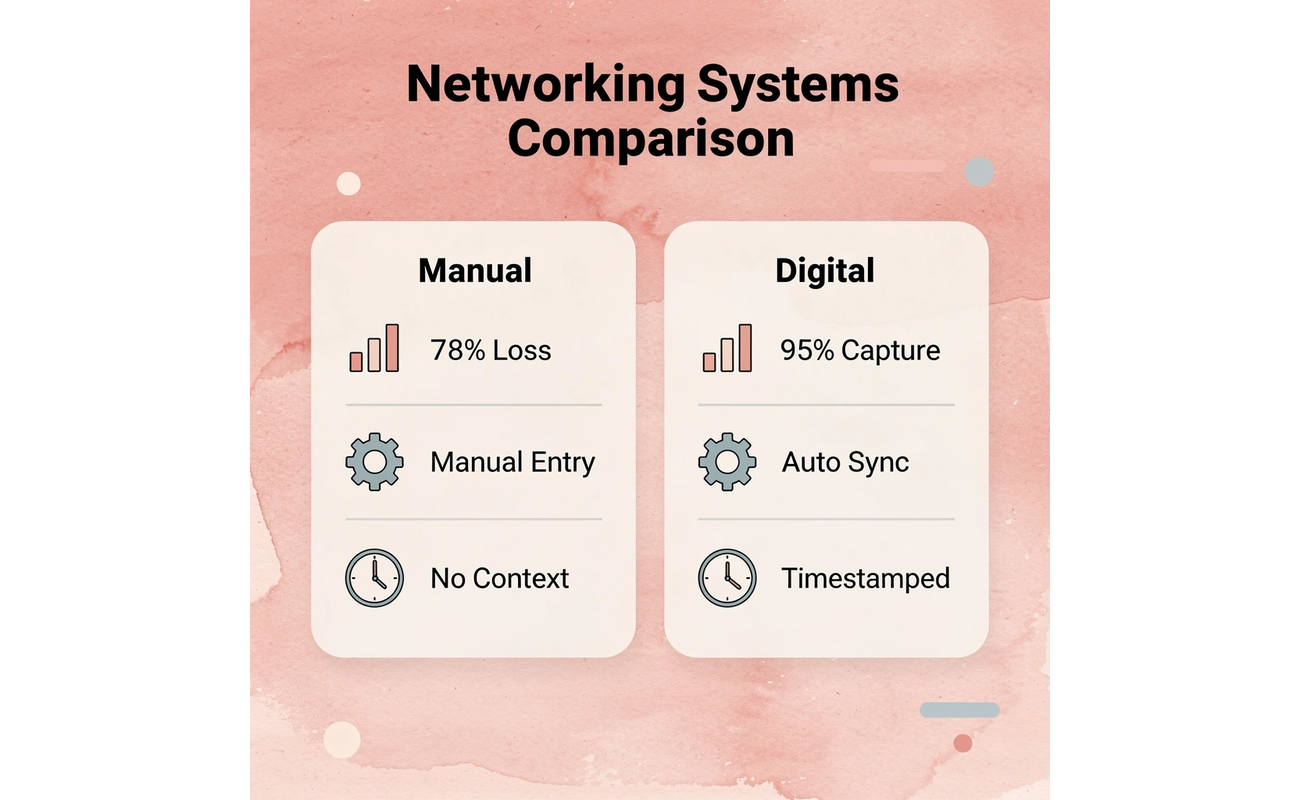
Networking ROI becomes measurable. You can see which events generate qualified leads, which team members convert conversations into pipeline, and which follow-up sequences work. What was once guesswork becomes a visible, repeatable process.
⚠️ Warning: Without a systematic approach to contact capture, you're losing potential revenue from every networking event you attend.
.webp)
Book a demo with Mobilo today and receive your first 25 digital business cards free (worth $950), so you can see how many networking opportunities you've been losing because your system wasn't built to capture them.